
Imagine a group of strangers trying to agree on the score of a soccer match without a referee. That is exactly what blockchain consensus mechanisms solve. These protocols allow distributed networks to agree on the state of a shared ledger without requiring trust between participants. Without them, digital money would be vulnerable to double-spending, and decentralized records could easily be corrupted.
The first practical implementation was Proof of Work (PoW), created by Satoshi Nakamoto in 2008 for Bitcoin. However, the underlying concept dates back to 1993 when computer scientists Cynthia Dwork and Moni Naor developed it as an anti-spam measure. Today, the landscape has shifted dramatically toward energy-efficient alternatives like Proof of Stake (PoS), especially after Ethereum completed its transition in September 2022, reducing energy consumption by approximately 99.95%.
Why Do We Need Consensus Algorithms?
At their core, these algorithms solve the Byzantine Generals Problem. This classic computer science puzzle asks how multiple parties can reach an agreement when some might act maliciously or fail completely. In permissionless blockchains, where participants are anonymous and untrusted, this is critical.
- Data Integrity: Ensures that once a transaction is recorded, it cannot be altered retroactively.
- Prevention of Double-Spending: Stops users from spending the same digital asset twice.
- Network Security: Maintains reliability even if some nodes behave badly.
As Andreas Antonopoulos, author of 'Mastering Bitcoin,' noted in a 2022 interview, "PoW is the only mechanism that has proven security at scale for permissionless blockchains over a 14-year period." Yet, others like Emin Gün Sirer argue that PoS provides equivalent security with far less energy use. The right choice depends entirely on your priorities: security, speed, or decentralization.
Proof of Work (PoW): The Original Standard
Proof of Work requires miners to solve complex cryptographic puzzles using significant computational power. In Bitcoin's case, this involves SHA-256 hashing. The network difficulty adjusts every 2,016 blocks-roughly every two weeks-to maintain a consistent 10-minute block time.
This method is incredibly secure but resource-intensive. According to the Cambridge Bitcoin Electricity Consumption Index, Bitcoin's PoW consumes approximately 110.25 terawatt-hours annually. For context, that rivals the annual electricity usage of medium-sized countries. Entry into PoW mining also demands substantial hardware investment; an entry-level ASIC miner like the Antminer S19 Pro costs around $2,499 and consumes 3,250 watts of power.
Despite its environmental impact, PoW remains dominant for store-of-value applications. A 2021 study by the National Bureau of Economic Research indicated that PoW networks become more secure as hash rate increases, with the cost of a 51% attack on Bitcoin exceeding $10 billion based on current mining equipment prices.
Proof of Stake (PoS): The Energy-Efficient Alternative
Proof of Stake replaces energy consumption with economic stake. Instead of solving puzzles, validators lock up cryptocurrency to participate in block validation. In Ethereum's implementation, validators must stake 32 ETH (approximately $51,200 at recent prices) to join the network.
The rewards for staking are modest but steady, with a maximum annual return rate of about 4.3%. Validators must maintain 99.9% uptime to avoid "slashing" penalties, which can remove up to 100% of their staked ETH for malicious behavior. This creates a strong incentive for honest participation.
PoS networks face unique challenges, such as the "nothing at stake" problem, where validators could theoretically vote for multiple blockchain histories simultaneously. However, modern implementations have largely mitigated this risk. Community feedback from Reddit's r/ethereum shows that 78% of users report positive experiences regarding reduced energy consumption, though 42% note increased complexity for solo stakers.

Practical Byzantine Fault Tolerance (PBFT): Speed for Enterprises
Practical Byzantine Fault Tolerance is designed for high-throughput environments. It can tolerate up to (n-1)/3 malicious nodes in a network of n nodes, achieving consensus in just 3-4 communication steps. This makes it ideal for enterprise applications where speed and finality are paramount.
Implementations like Hyperledger Fabric achieve 3,500 transactions per second (TPS) with near-instant finality. However, PBFT is limited to approximately 100 nodes due to communication overhead. According to a Deloitte survey of 1,280 enterprise executives, 67% of enterprise blockchain implementations use PBFT or variants because of their predictable performance.
Walmart's blockchain architect praised PBFT's reliability, noting it delivers 99.99% uptime and sub-second finality for their food traceability system. But this comes at a cost: deployment typically takes 3-6 months and requires careful management of node synchronization and permissions.
Other Notable Mechanisms
Beyond PoW, PoS, and PBFT, several other mechanisms serve specific niches:
- Ripple Consensus Algorithm: Requires an 80% super-majority vote from nodes in the Unique Node List (UNL). Settlement times are under 5 seconds, but critics point out centralization concerns, with 66% of UNL nodes operated by Ripple Labs.
- Stellar Consensus Protocol (SCP): Uses quorum slices, allowing each node to define its own trusted validators. Global consensus emerges when these quorums intersect.
- Delegated Proof of Stake (DPoS): Systems like EOS let token holders vote for 21 block producers who validate transactions in a round-robin fashion every 0.5 seconds, achieving ~4,000 TPS.
- Proof of Authority (PoA): Relies on pre-approved validators. Networks like VeChain process 50-100 TPS with 10-second finality but sacrifice decentralization.
Comparing Performance Metrics
| Mechanism | Transactions Per Second (TPS) | Finality Time | Decentralization | Energy Efficiency |
|---|---|---|---|---|
| Proof of Work (Bitcoin) | ~7 | ~60 minutes | High | Low |
| Proof of Stake (Ethereum) | 15-45 | 12-15 minutes | High | Very High |
| PBFT (Hyperledger) | ~3,500 | Near-instant | Low (Permissioned) | High |
| Proof of Authority (VeChain) | 50-100 | ~10 seconds | Low | High |
| DPoS (EOS) | ~4,000 | Sub-second | Medium | High |
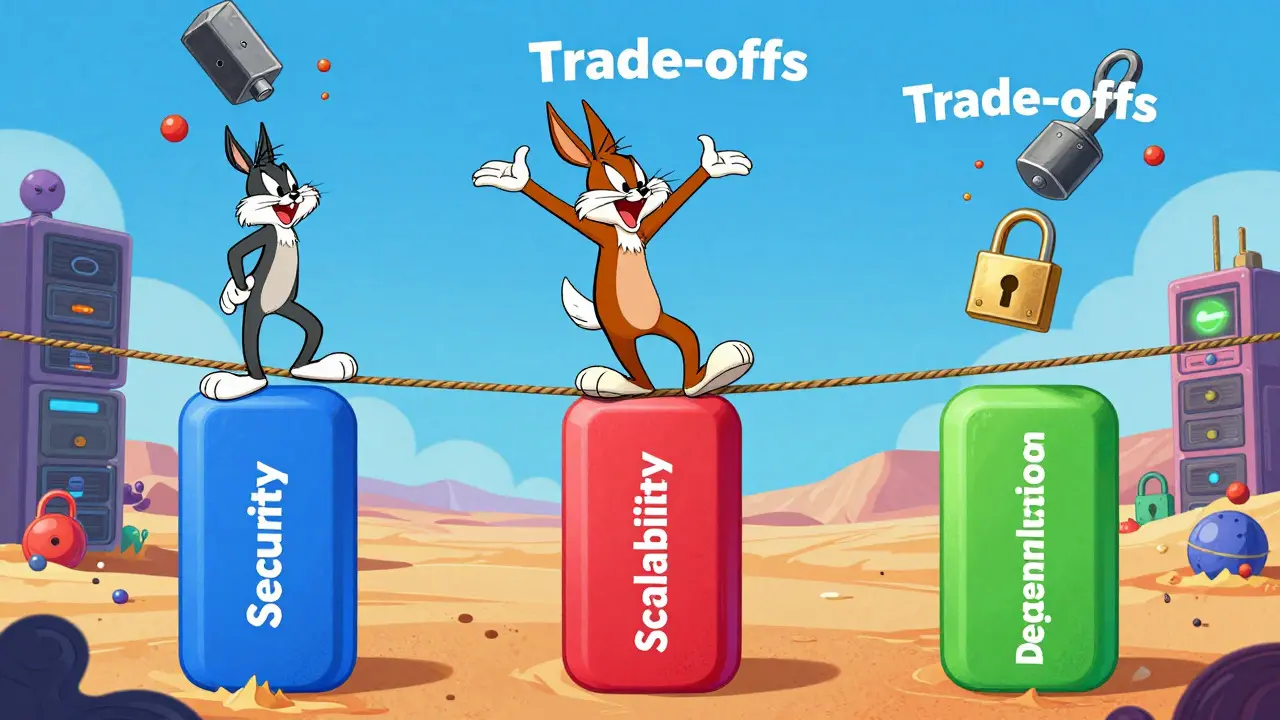
The data highlights the Blockchain Trilemma, coined by Vitalik Buterin. You generally can only optimize for two of three attributes: scalability, decentralization, and security. PoW excels in security and decentralization but fails in scalability. PoA offers high scalability and security but sacrifices decentralization.
Choosing the Right Mechanism for Your Project
Selecting a consensus mechanism isn't one-size-fits-all. Consider these factors:
- Use Case: Is this a public currency, a private supply chain tool, or a decentralized application?
- Regulatory Environment: The EU's MiCA regulations (effective 2024) require PoS validators to register as virtual asset service providers, potentially affecting 85% of Ethereum staking providers.
- Resource Constraints: Do you have the budget for ASIC miners (PoW) or the technical expertise to manage validator nodes (PoS/PBFT)?
- Speed Requirements: Do you need instant finality for financial settlements, or is eventual consistency acceptable?
Market trends show PoS accounting for 61% of new projects in 2023, while PoW powers 42% of public blockchain transactions by volume. Hybrid models combining PoS and PBFT are rising, with 37% of new projects adopting such approaches according to Electric Capital's Developer Report.
Future Developments and Challenges
The field continues to evolve rapidly. Ethereum's upcoming upgrades aim to implement proto-danksharding, potentially increasing scalability to 100,000 TPS. Meanwhile, quantum computing poses a long-term threat; Google's Quantum AI team estimates that quantum-resistant consensus mechanisms will be necessary by 2030.
Environmental regulations are also driving change. The US Federal Energy Regulatory Commission reported that PoW mining accounts for 0.5% of national electricity consumption, prompting legislative efforts in 23 states to regulate or incentivize renewable energy usage for mining operations.
Ultimately, there is no perfect consensus mechanism. Each represents a trade-off between competing values. Understanding these trade-offs allows developers and enterprises to build systems that align with their specific goals, whether that's maximum security, highest throughput, or greatest accessibility.
What is the main difference between Proof of Work and Proof of Stake?
Proof of Work relies on computational power and energy consumption to secure the network, while Proof of Stake uses economic collateral (staked coins) to incentivize honest behavior. PoS is significantly more energy-efficient, reducing consumption by up to 99.95% compared to PoW.
Which consensus mechanism is best for enterprise use?
Practical Byzantine Fault Tolerance (PBFT) and Proof of Authority (PoA) are often preferred for enterprise applications due to their high throughput and fast finality. They prioritize performance and control over full decentralization, making them suitable for known participant groups.
Is Proof of Work still relevant in 2026?
Yes, particularly for Bitcoin and other store-of-value cryptocurrencies. Despite its energy intensity, PoW remains highly secure and decentralized. It continues to power a significant portion of public blockchain transactions by volume.
How does the Blockchain Trilemma affect consensus choices?
The trilemma suggests you can only optimize for two of three properties: scalability, security, and decentralization. PoW prioritizes security and decentralization, sacrificing scalability. PBFT prioritizes scalability and security, sacrificing decentralization. PoS attempts to balance all three but faces unique challenges.
What are the risks associated with Proof of Stake?
Risks include the "nothing at stake" problem, potential centralization among large staking pools, and slashing penalties for validator downtime or misbehavior. Regulatory requirements, such as those in the EU's MiCA framework, also add compliance burdens for validators.
hey so i read through this and honestly the part about slashing penalties in pos is kinda scary but also makes sense. if you dont keep your node up they take your money. its basically like a performance bond for validators. i think people forget that security comes from economic incentives not just raw power anymore.
The truth is they are hiding the real energy costs of PoS servers which run 24/7 without pause. The elites want us to believe it is green but the data centers are still sucking the life out of the grid while we sleep. They control the narrative through these articles to make you feel safe when in reality the centralization is already here. Wake up sheeple the validators are just new bankers with better PR teams.
Oh look another basic explanation of blockchain for people who cant handle actual code 🙄 You guys really think reading a blog post makes you an expert? Please. The real devs are laughing at this oversimplified garbage. PoW is dead because only nerds love it now. Everyone else wants fast transactions and pretty charts. Move along peasants there is nothing to see here except your own ignorance 😂
Actually you missed the point about PBFT being permissioned. It's not really blockchain in the decentralized sense because you have to know who the nodes are beforehand. That's why enterprises use it. They don't care about decentralization they care about speed and control. Bitcoin is the only true permissionless network left that matters for value storage.
Let me tell you something about American innovation. We built the internet and we built the early crypto infrastructure. Now Europeans come in with MiCA regulations trying to stifle growth. Typical. US miners are moving to Texas using stranded wind power. We are leading the charge on energy independence. Stop listening to EU bureaucrats and start supporting domestic industry. America first always.
I think this is such a helpful overview!! It’s really cool how Ethereum reduced energy usage by almost 100% 🌱✨ I was worried about the environment before but now I feel much better about holding ETH. It’s great to see technology evolving to be more sustainable. Thanks for sharing this info it made my day! 💖
the nature of consensus is a reflection of human trust which is inherently flawed. when we remove the referee we do not remove the bias we merely distribute it among the many. is it truly freedom if the majority can oppress the minority via voting mechanisms? perhaps the blockchain is just a digital panopticon where everyone watches everyone else forever. deep thoughts huh or am i just typing gibberish into the void again lol
Weak analysis. You ignore the liquidity risks in DPoS. Centralization is inevitable in any system that rewards wealth concentration. PoS is just feudalism with code. Validators will merge until there are three entities controlling everything. Then what? You rely on their honesty? Pathetic. Security requires cost. Energy is the only honest cost.
Wow, this article really highlights how divided we are on this topic! But isn't that beautiful? We have options for every need. Some want security, some want speed. Instead of fighting, let's appreciate the diversity of solutions. Maybe the future isn't one winner takes all but a federation of blockchains working together. Let's keep the peace and build bridges instead of walls! 🌉
So basically you're saying your grandma could validate a block if she had enough ETH? That's cute. But does she understand the cryptographic proofs? Probably not. She's just renting her coins to a pool operator who takes a cut. It's financial slavery disguised as passive income. And don't get me started on the hardware requirements for solo staking. It's a scam for the little guy. 🤡
In consideration of the aforementioned points regarding the Byzantine Generals Problem it becomes evident that the theoretical underpinnings of distributed ledger technology require a nuanced approach to implementation particularly when one considers the varying degrees of trust required among participants in both permissioned and permissionless environments which ultimately dictates the choice of consensus mechanism based on specific organizational needs and regulatory constraints that may vary significantly across different jurisdictions globally.
Look I've been in tech since the dot com bubble. This stuff is just hype. First it was AI then blockchain now quantum resistance. Same old same old. The market will correct itself. Most of these projects will fail within five years. Save your money and buy index funds. At least those are regulated properly unlike this wild west of crypto nonsense.
You clearly lack the sophistication to grasp the nuances of Nakamoto consensus vs Tendermint BFT. The average reader here probably thinks TPS is the only metric that matters. How quaint. Real security lies in game-theoretic finality and cryptoeconomic assumptions. Read 'Mastering Blockchain' before commenting further. Your superficial understanding is embarrassing to the community. :P
This whole debate is ruining marriages everywhere! My wife sold our house to buy ASIC miners and now we live in a van. Was it worth it? Absolutely not! But at least we have stories. And free electricity from solar panels we installed ourselves. Live free or die I guess. Send help or bitcoin preferably bitcoin. 😭🏠💸
It is absolutely preposterous to suggest that Proof of Stake offers equivalent security to Proof of Work. The energy expenditure in PoW is not a bug; it is a feature that ensures physical anchoring to the real world. Without that tangible cost, attacks become trivially cheap. You are sacrificing fundamental security for the sake of political correctness regarding carbon footprints. Disgraceful.
PoW is obsolete. PoS is the standard. PBFT is for corps. Pick one and move on.