
Sending money across borders today feels like a relic from the 1970s. You wait days for funds to arrive, pay hefty fees that can eat up nearly 7% of your transfer, and have little visibility into where your money is stuck. Central Bank Digital Currencies (CBDCs) are trying to fix this broken plumbing. These aren't just another crypto trend; they are digital versions of sovereign money issued by national banks, designed specifically to slash costs and speed up international transactions.
As of September 2026, the landscape has shifted dramatically. While many early pilots were experimental, we now see operational corridors handling real value. The World Bank estimates that remittances alone moved $702 billion globally in recent years, a market ripe for disruption. But are CBDCs actually delivering on their promise, or are they creating new headaches? Let's break down how these digital currencies interact with cross-border payments, what projects are working, and where the pitfalls lie.
The Broken State of International Money
To understand why CBDCs matter, you first need to look at why current systems fail. Traditional cross-border payments rely on correspondent banking. Imagine sending money from New York to Bangkok. Your bank doesn't talk directly to the Thai bank. Instead, it routes through one or more intermediary banks, each taking a cut and adding time. This chain often involves three to five intermediaries per transaction.
The result? High friction. According to World Bank data, the average cost of sending remittances hovers around 6.42%, far above the G20’s target of 3%. Settlement times typically range from one to five business days. Transparency is poor-you might know when you sent money, but not exactly when it will land. For businesses, this ties up capital. For individuals, it means losing hard-earned cash to fees. CBDCs aim to shorten this value chain by allowing direct settlement between central banks or their authorized nodes, bypassing those expensive middlemen.
How CBDCs Actually Work Across Borders
Not all CBDCs work the same way internationally. The Committee on Payments and Market Infrastructures (CPMI) identifies three main models for interoperability. Understanding these helps clarify why some projects succeed while others stall.
- Interoperability: Different countries keep their own separate CBDC systems but agree on common technical standards. Think of it as different phone networks agreeing on a universal charging port. It reduces operational burdens but requires constant coordination.
- Interlinking: Systems remain distinct but are connected via bridges. Participants can transact without joining the other country’s system. This is the model behind many bilateral agreements.
- Single Shared Ledger: Multiple CBDCs live on one platform. This is the most ambitious approach, exemplified by Project mBridge. Here, central banks share a single infrastructure, allowing near-instant settlement.
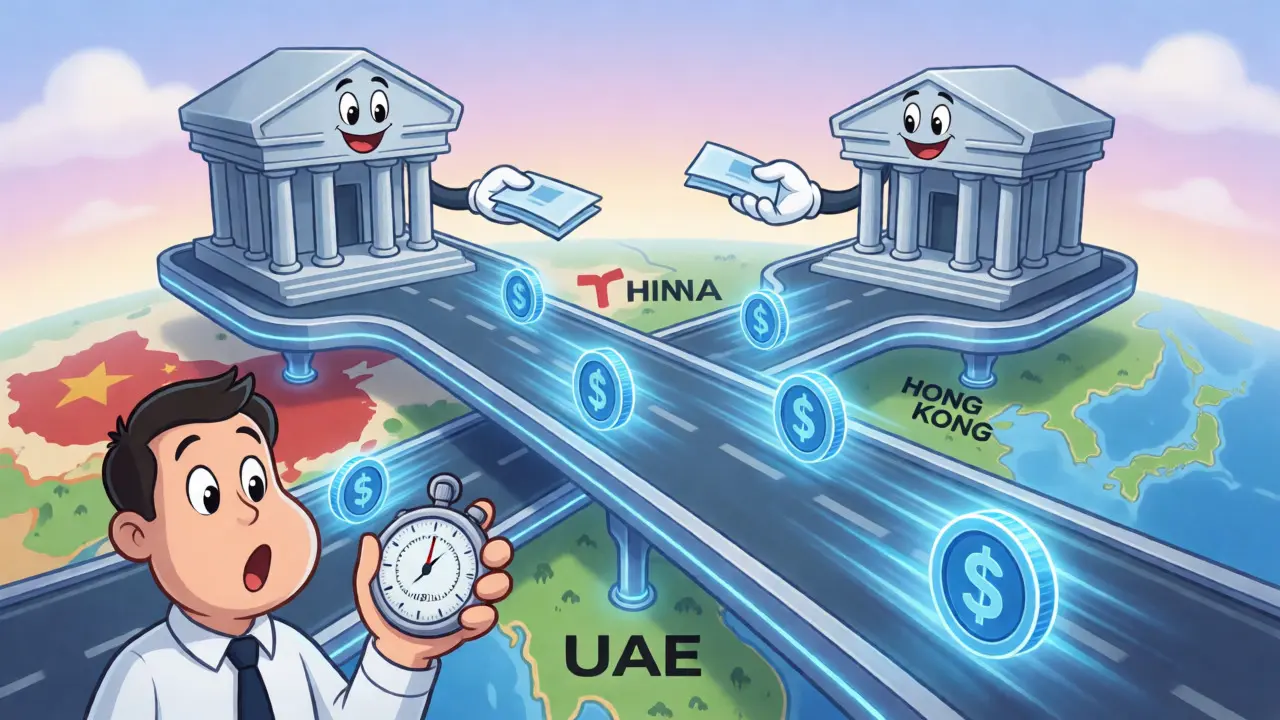
Project mBridge deserves special attention. Led by the BIS Innovation Hub Hong Kong Centre, this project connects China, Thailand, the UAE, and Hong Kong SAR. In its minimum viable product phase, it processed over $22 million in simulated transactions. By late 2023, it moved to commercial pilot status with 15 participating banks executing live trades. The tech stack achieved transaction finality in 10-15 seconds. Compare that to the days-long waits of traditional SWIFT transfers, and the efficiency gain becomes obvious.
Cost Savings and Speed: The Numbers
Does the hype match the reality? Data suggests yes, but with caveats. The IMF estimates that CBDC-enabled payments could reduce transaction costs by 30-50%. For high-volume corridors, this is massive. If you’re a company moving millions daily, saving even 1% translates to significant profit retention.
| Feature | Traditional Correspondent Banking | SWIFT GPI | CBDC Corridors (e.g., mBridge) |
|---|---|---|---|
| Average Cost | ~6.42% | ~3.97% | Estimated 1-3% |
| Settlement Time | 1-5 Days | Same Day (78%) | Seconds (10-15s) |
| Transparency | Low | High | Real-time Visibility |
| Liquidity Needs | High (Pre-funding) | Moderate | Reduced by 40-60% |
Notice the liquidity point. Traditional systems require banks to hold large amounts of foreign currency in pre-funded accounts to ensure smooth flows. CBDCs can reduce these requirements because settlement happens instantly upon exchange. This frees up capital for banks to lend or invest elsewhere. However, these savings depend heavily on the specific corridor. High-volume pairs like USD/EUR benefit more than niche currencies with low trading activity.
Retail vs. Wholesale: Who Uses What?
A critical distinction exists between retail and wholesale CBDCs. Retail CBDCs, like Jamaica’s JAM-DEX or The Bahamas’ Sand Dollar, are meant for everyday consumers. They face hurdles in cross-border use due to privacy concerns and strict identity verification rules. If every small purchase requires KYC (Know Your Customer) checks, users might avoid them for international spending.
Wholesale CBDCs (wCBDCs), however, are designed for institutions. Banks and financial entities use them for large-scale settlements. Projects like mBridge focus here. Why? Because institutional users care less about privacy and more about speed and compliance. A bank settling a $10 million trade doesn’t mind providing detailed documentation if it saves hours and thousands in fees. The IMF notes that wCBDCs offer stronger compliance frameworks, making them safer bets for regulators wary of illicit flows.
The Geopolitical Chessboard
Money is never just money; it’s power. The rise of CBDCs has sparked geopolitical tension. The US dollar currently dominates global payments, accounting for roughly 47% of cross-border transactions. A Federal Reserve analysis suggests interoperable CBDCs could actually strengthen this position, potentially pushing the dollar’s share to 52-55% by 2030. But only if the US participates actively.
China’s e-CNY is already live domestically, though capital controls limit its immediate cross-border impact. Meanwhile, the Eurosystem plans a digital euro that could handle 30-40% of intra-EU payments within five years. If major economies launch incompatible systems, we risk fragmenting into "digital currency blocs." Kristalina Georgieva, IMF Managing Director, warned that without coordination, CBDCs could create new barriers rather than bridges. We don’t want a world where you can’t easily convert digital dollars to digital euros because their ledgers don’t speak the same language.

Hurdles Still Standing in the Way
Despite progress, significant challenges remain. First, legal fragmentation. Only 37 of the 134 countries exploring CBDCs have updated their payment laws to accommodate them. Without clear legal tender status and liability rules, banks hesitate to adopt new tech. Second, technical standards vary. India uses Aadhaar-based ID; Singapore uses MyInfo. Making these systems talk to each other requires complex middleware.
Privacy is another sticking point. In the US proposal, transactions over $1,000 require identity verification. Privacy-conscious users might resist this surveillance. Conversely, criminals exploit anonymity, so regulators demand transparency. Finding the balance is tricky. Furthermore, established players aren’t standing still. SWIFT launched its Global Payments Innovation (GPI) initiative, reducing costs to under 4% and speeding up settlements. CBDCs must prove they are significantly better, not just marginally faster, to displace entrenched networks.
What’s Next for Cross-Border CBDCs?
Momentum is building. Ten additional central banks joined mBridge in 2024, expanding coverage to potentially 25% of global trade. The World Bank’s Digital Currency Network aims to standardize legal frameworks, with pilots expected in African and Southeast Asian corridors soon. The goal is clear: make cross-border payments as easy as sending an email.
For now, CBDCs are complementary to existing systems, not replacements. They excel in specific corridors with high volume and aligned regulations. As technical standards harmonize and legal frameworks mature, expect adoption to accelerate. The future isn’t necessarily a single global digital currency, but a network of interoperable national ones. If done right, we’ll send money abroad in seconds, for pennies, with full visibility. That’s a win for everyone.
Are CBDCs the same as cryptocurrencies like Bitcoin?
No. Cryptocurrencies like Bitcoin are decentralized assets with no central issuer. Their value fluctuates wildly. CBDCs are centralized digital forms of sovereign fiat currency (like the Dollar or Euro). They are stable, backed by the central bank, and legally recognized as tender.
Why do cross-border payments take so long today?
They involve multiple intermediaries called correspondent banks. Each bank must verify, process, and settle the transaction, often requiring pre-funded accounts in foreign currencies. This multi-step process adds delays of 1-5 days and increases costs due to fees at each stage.
What is Project mBridge?
mBridge is a collaborative project by the BIS Innovation Hub involving China, Thailand, the UAE, and Hong Kong SAR. It tests a shared ledger for wholesale CBDCs, enabling instant cross-border settlements among these jurisdictions. It has moved from simulation to live commercial pilots.
Will CBDCs replace cash entirely?
Unlikely in the short term. Most central banks plan to coexist digital and physical cash. Cash remains crucial for privacy, offline access, and those without digital literacy. CBDCs primarily target digital efficiency and cross-border flows, not necessarily eliminating paper money immediately.
How do CBDCs affect the US dollar's dominance?
It depends on US participation. If the US launches an interoperable CBDC, it could reinforce the dollar’s role by making it easier to use globally. If the US lags, other nations might form alternative payment networks, potentially eroding the dollar’s share in international trade settlements.
hey folks this is huge news for anyone sending money home or to friends abroad. i know its confusing but think of it like upgrading from a horse and buggy to a tesla. the fees are gonna drop so much and its way faster. dont stress about the tech stuff just know your wallet will thank you soon. keep an eye on these pilots they are actually working now not just talk. stay positive we are moving forward!!
The media loves to hype up CBDCs as some kind of liberation tool for the common man but let us be real about who really benefits from this architecture. It is not the person sending $200 to their grandmother in Manila who cares about settlement finality in 10 seconds. The banks and the central planners care because they get total visibility into every single transaction which means the end of financial privacy as we know it. Once the ledger is centralized and controlled by the state there is no escape from surveillance. They say it fixes the broken plumbing but what they are really doing is putting a smart meter on every drop of water that flows through the pipes so they can monitor usage and cut you off if they want. This isn't efficiency it's control disguised as convenience and once the infrastructure is built they will never give it back to the private sector.
finally someone said it 🙄 the 'broken plumbing' metaphor is overused and ignores the fact that correspondent banking exists for legal compliance reasons not just inefficiency 📉 mBridge is cool but it's a walled garden for select nations 🌍 if the US doesn't join immediately we're just building parallel systems that don't talk to each other 💸 stop pretending this solves everything when it creates new geopolitical risks 🚫🧠
I find it deeply troubling how this article glosses over the liquidity fragmentation risk while celebrating the speed metrics without contextualizing the systemic fragility introduced by instant settlement mechanisms. When you remove the buffer time inherent in traditional correspondent banking you also remove the natural circuit breakers that prevent cascading failures during high-volatility events which means a flash crash in one corridor could instantly transmit shockwaves across the entire global network before human intervention is even possible. Furthermore the assumption that interoperability standards will harmonize globally is naive at best given the divergent regulatory philosophies between the EU GDPR framework and the US approach to data sovereignty which suggests that true seamless cross-border utility remains a decade away at minimum rather than the imminent revolution being touted here.
It is fascinating, truly, to observe the tectonic shifts occurring beneath the surface of our monetary foundations, where the ancient gears of SWIFT and correspondent banking are grinding against the sleek, digital teeth of Central Bank Digital Currencies. We are witnessing a fundamental reimagining of value transfer, moving from a world of trust-based intermediaries to one of code-enforced certainty, yet we must remain vigilant observers of this transformation. The promise of frictionless exchange is seductive, whispering of a future where borders dissolve in the face of instantaneous settlement, but history teaches us that every technological leap brings with it a shadow of unintended consequences. As we stand on the precipice of this new era, we must ask ourselves not just how fast the money moves, but who controls the switchboard, and whether the convenience we gain is worth the potential erosion of individual financial autonomy in a world increasingly defined by algorithmic governance and state oversight.
This is exactly the progress we need! 🚀 Imagine sending money to family overseas without losing half to fees. That’s life-changing for so many people. Let’s keep pushing for these solutions that make finance accessible and fair for everyone! 💪💰✨
Great breakdown. 👍 Just remember that wholesale CBDCs (wCBDC) are the real game changers here for B2B transactions. Retail use cases are still tricky due to privacy laws. But for businesses? The cost savings are undeniable. Keep an eye on the USD/EUR corridor specifically. 🏦📈
Hey all, nice thread. I've been looking into the technical specs of mBridge lately. It's interesting to see how they handle the consensus mechanism compared to public blockchains. If anyone wants to chat more about the node requirements for institutional participants, feel free to DM me. No pressure though, just happy to share notes if it helps anyone out. 😎
I appreciate the balanced view. It’s reassuring to know that cash won’t disappear overnight. For my elderly parents, physical money is still very important for their sense of security and independence. Glad to see coexistence is part of the plan. ❤️
meh... too much jargon... 🙄... 'interoperability'... 'interlinking'... blah blah blah... 🤷♂️... just send the money already... why does it have to be so complicated... 😴... probably won't work anyway... 🤡...
Spot on regarding the distinction between retail and wholesale applications. From a UK perspective, the Bank of England’s exploration of a digital pound seems to prioritize stability and resilience over radical disruption, which I think is the prudent path. It’s good to see the focus on maintaining existing relationships with commercial banks rather than disintermediating them entirely, as that would likely cause unnecessary market volatility. A collaborative approach is key here.
Legal tender status is the missing piece. Without it, adoption stalls. Period.
Quietly observing the pilot programs. The data from mBridge is promising but early days. Will wait for more concrete results before changing my payment habits.