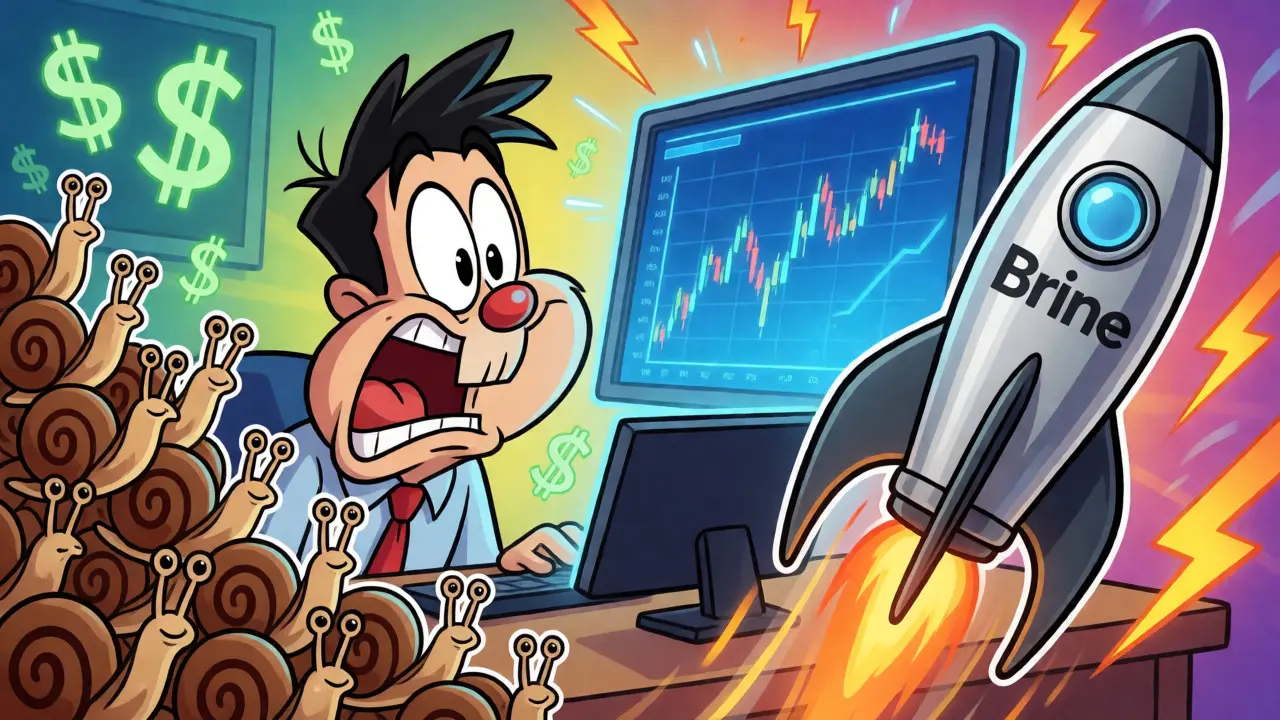
You’ve probably felt it before. You’re staring at a chart, seeing a perfect entry point for Bitcoin, but you hesitate. Why? Because on most decentralized exchanges (DEXs), speed is the enemy. Orders sit in the mempool, gas fees eat your profits, and front-running bots snatch your deal before you even click "confirm." It’s a trade-off that has plagued DeFi since its inception: choose the security of self-custody or the speed of centralized platforms like Binance. But what if you didn’t have to choose?
This is the core promise of Brine Fi. Launched publicly in September 2023 after a $16.5 million Series A led by Pantera Capital, Brine isn't just another automated market maker (AMM). It’s an orderbook-based DEX built on StarkWare’s Layer 2 infrastructure, designed specifically to solve the latency and privacy issues that keep institutional traders away from DeFi. If you’re tired of watching your limit orders get filled late-or not at all-this review breaks down whether Brine actually delivers on its claim to be the fastest secure exchange in crypto.
The Core Problem Brine Solves
Traditional DEXs like Uniswap rely on Automated Market Makers. While great for liquidity provision, AMMs are terrible for active trading. When you place a large order on Ethereum mainnet, you wait seconds or minutes for confirmation. Worse, because blockchain data is public, sophisticated bots can see your pending transaction and buy the asset before you do, driving up the price. This is called front-running, and it costs retail traders millions annually.
Brine attacks this problem head-on using zero-knowledge proofs (zkP) powered by StarkWare. Unlike other L2s that simply batch transactions, Brine uses validity proofs to ensure state transitions are correct without revealing every single trade detail immediately. This architecture allows for:
- Millisecond Execution: Orders match off-chain instantly, then settle on-chain.
- Order Privacy: Your position size and strategy remain hidden until settlement.
- Non-Custodial Security: You never hand over your keys; assets stay in your wallet.
It’s a hybrid model that feels like a centralized exchange (CEX) but functions like a true DEX. For high-frequency traders (HFTs), this distinction is critical.
Technical Architecture: How It Works Under the Hood
To understand why Brine is fast, you need to look at its dual-layer system. Most DEXs force everything on-chain, which creates bottlenecks. Brine splits the workload between an off-chain engine and an on-chain settlement layer.
The off-chain component handles the heavy lifting: matching orders, managing inventory, and creating transaction batches. It communicates with the on-chain layer only when necessary to commit state changes. This means the user experience is nearly instantaneous. According to technical documentation, Brine’s matching engine supports up to 600,000 transactions per second (TPS). To put that in perspective, Ethereum mainnet handles roughly 15-30 TPS. Even optimistic rollups often struggle to maintain consistent sub-second finality under load.
| Feature | Brine Fi | Uniswap v3 (Ethereum) | dYdX (v4) |
|---|---|---|---|
| Trading Model | Central Limit Order Book (CLOB) | Automated Market Maker (AMM) | CLOB / Hybrid |
| Execution Speed | Sub-100ms | 10-30 seconds (block time) | Seconds to Minutes |
| Gas Fees | None (L2 subsidized/batched) | $5-$25+ per swap | Variable (Chain dependent) |
| Privacy | High (zkP encrypted) | Low (Public mempool) | Moderate |
| Custody | Non-Custodial | Non-Custodial | Non-Custodial |
The use of zkP technology is the secret sauce. By proving the validity of trades mathematically rather than executing them individually on-chain, Brine reduces the computational burden. This allows the platform to offer gasless trading for users, as the network absorbs the minor L2 costs into the fee structure.
Fees and Trading Experience
If you’re coming from Coinbase or Kraken, the interface will feel familiar. Brine uses a traditional order book, not a swap slider. You see bid and ask prices, depth charts, and order history. This is a huge plus for anyone who hates guessing slippage on AMMs.
Let’s talk money. On Ethereum DEXs, a simple swap can cost $10 in gas during congestion. On Brine, the base trading fee starts at 0.05%. For high-volume traders, this drops to 0.01%. There are no separate gas fees for placing or canceling orders, which is a massive win for scalpers who make dozens of trades a day.
However, there is a catch regarding token variety. As of late 2023, Brine supported approximately 45 major token pairs. Compare this to Uniswap’s 25,000+ pairs, and you’ll see the limitation. Brine focuses on liquidity depth in major assets (BTC, ETH, USDC, USDT) rather than breadth. If you’re looking to ape into obscure altcoins with low liquidity, Brine might not have the pair yet. But for major cap trading, the spread is tight due to professional market makers providing liquidity.
Institutional Focus and Compliance
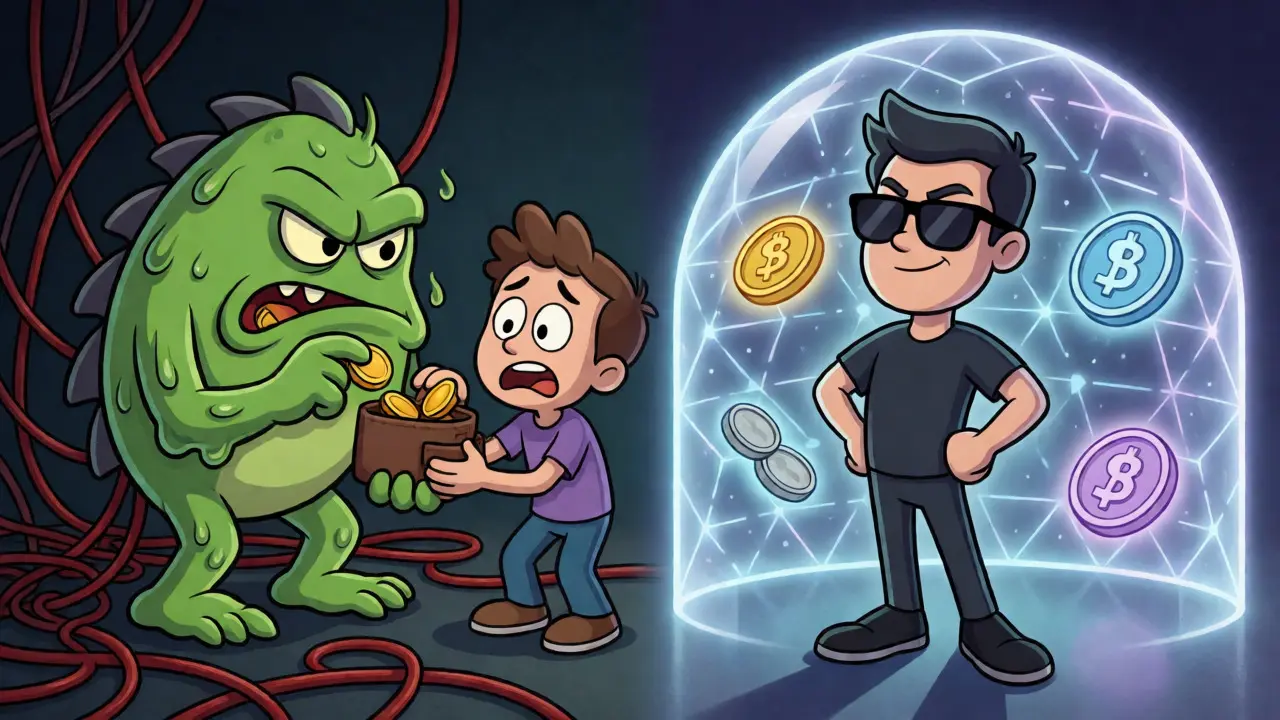
Most DEXs ignore regulation. They assume anonymity is king. Brine takes a different approach, targeting the "Institutional DeFi" segment. The platform allows institutions to execute orders exclusively with KYC-verified counterparties. This feature alone makes it attractive to hedge funds that cannot legally trade with anonymous entities.
The founders, Lakshminarayanan, Bhavesh Praveen, and Ritumbhara Bhatnagar, previously built Krypto, an Indian payments app that processed $400 million in transactions. Their background explains the focus on reliability and compliance. During its testing phase, Brine onboarded several large hedge funds and HFT firms, processing $1.6 billion in volume before going public. This isn’t a toy protocol; it’s built for serious capital.
Security is audited by PeckShield, adding a layer of trust often missing in new DeFi protocols. The smart contracts are open-source, allowing community verification, while the off-chain engine remains proprietary-a common trade-off for performance-focused platforms.
User Feedback and Community Sentiment
Early adopters on Reddit’s r/defi have been vocal about the speed advantage. One user noted executing 127 trades in under three seconds during a volatility spike, something impossible on mainnet DEXs. The referral program, offering up to 50% fee rebates, has also incentivized early growth.
That said, the learning curve exists. If you’re used to MetaMask pop-ups for every action, Brine’s seamless flow might feel too smooth, causing anxiety about where your assets actually are. Rest assured, they remain in your wallet until settlement. However, beginners should utilize the "Beginner Mode," which simplifies the UI and hides complex order types.
Community resources are still growing. Since the platform launched recently, there are fewer third-party tutorials compared to Uniswap. You’ll likely rely on official docs and Discord support for troubleshooting.

Pros and Cons
Is Brine right for you? Let’s break it down honestly.
- Pros:
- Blazing fast execution (sub-100ms).
- No gas fees for trading.
- True non-custodial security.
- Order privacy prevents front-running.
- Low fees (0.01% - 0.05%).
- Institutional-grade compliance features.
- Cons:
- Limited token selection (~45 pairs).
- Newer platform with less historical uptime data.
- Less integrated with broader DeFi yield farms.
- Requires understanding of order books (not AMM).
Final Verdict: Who Should Use Brine?
Brine Fi is not trying to replace Uniswap for everyone. It’s not the best place to provide liquidity for exotic tokens or farm yield across multiple protocols. Instead, it targets a specific niche: active traders and institutions who value speed and privacy above all else.
If you are a day trader frustrated by slow confirmations and high gas fees, Brine offers a compelling alternative. If you are an institution looking for a compliant, non-custodial venue, Brine is one of the few options that fits the bill. With backing from Pantera Capital and a clear roadmap to expand token pairs, it’s a platform worth watching as DeFi matures.
Is Brine Fi safe?
Yes, Brine Fi employs non-custodial architecture, meaning you retain control of your private keys. Additionally, its smart contracts have been audited by PeckShield, a reputable security firm. The use of StarkWare's zero-knowledge proofs adds an extra layer of cryptographic security to transaction validity.
Does Brine charge gas fees?
No, Brine does not charge separate gas fees for placing or canceling orders. The platform operates on a Layer 2 solution that batches transactions, absorbing these costs into the trading fee structure, which ranges from 0.01% to 0.05% depending on your volume.
How many cryptocurrencies does Brine support?
As of its recent updates, Brine supports approximately 45 major token pairs, focusing on high-liquidity assets like Bitcoin, Ethereum, and stablecoins. This is significantly fewer than broad-spectrum DEXs like Uniswap, but it ensures tighter spreads and better depth for major pairs.
Can I trade anonymously on Brine?
While the platform uses zero-knowledge proofs to hide trade details from the public blockchain, it offers optional KYC verification for institutional traders. Retail users can generally trade without mandatory KYC, but certain institutional features require verified counterparties.
What is the minimum deposit for Brine?
There is no strict minimum deposit enforced by the protocol itself, but practical limits depend on the minimum order sizes set by market makers for specific pairs. Generally, small amounts (e.g., $10-$50) can be traded, though efficiency improves with larger volumes due to fixed overheads in some strategies.
Speed is definitely the main thing for me. I hate waiting around when the market moves fast.
The integration of StarkWare's zk-rollup technology here is nothing short of revolutionary for retail traders. By leveraging validity proofs, Brine effectively eliminates the latency issues that have historically plagued Ethereum-based DEXs. It is fascinating to see how they handle state transitions off-chain while maintaining on-chain security guarantees. This architecture allows for sub-100ms execution times which is crucial for HFT strategies. I believe this sets a new standard for what we should expect from decentralized infrastructure. The privacy features are also a significant upgrade over public mempool visibility. We are witnessing the convergence of CEX speed and DEX sovereignty in real time. Truly an impressive engineering feat by the team.
YES! FINALLY someone understands that we need speed AND security!!! Stop making us choose between being robbed by bots or losing our keys!!! This is exactly what DeFi needed to go mainstream!!! Get ready because the institutions are coming and Brine is the door!!!
It is worth noting... that the trade-off... between centralization and decentralization... has always been the elephant in the room... regarding DeFi adoption... However... with zero-knowledge proofs... we might finally be moving past this dichotomy... into a new era of financial freedom...
I have been thinking about this quite a bit lately, considering how the traditional order book model interacts with blockchain settlement layers, and honestly, the promise of non-custodial trading at these speeds is compelling enough to make me reconsider my current reliance on centralized exchanges for active trading pairs, especially given the recent regulatory pressures that have made holding funds on CEXs feel increasingly precarious for long-term holders who still want to day-trade occasionally without sacrificing their self-sovereignty principles entirely.
I appreciate the focus on user experience here. It feels less intimidating than other DeFi platforms.
The color of money is changing, friends. It’s not just green candles anymore; it’s the vibrant hue of instant settlement. When you can trade BTC without watching a spinner for ten minutes, it feels like magic. But it’s math magic. And that’s beautiful. I love seeing tools that respect both the artist and the engineer in all of us.
😭 Another L2? Really? 😩 I'm so tired of hearing about new protocols that promise the moon and deliver dust. 🌑 Just hoping this one doesn't rug us too. 🤞💸
Oh please. Another 'revolutionary' platform backed by VCs who don't care about retail. Pantera Capital? Sure, let's trust them. They probably have insider info on every single listing. I bet the early whales are already dumping on us while we read these glowing reviews. Typical crypto circus. 🎪🐍
This is great news for everyone in emerging markets where access to reliable liquidity is key! Speed changes everything for arbitrage opportunities across global exchanges. Let's keep building and supporting these innovations together!
Seems decent :) Though I worry about the limited token selection :( Need more alts before I switch fully :/
i tried it last week and honestly its pretty smooth but i dont know if its safe yet idk maybe im paranoid lol but the lack of many coins is annoying
People fail to understand that true decentralization requires friction. Removing friction removes the philosophical underpinning of blockchain. You are simply recreating Binance with extra steps. It is a regression, not progress. Those who celebrate this do not understand what they are celebrating.
Man, I was so stressed out trying to catch that pump on Uniswap last month. Gas fees were insane. This looks way better. Hope it works out for you guys.
IT IS A MORAL IMPERATIVE TO OWN YOUR KEYS!!! We must stop trusting centralized entities with our livelihoods!!! This platform restores dignity to the trader!!! It is glorious!!!
I find the emphasis on institutional compliance particularly reassuring. It suggests a maturation of the sector that I have been hoping for.
Looks good. Will check it out later. Not urgent for me right now.
I think the UX improvements are genuinely helpful for newcomers. It lowers the barrier to entry significantly. Good work on the documentation too.
Where is the audit report link?
They say it is secure but what happens when the off chain engine crashes?? Are we left hanging?? The drama never ends in this space!! One glitch and we lose everything!! Why do we even bother??!!
Interesting concept. Keeping an eye on the volume growth.