Imagine you are building a blockchain game. You need to issue 10,000 unique swords and 1,000,000 gold coins. If you use the old way, you might end up deploying thousands of separate smart contracts just to handle these items. The gas fees would eat your budget alive, and managing all those individual addresses would be a nightmare for users. This is exactly the problem ERC-1155 was built to solve. It’s not just another token standard; it’s a hybrid approach that lets you manage fungible and non-fungible assets in one place.
Most people know about ERC-20 for money-like tokens (like USDC) and ERC-721 for unique collectibles (like Bored Apes). But what if an item starts as a common sword (fungible) and then gets upgraded into a legendary, unique blade (non-fungible)? That’s where semi-fungible tokens come in. They bridge the gap between interchangeable currency and unique digital art. In this guide, we’ll break down how ERC-1155 works, why it saves so much on gas, and when you should actually use it instead of the older standards.
What Makes a Token Semi-Fungible?
To understand ERC-1155, you first have to grasp the concept of semi-fungibility. Think of it like a concert ticket. Before the show, all tickets for Section A are identical. You can swap yours for someone else’s without any loss of value or identity. They are fungible. But once you enter the venue and mark your seat, or perhaps get a signed poster attached to your ticket, it becomes unique. Now, your specific experience matters more than just the general access right. It has become non-fungible.
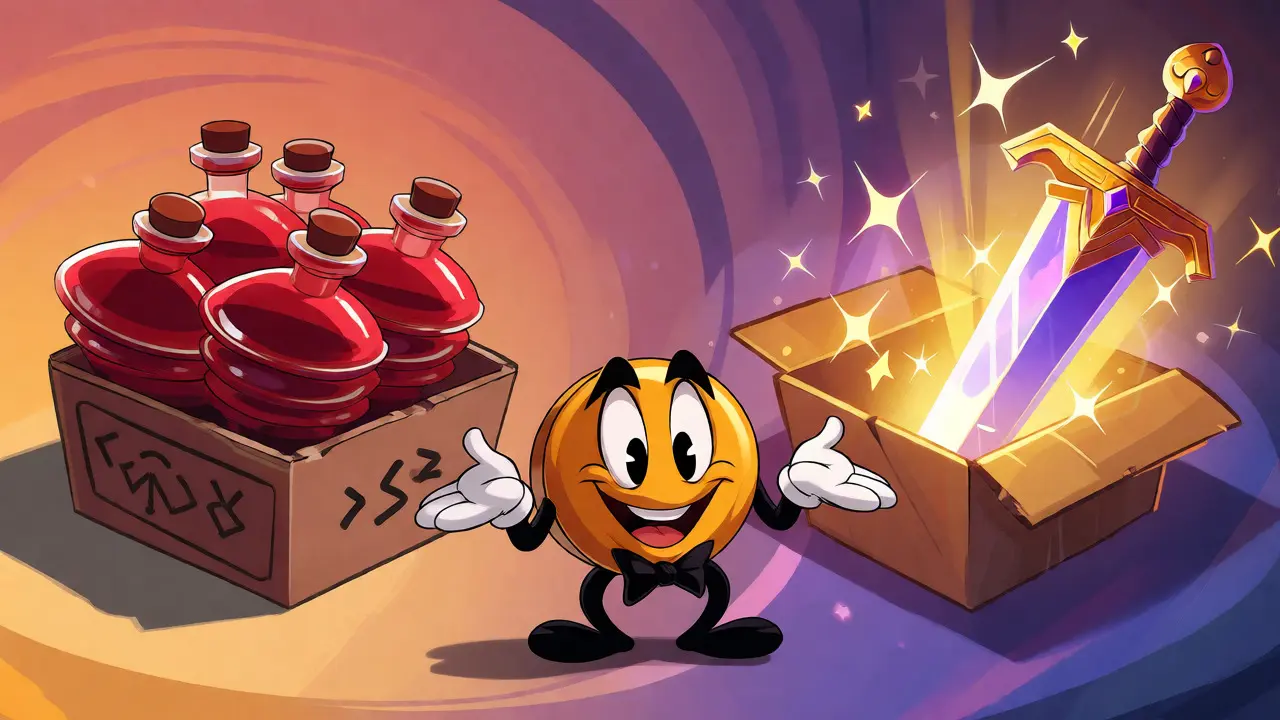
In the crypto world, this transition happens digitally. An ERC-1155 token can represent a stack of 100 "Health Potions." These are fungible because one potion is exactly the same as another. However, the same contract can also hold a single "Excalibur" sword. That sword is unique. Because both exist within the same smart contract structure, developers don’t need to write two different systems. This unified architecture is the core innovation here. It reduces code complexity and makes user wallets cleaner because they only interact with one contract address for multiple types of assets.
The Technical Architecture Behind the Standard
How does one contract handle such different things? The magic lies in the ID system. Unlike ERC-721, where each token has its own unique identifier that persists forever, ERC-1155 uses a mapping of IDs to balances. When you mint a new type of item, say "Iron Shield," you assign it an ID, like #42. If you mint 500 Iron Shields, the contract records that User A owns 500 units of ID #42. If you mint a unique "Dragon Slayer" sword, you assign it ID #99. The contract records that User B owns 1 unit of ID #99.
This setup allows for batch operations that were previously impossible or too expensive. You can send ten different types of tokens to ten different people in a single transaction. The function `safeBatchTransferFrom` handles this heavy lifting. Without this, sending five different NFTs would require five separate transactions, each costing gas. With ERC-1155, you pay for one interaction. According to technical analyses from Merkle Science, this batching capability can reduce gas costs by nearly 40-60% compared to equivalent ERC-721 operations when moving multiple assets. For a developer, this isn't just a convenience; it's a survival mechanism for high-volume applications.
Real-World Efficiency and Cost Savings
Let’s look at the numbers. If you are transferring ten unique NFTs using the standard ERC-721 method, you might burn around 221,000 gas units. Doing the same with ERC-1155 drops that number to roughly 125,000. That’s a significant saving, especially on networks where gas prices spike during peak hours. But the savings aren't just in transaction fees. Deployment costs drop too. Instead of deploying a new contract for every new game item category, you deploy one master contract and just add new IDs to it.
Consider The Sandbox, a popular metaverse platform. They use ERC-1155 to manage over 1.2 million in-game items, including armor, weapons, and tools. If they had used ERC-721, they would have needed 1.2 million separate contracts. Can you imagine trying to index and search through that many addresses? With ERC-1155, everything lives in one place. This consolidation makes data retrieval faster for marketplaces and simpler for wallets to display. Users see their inventory clearly without getting confused by hundreds of different contract addresses.
| Feature | ERC-20 (Fungible) | ERC-721 (Non-Fungible) | ERC-1155 (Multi-Token) |
|---|---|---|---|
| Token Type | Interchangeable | Unique | Both Fungible & Non-Fungible |
| Contract Structure | Single contract per asset class | Often one contract per collection | One contract for multiple asset classes |
| Batch Transfers | Yes | No (typically one-by-one) | Yes (highly optimized) |
| Gas Efficiency (High Volume) | High | Low | Very High |
| Best Use Case | Currency, Utility Tokens | Art, Collectibles, Identity | Gaming, Supply Chain, Mixed Assets |
Who Is Using ERC-1155 Today?
You’ve probably interacted with ERC-1155 tokens without realizing it. Blockchain gaming is the biggest driver. Games like Enjin powered titles rely heavily on this standard. Why? Because games generate massive amounts of small-value items. Loot boxes, consumables, and equipment stacks fit perfectly into the semi-fungible model. You don’t want to pay $5 in gas to buy a $0.50 health potion. Batching solves this.
Beyond gaming, enterprise sectors are waking up. Supply chain management is a prime example. Imagine tracking a shipment of 1,000 identical laptops (fungible) alongside a single prototype device (non-fungible) sent for testing. Both can be tracked under one contract. This simplifies auditing and ownership verification. Even loyalty programs are exploring this. A coffee shop could issue points (fungible) and limited-edition mugs (non-fungible) through the same backend system, making the user experience seamless.
However, it’s not perfect. Some high-end digital art platforms stick to ERC-721 because buyers want explicit uniqueness. There’s a psychological factor there. If an artwork is part of a batch, some collectors worry it lacks the prestige of a standalone NFT. Additionally, wallet support varies. While major wallets like MetaMask handle ERC-1155 well now, smaller or niche wallets sometimes struggle to display mixed inventories correctly, leading to confusion for less tech-savvy users.
Implementation Challenges and Developer Tips
If you’re a developer looking to implement this, brace yourself for a steeper learning curve than ERC-721. The logic for handling both fungible and non-fungible states requires careful coding. You need to ensure that metadata updates don’t accidentally change the nature of a token. For instance, if you update the metadata of a fungible item, does it remain fungible? Usually, yes, but edge cases exist.
Security is another critical area. Since one contract holds many types of assets, a bug in the contract affects everything inside it. Auditing becomes paramount. Tools like OpenZeppelin provide audited reference implementations, which are highly recommended. Don’t roll your own security unless you have to. Also, consider your metadata storage. Storing large JSON files on-chain is expensive. Most projects use IPFS or Arweave, pointing to them via URIs in the contract. This keeps gas costs low while ensuring decentralization.
Debugging can be tricky too. Traditional block explorers might show a raw hex string for a token ID rather than a human-readable name. Developers often complain about limited tooling compared to the mature ecosystem around ERC-721. Plan for extra time in your development schedule to build custom dashboards or use specialized indexing services like The Graph to make sense of your data.
The Future of Multi-Token Standards
As Ethereum continues to evolve, efficiency remains king. Upcoming upgrades aim to further reduce the cost of complex transactions, which benefits ERC-1155 disproportionately because it thrives on batch processing. We are also seeing cross-chain compatibility improve. Networks like Polygon, Avalanche, and BNB Chain all support ERC-1155 natively, allowing assets to move between ecosystems with relative ease.
Regulators are still figuring out how to classify these hybrids. Are they securities? Commodities? The SEC has noted that semi-fungible tokens create novel classification challenges. This uncertainty might slow down institutional adoption slightly, but the utility argument is strong. For practical applications-gaming, logistics, membership passes-ERC-1155 offers a level of efficiency that older standards simply cannot match.
So, should you switch? If you are building a simple meme coin, stick with ERC-20. If you are selling one-of-a-kind digital paintings, ERC-721 is still the cultural favorite. But if you are building an economy with varied assets, dynamic supply, and high transaction volume, ERC-1155 is likely your best bet. It represents a maturation of blockchain technology, moving from novelty to utility.
Can I convert an ERC-721 token to ERC-1155?
Not directly. They are different smart contract standards. You would typically need to burn the ERC-721 token and mint a new ERC-1155 token representing the same asset, assuming the project supports such a migration.
Why are ERC-1155 transactions cheaper?
They allow batch transfers. Instead of paying gas for each individual token transfer, you pay once for a bundle of transfers. This amortizes the fixed costs of interacting with the blockchain across multiple assets.
Do all wallets support ERC-1155?
Most major wallets like MetaMask, Trust Wallet, and Rainbow support it. However, some older or niche wallets may not display mixed fungible/non-fungible inventories correctly, potentially hiding some assets.
What is the main risk of using ERC-1155?
Complexity. Managing a single contract for diverse assets increases the attack surface. A bug in the shared contract can affect all token types simultaneously, unlike isolated ERC-721 collections.
Is ERC-1155 good for NFT marketplaces?
Yes, especially for gaming and utility NFTs. It allows users to list bundles of items efficiently. However, for high-value fine art, the lack of explicit 'unique' branding in some UIs can be a hurdle.