
Imagine you are buying a coffee. You hand over your card, wait two seconds, and walk away. Now imagine sending Bitcoin to pay for that same coffee. You wait ten minutes. Then another ten. And maybe another. If you are trying to run a high-frequency trading bot or a real-time multiplayer game, waiting an hour for settlement is not just annoying-it is impossible.
This friction exists because block time is the expected interval between consecutive blocks in a blockchain network. It is the heartbeat of every distributed ledger. But here is the catch: there is no single "best" block time. Speeding up the clock on one chain might make it faster, but it could also make it less secure or more centralized. Slowing it down makes it safer, but kills user experience.
In this guide, we break down how different networks like Bitcoin, Ethereum, and Solana choose their speeds, why those choices matter for your specific use case, and how you can optimize your own applications around these constraints. We will look at the math behind the trade-offs and what the data from mid-2026 tells us about where the industry is heading.
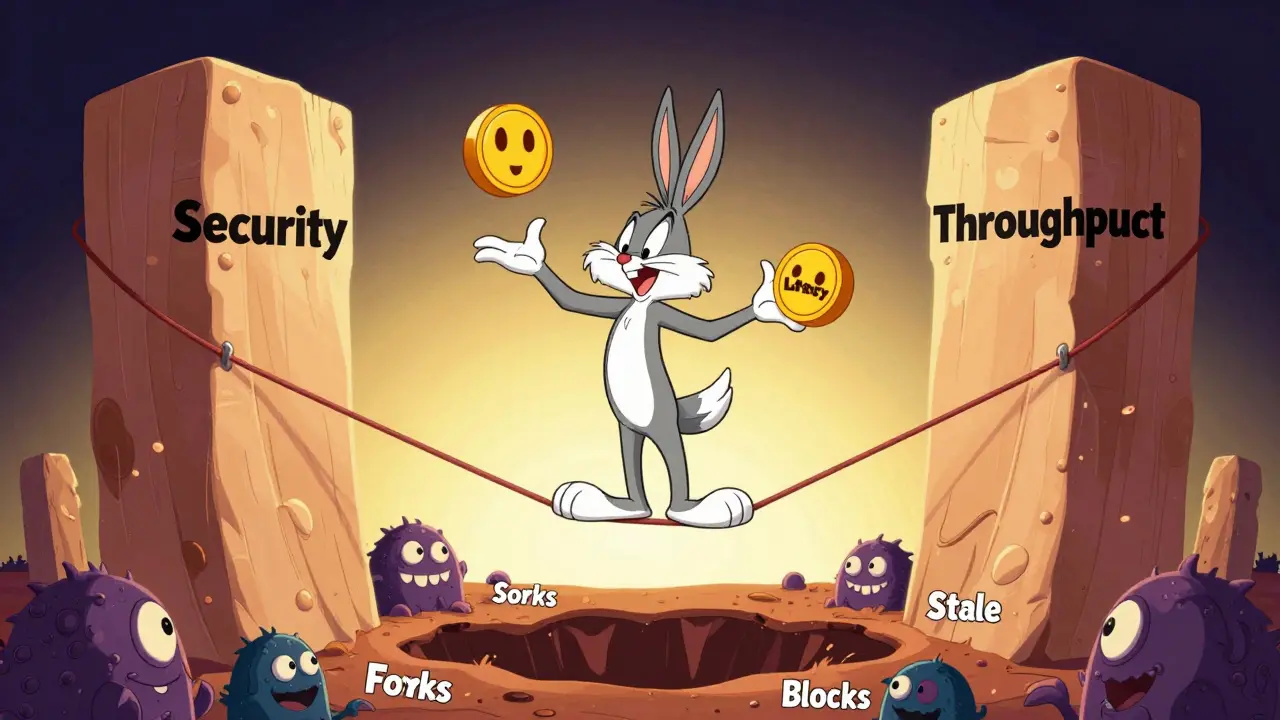
The Core Trade-off: Security vs. Speed
To understand block time, you have to accept that blockchain is a balancing act. You cannot maximize everything at once. This is often called the blockchain trilemma, but when it comes specifically to timing, it is a three-way tension between:
- Security: How hard is it for an attacker to reverse a transaction (double-spend)?
- Latency: How long does the user wait before seeing their transaction confirmed?
- Throughput: How many transactions per second (TPS) can the network handle?
If you shorten the block time, you increase throughput and reduce latency. Users get faster confirmations. However, you also increase the risk of "stale" or "orphan" blocks. Here is why that matters: when blocks are produced very quickly, they do not have enough time to propagate across the entire global network before the next block starts being mined or validated. This leads to forks-where two parts of the network disagree on which block came first.
Forks are bad for security. They give attackers a window of opportunity. If a malicious actor controls a significant portion of the network’s computing power (in Proof-of-Work) or stake (in Proof-of-Stake), frequent forks make it easier for them to rewrite history and double-spend coins. Academic research from 2023 and 2024 formalizes this: as block time approaches the network’s propagation delay, the cost of a double-spend attack drops significantly.
Therefore, the "optimal" block time is always several times larger than the median time it takes for a block to travel from one node to another. For a global network with thousands of nodes spread across continents, that propagation delay is a few seconds. For a local enterprise network, it might be milliseconds.
Bitcoin: The Fortress Approach
Bitcoin is a decentralized digital currency designed as a peer-to-peer electronic cash system and store of value. When Satoshi Nakamoto launched Bitcoin in January 2009, he set the target block time to 600 seconds (10 minutes). This was not an accident. It was a conservative choice optimized for maximum security and decentralization on a nascent, slow internet infrastructure.
| Metric | Value |
|---|---|
| Target Block Time | 600 seconds (10 minutes) |
| Block Size Limit | ~1 MB (base layer) |
| Transactions Per Second (TPS) | ~7 TPS |
| High-Value Finality Window | 30-60 minutes (3-6 confirmations) |
Because Bitcoin blocks take so long to produce, the rate of stale blocks remains very low, even though the network is globally distributed. This keeps the security model robust. The downside? Throughput is capped at roughly 7 transactions per second. That is slower than a dial-up connection from the 1990s.
For most users, waiting 10 minutes for one confirmation is too long for daily spending. However, for high-value settlements-like moving millions of dollars between exchanges or institutions-this slowness is a feature, not a bug. It provides a deep probabilistic security buffer. The standard practice for large transactions is to wait for six confirmations, which takes about an hour. During that hour, the computational work required to reverse the transaction becomes astronomically expensive, effectively securing the funds.
Merchants who want to accept Bitcoin for small purchases often rely on zero-confirmation or one-confirmation policies. They accept the risk of a rare double-spend because the fraud potential is low compared to the convenience. This is a practical optimization at the application layer, working around the base-layer limitations.
Ethereum: The Middle Ground
Ethereum is a programmable blockchain platform that supports smart contracts and decentralized applications. Ethereum has always aimed for a balance. In a seminal 2015 blog post, Vitalik Buterin argued that block times should be short enough to provide quick user feedback but long enough to avoid excessive fork rates. He settled on a range of 12-17 seconds.
Today, after transitioning to Proof-of-Stake in September 2022 (The Merge), Ethereum maintains a slot time of approximately 12 seconds. This speed allows for interactive decentralized finance (DeFi) applications. If you are swapping tokens on Uniswap or providing liquidity, waiting 10 minutes would destroy the user experience. Twelve seconds is fast enough to feel responsive, yet slow enough to allow validators spread across the globe to communicate and agree on the state of the ledger without creating too many conflicting blocks.
Ethereum handles finality differently than Bitcoin. While Bitcoin relies purely on the length of the chain (probabilistic finality), Ethereum uses a mechanism called Casper FFG. This adds a layer of economic finality on top of the block production. Typically, a transaction is considered "finalized" after a few minutes, meaning it is economically irrational for validators to try and reverse it. This hybrid approach gives Ethereum a sweet spot: sub-minute finality for most users, while maintaining a highly decentralized validator set.
Solana and High-Performance Chains: The Speed Demons
If Bitcoin is a fortress and Ethereum is a balanced city, Solana is a high-performance blockchain protocol designed for scalability through unique consensus mechanisms is a Formula 1 car. Solana targets a slot time of 400 milliseconds (0.4 seconds). That is 150 times faster than Bitcoin.
How is this possible without collapsing under the weight of network lag? Solana uses a mechanism called Proof of History (PoH) is a cryptographic clock that creates a verifiable record of events before they are processed by the consensus algorithm. PoH allows validators to order transactions locally without waiting for network-wide communication at every step. It essentially pre-packages the timeline, allowing the network to process blocks in parallel rather than sequentially.
| Network | Block/Slot Time | Practical Finality | Primary Use Case |
|---|---|---|---|
| Solana | ~400 ms | 2-5 seconds | High-frequency trading, Gaming |
| Avalanche | ~1-2 seconds | 1-2 seconds | Enterprise DeFi, Subnets |
| Algorand | ~3.3 seconds | ~3 seconds | Retail Payments, CBDCs |
In practice, users on Solana report that while the theoretical slot is 400ms, "economic finality"-the point where you can confidently spend the money-takes about 2 to 5 seconds. This is comparable to Visa’s ~2.4-second authorization time for point-of-sale transactions. This speed makes Solana ideal for retail payments, NFT minting, and real-time gaming, where immediate feedback is critical.
However, this speed comes with costs. Solana requires validators to have high-end hardware and massive bandwidth connections. This raises concerns about decentralization. If only a few large entities can afford to run nodes, the network becomes more centralized. Furthermore, rapid block production increases the complexity of software development; bugs can cascade much faster.
Choosing the Right Block Time for Your Use Case
If you are building a blockchain application or choosing a network for your business, you need to match the block time to your user’s tolerance for wait times and your requirement for security. Here is a decision framework based on common scenarios in 2026.
Scenario 1: Store of Value / Institutional Settlement
Best Fit: Bitcoin or similar slow chains.
If your primary goal is preserving wealth or settling large, infrequent transfers, speed is secondary to security. You want the deepest security margin available. Accept the 30-60 minute wait time. The low orphan rate ensures that once those blocks are buried, the transaction is virtually immutable. Do not try to optimize for speed here; you will compromise the core value proposition.
Scenario 2: Decentralized Finance (DeFi) & Smart Contracts
Best Fit: Ethereum, Avalanche, or Layer-2 Rollups.
DeFi users expect interactions to complete within seconds. If a swap takes 10 minutes, arbitrage opportunities vanish, and users lose trust. Ethereum’s 12-second blocks are manageable, especially when combined with Layer-2 solutions like Optimism or Arbitrum, which bundle transactions and settle them on Ethereum later. For native L1 performance, Avalanche’s sub-2-second finality is excellent for complex contract logic without the extreme hardware demands of Solana.
Scenario 3: Retail Payments & Point-of-Sale
Best Fit: Solana, Algorand, or Lightning Network (Bitcoin).
When paying for groceries, users will not wait. They expect near-instant confirmation. Native chains like Solana and Algorand provide this directly. Alternatively, you can use Bitcoin’s Lightning Network, which operates off-chain and settles instantly, using the slow Bitcoin mainchain only for occasional batch settlements. The key metric here is "time to spendable," which must be under 5 seconds.
Scenario 4: Real-Time Gaming & IoT
Best Fit: Solana, Polygon, or specialized sidechains.
Gaming requires state updates to happen in sync with player actions. Latency spikes cause desynchronization and ruin the experience. Block times under 1 second are mandatory. Additionally, these applications generate massive amounts of small transactions. High-throughput chains with efficient data availability layers are essential. Note that you may need to implement optimistic UI patterns in your frontend, showing the action as "done" before the blockchain fully finalizes, relying on the statistical improbability of reorgs at early confirmation stages.

Implementation Tips for Developers
As a developer, you cannot change the block time of public networks, but you can optimize your application around them. Here are three practical strategies:
- Calibrate Confirmation Expectations: Do not treat "included in a block" as "final." On Bitcoin, wait for 1-6 confirmations depending on value. On Solana, wait for "finalized" commitment level, not just "processed." Display progress bars to users so they know the system is working, reducing anxiety during the wait.
- Use Layer-2 Solutions: If you need Ethereum’s security but Solana’s speed, build on a rollup. Rollups inherit the security of the base layer but offer sub-second UX because they process batches of transactions off-chain and submit a single proof to the mainnet.
- Monitor Network Health: Block times are averages. During congestion, Ethereum blocks can take longer, and Solana can experience dropped transactions. Build retry logic and fallback mechanisms into your dApps. Never assume the network will behave exactly according to its theoretical specifications.
Future Trends: Will Block Times Get Faster?
As of June 2026, the trend is toward heterogeneity. We are not seeing a convergence on a single optimal block time. Instead, we see specialized networks optimizing for specific niches. Research suggests that for global, permissionless networks, pushing block times below 1-2 seconds remains challenging without sacrificing decentralization or requiring prohibitive hardware costs.
However, improvements in networking protocols (like QUIC and WebTransport) and sharding techniques may gradually lower the safe minimum block time for general-purpose chains. Meanwhile, modular blockchains are separating execution from settlement, allowing apps to run on fast execution layers while relying on slower, secure settlement layers. This architectural shift means the concept of a single "block time" is becoming less relevant for end-users, who will increasingly interact with instant-feeling interfaces backed by complex, multi-layered backend systems.
What is the difference between block time and finality?
Block time is the average interval between new blocks being added to the chain. Finality is the point at which a transaction is considered irreversible. On Bitcoin, finality is probabilistic and depends on the number of blocks added after yours (e.g., 6 blocks = ~60 minutes). On Ethereum, finality is achieved via a separate consensus mechanism (Casper) that typically takes a few minutes. On Solana, finality is reached after tens of slots, taking about 2-5 seconds.
Why doesn't Bitcoin just reduce its block time to 1 minute?
Reducing block time increases the rate of stale blocks because blocks don't have enough time to propagate globally. This increases the likelihood of forks, which reduces security and makes double-spending attacks cheaper. Bitcoin prioritizes maximum security and decentralization over speed, making the 10-minute target optimal for its current network topology.
Which blockchain is best for online gaming?
Chains with sub-second block times and fast finality are best for gaming. Solana (400ms slots) and Avalanche (1-2s finality) are popular choices because they can handle the high frequency of state updates required by games without noticeable lag. Layer-2 solutions on Ethereum are also viable if the game logic is not extremely latency-sensitive.
How does Proof of Stake affect block time compared to Proof of Work?
Proof of Stake (PoS) allows for more deterministic and potentially shorter block times because validators are known and scheduled, unlike miners who compete randomly. However, the physical limit of network propagation still applies. Even in PoS, if blocks are produced too quickly relative to network speed, forks occur. Ethereum’s move to PoS allowed it to maintain a consistent 12-second slot time, whereas Bitcoin’s PoW results in variable block intervals averaging 10 minutes.
Can I change the block time of my private blockchain?
Yes. For private or consortium blockchains, you can tune the block time based on your network's physical layout. If all nodes are in the same data center, you can set block times to milliseconds. If nodes are geographically dispersed, you should measure the 90th percentile propagation delay and set the block time to be several times larger than that to avoid forks.