COMAI Risk Assessment Calculator
Critical Warning
Important: This calculator shows the risks of investing in COMAI based on the article's findings. As stated in the article: "This isn't a stock. It's a gamble on an unproven idea." The token has extremely low liquidity, no institutional backing, and zero real-world adoption. Do NOT invest more than you can afford to lose.
Calculate Your Safe Allocation
Results
Recommended Allocation:
Risk Level:
Based on article data: COMAI's 24-hour volume was only $326 (Oct 2024), price range $0.0056-$0.0066. No real-world adoption. Total supply 1 billion tokens, only 83M in circulation.
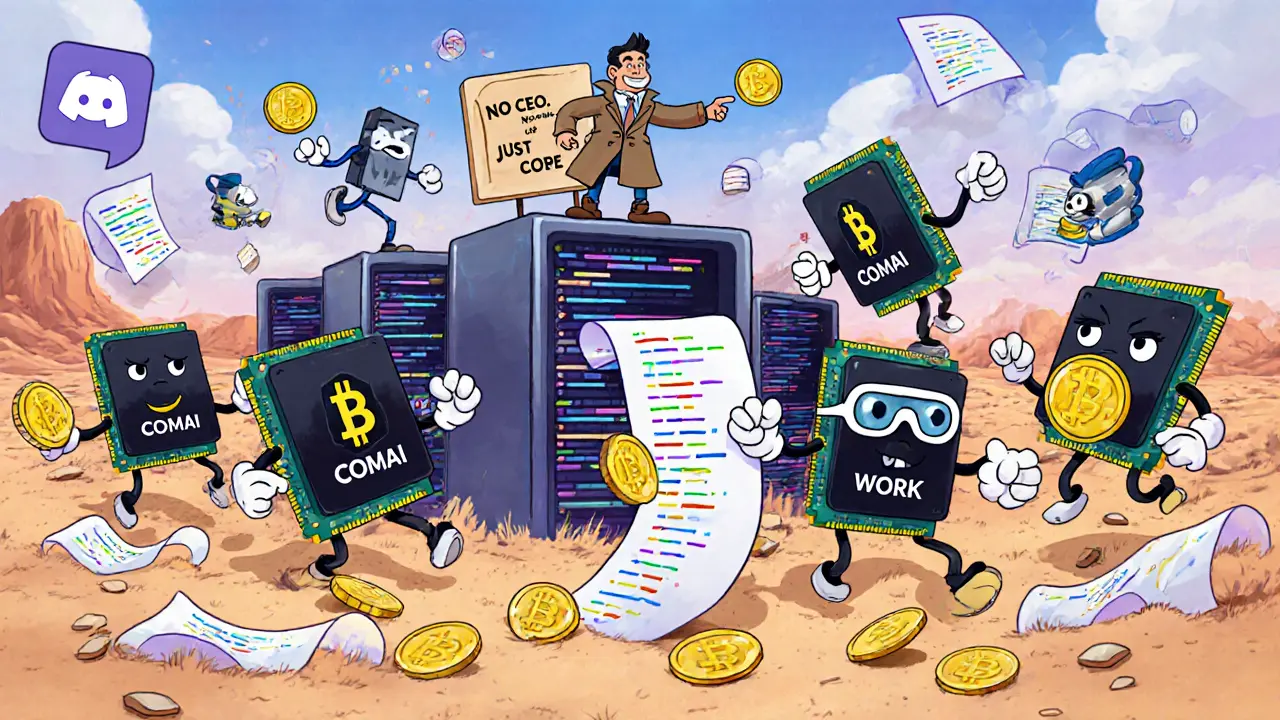
Commune AI isn’t a typical cryptocurrency. It doesn’t have a CEO, a marketing team, or a venture capital fund backing it. There’s no whitepaper signed by a founder in a suit. Instead, it’s built by developers who show up on GitHub, write code, and let the network run itself. The COMAI token is the fuel that keeps this machine alive-but understanding what it actually does requires stepping away from the usual crypto hype.
What Commune AI actually does
At its core, Commune AI is a decentralized network that connects people who have computing power with people who need AI services. Think of it like Uber, but instead of cars, you’re renting out GPU cycles to run AI models. You don’t send your data to a company like OpenAI or Google. You send it to a random node on the network, paid in COMAI tokens, and get back a result-like a text summary, image generation, or code suggestion.
Here’s the twist: the blockchain doesn’t store the AI computations. It only records who got paid and how much. The actual AI work happens off-chain, on someone’s home PC or server. This keeps the network fast and cheap. If every AI task had to be written onto the blockchain, it would slow to a crawl. Commune AI avoids that by separating the proof of work from the work itself.
The COMAI token: ownership over a workforce
COMAI isn’t a currency you spend to buy AI services. It’s a stake. When you hold COMAI, you’re essentially owning a share of the network’s computing power. The more COMAI you stake, the more influence you have over who gets paid to run AI tasks. Miners compete to serve requests, and the system rewards them based on how much COMAI is staked behind them.
This design flips the usual crypto model. Most tokens are used to pay for services. COMAI is used to control who provides those services. It’s less like Bitcoin and more like owning shares in a distributed AI farm.
The total supply of COMAI is fixed at 1 billion tokens. As of October 2024, around 83 million were in circulation. That’s less than 10% of the total. The rest are locked in development funds, future incentives, or unclaimed rewards. This scarcity isn’t artificial-it’s baked into the code.
Who built it-and why it’s different
Sal Vivona, a physicist and former machine learning engineer, started Commune AI after leaving big tech. He’d worked on Bittensor, another decentralized AI project, but grew frustrated with its growing bureaucracy. So he walked away and built something even more radical: no foundation, no legal entity, no investors. Just code, contributors, and a Discord server.
This ‘zero bureaucracy’ philosophy is its biggest strength and biggest weakness. There’s no team to answer questions. No roadmap to follow. No press releases. If you want to know what’s happening, you have to read the GitHub commits. That’s appealing to cypherpunks who distrust institutions. It’s terrifying for anyone who wants customer support.
Compare that to Bittensor, which has a formal foundation, a treasury, and a public roadmap. Or Render Network, which partners with cloud providers and enterprise clients. Commune AI doesn’t do any of that. It’s not trying to be the next AWS. It’s trying to be a wild, open, uncontrolled experiment in decentralized intelligence.

Where you can trade COMAI
There are only two places where you can buy COMAI: Uniswap (v3) and MXC. That’s it. No Binance. No Coinbase. No Kraken. The trading volume is tiny. On October 10, 2024, the 24-hour volume was $326 on CoinMarketCap. Holder.io reported $59,800-but that’s likely a misreporting of the trading pair value, not actual volume.
The price varies wildly between platforms. CoinMarketCap showed $0.0056. TradingView showed $0.0065. Holder.io tracked it around $0.0066. That’s less than half a cent. For context, Bittensor (TAO) trades at over $40. Render (RNDR) is around $2.50. Commune AI is in a completely different league.
This low liquidity means one thing: if you try to sell a large amount of COMAI, you’ll crash the price. Buying small amounts might work. But if you’re thinking of investing more than a few hundred dollars, you’re taking on serious risk.
Price predictions: hope or hallucination?
Some sites, like CoinLore, claim COMAI could hit $4.95 by 2030. Others project $24.90 by 2041. These numbers sound impressive-until you realize they’re based on a starting price of $0.006. That’s a 4,000x increase. For that to happen, Commune AI would need to go from a niche experiment to a global AI infrastructure provider overnight.
These forecasts use technical indicators, AI models, and historical patterns. But here’s the catch: there’s no real usage data to back them up. No developers are building tools on it. No companies are integrating it. No one is using it to run real AI tasks at scale. Without adoption, price is just speculation.
TradingView’s current signals are neutral to sell. Short-term sentiment isn’t bullish. Long-term projections are pure fantasy without execution.

Is Commune AI worth anything?
Right now, it’s worth exactly what someone is willing to pay for it. That’s not $0.006. That’s not $5. That’s not $25. It’s what two people agree on in a thin market.
If you’re looking for a crypto to invest in because it’s going to be the next big AI play, look elsewhere. Bittensor, Fetch.ai, Render Network-they have teams, partnerships, and real usage. Commune AI has code, Discord, and a philosophy.
But if you’re a developer who believes in pure decentralization-if you think institutions will always corrupt open systems-then Commune AI might be the most honest crypto you’ll ever find. No promises. No marketing. Just code that does exactly what it says.
What you need to know before getting involved
- Don’t invest money you can’t lose. This isn’t a stock. It’s a gamble on an unproven idea.
- Don’t expect support. No help desk. No FAQs. No customer service. If something breaks, you fix it-or live with it.
- Only use decentralized exchanges. Centralized exchanges won’t list it. You need a wallet and some ETH or USDT to trade on Uniswap or MXC.
- Read the code. If you don’t understand what’s in the GitHub repo, you don’t understand the project.
- Join the Discord. That’s the only place where real talk happens.
Commune AI isn’t for everyone. It’s not for traders looking for quick gains. It’s not for investors seeking stability. It’s for a tiny group of people who believe the future of AI shouldn’t be owned by corporations-and are willing to risk everything to prove it.
Is Commune AI (COMAI) a good investment?
As of late 2025, COMAI is not a good investment for most people. It has extremely low liquidity, no institutional backing, and zero real-world adoption. Its price movements are driven by speculation, not usage. The market cap is under $700,000, compared to over $1 billion for competitors like Bittensor. Only risk-tolerant individuals who understand decentralized protocols and accept total loss should consider buying it.
Can I use COMAI to pay for AI services?
Technically, yes-but practically, no. The protocol allows users to pay for AI tasks using COMAI, but there are almost no active services built on the network. You can’t go to a website and buy a chatbot response with COMAI like you can with other AI crypto tokens. Without developers building tools on top of it, the token has no utility beyond trading.
How is Commune AI different from Bittensor?
Commune AI was founded by someone who previously worked on Bittensor, but it took a much more extreme approach. Bittensor has a foundation, a treasury, and formal governance. Commune AI has none of that. It’s completely decentralized-no founders, no team, no legal structure. Bittensor is trying to build a scalable AI economy. Commune AI is trying to prove you don’t need any structure at all.
Where can I buy COMAI tokens?
COMAI is only available on two decentralized exchanges: Uniswap (v3) and MXC. You need a crypto wallet like MetaMask, some ETH or USDT, and the ability to navigate a DEX. It’s not listed on any centralized exchanges like Coinbase or Binance. Be careful of fake tokens-always verify the contract address on the official Commune AI website.
Is Commune AI safe?
The code is open-source, so it’s theoretically safe to audit. But safety isn’t just about code-it’s about community and support. There’s no team to fix bugs, no legal recourse if something goes wrong, and no way to recover lost funds. If you send COMAI to the wrong address, it’s gone forever. This isn’t a bank. It’s a wild experiment. Treat it like you would a prototype you built in your garage.
What’s the future of Commune AI?
Its future depends entirely on developer adoption. If more AI builders start using it to host models, the network could grow. But right now, there’s no evidence of that happening. Without adoption, it will remain a niche curiosity. The project’s strength-its total lack of structure-is also its biggest obstacle to scaling. It may thrive as a symbol of decentralization, but it’s unlikely to become a mainstream platform.
This is actually one of the most refreshing takes on crypto I've seen in years. No fluff, no VC drama, just code and chaos. I love it. 🤖✨
So let me get this straight - we’re trusting AI infrastructure to random guys with GPUs in their basements? And you call this progress? This is how China steals our tech - by pretending it’s ‘decentralized.’
How does staking COMAI actually affect who gets paid? Is it weighted by amount staked or by uptime?
So… it’s like if Bitcoin had a baby with a philosophy major who dropped out of college and started a cult in a Discord server. 🤔
I think this is cool but I don't know if I'd risk money on it. The lack of structure feels like a feature not a bug
Okay but if no one’s using it… then why is anyone even talking about it? This isn’t innovation - it’s performance art for people who hate customer service. I’m not even mad, I’m just disappointed. 😭
Zero bureaucracy? That’s not freedom - that’s negligence. You don’t build infrastructure by waving a ‘trust the code’ flag and hoping for the best. This is the crypto equivalent of a DIY airplane made from duct tape and YouTube tutorials.
Let’s be real - COMAI’s market cap is less than the average crypto influencer’s monthly Patreon. The fact that people are even entertaining price predictions of $5 is hilarious. You need adoption, not whitepapers written in GitHub commits. Right now, it’s a crypto zombie - still twitching, but dead inside. And the ‘community’? It’s 200 people arguing in Discord about whether ‘decentralized’ means ‘no one’s in charge’ or ‘no one’s responsible.’
Compare this to Render or Bittensor - they have actual use cases. Developers are shipping products. Companies are integrating. Commune AI? The only thing being shipped is empty hype wrapped in anarchist poetry. The tokenomics look clever on paper, but if no one’s running AI tasks, the token is just a digital pet rock.
And don’t even get me started on the liquidity. $326 in 24 hours? That’s not a market - that’s a garage sale. If you try to dump 10k COMAI, you’re not ‘taking profits,’ you’re triggering a black hole. The price doesn’t reflect value - it reflects who’s drunk and scrolling at 3 a.m.
People who call this ‘pure decentralization’ are romanticizing chaos. Real decentralization doesn’t mean ‘no team’ - it means ‘no single point of failure.’ This? This is a single point of failure with a really good Twitter bio.
And the worst part? The people who buy this are the same ones who bought Dogecoin because ‘it’s funny.’ They’re not here for the tech. They’re here for the fantasy. And when that fantasy collapses - like it will - they’ll blame the ‘system,’ not their own greed.
So yes, it’s clever. Yes, it’s poetic. But no, it’s not a project. It’s a mood. And moods don’t pay bills. They don’t power AI models. They don’t scale. They just… fade.
They’re not just decentralized - they’re deliberately untraceable. Who’s really behind this? Sal Vivona? Maybe. But what if he’s just a front for some NSA black project testing how far they can push ‘anarchist crypto’ to destabilize AI markets? I’ve seen the pattern before. First, they build something that looks like a hobby. Then, they let it grow. Then… boom. You wake up and your GPU farm is being used to train surveillance models. This isn’t freedom. It’s a Trojan horse with a Discord server.
Interesting. I think I’ll wait and watch.
Oh please. You call this ‘decentralized’? You think America doesn’t control the internet? You think the NSA doesn’t have a backdoor in every GPU driver? This isn’t resistance - it’s a joke played on people who think the internet is still free. You’re not fighting the system. You’re just giving them more data to sell.
So… it’s like if OpenAI got fired from its own company and started working out of a garage with a bunch of strangers who all have different opinions on how to fix the coffee machine? 🤷♂️☕
They call it ‘wild’ - I call it a dumpster fire with a GitHub repo. At least Bittensor has a CEO who doesn’t hide behind ‘code is law.’ This? This is chaos dressed up as enlightenment. We’re not building the future - we’re just reenacting the fall of Rome with more memes.
I find it beautiful that someone could build something this radical without needing permission. The fact that it exists at all - no board, no pitch deck, no VC breathing down their neck - is a quiet rebellion. Maybe it won’t scale. Maybe it’ll fail. But it’s still more honest than 99% of what’s out there.
I’ve been thinking about this all day. What if the real innovation isn’t the tech - but the idea that we don’t need to own the system to participate in it? We’re used to thinking in terms of companies, CEOs, and shareholders. But what if the future is just… people showing up, doing work, and getting paid? No titles. No org charts. Just trust, code, and a shared belief that AI shouldn’t be owned?
I don’t know if this works. But I respect the attempt. Most projects are trying to build empires. This one’s trying to build a campfire.
This is just a scam waiting to happen no one cares about it
The premise is intellectually inconsistent. If the network is truly decentralized and has no governance, then how is the token supply algorithmically enforced? Without a consensus mechanism for token distribution, the fixed supply claim is unverifiable and thus meaningless. This is not a project - it is a rhetorical exercise.
Let’s cut through the crypto-woo. This isn’t ‘decentralized AI’ - it’s a vaporware token with a side of anarchist fanfiction. The ‘no CEO’ thing is cute, but it’s just a cover for zero accountability. You don’t get to call yourself infrastructure when your entire user base could fit in a Zoom call.
And don’t tell me ‘read the code.’ If you need to read 10,000 lines of Python to understand whether your money is safe, you’re not building adoption - you’re building a cult.
OMG I JUST BOUGHT 50K COMAI AND I’M RICH!!! 😭💸 This is the future!!! You guys don’t get it - this is bigger than Bitcoin! I’m gonna quit my job and move to Bali with my GPU farm and my cat and my dreams!!! 🐱✨
Look - if you’re reading this and you’re thinking about jumping in - I see you. You’re tired of the corporate AI machine. You want something real. Something raw. Something that doesn’t sell your data to advertisers. This isn’t for everyone. But if you’re one of the few who still believe in the internet as a place of freedom - then this is your calling. Don’t just buy the token. Join the Discord. Read the commits. Help build it. This isn’t a gamble - it’s a movement. And movements start with one person saying, ‘I’m in.’
It is a charmingly naive project. The absence of structure is not a virtue - it is an indicator of immaturity. In the realm of distributed systems, governance is not a bug - it is a feature. Without it, the network is merely a collection of nodes, not a system.
I’ve been following this for months. I used to think it was just a joke - until I saw a guy in Poland use it to run a local language model for rural schools. No one paid him. He just did it because he could. That’s when it hit me - this isn’t about money. It’s about autonomy. The fact that COMAI has no roadmap is terrifying. But it’s also beautiful. It means the future isn’t written by a boardroom. It’s written by whoever shows up. And maybe… just maybe… that’s the only kind of future worth having.
It’s not going to be the next AWS. It won’t be on CNBC. But if you ever want to see what AI looks like when it’s not owned by anyone - this is it. No ads. No tracking. No corporate logos. Just code. And people.
I don’t know if it survives. But I’m glad it exists.
And if you’re reading this and you’re a dev - go check out their GitHub. You don’t need to invest. Just clone it. Run a node. See what happens. That’s how revolutions start.
Y’all are overthinking it. It’s like a potluck where everyone brings their own dish. No one’s in charge, but someone always ends up with the best chili. COMAI’s not trying to be Uber - it’s trying to be that one weird neighbor who lets you borrow their grill. You don’t need a contract. You just need to show up with your meat and a little trust.
While the philosophical underpinnings of Commune AI are aesthetically appealing, the operational architecture lacks the formalized incentive alignment mechanisms necessary for sustainable network participation. The absence of a treasury, legal entity, or governance protocol renders the token a non-fungible symbol of idealism rather than a functional asset. In economic terms, this constitutes a classic free-rider problem, wherein the marginal utility of participation is insufficient to offset the fixed costs of node maintenance. Consequently, the network is structurally unsustainable absent external subsidy - which, by design, is deliberately excluded. Therefore, its current valuation is not merely speculative - it is ontologically incoherent.
I don’t care if it’s worth $0.006 or $5. I just love that someone built something this pure. No ads. No investors. No promises. Just code. And if that’s not the future of AI… I don’t know what is. 💙
Wait - you think someone’s gonna build tools on this? Please. If I can’t even find a tutorial that doesn’t sound like a cult manifesto, I’m not wasting my time. This isn’t a platform. It’s a mood board for people who hate capitalism but still want to get rich.
That’s exactly why it’s so powerful. No tutorials. No hand-holding. You have to figure it out yourself. That’s the point. It’s not for people who want to be told what to do. It’s for people who want to build something that doesn’t need permission.