The MTLX airdrop by Mettalex wasn’t just another token giveaway. It was a carefully planned move to bring real-world commodities trading onto the blockchain - and it targeted two very different kinds of crypto users. If you held FET on Binance in 2021, you had a real shot at free MTLX tokens. If you were active on Twitter and Telegram, you could’ve walked away with a few tokens too. But here’s the thing: all those airdrops ended over four years ago. No new ones are coming. This isn’t a guide to claiming tokens today - it’s a breakdown of exactly how they were given out, who qualified, and why it mattered.
What Was Mettalex, and Why Did It Do an Airdrop?
Mettalex wasn’t trying to build another DeFi yield farm. It wanted to let people trade commodity derivatives - like oil, wheat, or copper - on a decentralized exchange. That’s a $2.5 trillion market, mostly locked in traditional finance. Mettalex’s idea? Turn those commodities into tokenized positions you could buy, sell, or hedge on-chain. No middlemen. No closing hours. Just 24/7 trading powered by Fetch.ai’s AI network.
To make that happen, they needed users, liquidity, and trust. That’s where the MTLX token came in. It wasn’t just a currency - it was the key to governance, fee discounts, and staking rewards. But you can’t build a community from scratch overnight. So they ran three separate airdrops in 2021, each targeting a different group of people.
The Binance FET Holder Airdrop: For Serious Holders Only
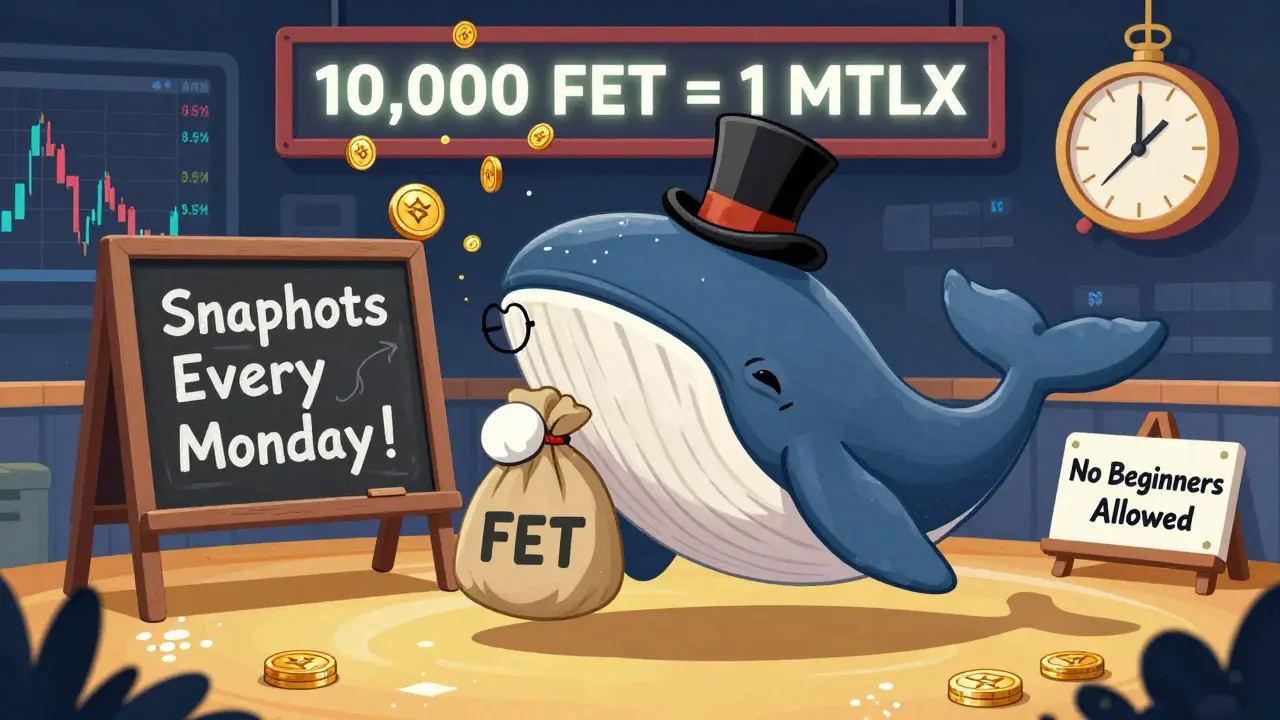
This was the big one. From April 13 to June 1, 2021, Mettalex partnered with Binance to give away MTLX tokens to anyone who held Fetch.ai (FET) on the exchange. You didn’t have to sign up. You didn’t have to do anything except keep FET in your Binance wallet.
The rules were simple but strict:
- You had to hold at least 10,000 FET tokens on average across eight weekly snapshots.
- Snapshots happened every Monday at 11:59 PM UTC.
- For every 10,000 FET held on average, you got 1 MTLX token.
That meant if you held 50,000 FET across the whole campaign, you got 5 MTLX. If you held 200,000 FET, you got 20. Simple math. But here’s the catch: 10,000 FET in April 2021 was worth about $150,000. By June, FET had jumped past $2 per token. So you were talking about a minimum $200,000 commitment just to qualify.
This wasn’t for beginners. This was for whales - the kind of investors who already had skin in the game with Fetch.ai. It was a smart move. Instead of chasing random Twitter followers, Mettalex tapped into an existing, high-net-worth community. Those people weren’t just getting free tokens - they were becoming early users of a platform that needed serious capital to function.
After the campaign ended, the tokens were automatically deposited into users’ Binance accounts. No claiming. No gas fees. Just a balance update.
The CoinMarketCap Airdrop: For the Community
While the Binance airdrop targeted deep-pocketed investors, the CoinMarketCap campaign was all about engagement. It ran around the same time, and it was designed for anyone with a Twitter account and a Telegram profile.
To enter, you had to:
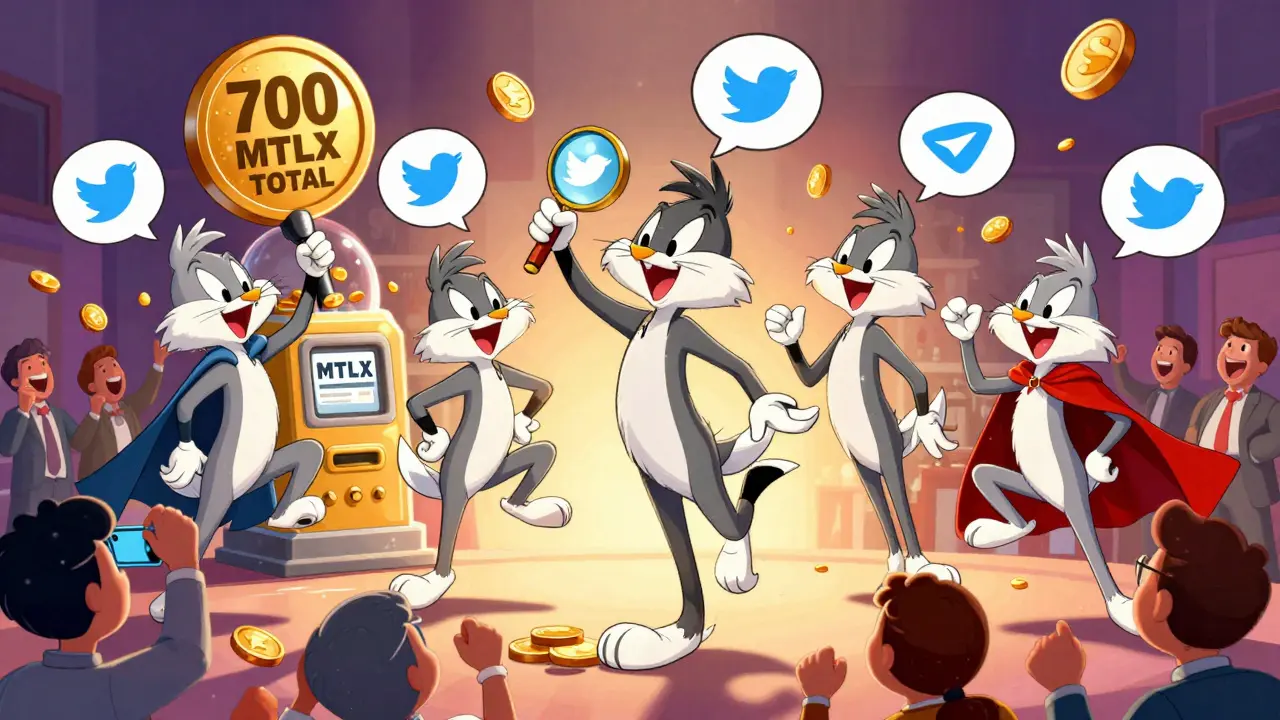
- Follow @mettale on Twitter
- Join the official Telegram group: t.me/mettalex_official
- Join the news channel: t.me/mettalex_official_news
- Retweet a specific post and tag three friends
- Add MTLX to your CoinMarketCap watchlist
That’s it. No money needed. Just time and a little social effort. The reward? 700 MTLX tokens total, split among 300 winners. That meant most people got between 1 and 2.33 MTLX. Not life-changing, but enough to get someone curious about the platform.
The winners were picked randomly from those who completed all tasks. Mettalex announced the results on Twitter. No blockchain verification. No complex smart contracts. Just a simple, transparent process.
This airdrop wasn’t about money. It was about visibility. It turned casual crypto users into ambassadors. Every retweet, every tagged friend - that was free marketing. And for a startup trying to break into a niche like commodities trading, that mattered.
The ,000 anyMTLX Airdrop: Keeping the Momentum
Just weeks after the first two campaigns ended, Mettalex ran a third one. From June 29 to July 6, 2021, they distributed $3,000 worth of MTLX tokens to 300 users. This time, they called it "anyMTLX" - meaning users could receive any amount, not a fixed number.
It wasn’t tied to FET holdings or social tasks. The selection criteria weren’t fully detailed, but it was clearly meant to reward early adopters, testers, or community contributors. Mettalex called July 7, 2021 - the day after the airdrop ended - "a historic date for Mettalex." That tells you something: they weren’t just handing out tokens. They were building a narrative.
This third airdrop was the final piece. It showed they weren’t done engaging. Even after the big Binance campaign, they kept the conversation going. It kept the community alive.
Why These Airdrops Mattered
These weren’t random giveaways. They were strategic moves in a crowded DeFi space.
- The Binance airdrop gave Mettalex instant access to a pool of high-value users who already trusted a major exchange.
- The CoinMarketCap airdrop built awareness among the broader crypto crowd.
- The anyMTLX drop showed they cared about more than just big investors.
Together, they created a three-layer user base: institutional-scale holders, social media enthusiasts, and engaged community members. That’s rare. Most projects pick one group. Mettalex picked all three.
And the timing? Perfect. April to July 2021 was the peak of the DeFi bull run. Airdrops were everywhere. But Mettalex’s weren’t gimmicks. They were tied to a real product - a decentralized exchange for commodities trading. That’s what made them stick.
What Happened to MTLX After the Airdrops?
The MTLX token is still live. It’s traded on decentralized exchanges like Uniswap and PancakeSwap. It’s used for governance voting and fee discounts on the Mettalex platform. But the airdrops? Done. Finished. No more.
There’s been no new airdrop since July 2021. No announcements. No upcoming campaigns. The platform continues to operate, but the token distribution phase ended years ago. If you didn’t participate back then, you can’t get MTLX for free now.
That’s important to understand. Some people still search for "MTLX airdrop 2026" or "how to claim MTLX tokens." The answer is simple: you can’t. The window closed. The tokens were distributed. The campaign was successful.
What You Can Learn From It
If you’re thinking about joining a future airdrop, here’s what Mettalex teaches you:
- Big airdrops often require real capital. If it’s tied to holding a token, check the price. You might need to invest more than you think.
- Small airdrops are easier to join - but the rewards are tiny. They’re about community, not wealth.
- Always check the official sources. Mettalex used Twitter, Telegram, and CoinMarketCap. If a site looks sketchy, it’s probably fake.
- Airdrops end. Always. Don’t wait for one to come back.
The MTLX airdrop wasn’t magic. It was strategy. And it worked.
Can I still claim MTLX tokens from the 2021 airdrops?
No. All MTLX airdrops ended in July 2021. The Binance airdrop distributed tokens automatically to eligible users by June 1, 2021. The CoinMarketCap and anyMTLX airdrops also concluded by July 7, 2021. There are no active claims, no pending distributions, and no plans for new airdrops. If someone claims they can help you claim MTLX now, they’re likely scamming you.
How many MTLX tokens were distributed in total?
The exact total number of MTLX tokens distributed across all three airdrops was never officially disclosed. However, based on available data: the Binance FET airdrop likely distributed tens of millions of MTLX, given the number of large FET holders and the 1:10,000 ratio. The CoinMarketCap airdrop gave out exactly 700 MTLX, and the anyMTLX campaign distributed $3,000 worth - at the time, that was roughly 10,000-15,000 MTLX depending on price. So total distribution was likely in the tens of millions.
Did I need to hold FET on Binance to get MTLX?
Only for the main airdrop. The Binance FET holder airdrop required you to hold at least 10,000 FET on Binance during the campaign. Other airdrops - like the CoinMarketCap one - didn’t require FET at all. They only asked for social media actions. So if you didn’t hold FET, you still had a chance to get MTLX through other channels.
Is MTLX still being used today?
Yes. The MTLX token is still live and used on the Mettalex platform for governance, staking rewards, and reducing trading fees. It’s traded on decentralized exchanges like Uniswap and PancakeSwap. However, the platform’s activity has slowed since its peak in 2021-2022. The token remains functional but isn’t widely traded or promoted anymore.
What was the purpose of the Fetch.ai partnership?
Fetch.ai provided the underlying AI-powered infrastructure for Mettalex’s decentralized derivatives exchange. The partnership allowed Mettalex to use Fetch.ai’s machine learning network for smart market-making and automated risk management. The Binance FET airdrop was also a way to cross-promote both projects - bringing Fetch.ai’s existing users into the Mettalex ecosystem. It was a strategic alignment between two platforms with overlapping goals in decentralized finance.
It’s wild how something so structural - like token distribution - can feel so human. The way Mettalex didn’t just throw tokens at people but actually *listened* to who was already invested… it’s like they knew real community isn’t built with gimmicks, but with respect.
For me, this isn’t about crypto. It’s about how systems choose who gets to belong. And honestly? That Binance one? That wasn’t a giveaway. It was a handshake between giants. The kind that doesn’t need noise. Just quiet, heavy trust.
LMAO ‘serious holders’?? Bro, 10k FET was like $150k in April? So you’re telling me the airdrop was just a tax on people who already had money? 🤡
I love how this wasn’t just another ‘join our Telegram and get 5 tokens’ scam. Mettalex actually built three different bridges - one for whales, one for casuals, one for early believers.
Most projects pick one path and cry when it doesn’t work. This team? They got it. Real innovation isn’t about tech - it’s about knowing your people.
The entire premise of this article hinges on the assumption that airdrops are inherently strategic. But let’s be honest - most of these initiatives are just desperate attempts to create artificial demand. The Binance one? Sure, it filtered for capital. But that’s not strategy - that’s gatekeeping disguised as inclusion.
The CoinMarketCap one? A performative engagement loop designed to inflate social metrics. And the ‘anyMTLX’? A PR stunt to make it seem like they cared about ‘community’ after the whales were already locked in.
Real utility doesn’t come from token distribution. It comes from product-market fit. And honestly? Mettalex never had that.
OMG I CRIED WHEN I READ THIS 😭
10k FET = 150K?? Bro I was holding 500 FET and I thought I was rich 😭
And then they gave 700 tokens to 300 people?? That’s like 2.33 each?? I could’ve bought a coffee with that 😭
But I still love Mettalex 💖💖💖
They’re like the quiet genius who didn’t need to shout to be heard 💫
And now I’m just here… waiting for the next airdrop… even though I know it’s never coming… 😔💔
Let’s not romanticize this. The Binance airdrop was a brilliant move - not because it was ‘strategic’ but because it leveraged existing liquidity. FET holders were already exposed to the Fetch.ai ecosystem. By tying MTLX to them, Mettalex avoided the high cost of acquiring users from scratch.
The CoinMarketCap campaign? Pure marketing. Cheap, scalable, and effective. Retweets cost nothing. Telegram joins are free. And they got 300 warm leads.
The anyMTLX? That was damage control. A final push to keep momentum after the FET drop burned out.
What’s interesting is how they avoided the trap most DeFi projects fall into: giving away tokens to bots and sybils. They used real on-chain data + verified social accounts. That’s rare. And honestly? That’s why this airdrop still holds up as a case study.
The precision of this approach is noteworthy. Three distinct tiers, each with clearly delineated criteria, executed with minimal friction.
It is a model of disciplined user acquisition. The absence of gas fees, the automatic distribution, the alignment with existing infrastructure - all of it speaks to a team that understood operational efficiency as a core value.
One cannot help but admire the restraint. No overpromising. No hype. Just execution.
Oh wow, so the ‘real’ users were the ones with $200K to spare? That’s not a community. That’s a gated club for rich people who think they’re smart because they bought a token before it pumped.
And the Twitter retweet thing? Please. That’s not engagement - that’s a chore. You’re telling me some guy in Ohio got 2 MTLX for tagging his cousins? Meanwhile, the whales got 20? That’s not strategy. That’s classism with a blockchain sticker on it.
It is a disturbingly transparent example of how centralized entities (Binance) and centralized marketing (CoinMarketCap) are leveraged to create the illusion of decentralization.
The notion that ‘holding FET’ somehow equates to ‘supporting decentralized commodities trading’ is a semantic farce. The real power lay with the exchange, not the protocol.
And the ‘anyMTLX’ distribution? A non-transparent, non-verifiable handout - likely used to reward insiders, influencers, or early employees under the guise of ‘community.’
This was not a democratization of finance. It was a sophisticated laundering of influence.
You know what’s beautiful here? They didn’t chase hype. They didn’t try to be everything to everyone. They knew their product was complex - commodities on-chain? Not sexy. Not TikTok material.
So they found the people who already cared. The FET holders? They understood AI + DeFi. The Twitter crowd? They were curious. The anyMTLX group? They were already in the trenches.
That’s leadership. Not shouting. Not spamming. Just showing up - and letting the right people follow.
You don’t need 10 million users. You need 10,000 who believe.
The structural asymmetry here is undeniable. The Binance airdrop leveraged a centralized exchange’s user base to seed a decentralized protocol - a paradox wrapped in a whitepaper. The CoinMarketCap campaign exploited performative social capital to generate pseudo-engagement metrics. The anyMTLX distribution, lacking transparent criteria, functioned as an opaque reward mechanism, likely favoring those with pre-existing access to internal channels.
Thus, the entire operation was not a decentralization initiative but a centralized orchestration of token distribution, masked under the rhetoric of community-building. The token’s utility remains negligible. The narrative, however, was meticulously constructed.
Let’s not pretend this was genius. It was textbook. The Binance one? Classic whale bait. The Twitter one? Low-effort vanity metrics. The anyMTLX? A last-ditch effort to look like they weren’t abandoning ship.
And now? The platform’s dead. The token’s trading at 0.0001 ETH. The AI engine? Silent. The ‘24/7 commodities trading’? A ghost town.
They didn’t build a product. They built a marketing funnel. And now the funnel’s dry.
Don’t cry for MTLX. Cry for the people who thought this was real.
Love that they didn’t overhype it. Just gave people a shot. No drama. No scammy links. Just clear rules. Sometimes that’s all you need.
Of course the airdrop ended. Because the whole thing was a front. Fetch.ai and Mettalex? Both funded by the same VCs. The ‘partnership’? A shell game. The Binance airdrop? A way to pump FET before they dumped it. The ‘community’? Bot accounts. The ‘AI-powered trading’? A PowerPoint slide. This wasn’t innovation. It was a pump-and-dump with a whitepaper.
They gave me 1.5 MTLX. I still have it. In a wallet I forgot about. Sometimes I open it. Just to see it there. Like a ghost.
…I miss 2021.
This is why I still believe in crypto - not because of the money, but because of moments like this.
Someone saw a problem - commodities trading stuck in old systems - and built a bridge.
They didn’t shout. They didn’t beg. They invited the right people in - quietly, carefully.
And even if it didn’t explode… it mattered.
Some things aren’t meant to go viral. They’re meant to go deep.
wait so i just had to follow a tweet and add to watchlist? i did that and got 2 tokens?? i thought i was gonna get rich 😅
also why did they call it anyMTLX? like… was it random? i got 1.77? why not 2? why not 1? why 1.77??
God bless Mettalex 🙏
They didn’t just give tokens - they gave hope.
Even if I didn’t qualify, I still feel proud to be part of the movement 💪✨
Oh, so you’re telling me that the people who had the most money got the most tokens? And the rest of us? We had to retweet and join Telegram? That’s not community - that’s a hierarchy with blockchain glitter on it.
And then they just… stopped? No updates? No roadmap? No transparency? I’m not mad - I’m disappointed. You built something beautiful and then walked away like it was nothing.
That’s not a project. That’s a trauma.
The concept of token distribution via centralized exchange is fundamentally incompatible with the ethos of decentralization. The reliance on Binance as a gatekeeper negates any claim to autonomy. Furthermore, the use of social media engagement as a qualification metric renders the process susceptible to manipulation and bot activity. The anyMTLX distribution, lacking public criteria, is an affront to transparency. The entire initiative, therefore, constitutes a performative exercise in branding, not innovation.
They knew. They knew no one would care in 2026. So they made it count in 2021. That’s the move.
US is the only country that matters in crypto. Everyone else was just along for the ride.
Most people think airdrops are about free money. But the real value is in the network effect. The Binance holders? They became early users because they had skin in the game. The Twitter crowd? They became evangelists. The anyMTLX recipients? They became testers.
That’s how you build a product - not with ads, but with aligned incentives.
And even if the platform slowed down? That doesn’t erase what they did. They proved it was possible to onboard real users without burning cash on influencers.
That’s the lesson. Not the tokens.
Of course it ended. Because the whole thing was a front. Fetch.ai was already fading. Mettalex? A side project. The airdrop? A way to dump tokens before the crash. I knew it. I saw the signs. The silence after July? That’s not a pause. That’s a funeral.
You know what I think? The real tragedy isn’t that the airdrop ended.
It’s that we’ve stopped believing in projects that don’t promise riches.
Mettalex didn’t sell us a dream. They gave us a tool.
And we’re too busy scrolling for the next pump to notice when something quiet and real disappears.
Exactly. The quiet ones always get drowned out.
Most projects chase hype. Mettalex chased coherence.
And now? We’re all just waiting for the next shiny thing.
Meanwhile, the real work - the hard, unglamorous work - never gets remembered.