Singapore Crypto License Eligibility Checker
Business Type Selection
Select your business type to determine license requirements
Transaction Volume
Enter your estimated monthly transaction volume (SGD)
Enter your business details and click "Check Eligibility" to see your license requirements.
Singapore’s crypto rules aren’t just strict-they’re designed to make the system work
If you’re running a crypto business in Singapore or planning to, you need to understand one thing: the rules changed on June 30, 2025. There’s no grace period. No extensions. If you’re operating a digital token service from Singapore-even if your customers are all overseas-you’re required to be licensed. And if you’re not? You’re breaking the law.
The Monetary Authority of Singapore (MAS) didn’t just tweak the rules. They rebuilt them under the Financial Services and Markets Act 2022 (FSMA), turning Singapore into one of the few places in the world with crystal-clear, enforceable crypto regulations. This isn’t about stifling innovation. It’s about making sure innovation doesn’t come at the cost of financial stability.
What counts as a digital token service?
Under the new FSMA rules, a digital token service provider (DTSP) is any business that offers one or more of these services from Singapore:
- Buying or selling cryptocurrencies like Bitcoin or Ethereum
- Operating a crypto exchange platform
- Providing crypto wallet services
- Facilitating crypto transfers or payments
- Issuing or managing stablecoins
It doesn’t matter if you’re a startup in a co-working space or a hedge fund with offices in Marina Bay. If your servers are in Singapore and you’re touching digital tokens, you need a license. Even if you only serve clients in Nigeria, Brazil, or Canada-your location is what triggers the requirement.
The two license tiers: Small operators vs. big players
Singapore doesn’t treat all crypto businesses the same. The Payment Services Act (PSA) still applies, and it divides licenses into two main categories based on transaction volume.
Standard Payment Institution License is for businesses handling up to SGD 3 million in monthly transactions. You need at least SGD 100,000 in capital, basic AML systems, and a Singapore-based compliance officer. This license fits most small exchanges, wallet apps, and payment processors.
Major Payment Institution License kicks in when you hit that SGD 3 million monthly threshold. Now you need SGD 250,000 in capital, advanced risk controls, annual third-party audits, and stricter cybersecurity protocols. This is what big players like Kraken, Binance (if they applied), or local giants like Coinhako must hold.
There’s also an Exempt Payment Service Provider status, but it’s narrow. Only businesses doing very low-risk activities-like accepting crypto as payment for goods without holding funds-are eligible. Even then, you still have to notify MAS and follow strict limits.
The Crypto Travel Rule: You must track every transaction
Singapore doesn’t just want to know who you are-they want to know where every dollar goes. MAS Notice PSN02, often called the Crypto Travel Rule, forces all licensed providers to collect and share customer data on every crypto transfer over SGD 1,000.
That means if you send ETH from your wallet to another wallet, your exchange has to send the sender’s name, ID number, and address to the recipient’s platform. Same if you’re withdrawing to a private wallet. This isn’t optional. It’s built into the system. If your software can’t handle this, you won’t get licensed.
This rule mirrors what banks have done for decades with wire transfers. MAS is saying: crypto isn’t a loophole. It’s part of the financial system now. And if you want to operate here, you play by the same rules.

Credit cards banned. No leverage. No guessing games
One of the most visible changes in 2025 is the outright ban on using credit cards to buy crypto. If you try to use your Visa or Mastercard to purchase Bitcoin on a Singapore-based exchange, the transaction will be blocked.
Why? Because MAS saw too many retail investors getting into crypto with borrowed money-then losing everything when prices dropped. The goal isn’t to stop people from investing. It’s to stop them from gambling with debt.
Alongside this, exchanges must now meet minimum capital requirements and prove they can absorb losses without collapsing. No more fly-by-night platforms with $50,000 in bank accounts and 10,000 users. If you’re serious about operating here, you need real financial backing.
Stablecoins are regulated-hard
Stablecoins like USDT or USDC aren’t treated as “crypto lite” in Singapore. They’re treated like financial instruments. Issuers must prove they hold 1:1 backing in cash or cash equivalents, stored in segregated accounts with approved banks. They must also allow daily redemption requests and submit quarterly audits.
Only licensed issuers can operate stablecoins in Singapore. Unlicensed ones? They’re blocked from local banking channels. That means even if you’re a foreign stablecoin issuer, if you want to be used by Singaporean exchanges or users, you need MAS approval.
This is why Tether and Circle have both applied for licenses. It’s not optional anymore. If you’re a stablecoin issuer without a Singapore license, you’re effectively cut off from the region’s most sophisticated financial market.
How Singapore compares to the rest of the world
While the U.S. is still stuck in regulatory debates and the EU is rolling out MiCAR with a multi-year transition, Singapore is already live. By June 2025, every DTSP had to comply-or shut down.
Hong Kong is catching up, but they’re still refining rules for derivatives and lending. Japan has strict rules but lacks the same extraterritorial reach. Dubai offers licenses but with less transparency. Singapore’s edge? Clarity, enforcement, and global recognition.
Companies from Switzerland, South Korea, and even the U.S. are relocating their Asia operations to Singapore-not because it’s cheap, but because they know exactly what’s allowed and what’s not. That predictability is worth more than tax breaks.
What happens if you ignore the rules?
The penalties aren’t a slap on the wrist. Operating without a license can lead to:
- Fines up to SGD 2 million
- Imprisonment for up to 10 years for executives
- Asset freezes and bank account closures
- Blacklisting from Singapore’s financial system
There’s no “we didn’t know” defense. MAS publishes all licensed providers on their website. If you’re not on that list, you’re illegal. Period.
Who’s licensed as of October 2025?
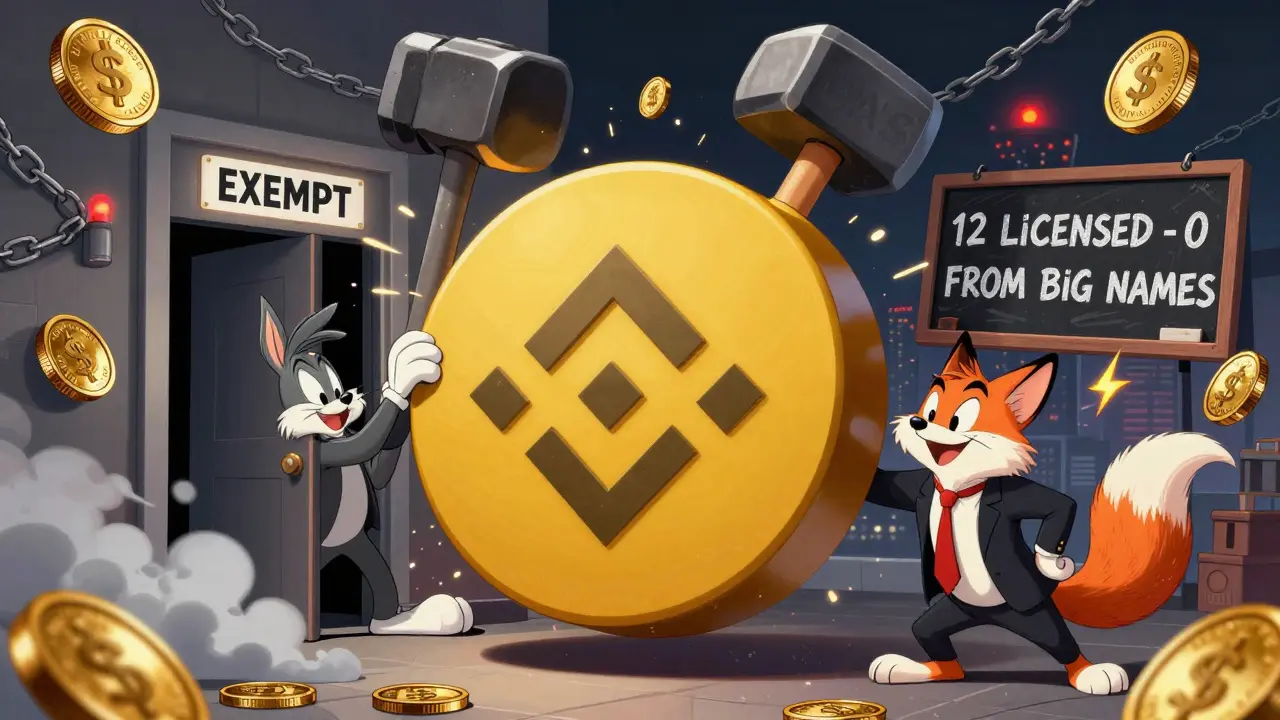
As of October 2025, only 12 entities hold full DTSP licenses under FSMA. That includes:
- Coinhako
- Independent Reserve (Singapore)
- Bitget (Singapore Pte. Ltd.)
- OKX Singapore
- Two local stablecoin issuers
That’s it. No big names like Binance or Coinbase are licensed yet. They either didn’t apply, or their applications were rejected. MAS doesn’t give licenses to companies with weak compliance histories. They’re not trying to attract volume-they’re trying to attract trust.
What’s next for Singapore’s crypto scene?
Singapore isn’t done. MAS is already exploring tokenized bonds, CBDC pilots, and cross-border stablecoin settlements with Thailand and Indonesia. But they’re moving slowly-because they know one bad actor can break trust.
The message is clear: innovation is welcome, but only if it’s safe, transparent, and accountable. If you’re building something new, you can still do it here. But you’ll need to do it right.
For businesses, the path is simple: apply early, build compliance into your tech from day one, and never assume you can operate in the gray. Singapore doesn’t have gray areas anymore.
Do I need a license if I only trade crypto personally in Singapore?
No. Personal trading-buying and selling crypto for your own account-is not regulated. The rules only apply to businesses offering services to others. If you’re not running a platform, exchange, or wallet service, you don’t need a license.
Can foreign crypto companies operate in Singapore without a license?
No. If your company is based in Singapore-even if your servers are in the cloud or your team is remote-you’re subject to Singapore law. If you’re offering crypto services to anyone from Singapore, you need a license. MAS enforces this extraterritorially.
What if I’m just building a blockchain app that doesn’t handle crypto?
If your app doesn’t involve digital payment tokens-like Bitcoin or Ethereum-and doesn’t facilitate transfers, exchanges, or custody of crypto assets, then you’re not a DTSP. You’re free to build blockchain tools, smart contracts, or enterprise solutions without a license. But if you touch tokens, you’re in regulated territory.
How long does it take to get a crypto license in Singapore?
The process typically takes 6 to 9 months. MAS reviews applications thoroughly-checking your compliance systems, AML controls, cybersecurity measures, and financial health. Rushing it won’t help. Most applicants are rejected on their first try because they underestimate the depth of documentation required.
Are stablecoins legal in Singapore?
Yes-but only if they’re issued by a licensed entity. Unlicensed stablecoins can’t be used on Singaporean exchanges or linked to local bank accounts. The government requires full backing, daily redemption rights, and regular audits. This isn’t a free-for-all. It’s a tightly controlled system.
Can I use a Singapore license to operate in other countries?
A Singapore license doesn’t automatically let you operate elsewhere. Each country has its own rules. But having a MAS license gives you credibility. Many countries, especially in Asia, recognize Singapore’s standards as a benchmark. It makes it easier to apply for licenses abroad.
What’s the minimum capital to start a crypto business in Singapore?
For a Standard Payment Institution License, you need at least SGD 100,000 in paid-up capital. For a Major Payment Institution License, it’s SGD 250,000. This isn’t a suggestion-it’s a legal requirement. You must prove you have the funds before MAS approves your application.
Do I need a physical office in Singapore?
Yes. You must have a registered business address in Singapore. Remote teams or virtual offices aren’t enough. MAS requires a local presence to ensure accountability. This includes having a Singapore-based compliance officer who can be contacted by regulators.
Can I apply for a license if I have a criminal record?
It’s extremely unlikely. MAS conducts background checks on all directors, major shareholders, and compliance officers. A history of financial crimes, fraud, or money laundering will disqualify your application. Even past regulatory violations elsewhere can be grounds for rejection.
Is crypto mining regulated in Singapore?
Mining itself isn’t regulated under the DTSP framework-it’s not a service provided to customers. But if you’re mining and then selling the coins you earn, you’re operating as a dealer. That requires a license. Also, large-scale mining operations face energy and environmental scrutiny from other government agencies.
This is actually one of the clearest crypto regulatory frameworks I've ever seen. No vague language, no loopholes, just straight-up rules. I wish more countries would do this instead of playing regulatory whack-a-mole.
Of course Singapore thinks it's the center of the universe. Meanwhile, the US is letting startups die while bureaucrats argue over coffee. This isn't regulation-it's a monopoly play for local banks.
I'm so tired of these 'Singapore is perfect' takes. 🙄 You think banning credit cards is smart? What about people who actually use crypto to get out of debt? You're punishing the desperate because you're scared of innovation. #FreeCrypto
Bro. This isn't regulation. This is a corporate spa day for banks. You wanna know what's wild? The fact that Binance didn't get licensed? That's not a failure-it's a rebellion. MAS wants robots, not revolutionaries. And honestly? I respect that.
I think the real story here isn't the licensing framework it's the cultural shift behind it Singapore has quietly become the Switzerland of crypto not because they're the most lenient but because they're the most consistent and that consistency builds trust over time even if it feels heavy at first
ok so MAS says stablecoins need 1:1 backing but where's the proof? like where's the audit trail? i looked at their site and there's no public ledger for the issuers. this feels like a marketing stunt not a policy. #crypto
The Travel Rule is a nightmare. You're forcing private wallets to become surveillance nodes. This isn't financial regulation-it's social credit for crypto. And don't give me that 'it's just like banks' nonsense. Banks don't track your crypto purchases unless you're flagged.
You think this is innovation? This is control dressed up as safety. Real innovation doesn't need permission. Real builders don't wait for licenses. They build in the dark until the world has no choice but to notice
The capital requirements are ridiculous. $100k just to run a wallet app? That’s a barrier to entry for anyone who isn’t already rich. This isn’t about safety-it’s about protecting incumbents.
Let me be perfectly clear: Singapore’s approach is the gold standard. The fact that you’re even questioning this reveals a fundamental misunderstanding of financial integrity. If you want to operate in a system that values stability over chaos, you follow the rules. If you don’t, you’re not a pioneer-you’re a liability.
If you're building something real, this is a gift. Clear rules mean you can sleep at night. No more wondering if tomorrow’s news will shut you down. Just build, comply, and scale. This is the path to real adoption.
I appreciate the clarity, but I worry about small devs in Southeast Asia who can’t afford the compliance overhead. The rules are good, but the cost might push innovation offshore.
This is why I moved my team to Singapore. I’ve worked in 5 countries. This is the first time I didn’t have to hire a lawyer just to understand if I was breaking the law. That’s priceless.
The fact that only 12 licenses were issued says more than the rules themselves. MAS isn’t trying to attract crypto. They’re trying to filter it. And honestly? I respect that.
This is the future 🌍. Clear rules, real accountability, no shady actors. I’ve seen so many crypto projects collapse because of chaos. Singapore is giving us a roadmap. Let’s not complain about the rules-let’s follow them and build something that lasts.
The stablecoin requirements are actually quite elegant. 1:1 backing, segregated accounts, daily redemption-it’s the only way to prevent another Terra. And the fact that they’re pushing for cross-border settlements with Thailand? That’s the real game-changer.
Credit card ban makes sense. Saw too many people blow their savings on Dogecoin. This isn’t censorship-it’s harm reduction.
You people act like Singapore invented regulation. In India we’ve had KYC for crypto since 2018. At least here you can’t even open a wallet without ID. You think this is hard? Try dealing with RBI.
I run a small crypto payment service in Nigeria. We never touched Singapore. But now our clients ask if we’re MAS licensed. Because they know if you’re licensed there, you’re not a scam. That’s power.
They’re not stopping innovation. They’re just making sure it doesn’t come with a body count. People forget crypto isn’t just tech-it’s finance. And finance kills when it’s reckless.
This is what global trust looks like. Not hype. Not memes. Just clear rules that work for everyone. If you’re building something real, this is your home.
I think people miss the bigger picture. Singapore isn’t just regulating crypto. They’re building a new kind of financial infrastructure-one that doesn’t rely on trust in institutions but on verifiable code and enforceable law. It’s not perfect, but it’s the most honest system we’ve seen yet. The fact that they’re already exploring tokenized bonds and CBDCs shows they’re thinking 10 years ahead, not just next quarter.
What’s fascinating isn’t the rules-it’s the mindset behind them. Singapore doesn’t see crypto as a threat to be contained, but as a force to be channeled. They’re not trying to be the biggest crypto hub. They’re trying to be the most trustworthy. And in a world full of scams, that’s the rarest currency of all.