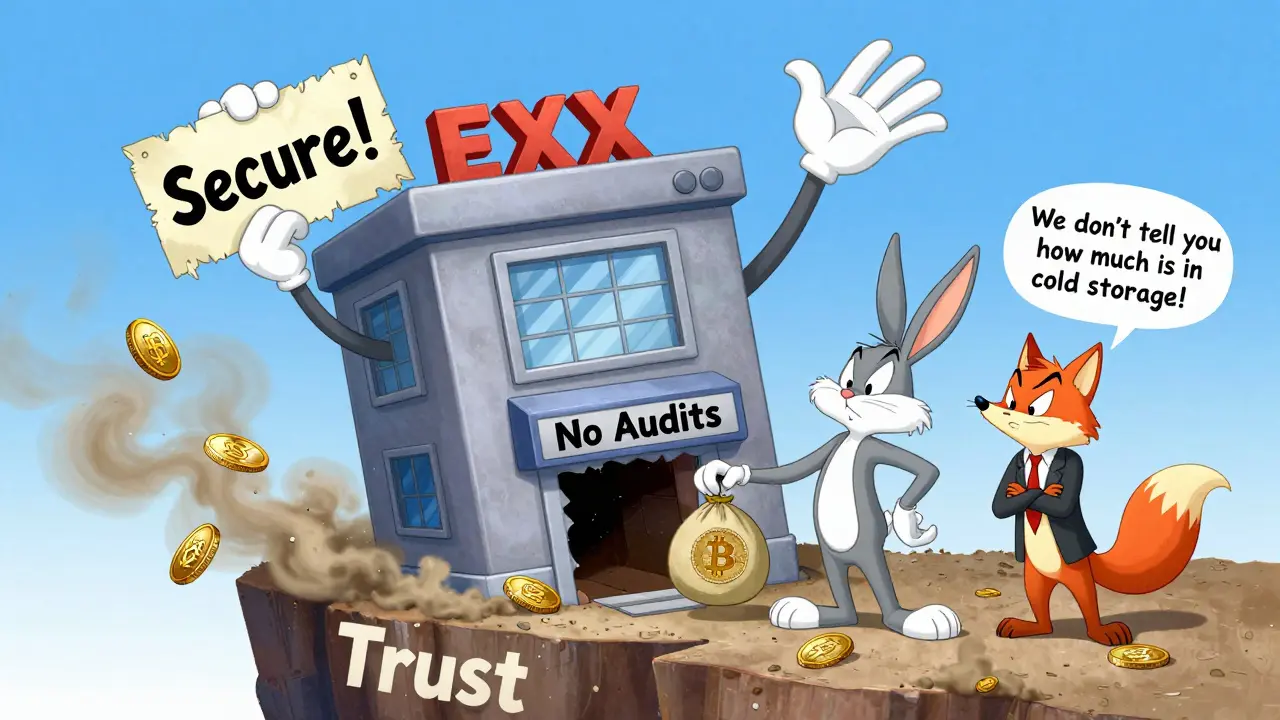
When you're looking to trade cryptocurrencies, you don't just want another app that says "secure." You want to know if your money is actually safe. That's where EXX comes in - a platform that claims solid security but leaves big questions unanswered. If you're thinking about using EXX, here's what you really need to know before depositing even a single Bitcoin.
What EXX Claims to Offer
EXX positions itself as a straightforward, no-frills crypto exchange focused on keeping your assets safe. According to their public statements, they use six key security measures: offline cold storage, multi-signature wallets, geographically redundant servers, SSL encryption, real-time transaction monitoring, and strict internal controls. These aren’t flashy buzzwords - they’re standard practices used by exchanges like Kraken and Coinbase. But here’s the catch: EXX doesn’t tell you how much of your money is actually in cold storage. Most reputable exchanges publish this number - often 95% or higher. EXX says nothing. That’s not just quiet - it’s suspicious.
They also claim to follow industry best practices, but they don’t show proof. No third-party audit reports. No public proof-of-reserves. No insurance fund like Binance’s SAFU or Coinbase’s cold storage insurance. If you’re comparing EXX to exchanges that have been around since 2011 or 2012, this gap is huge. You’re not just choosing a platform - you’re choosing a level of trust. And EXX isn’t giving you anything concrete to trust.
Transparency: The Missing Piece
One of the biggest red flags with EXX is how little they share. You won’t find their founding date. You won’t find who runs the company. You won’t find any regulatory license number. Not even a mention of which country they’re registered in. Compare that to Kraken, which publishes detailed compliance reports for U.S., EU, and Canadian regulators. Or Coinbase, which is licensed in over 50 U.S. states. EXX doesn’t even pretend to have that kind of footprint.
And then there’s KYC and AML. Most exchanges require ID verification to comply with global financial rules. EXX says they do, but they don’t say what documents they need, how long it takes, or if they block users from certain countries. If you’re in New Zealand, the U.S., or the EU, you might assume you’re covered - but you can’t be sure. That’s not how a trustworthy exchange operates. Legit platforms make this information easy to find. EXX makes you dig - and even then, you’ll find nothing.
Where Are the User Reviews?
Here’s something you won’t see anywhere: real user feedback. No Reddit threads. No Trustpilot ratings. No Twitter complaints about slow withdrawals. No YouTube videos showing how the app works. That’s not normal. Even smaller, lesser-known exchanges have some level of online chatter. EXX? Silence. That’s not a sign of a quiet, happy user base - it’s a sign that either no one uses it, or people who did have left because they couldn’t get help.
EXX lists a Help Center and a support email ([email protected]), but there’s no data on response times. Have they fixed a withdrawal issue in 2 hours? Or does it take 5 days? No one knows. And if you’re trading, time matters. A delay of even 24 hours during a market swing can cost you thousands. Without knowing how support works, you’re gambling.
Trading Features: Bare Bones
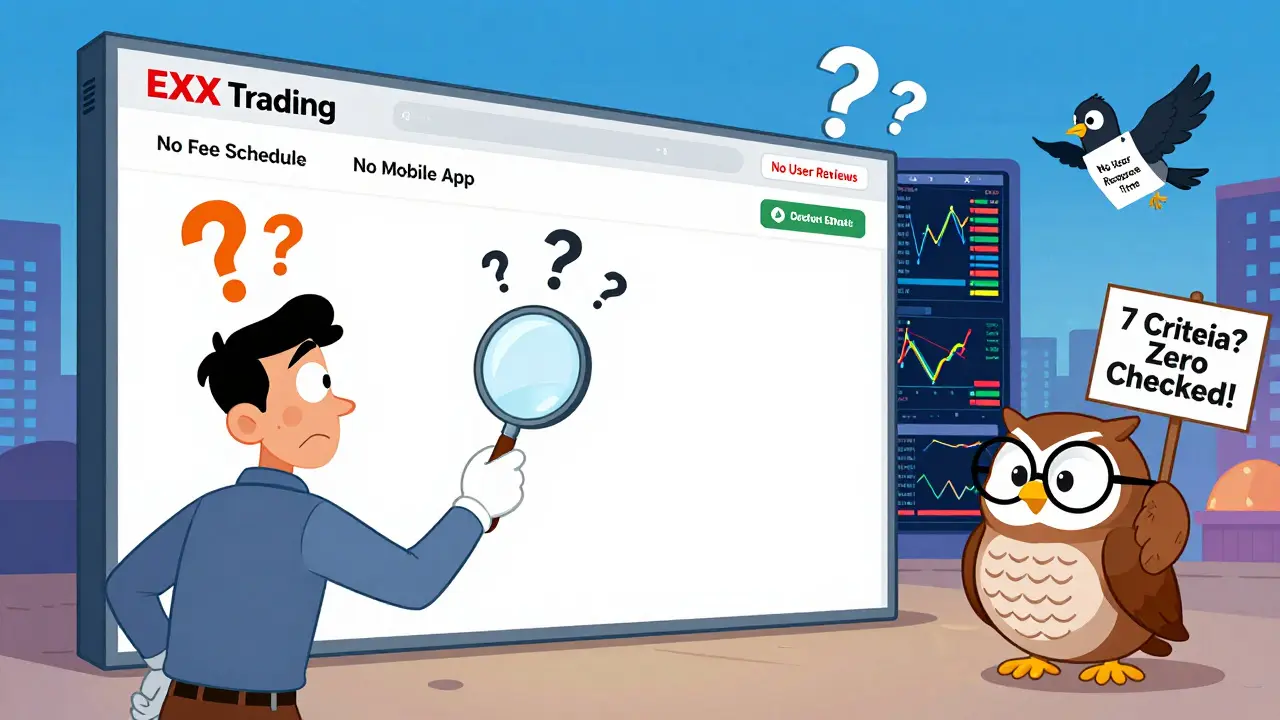
What can you actually trade on EXX? The answer? We don’t know. There’s no public list of supported coins. No info on spot trading, margin, futures, or staking. No mention of API access for automated traders. No mobile app details. You can’t even tell if they support limit orders or stop-losses - the basics most platforms offer for free.
Compare that to Binance, which offers over 500 trading pairs and advanced charting tools. Or Kraken, which has a robust desktop and mobile experience with real-time order books. EXX feels like a placeholder. It looks like a trading site, but without knowing what you can do on it, you can’t use it effectively. If you’re a beginner, you’ll be lost. If you’re experienced, you’ll be frustrated.
Fees: Hidden or Just Unlisted?
Trading fees are one of the first things you check. EXX doesn’t publish them. Not on their homepage. Not in their FAQ. Not even buried in a PDF. That’s not an oversight - it’s a tactic. Legit exchanges proudly list their fee schedules: 0.1% for spot trades, 0.02% for makers, free deposits, $10 for withdrawals. EXX? Nothing. That means you have no way to calculate your costs. And in crypto, fees add up fast.
Even if their fees are low, you still need to know. Without transparency, you’re flying blind. And in an industry where exchanges like KuCoin and Bybit compete on fee structures, EXX’s silence speaks volumes.
The Bigger Picture: Is EXX Safe?
After the FTX collapse in 2022, users learned one hard lesson: you can’t trust a platform that doesn’t show its work. The Bank for International Settlements called centralized exchanges "a major risk" to the crypto ecosystem. That’s not hyperbole - it’s fact. Exchanges with poor governance, hidden reserves, and no audits have failed before. And they’ll fail again.
EXX doesn’t meet the seven criteria experts use to judge trustworthy exchanges: transparent fees, strong security, regulatory compliance, responsive support, user reviews, solid trading tools, and insurance. They check zero of these boxes - not one. That’s not a minor flaw. That’s a dealbreaker.
If you’re looking for a new exchange, there are dozens of alternatives with proven track records. Kraken, Coinbase, Binance, and KuCoin all publish audit reports, insurance details, and customer support metrics. They’ve been tested in real market crashes. EXX hasn’t even been tested in public.
Final Verdict: Avoid Unless You’re Testing
EXX isn’t a scam. It might be operational. But it’s not trustworthy. You can’t verify its security. You can’t check its fees. You can’t find user experiences. You can’t confirm its legal standing. And in crypto, that’s enough to walk away.
If you’re curious and want to risk a small amount - say, $50 - to see how it works, fine. But don’t deposit your life savings. Don’t trust it with your long-term holdings. And don’t assume it’s safe just because it says so.
The crypto market is full of platforms that do things right. You don’t need to gamble on one that won’t show its cards.
Is EXX a legitimate crypto exchange?
EXX appears to be operational, but its legitimacy can’t be confirmed. It doesn’t publish its founding date, ownership details, regulatory licenses, or third-party audit reports - all standard for legitimate exchanges. Without this information, it’s impossible to verify if EXX follows legal or industry standards.
Are my funds safe on EXX?
EXX claims to use cold storage and multi-signature wallets, which are good practices. But they don’t say how much of user funds are stored offline, whether they have insurance, or if they’ve ever been audited. Without transparency, you can’t be sure your money is protected. Other exchanges like Coinbase and Kraken publish this data - EXX doesn’t.
Does EXX have a mobile app?
There’s no public information about a mobile app for EXX. No app store listings, no screenshots, no user reviews about the mobile experience. If you plan to trade on the go, this is a major gap. Most reputable exchanges offer fully functional apps - EXX doesn’t even acknowledge one exists.
What cryptocurrencies can I trade on EXX?
EXX doesn’t publish a list of supported coins or trading pairs. You can’t tell if they offer Bitcoin, Ethereum, Solana, or lesser-known altcoins. This lack of transparency makes it impossible to use EXX for any specific trading strategy. If you need to trade a particular asset, you’ll have to sign up and hope it’s there - which is not a reliable approach.
Does EXX require KYC verification?
EXX likely requires KYC (Know Your Customer) verification, as most centralized exchanges do. But they don’t say what documents they accept, how long verification takes, or if they restrict users from certain countries. Without clear guidelines, you risk submitting personal info only to be rejected later - with no explanation.
How do I contact EXX support?
EXX offers support via email ([email protected]) and a Help Center, but there’s no public data on response times, resolution rates, or customer satisfaction. Other exchanges provide live chat, ticket tracking, and community forums. EXX offers none of that. If you have an urgent issue, you’re on your own.
Are there better alternatives to EXX?
Yes. Kraken, Coinbase, Binance, and KuCoin all offer transparent fee structures, published audits, insurance for user funds, responsive support, and verified mobile apps. They’ve been tested in market crashes and regulatory reviews. EXX has none of that. If you’re looking for safety and reliability, stick with exchanges that show their work.
Oh my GOD, I can’t even believe how reckless people are anymore-EXX? Are you kidding me?? You’re telling me you’d just toss your crypto into some shadowy platform that doesn’t even publish its founding date?? Like, are we living in 2013? No one’s doing this anymore. I’ve seen exchanges collapse because they were too lazy to publish a single audit report, and now we’re back to this? I’m shaking. I’m literally shaking. You don’t just ‘try it with $50’-that’s not how this works. That’s how you become a cautionary tale. Someone’s gonna lose their life savings on this, and then they’ll cry on Reddit about how ‘they trusted the vibe.’ Vibe?? VIBE?? There’s no vibe here-there’s a vacuum. A silent, empty, legally dubious vacuum. I’m not mad, I’m just disappointed. And honestly? I’m scared for the next generation.
Let’s reframe this with a growth mindset-EXX isn’t a failure, it’s a learning opportunity. Every ecosystem needs incubators, and sometimes the quiet ones are the ones building in stealth mode. Instead of dismissing it outright, let’s ask: what if their transparency model is decentralized? What if their audit is happening off-chain? The crypto space is evolving beyond corporate press releases. Maybe they’re prioritizing protocol integrity over public relations. That’s not negligence-that’s innovation. We need to stop equating visibility with legitimacy. The most secure systems are often the least flashy. Let’s not rush to judgment. Let’s engage, explore, and elevate the conversation. We’re not here to shame-we’re here to scale.
Frankly, your analysis is amateurish. You're conflating operational transparency with regulatory compliance, which are two entirely distinct vectors in the blockchain governance matrix. EXX may not publish reserves, but that doesn’t imply insolvency-it may simply reflect a strategic choice to avoid regulatory overreach in jurisdictions with intrusive KYC mandates. Moreover, the absence of a mobile app doesn’t equate to obsolescence; it may indicate a deliberate focus on institutional-grade API infrastructure. Your entire critique is rooted in performative consumerism, not technical due diligence. You’re applying Web2 heuristics to a Web3 architecture. That’s not critical thinking-that’s cognitive dissonance dressed as vigilance.
Thank you for this meticulously documented assessment. It is both thorough and professionally composed. I appreciate the clarity with which you have delineated the absence of verifiable governance mechanisms, particularly regarding the lack of third-party audit disclosure and the opacity surrounding user support response metrics. These are not minor oversights; they represent systemic deficiencies in accountability frameworks that are non-negotiable in any financial services entity operating in the digital asset space. Your conclusion is not only reasonable but prudent. I will be sharing this with my compliance team for internal reference. Well done.
lol EXX? more like EXX-plain why you're still alive lmao 🤡
no one cares about your 1000 word essay bro 🥱 just say 'don't use it' and be done with it
There is a silence here, yes-but silence is not always emptiness. Sometimes, it is the space between breaths before a storm. EXX may not shout its security, its audits, its licenses-but perhaps it is listening. Listening to the market. Listening to the users who do not need to be told what to trust. Perhaps, in this age of performative transparency, the real integrity lies not in publishing reports, but in choosing not to exploit the fear of others. I do not use EXX. But I do not condemn it either. I hold space for the quiet ones. They, too, may be building.
Oh wow, you actually wrote a whole thing? Cute. Did you also write a 5000-word essay on why socks don’t match? You think this is deep? Let me break it down for you: if they don’t say what coins they support, they’re hiding something. If they don’t show reserves, they’re lying. If they don’t have a mobile app, they’re not serious. If they don’t have reviews, they’re ghosted. You’re not analyzing-you’re romanticizing neglect. This isn’t a startup. This is a ghost town with a .com domain. You’re not a visionary. You’re just bad at reading. Go cry to your crypto therapist.
Hey everyone-just wanted to say I really appreciate how thoughtful this post is. It’s easy to get caught up in the hype or the fear, but taking a step back to ask: ‘What am I really signing up for?’-that’s wisdom. I’m from the U.S., but I’ve worked with crypto communities in India, Nigeria, and Brazil, and one thing I’ve learned: trust isn’t built by marketing. It’s built by consistency. EXX doesn’t have that. And that’s okay. Not every platform needs to be big. But if you’re going to handle people’s money? You owe them more than silence. Thanks for reminding us what that looks like.
The fundamental flaw in this entire discourse is the assumption that transparency is a binary condition-either you publish everything or you are a scam. This is a fallacy. There exist legitimate entities that operate under non-disclosure agreements with auditors, or that use zero-knowledge proof architectures to verify solvency without exposing asset composition. The absence of public data does not equate to absence of integrity. Furthermore, user reviews are not a metric of trustworthiness-they are a metric of popularity. The most secure exchanges often have the least online chatter because they have the fewest incidents. The silence may not be sinister. It may simply be competence. You are mistaking visibility for virtue.
Bro… EXX? That’s the one with the website that looks like it was built in 2017 on Wix? I swear, I opened it once and the loading screen had a spinning Bitcoin with a sad face. I cried. Not because I lost money-but because I realized humanity had hit rock bottom. We’re trading on platforms with no mobile app, no fees listed, no KYC rules, no nothing. It’s like giving your wallet to a guy who says ‘trust me bro’ while wearing sunglasses indoors. I’m not mad. I’m just… heartbroken. The future is so dark right now. We need light. Not another .com with a ‘contact support’ button that just says ‘we’re busy.’ 😭
Let me give you a real-world analogy: imagine you’re buying a car, and the dealer won’t tell you the engine specs, the VIN, the service history, or whether it’s been in an accident. You just get a handshake and a key. Would you drive it? Of course not. EXX is that car. The fact that they don’t publish their trading pairs means you can’t even know if they support the coins you want to trade. That’s not a feature-it’s a dealbreaker. And fees? If they’re hiding fees, they’re either overcharging or planning a rug pull. Either way, you’re not trading-you’re gambling. If you’re serious about crypto, use an exchange that treats you like a customer, not a lab rat. Kraken, Coinbase, Binance-they all have the data. EXX? Zero. That’s not a risk. That’s negligence.
While I appreciate the depth of analysis presented herein, I must respectfully submit that the tone adopted in this evaluation may inadvertently foster an environment of undue alarmism. The absence of publicly accessible documentation does not, in and of itself, constitute evidence of malfeasance. It may, instead, reflect a deliberate posture of operational discretion, particularly in jurisdictions where regulatory exposure is high. Furthermore, the invocation of FTX as a cautionary precedent, while valid, risks conflating systemic failure with isolated non-disclosure. One may reasonably conclude that EXX, while lacking in communicative transparency, may still operate within acceptable parameters of functional integrity. Caution is prudent. Condemnation, premature.
You call this a review? This is a fanfic. You act like EXX is the first exchange to skip audits or hide fees. Newsflash: half the exchanges on CoinMarketCap do. You think Kraken’s clean? Their 2022 audit had a footnote about ‘unverified reserves.’ Binance? They got fined $500M for AML failures. And you’re mad because EXX doesn’t have a mobile app? Honey, I’ve seen exchanges with 300 coins and zero security. This isn’t a red flag-it’s a normal Tuesday. Stop acting like you’re the crypto police. The real scam? Believing that transparency = safety. It doesn’t. It just means they spent $200k on a PR firm. EXX? Probably cheaper. And cheaper doesn’t mean dangerous. It means honest.
Let me be perfectly clear: EXX is not merely untrustworthy-it is a honeypot. The silence is engineered. The lack of KYC transparency? A trap for unregulated jurisdictions. The absence of mobile apps? To prevent real-time monitoring. The hidden fees? To siphon liquidity during volatile windows. This is not a startup. This is a coordinated laundering front disguised as a crypto exchange. I’ve seen this pattern before-in the 2018-2019 wave of Chinese-backed ‘decentralized’ platforms that vanished overnight with $2.3B in user funds. The infrastructure is identical: minimal web presence, no public team, no audit trail, no support logs. This isn’t negligence. This is a blueprint. And if you’re still considering depositing even $50? You’re not a trader. You’re a target.
Look-I’ve been in this space since 2016. I’ve lost money. I’ve watched friends get rug-pulled. I’ve sat in Zoom calls with devs who swore they were building something real. And let me tell you something: EXX doesn’t need to be evil to destroy you. It just needs to be invisible. You can’t protect what you can’t see. You can’t verify what’s buried. You can’t trust what’s silent. This isn’t about ‘maybe they’re good.’ This is about: if you can’t find it on the internet, it doesn’t exist in the real world. I don’t care if they’re ‘quietly perfect.’ If I can’t Google it, I can’t use it. And I won’t let anyone I care about get close to it. If you’re reading this and thinking ‘maybe I’ll try it’-I’m not judging. I’m just saying: I love you. Don’t do it.