You remember the old electronics store with the green and yellow logo? The one that sold batteries and walkie-talkies for decades? That brand name has a second life now. It’s not selling hardware anymore. Instead, it operates as a cryptocurrency swap platform called RadioShack Swap, which is a decentralized exchange (DEX) focused on low-fee token swaps across multiple blockchains including Binance Smart Chain (BSC). But here is the big question you need to answer before you connect your wallet: Is this a legitimate trading tool, or is it just a nostalgic gimmick with thin liquidity?
If you are looking at the RADIO token on BSC today, you need to understand exactly what you are buying into. This isn’t Coinbase or Binance. It’s a niche protocol built on a specific technical architecture. Let’s break down how it works, where the money goes, and whether it actually saves you fees compared to Uniswap or PancakeSwap.
The Core Concept: What Is RadioShack Swap?
RadioShack Swap launched around 2022. The company behind it decided to pivot from retro apparel sales to digital assets. They positioned themselves as a solution to a very real problem in the decentralized finance (DeFi) world: liquidity fragmentation.
In most Automated Market Makers (AMMs), like the ones powering Uniswap, liquidity is scattered. If you want to swap Token A for Token B, there might be five different pools doing it. This splits the depth of the market. Slippage goes up. Fees go up. RadioShack claims their architecture fixes this.
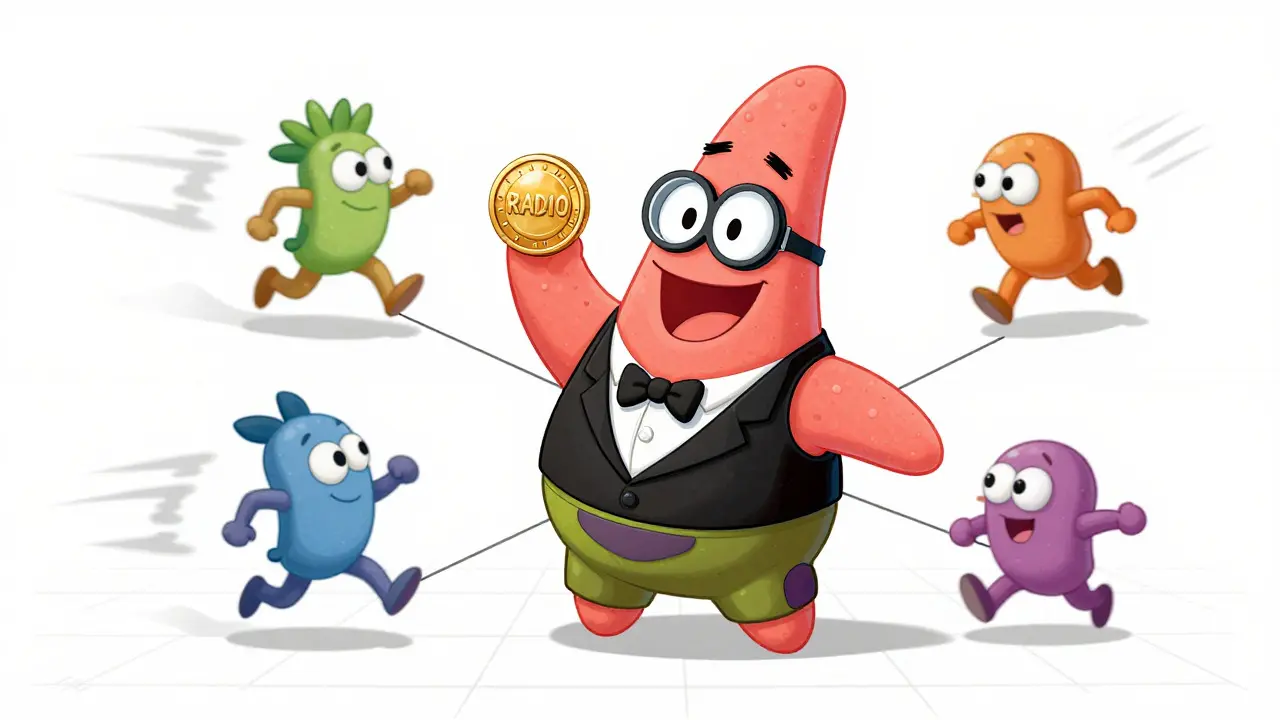
They call it "The Starfish Topology." Instead of creating a new pool for every possible pair of tokens, they use a central hub node-the RADIO token. Every swappable asset pairs directly with RADIO. Think of it like a wheel. RADIO is the hub. All other tokens are spokes. You swap your USDC for RADIO, then RADIO for your target token. Theoretically, this concentrates all liquidity into fewer, deeper pools. In practice, it means the success of the entire platform hinges entirely on the stability and volume of the RADIO token itself.
Technical Architecture: How Starfish Topology Works
To understand if this exchange is worth your time, you have to look under the hood. Most DEXs use a graph structure where any token can pair with any other token. As more tokens launch, the graph gets messy. Liquidity providers (LPs) get confused about where to put their money.
Starfish Topology is a centralized liquidity model that routes all trades through a single base asset to reduce graph complexity and increase pool depth. By forcing all pairs to connect to RADIO, the protocol reduces the number of active pools. This should make price discovery cleaner. It also simplifies the experience for LPs because they only need to provide liquidity against one major asset.
However, there is a catch. If the RADIO token crashes, every other pair on the platform suffers volatility. The hub becomes a single point of failure for price stability. On Binance Smart Chain (BSC), this topology is particularly relevant because gas fees are low, but competition from PancakeSwap is fierce. Does Starfish Topology offer enough efficiency to beat the established giants? The data suggests it is still trying to prove that point.
Trading on BSC: Volume and Liquidity Reality Check
Let’s talk numbers. When RadioShack first launched, they reported daily volumes between $500,000 and $2 million. By May 2022, they had processed nearly $40 million total. Those were impressive stats for a rebranded legacy company entering DeFi cold.
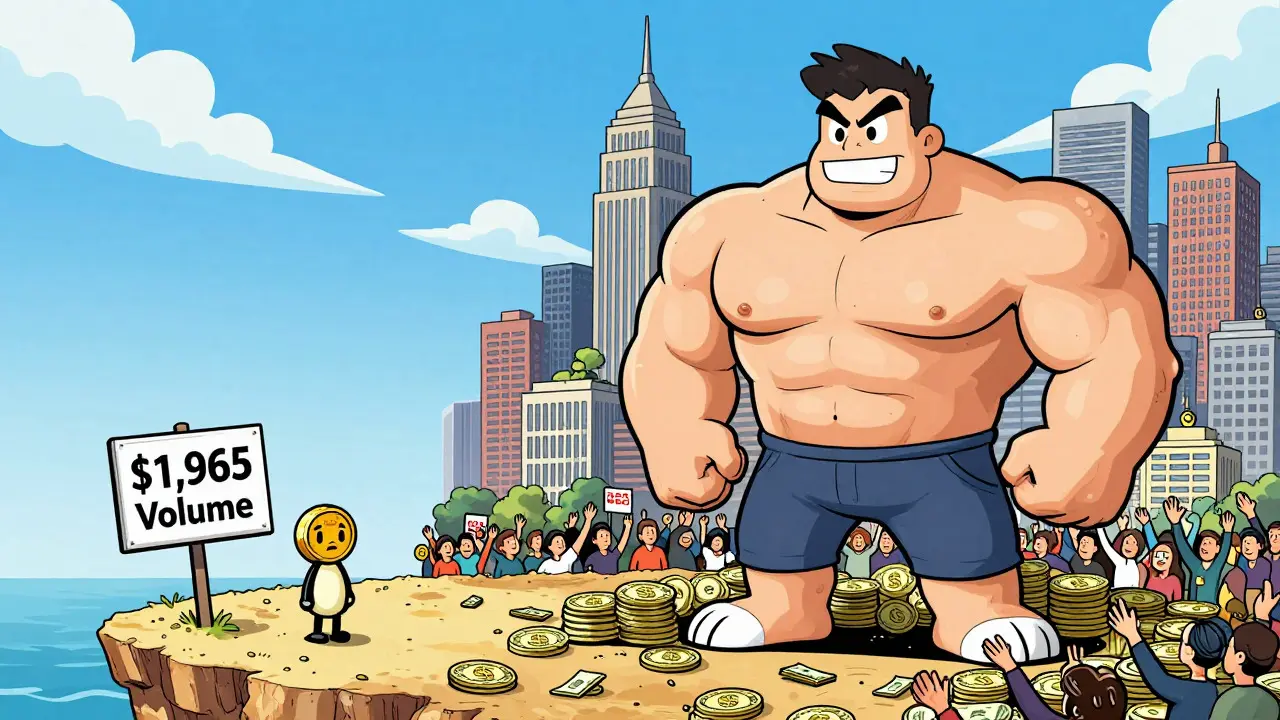
Fast forward to 2026. The landscape has changed dramatically. The RADIO token currently trades at approximately $0.0002388 USD. Its 24-hour trading volume sits around $1,965. On CoinMarketCap, it ranks #4993. To put that in perspective, top-tier altcoins move billions. Mid-tier projects move millions. RadioShack is moving thousands.
On BSC specifically, the RADIO/WBNB pair is the most active. It accounts for roughly 46% of the platform's total volume. Other pairs like RADIO/BUILD--2 and RADIO/BUSD--3 see minimal activity, often under $1,000 per day. This tells us something important: the user base has shrunk significantly since the 2022 hype cycle. Most traders have moved back to larger exchanges with deeper liquidity.
| Metric | Value / Status | Implication for Traders |
|---|---|---|
| Token Price (RADIO) | $0.0002388 | Extremely low unit price; high volatility risk |
| 24h Volume | ~$1,965 | Very thin liquidity; large trades will cause slippage |
| Primary Chain | Binance Smart Chain (BSC) | Low gas fees, but high competition from PancakeSwap |
| CoinMarketCap Rank | #4993 | Niche project; limited mainstream adoption |
| Architecture | Starfish Topology | Centralized liquidity via RADIO token |
Fees and Costs: Are You Actually Saving Money?
The main selling point of RadioShack Swap was always lower fees. They advertised competitive rates compared to Ethereum-based DEXs. On BSC, transaction costs are already negligible-often less than $0.10 per trade. So, saving on gas doesn't help much.
The real cost in DeFi is slippage and spread. Because RadioShack’s liquidity is thin, you pay with price impact. If you try to swap $100 worth of RADIO for WBNB, you might get less than expected because the pool is shallow. The "low fee" promise falls apart when the spread is wide.
Compare this to PancakeSwap. PancakeSwap has massive liquidity on BSC. Their fees are standard, but the depth of the market ensures you get closer to the actual market price. For small trades, RadioShack might be fine. For anything substantial, the lack of volume makes it inefficient.
Security and Trust: The Legacy Brand Factor
One advantage RadioShack has over random meme-token DEXs is brand recognition. People know the name. It feels safer than a protocol named after a cat. But does that mean it is secure?
There is little public information about recent security audits. In the early days, the team emphasized their innovative topology, but they did not publish extensive third-party audit reports comparable to those from CertiK or Trail of Bits. In DeFi, code is law. If there is a bug in the Starfish Topology smart contracts, users lose funds. Without transparent, up-to-date audit records, you are taking a calculated risk.
Additionally, the multi-chain deployment (Ethereum, Polygon, Avalanche, BSC) increases the attack surface. Each chain requires separate contract deployments and maintenance. Any lag in updating contracts on one chain could leave a vulnerability open.
Who Should Use RadioShack Swap?
This platform is not for everyone. Here is who fits the profile:
- RADIO Token Holders: If you already own RADIO, using the native swap gives you utility and potentially fee discounts (if applicable).
- Small-Scale Traders: If you are swapping tiny amounts ($10-$50) and don’t mind checking multiple platforms for the best rate.
- Curious Experimenters: Users interested in testing alternative AMM architectures like Starfish Topology without risking significant capital.
Who should avoid it?
- Large Traders: The liquidity is too thin. You will suffer heavy slippage.
- Mainstream Investors: Stick to PancakeSwap, Uniswap, or centralized exchanges for better support and depth.
- Security Purists: If you require audited, battle-tested protocols with years of uptime, this may not meet your criteria.
Alternatives to Consider on BSC
If RadioShack’s volume doesn’t excite you, where else can you go on Binance Smart Chain?
PancakeSwap is the leading decentralized exchange on BSC, offering deep liquidity, yield farming, and NFT markets. It is the default choice for a reason. High volume, reliable interface, and strong community governance.
BiSwap is a newer competitor on BSC focusing on lower swap fees and higher rewards for liquidity providers. If you are chasing lower fees, BiSwap is a more viable alternative than RadioShack today.
ApeSwap is another established DEX on BSC with a focus on cross-chain compatibility and unique tokenomics. It offers a solid middle ground between size and innovation.
Final Verdict: Niche Tool, Not Mainstream Solution
RadioShack Swap is an interesting experiment in applying legacy branding to modern DeFi architecture. The Starfish Topology is clever in theory, concentrating liquidity to simplify the trader’s path. However, execution matters more than theory. With daily volumes hovering under $2,000 and a token ranking near #5000, the platform lacks the critical mass needed to compete effectively.
If you hold RADIO tokens, it serves its purpose. If you are looking for a primary exchange on BSC, look elsewhere. The nostalgia factor doesn’t protect your portfolio from slippage.
Is RadioShack Swap safe to use?
Safety in DeFi depends on smart contract audits. While RadioShack uses a known brand name, recent comprehensive security audit reports are not widely publicized. Always verify contract addresses yourself and start with small amounts to test reliability.
What is the Starfish Topology?
Starfish Topology is a liquidity model where all token pairs connect to a single central asset (RADIO). This reduces the number of pools needed and theoretically increases liquidity depth for each pair, but it creates dependency on the stability of the RADIO token.
Can I buy RADIO token on Binance?
As of current data, RADIO is primarily traded on decentralized exchanges like RadioShack Swap and potentially smaller venues on BSC and Ethereum. It is not listed on major centralized exchanges like Binance or Coinbase. Check CoinMarketCap for the latest available trading pairs.
Why is the trading volume so low?
The crypto market consolidates around platforms with the deepest liquidity. Competitors like PancakeSwap offer better price execution for most users. RadioShack’s niche architecture and lower marketing presence have led to reduced user activity since its 2022 launch.
Does RadioShack Swap charge hidden fees?
Like most DEXs, fees are transparent in the smart contract. However, low liquidity can result in high slippage, which acts as a hidden cost. Always check the estimated output before confirming a swap to ensure you are getting a fair rate.
oh the irony of a legacy brand pivoting to crypto is just too rich for words. it’s like watching a dinosaur try to do parkour. 🦖💸
Hey everyone! 👋 Just wanted to say that while RadioShack might not be the main event, it’s always cool to see old brands trying new things. Keep exploring! ✨
Look, i get the nostalgia but lets keep it real here. the slippage on this thing is gonna eat you alive if you trade more than lunch money. stick to pancake unless you wanna lose your shirt. trust me on this one folks.
The Starfish Topology is fundamentally flawed; liquidity fragmentation remains an issue despite centralized routing via RADIO token. Volatility risk is exponential. Avoid.
i mean its kinda cool they tried tho. dont really care about the tech stuff but hey maybe someone will find use for it. no big deal either way imo.
Oh wow, another dead DEX pretending to be relevant? 😂📉 Classic move. The volume is so low my cat could generate more trades by walking on the keyboard. Truly inspiring work from the team there. 🙄
it seems like many are quick to dismiss without understanding the underlying mechanics. perhaps we should consider the educational value rather than just profit potential. silence often speaks louder than noise in these markets.
yo this post was super helpful thanks for breaking it down. i was thinking about buying some radio tokens but now im pretty sure ill just stick to bnb. good info guys!
why does everyone hate on small caps? you people have no vision. i lost money on this last year and its all because of you haters spreading FUD. my portfolio is ruined because of comments like yours.
This is typical American greed! We should support our local hardware stores instead of betting on digital air! The system is rigged against the little guy! Wake up sheeple!!!
Hey friend, don't let the negativity get you down. Every project has its ups and downs. Stay positive and keep learning about blockchain technology. You got this! 💪
It's disgusting how much money people waste on these useless tokens. If you cared about the planet or even basic financial literacy, you wouldn't touch this trash. Shame on all of you.
Absolutely dreadful analysis if you ask me. They clearly didn't dig deep enough into the audit failures. It’s lazy journalism at its finest, ignoring the glaring security holes that every decent investor would spot immediately.
I’ve been tracking similar AMM architectures since 2021. The hub-and-spoke model reduces graph complexity but introduces single-point-of-failure risks. Fascinating technical trade-off, though execution here seems lacking compared to early iterations.
its obvious this is part of a larger scheme to consolidate control over decentralized finance under corporate banners. the starfish topology is just a front for surveillance capitalism. wake up.
Boring. 😑
There is something poetic about a store that once sold walkie-talkies now facilitating silent digital swaps. It reflects the shift from tangible communication to abstract value transfer. A curious evolution indeed.
Hey folks! Let's give credit where it's due. Innovation takes courage, even if it fails. RadioShack tried something different. That deserves respect in our global community! 🌍✨
just wondering if anyone else noticed the typo in the article about 'sequestial' timestamps lol. other than that seems okay i guess. hope it helps someone out there.
You make a compelling point regarding liquidity depth. However, one must also consider the psychological impact of brand recognition on user retention. It is a nuanced balance between technical merit and marketing appeal.
namaste friends 🙏 just observing from india. the fees are low which is nice for us here. maybe it works for small amounts? who knows :)
the moral decay of society is evident when we celebrate failed retail giants turning into speculative casinos. yet here we are discussing slippage as if it matters. truly absurd times we live in.
everyone says its bad but what if its actually a hidden gem? contrarian view alert: maybe the low volume means less competition for whales. think outside the box people.
My dear simpletons, you fail to grasp the aesthetic brilliance of the Starfish Topology. It is not merely code; it is art. The liquidity flows like poetry through the veins of RADIO. You lack the cultural refinement to appreciate such nuance. 🎭