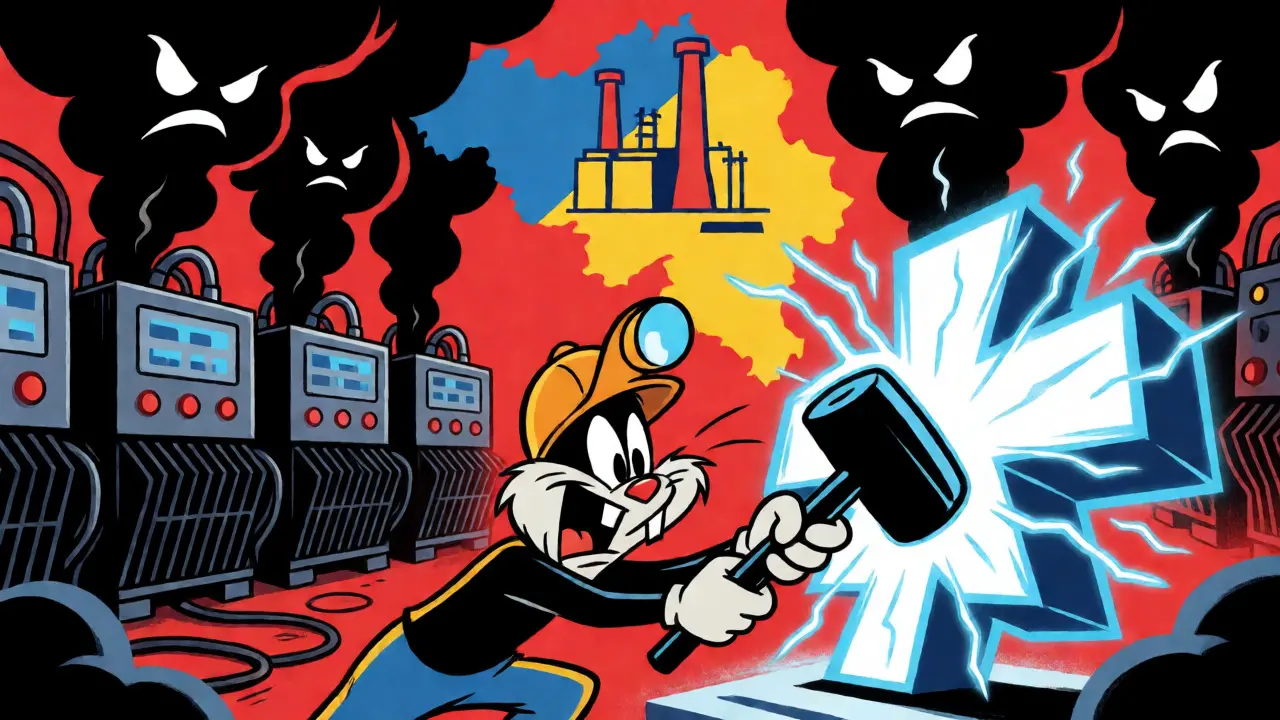
Imagine running a network that consumes as much electricity as the entire country of Belgium. That was Bitcoin’s reality for years, driven by its Proof of Work consensus mechanism. Now, imagine shrinking that footprint to match just a few thousand homes. This isn’t science fiction; it’s what happened when Ethereum switched to Proof of Stake. If you’re wondering why this matters beyond environmental headlines, think about cost, speed, and long-term viability. Energy consumption in blockchain isn’t just an eco-issue-it’s a fundamental design constraint that dictates how scalable and accessible a network can be.
The Core Problem: Why Consensus Burns Energy
At its heart, a blockchain consensus mechanism is an algorithm that allows distributed nodes to agree on the state of the ledger without a central authority. The challenge is preventing double-spending and ensuring honesty in a trustless environment. Early solutions like Proof of Work solved this by making it expensive to lie. Miners spend real-world resources-electricity and hardware-to solve cryptographic puzzles. The winner gets to add the next block and earns rewards. This "cost" creates security because attacking the network would require massive financial investment. But that security comes at a steep price: continuous, high-intensity energy usage.
As networks grew, so did the competition. Mining difficulty increased, forcing miners to upgrade to more powerful ASICs (Application-Specific Integrated Circuits) and consume more power. This arms race created a system where security was directly tied to energy expenditure. For a while, this worked. But as blockchain expanded into finance, supply chain, and identity, the environmental and economic costs became untenable for many use cases. Enter alternatives designed to decouple security from raw computational power.
Proof of Work: The Heavyweight Champion
Bitcoin remains the gold standard for decentralized security, but its energy profile is heavy. Estimates consistently place Bitcoin’s annual consumption in the range of 100-150 terawatt-hours, comparable to medium-sized nations. The mechanism relies on SHA-256 hashing algorithms, requiring miners to guess nonces until they find a hash below a target threshold. This brute-force approach means most of the energy spent is essentially "wasted" heat.
| Mechanism | Primary Example | Relative Energy Use | Security Model |
|---|---|---|---|
| Proof of Work (PoW) | Bitcoin | Extremely High (1x baseline) | Computational Cost |
| Proof of Stake (PoS) | Ethereum (post-Merge) | Very Low (~0.01% of PoW) | Economic Stake |
| Delegated Proof of Stake (DPoS) | Tron | Low | Voted Delegates |
| Proof of History (PoH) | Solana | Low-Moderate | Cryptographic Clock |
While PoW is robust, it faces criticism for its carbon footprint. Critics argue that burning fossil fuels to secure digital transactions is inefficient. However, proponents point out that mining often utilizes stranded renewable energy sources, such as excess hydroelectric power in regions like Sichuan or Texas wind farms. Despite these mitigations, the sheer scale of PoW’s energy demand remains its biggest hurdle for mass adoption in environmentally conscious markets.

Proof of Stake: The Efficient Alternative
Proof of Stake changes the game by replacing physical work with financial commitment. Instead of miners solving puzzles, validators lock up (stake) their tokens. The protocol randomly selects a validator to propose the next block, weighted by their stake size. If they act dishonestly, they lose part of their stake-a penalty known as slashing. This economic disincentive replaces the need for energy-intensive computation.
The impact is dramatic. When Ethereum completed "The Merge" in 2022, its energy consumption dropped by approximately 99.95%. Suddenly, a network that consumed as much as a small country required less power than a few thousand households. This shift didn’t just help the planet; it lowered barriers to entry. You don’t need a warehouse full of GPUs to participate; you just need capital. This democratizes validation, allowing individuals with smaller holdings to join staking pools and earn rewards.
However, PoS isn’t perfect. It introduces new risks, such as the "nothing at stake" problem, where validators might sign multiple conflicting blocks since there’s no computational cost to do so. Slashing penalties mitigate this, but critics worry about wealth concentration. Those with the most tokens have the highest chance of validating blocks, potentially leading to oligarchies if not properly managed through governance and decentralization efforts.
Beyond PoW and PoS: Innovative Approaches
The industry hasn’t stopped at binary choices. Newer mechanisms aim to balance speed, security, and efficiency even further. Take Proof of History used by Solana, which isn’t strictly a consensus mechanism but a cryptographic clock that timestamps events. By creating a verifiable historical record, Solana reduces the communication overhead between nodes, allowing for faster finality with lower energy demands compared to traditional PoS systems that rely heavily on message passing.
Another notable example is Hedera Hashgraph, which uses a gossip-about-gossip protocol and virtual voting. Unlike linear blockchains, Hedera’s DAG (Directed Acyclic Graph) structure allows for parallel processing. Its consensus mechanism achieves finality in seconds with negligible energy per transaction. Similarly, Delegated Proof of Stake, used by chains like Tron and EOS, lets token holders vote for a limited number of delegates to validate transactions. This reduces the number of active validators, significantly cutting down redundant computations and energy use, though it sacrifices some decentralization for speed.

Real-World Implications for Developers and Investors
Why should you care about energy metrics? First, operational costs. Networks with high energy demands often have higher transaction fees during congestion, as miners pass on electricity costs. Second, regulatory risk. Governments are increasingly scrutinizing crypto’s carbon footprint. The EU’s Markets in Crypto-Assets (MiCA) regulation includes transparency requirements regarding energy consumption. Projects using inefficient consensus mechanisms may face stricter compliance burdens or investor pushback.
For developers building dApps (decentralized applications), choosing a low-energy chain can expand your user base. Users in regions with unstable grids or high electricity prices prefer networks that don’t burden them with indirect environmental costs. Moreover, institutional investors are integrating ESG (Environmental, Social, and Governance) criteria into their portfolios. A blockchain’s energy profile is now a key metric in due diligence processes.
The Future: Hybrid Models and Sustainability
We’re seeing a trend toward hybrid models that combine elements of different mechanisms. Some networks use PoW for initial distribution and PoS for ongoing maintenance. Others incorporate sharding-splitting the network into smaller pieces-to reduce the load on individual nodes, thereby lowering energy needs per transaction. Quantum-resistant designs are also emerging, aiming to future-proof consensus against potential quantum computing threats without reverting to energy-heavy methods.
The trajectory is clear: energy efficiency is becoming a competitive advantage. As hardware improves and software optimizes, the gap between security and sustainability narrows. We’re moving away from the era where "secure" meant "expensive" and toward a model where efficient consensus enables broader adoption. Whether you’re a miner looking to pivot, a developer selecting a platform, or an investor assessing long-term value, understanding the energy dynamics of consensus mechanisms is no longer optional-it’s essential.
Is Proof of Stake always more energy-efficient than Proof of Work?
Generally, yes. Proof of Stake eliminates the need for intensive computational puzzle-solving, reducing energy consumption by over 99% compared to typical Proof of Work implementations like Bitcoin. However, specific implementations vary, and factors like network activity and node hardware efficiency play a role.
Does lower energy consumption mean lower security?
Not necessarily. Security models differ. Proof of Work secures the network through physical resource expenditure, while Proof of Stake secures it through economic incentives (staking and slashing). Both can be highly secure, but they protect against different types of attacks. PoS requires careful design to prevent wealth concentration issues.
How does Proof of History affect energy usage?
Proof of History is not a consensus mechanism itself but a component that works alongside others like Proof of Stake. It reduces the amount of data nodes need to communicate to reach agreement, indirectly lowering energy usage by improving throughput and reducing redundant verification steps.
Can Proof of Work become greener?
Yes, through renewable energy sourcing. Many mining operations are relocating to areas with abundant hydro, geothermal, or wind power. Additionally, newer ASIC hardware is becoming more energy-efficient. However, the fundamental design still requires significant energy input compared to non-PoW alternatives.
What is Delegated Proof of Stake?
DPoS is a variation of Proof of Stake where token holders vote for a small number of delegates to validate transactions. This reduces the number of nodes actively participating in consensus, lowering energy consumption and increasing speed, but at the cost of reduced decentralization compared to pure PoS.
It is honestly exhausting to see people still treating Proof of Work as some kind of sacred, unchangeable truth when the data clearly shows it's a relic. You're essentially burning Belgian-sized energy just to keep a ledger that could be maintained by a few thousand laptops. It’s not even about being 'green' anymore; it’s about basic engineering competence. Anyone who claims PoW is superior for scalability hasn't actually looked at the throughput numbers or the cost per transaction in a congested network. The elitism surrounding Bitcoin mining ignores the fact that we are solving problems with brute force instead of smart design. It feels like watching someone insist on using a steam engine because they love the noise, while electric cars exist. The 'security through waste' argument is intellectually lazy and economically unsustainable. We need to stop pretending that inefficiency equals robustness. If your security model requires a power plant, you haven't solved the problem; you've just monetized the solution poorly.
This is such a fantastic breakdown! 🌍 I really appreciate how you highlighted the democratization aspect of PoS. In Nigeria, where electricity can be unstable, the idea that validation doesn't require massive industrial hardware is incredibly empowering. It opens up participation to so many more people who might otherwise be priced out by infrastructure costs. We should definitely celebrate these shifts toward sustainability and accessibility. Keep up the great work spreading this knowledge! 💪
I think it's important to acknowledge both sides here though. While PoS is definitely more efficient, we shouldn't dismiss the battle-tested nature of PoW entirely. 😊 There's a certain peace of mind knowing that attacking the network requires physical resources that are hard to fake overnight. Maybe a hybrid approach is best? Or perhaps different chains for different needs? It doesn't have to be a zero-sum game. Let's try to find common ground rather than declaring one side dead. 🤝
but what about the centralization risk in pos if the big holders control the validators?? its kinda scary when u think about it... like are we just swapping plutocracy for tech-oligarchy?? i feel like we havent really solved the human element of trust just changed the currency we pay with...
You are all missing the deeper philosophical implication here. Consensus isn't just about speed or energy; it's about the ontology of value. Proof of Work anchors digital scarcity in thermodynamic reality. By moving to Proof of Stake, you are detaching value from physical law and tethering it purely to social consensus and capital accumulation. This creates a fragile epistemological framework where 'truth' is determined by wealth rather than effort. It’s a subtle but profound shift from an objective universe to a subjective one. Most people don't realize they are trading ontological stability for convenience. The 'efficiency' you praise is actually a form of spiritual decay in the digital realm. You’re optimizing for metrics while losing the soul of decentralization. It’s tragic, really, how blind most are to the metaphysical cost of their choices.
Great overview. One nuance worth adding is the role of liquid staking derivatives (LSDs) in PoS networks. They further lower barriers to entry but also introduce new systemic risks regarding liquidity mismatches. From a developer perspective, the choice often comes down to specific dApp requirements-high-frequency trading might still prefer PoW-like finality guarantees despite the cost, while NFT markets thrive on PoS efficiency. Regulatory clarity under MiCA will indeed become the deciding factor for institutional adoption over the next 2-3 years.
omg this is so stressful to read!! 😩 my head hurts thinking about all that wasted energy... it makes me want to cry for the polar bears. why do humans always choose the hardest way?? it feels like we are collectively self-sabotaging our future just to feel powerful. i just want everything to be easy and green and nice please!!! 🥺💔
We have a moral obligation to reject systems that prioritize profit over planetary survival! Every kilowatt-hour burned by miners is a theft from future generations. To defend PoW now is to defend greed dressed up as technology. We must demand ethical standards in every block produced. The time for excuses is over; the Earth is crying out for change, and those who ignore it are complicit in ecological destruction. Let us rise above our baser instincts and choose wisdom over waste!
Thank you for sharing this insightful analysis. It provides a balanced perspective on a complex topic. I particularly appreciated the section on real-world implications for developers, as it bridges the gap between technical specifications and practical application. Your explanation of ESG criteria integration is very timely and relevant for current market trends.
The discourse around consensus mechanisms often lacks sufficient granularity regarding the trade-offs inherent in distributed system architectures, specifically concerning Byzantine Fault Tolerance thresholds and latency finality profiles which directly impact user experience metrics. When evaluating Proof of Stake implementations, one must critically assess the potential for validator cartel formation and the economic incentives driving stake concentration, as these factors significantly influence the network's resilience against long-range attacks and its overall degree of permissionless participation. Furthermore, the environmental narrative frequently overlooks the embodied carbon footprint of hardware manufacturing versus operational energy consumption, creating a skewed perception of sustainability that fails to account for lifecycle assessments of ASICs versus standard server racks used in PoS environments. Consequently, the transition to low-energy protocols represents not merely an ecological imperative but a structural evolution in decentralized finance infrastructure that necessitates rigorous academic scrutiny and empirical validation beyond anecdotal evidence or superficial marketing claims.
nice info. simple language helps. good job explaining difference. 👍
I completely agree with the points made about regulatory pressure. It's refreshing to see a post that acknowledges the legitimate concerns about PoW without dismissing them entirely. We can respect the history of Bitcoin while still pushing for more sustainable solutions like Ethereum's merge. It's all about finding that balance between innovation and responsibility. Great discussion starter!
Your comparison table is misleading. Relative energy use ignores total network size and security budget. Comparing Bitcoin to Ethereum post-Merge is apples to oranges due to differing utility and market caps. Also, DPoS is not truly decentralized. Fix the bias.
THEY ARE HIDING THE TRUTH ABOUT POS CENTRALIZATION!!!! 😱😱😱 Its not free energy its just shifting the power to the whales!!! And who controls the whales??? THE ELITES!!! Wake up sheeple!!! They want us to think its green so we dont ask questions about who owns the stakes!!! ITS ALL A SCAM TO CONTROL THE LEDGER!!! 🤯🤯🤯
Interesting read. I'll take some time to digest the details on hybrid models.
Could you elaborate on the specific security assumptions required for Quantum-resistant designs mentioned in the conclusion? It would be beneficial to understand how these future-proofing strategies interact with current energy efficiency goals. Thank you.
I knew it! The push for PoS isn't just about saving trees, it's about consolidating power into fewer hands so they can manipulate the market easier. Why else would they rush the Merge? It smells fishy. The 'nothing at stake' problem is a feature, not a bug, for them because it allows rapid reorganization if needed by insiders. Don't let the eco-friendly branding fool you. 🕵️♀️🚨
This is such a valuable resource for anyone trying to navigate the blockchain landscape! Your clear explanation of the pros and cons empowers readers to make informed decisions based on their own values and project needs. I love how you included both the environmental and economic angles-it really highlights the multifaceted nature of this transition. Keep inspiring us with your thoughtful content! 🌟