You’ve probably seen the big names in crypto: Bitcoin, Ethereum, Solana. They dominate the headlines and the charts. But then there are projects like MintMe.com Coin, also known as MINTME, which operates on a completely different philosophy. Instead of chasing massive institutional investment or high-speed transaction throughput for DeFi giants, MINTME focuses on something simpler: letting anyone create their own digital currency using just a regular computer.
If you are wondering what this coin actually does, how it survives without expensive mining rigs, and whether it has any real value in 2026, you are in the right place. This isn’t just another speculative asset; it’s a niche experiment in egalitarian blockchain technology. Let’s break down exactly what MintMe.com Coin is, how its unique mining model works, and what you need to know before you consider buying or creating tokens on its platform.
The Origin Story: From Webchain to MintMe
To understand where MINTME is today, we have to look at where it started. The project was originally launched on May 8, 2018, under the name Webchain. At the time, the goal was ambitious: to create a blockchain that could be mined via websites and Internet-connected devices, rather than relying on specialized hardware.
Over time, the team realized that the name "Webchain" didn't fully capture the project's evolving purpose. It wasn't just about web mining; it was about empowering creators. So, they rebranded to MintMe.com Coin. This shift aligned the brand with the MintMe.com platform, a token-creation and crowdfunding exchange. The core idea remained the same, but the focus sharpened: MINTME is the native fuel for an ecosystem where users can launch their own "people coins," meme tokens, or AI agent currencies for free.
This rebranding highlights a key distinction. Unlike many altcoins that exist solely as store-of-value assets or speculative bets, MINTME serves a functional role. It secures the network and facilitates transactions on the MintMe.com exchange. If you want to trade a custom token created by your favorite artist or community leader on this platform, you interact with the MINTME economy.
How MintMe Mining Works: No ASICs Allowed
The most striking feature of MintMe.com Coin is its approach to security and mining. In the broader crypto world, Proof-of-Work (PoW) networks like Bitcoin have become dominated by Application-Specific Integrated Circuits (ASICs)-expensive, industrial-grade machines that consume vast amounts of electricity. This centralizes mining power in the hands of large farms, pushing out individual participants.
MINTME takes the opposite route. It uses a custom version of the Lyra2 hashing algorithm. Lyra2 is a memory-intensive algorithm designed to be efficient on Central Processing Units (CPUs) while being difficult to optimize for ASICs. The development team constantly revises the protocol parameters to maintain this balance. Why? To keep the network "egalitarian."
This means you don’t need to buy a $5,000 mining rig to participate. You can mine MINTME using:
- A standard desktop or laptop computer.
- Low-end servers.
- Internet of Things (IoT) devices.
- Even through websites that embed mining scripts to monetize traffic.
While the rewards per block might not make you rich overnight, the barrier to entry is incredibly low. For hobbyists, students, or developers who want to support the network without significant capital expenditure, this model offers a rare opportunity in the PoW space. It ensures that the security of the chain relies on a distributed base of everyday users rather than a few corporate entities.
Tokenomics: Supply and Scarcity
When evaluating any cryptocurrency, supply dynamics are crucial. How many coins exist? How many will ever exist? And what is currently circulating?
MintMe.com Coin has a hard cap on its maximum supply. Here is the breakdown based on recent market data:
| Attribute | Value |
|---|---|
| Maximum Supply | 564,000,000 MINTME |
| Circulating Supply | ~545,000,000 MINTME |
| Percentage Circulated | Approx. 96.8% |
| All-Time High (ATH) | $0.1064 USD |
Notice that nearly 97% of all MINTME coins are already in circulation. There are fewer than 20 million coins left to be mined or released. This scarcity factor is important. As new coins enter the market more slowly, the inflation rate drops significantly. If demand for the coin increases-whether from traders, miners, or creators launching tokens-the limited remaining supply could theoretically exert upward pressure on the price, assuming other market conditions remain stable.
However, price alone doesn't tell the whole story. As of mid-2026, MINTME trades at a fraction of its all-time high, often hovering around the $0.004 mark. This reflects its status as a small-cap asset with modest daily trading volume. It is not a volatile moonshot like some meme coins; it is a steady, low-volume utility token within its specific niche.
The MintMe Platform: Creating Your Own Coin
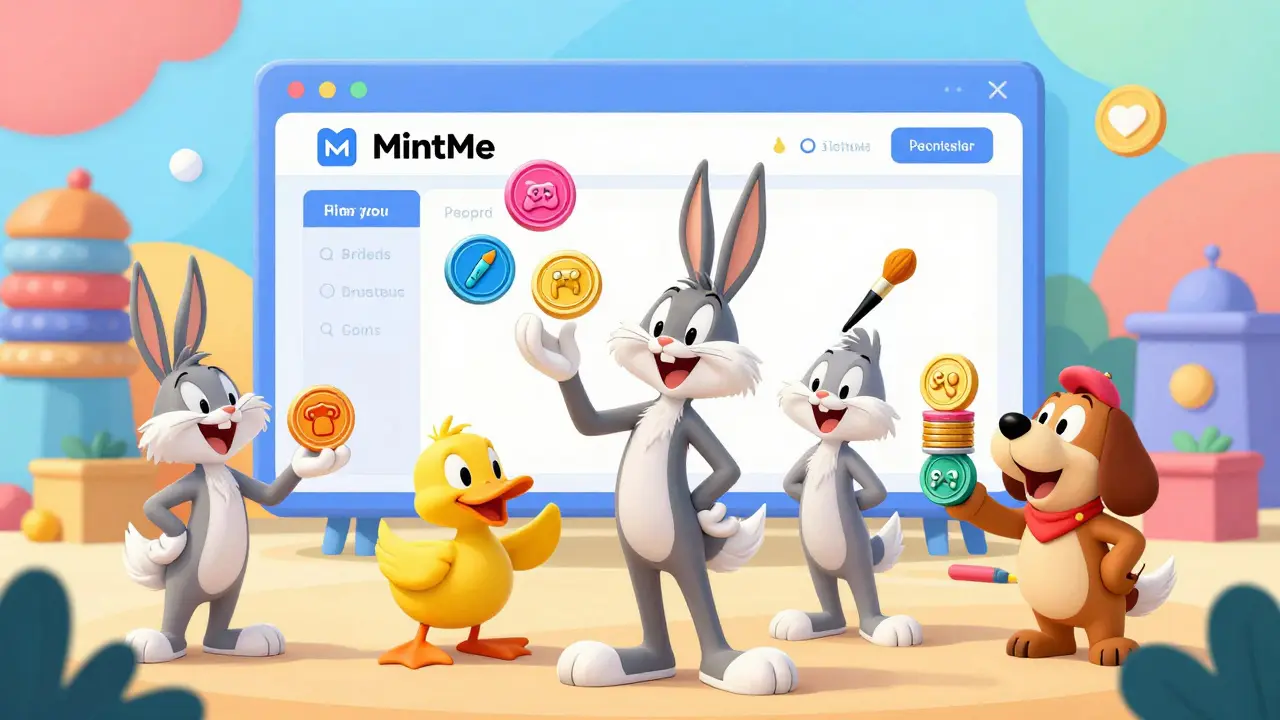
So, why would someone use MINTME? The primary utility lies in the MintMe.com platform itself. Think of it as a simplified storefront for digital assets. The platform allows users to create their own tokens-often called "people tokens"-without writing a single line of code.
Who is this for? Consider these scenarios:
- Content Creators: A YouTuber or streamer wants to reward loyal fans with a custom token that can be traded or used for exclusive access.
- Community Leaders: A local club or online forum creates a governance token to vote on decisions or fund events.
- Project Developers: An indie game developer launches a fundraising campaign by issuing a token that represents future revenue shares or in-game items.
The process is designed to be free and accessible. You don’t need to understand Solidity, Rust, or complex smart contract deployment. You simply use the web interface to define your token’s name, symbol, and supply. Once created, these tokens can be traded on the MintMe exchange.
Here is where MINTME comes into play again. It acts as the base currency for the exchange. Just as you might use USDT or ETH to trade other tokens on larger platforms, MINTME provides the liquidity layer for these smaller, community-driven assets. Additionally, the platform supports cross-chain trading, meaning tokens created on MintMe can potentially be bridged or listed on other blockchains, expanding their reach beyond the native network.
Buying and Storing MINTME
If you are interested in acquiring MINTME, either to hold, trade, or use on the platform, you have a few options. Because it is a smaller asset, you won’t find it on every major tier-1 exchange like Coinbase Pro or Kraken for direct fiat purchases. However, it is available through several routes.
Centralized Exchanges (CEX): The most active venue for trading MINTME is BitMart. Here, you can typically find the MINTME/USDT pair. The process is standard: create an account, complete identity verification (KYC), deposit funds, and execute a trade. Other exchanges may list it with lower liquidity, so checking volume before trading is wise to avoid slippage.
Decentralized Routes: Platforms like Binance offer guides on how to acquire MINTME using their Web3 Wallet. This involves connecting your wallet to decentralized exchanges (DEXs) that list the token. This method requires more technical know-how. You must verify the correct contract address to avoid scams, as fake tokens are common in the DeFi space.
Storage: Since MINTME runs on its own blockchain, you cannot store it in a standard Ethereum-compatible wallet like MetaMask unless the wallet supports multi-chain assets or specific plugins. You should use:
- The official MintMe wallet software.
- Hardware wallets that support custom chains (if compatible).
- Custodial wallets on exchanges like BitMart (though self-custody is always safer for long-term holds).
Risks and Realities
No investment is without risk, and MINTME is no exception. Before diving in, it is crucial to understand the limitations of this project.
Liquidity Constraints: With daily trading volumes often in the low hundreds of dollars, moving large amounts of MINTME can be difficult. If you try to sell a significant chunk of your holdings at once, you could drive the price down sharply. This makes it unsuitable for high-frequency trading or large-scale institutional investment.
Team Transparency: Unlike major projects with public founders and detailed roadmaps, the core team behind MintMe remains relatively anonymous. While the GitHub repository shows ongoing maintenance and updates to the Lyra2 algorithm, the lack of named leadership can be a red flag for some investors who prefer higher accountability.
Market Position: MINTME is a small-cap coin. It does not compete with Bitcoin or Ethereum in terms of market dominance or technological scalability. Its value is tied closely to the adoption of the MintMe.com platform. If the platform loses users or fails to attract new creators, the demand for MINTME could stagnate.
However, for those interested in the concept of CPU-minable cryptocurrencies or the creator economy, MINTME offers a unique case study. It proves that blockchains can still operate outside the ASIC-dominated norm, prioritizing accessibility over raw speed.
Conclusion: Is MINTME Worth Your Attention?
MintMe.com Coin is not trying to be the next Bitcoin. It is a specialized tool for a specific job: enabling easy token creation and providing a fair, CPU-based mining environment. If you are a creator looking to tokenize your community without coding headaches, the MintMe platform offers a straightforward solution. If you are a miner with spare CPU cycles, it gives you a way to participate in blockchain security without breaking the bank.
For investors, it remains a high-risk, low-liquidity asset. Do not expect rapid price appreciation driven by hype. Instead, view it as a bet on the longevity of its niche ecosystem. Keep an eye on the platform’s user growth and the continued effectiveness of its anti-ASIC measures. In the diverse landscape of cryptocurrency, MINTME carves out a quiet but persistent corner, proving that inclusivity in mining and creation is still possible.
Is MintMe.com Coin safe to mine?
Yes, mining MINTME is generally safe if you use official software from the project's GitHub. Since it uses a CPU-friendly Lyra2 algorithm, it does not require expensive hardware and poses minimal risk to your computer's lifespan compared to high-intensity GPU or ASIC mining. Always verify the source of your mining client to avoid malware.
Can I create my own coin on MintMe for free?
Yes, the MintMe.com platform allows users to create custom tokens, including meme coins and community tokens, for free. The process is designed to be non-technical, requiring no coding knowledge. You simply use the web interface to set up your token details.
Where can I buy MINTME in 2026?
The most popular centralized exchange for trading MINTME is BitMart, where you can trade the MINTME/USDT pair. You can also acquire it through decentralized exchanges using Web3 wallets, such as the Binance Web3 Wallet, though you must verify the contract address carefully.
Why is MINTME price so low?
MINTME is a small-cap cryptocurrency with low daily trading volume and limited exchange listings compared to major coins. Its price reflects its niche market position and the fact that it serves primarily as a utility token for the MintMe platform rather than a broad investment vehicle.
Does MINTME use ASIC miners?
No, MINTME is designed to resist ASIC mining. It uses a modified Lyra2 hashing algorithm that is optimized for CPUs. The development team regularly adjusts protocol parameters to ensure that specialized mining hardware cannot dominate the network, keeping it accessible to everyday users.