Running artificial intelligence models on a blockchain used to be a nightmare. You’d pay sky-high gas fees just to store a tiny dataset, and the network would crawl under the weight of complex computations. That bottleneck is exactly what 0G (also known as Zero Gravity) aims to fix.
0G isn’t just another meme coin or a generic smart contract platform. It’s a specialized Layer 1 blockchain built from the ground up to handle the massive data demands of AI applications. Think of it as the highway system for decentralized AI, designed to move huge amounts of information quickly and cheaply while keeping everything secure and transparent.
If you’ve heard whispers about 0G in crypto circles or seen its ticker symbol pop up on exchanges like WEEX, you’re probably wondering: what does this project actually do, and why does it matter right now? Let’s break down how 0G works, who it’s for, and whether it has the staying power to survive in the crowded world of crypto AI projects.
Why Blockchains Struggle with AI (And How 0G Fixes It)
To understand 0G, you first have to see the problem it solves. Traditional blockchains like Ethereum are incredibly secure but painfully slow when it comes to data-heavy tasks. They process transactions sequentially, meaning if you try to run a large AI model training job on-chain, the network gets clogged. Fees spike, and the computation grinds to a halt.
General-purpose chains weren’t built for terabytes of data; they were built for financial transactions. When developers tried to force AI onto these networks, they hit a wall. The cost per transaction was too high, and the storage capacity was too low.
0G flips this script by using a modular architecture. Instead of trying to do everything in one layer, 0G splits the work into specialized parts:
- Consensus: Agrees on the state of the network.
- Execution: Processes smart contracts.
- Data Availability: Ensures data is accessible when needed.
- Storage: Holds the actual heavy datasets.
- Computation: Runs the AI calculations.
By separating these functions, 0G allows each part to scale independently. This means you can pump more data through the storage layer without slowing down the consensus layer. For AI developers, this translates to faster processing times and significantly lower costs compared to running similar jobs on Ethereum or even some Layer 2 solutions.
The Four Pillars of 0G Technology
0G’s tech stack is built around four integrated components that work together to create a seamless environment for AI applications. Here is how each piece fits into the puzzle.
1. 0G Chain (The Foundation)
The 0G Chain is an EVM-compatible Layer 1 blockchain. “EVM-compatible” is key here because it means developers who already know how to build on Ethereum can switch to 0G with minimal code changes. You don’t need to learn a completely new programming language. The chain handles the core logic and security, ensuring that all transactions and smart contracts execute correctly.
2. 0G Storage (The Warehouse)
AI models need massive amounts of data to train and operate. Storing this data on traditional blockchains is prohibitively expensive. 0G Storage solves this with a distributed network optimized for large files. It uses a technique called Erasure Coding, which splits data into smaller, verifiable pieces. These pieces are scattered across different nodes. Even if some nodes go offline, your data remains intact and accessible. This makes the system highly resilient against outages or attacks.
3. 0G Data Availability (The Traffic Controller)
This is where 0G gets really clever. Most blockchains struggle to prove that data is available without storing it all on every node. 0G uses a Two-Lane Architecture:
- Publishing Lane: Handles metadata and proofs that data exists.
- Storage Lane: Manages the actual replication of data across the network.
This separation ensures that the network can verify data availability instantly without bogging down the main chain. It’s purpose-built for the bursty, high-volume data patterns typical of AI workloads.
4. 0G Compute (The Engine)
Finally, there’s the compute layer. This is a specialized network for AI model training and inference. Developers can request specific computational resources-like GPU power-and the network routes the task to the best available provider. Payments are handled automatically via smart contracts, ensuring that providers get paid only when the work is done correctly. This creates a marketplace for computing power that is both efficient and transparent.
Security: Keeping the Network Honest
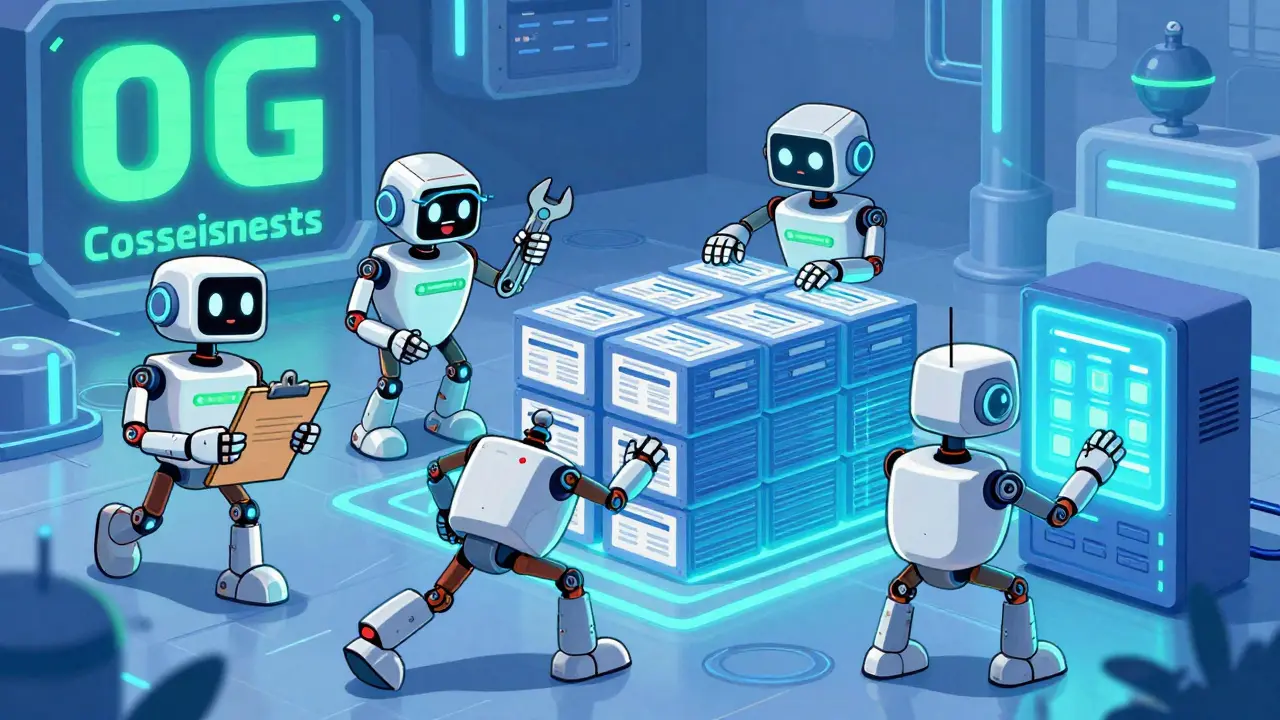
In a decentralized system, trust is earned through cryptography and incentives, not central authorities. 0G employs several mechanisms to keep bad actors at bay.
First, it uses an improved version of CometBFT, a Byzantine Fault Tolerant consensus mechanism. This allows nodes to agree on the network’s state even if some participants fail or act maliciously. Second, for storage, 0G implements Proof of Random Access (PoRA). This protocol randomly challenges storage nodes to prove they hold specific pieces of data. If a node fails to respond correctly, it gets penalized. If it succeeds, it earns rewards. This constant auditing ensures that data isn’t just claimed to exist-it actually does.
Additionally, 0G leverages Ethereum’s EigenLayer for shared security. By restaking assets on Ethereum, 0G borrows the immense security hash rate of the Ethereum network, making it much harder for attackers to compromise the 0G chain.
Tokenomics: How the 0G Token Works
The native 0G token is the fuel that powers this entire ecosystem. It serves multiple critical functions:
- Payments: Users pay for storage space, data availability checks, and compute cycles using 0G tokens.
- Staking: Validators and storage providers stake tokens to secure the network and earn rewards.
- Governance: Token holders can vote on future upgrades and parameter changes.
Here is a breakdown of the token distribution, which helps explain how the project plans to sustain itself long-term:
| Category | Percentage | Purpose |
|---|---|---|
| Ecosystem Growth | 28% | Funding development, partnerships, and grants |
| Backers | 22% | Early investors and venture capital firms |
| Team/Contributors/Advisors | 22% | Core development team and advisors |
| AI Alignment Node | 15% | Incentivizing early AI node operators |
| Community Rewards | 13% | Airdrops, liquidity mining, and user incentives |
The maximum supply is capped at 1 billion tokens. As of recent market data, approximately 213 million tokens are in circulation. This controlled supply model aims to prevent inflationary pressure while providing enough liquidity for trading and ecosystem operations.
0G vs. The Competition
You might ask, “Why not just use Filecoin for storage or Render for compute?” Good question. While those projects are excellent in their niches, they don’t offer a unified solution for AI.
Filecoin focuses purely on decentralized storage. It doesn’t have a built-in compute layer or a specialized data availability lane for AI. Bittensor emphasizes decentralized machine learning but lacks the integrated blockchain infrastructure for seamless data handling. Render Network provides GPU rendering power but isn’t optimized for the specific data throughput needs of AI training.
0G’s unique value proposition is integration. It combines Layer 1 blockchain functionality with purpose-built AI infrastructure layers. This reduces the friction for developers who currently have to stitch together multiple protocols to build a single AI application. According to industry analysts, this end-to-end approach could give 0G a significant edge in capturing market share within the growing on-chain AI sector.
Real-World Adoption and Challenges
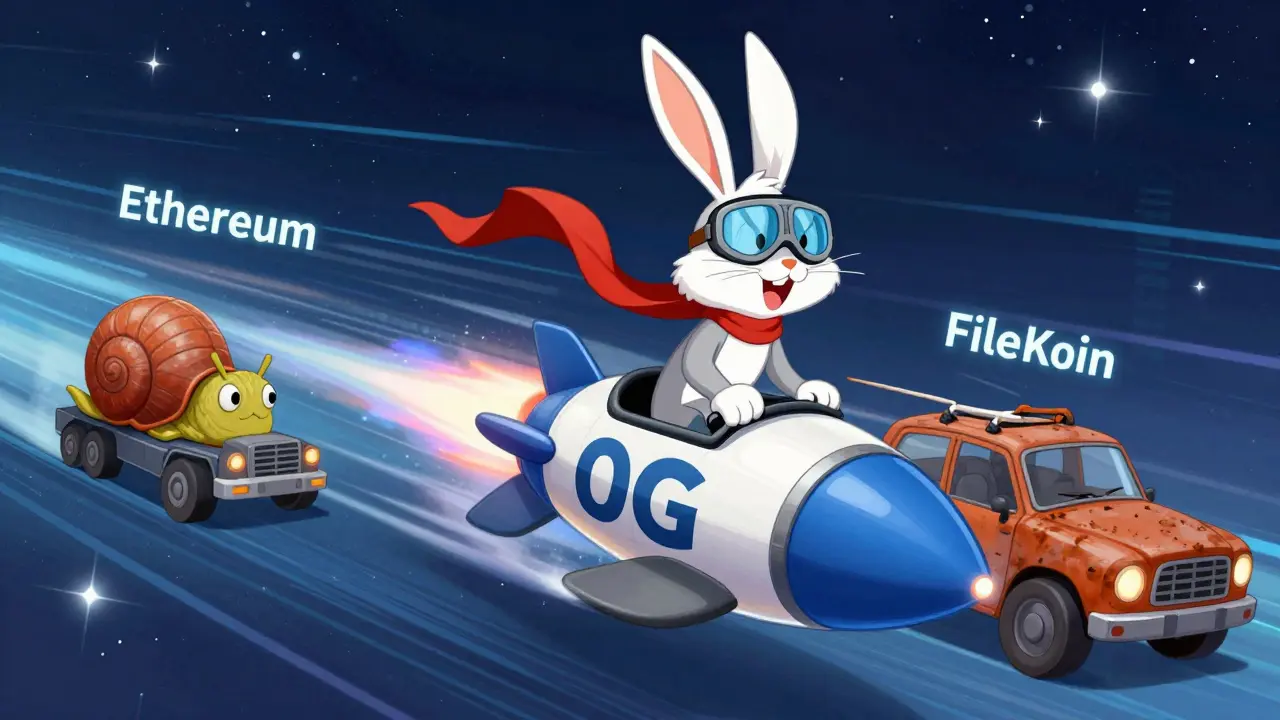
Technology is only as good as its adoption. Early feedback from developers suggests that 0G delivers on its promise of lower costs. One developer reported an 87% reduction in gas fees for AI computations compared to Arbitrum. However, there are hurdles.
The biggest challenge is the learning curve. While EVM compatibility helps, mastering the Two-Lane Architecture and PoRA verification requires intermediate knowledge of blockchain mechanics. Documentation is improving, but non-technical users may find the setup process complex. Additionally, the network needs to reach a critical mass of both storage providers and AI developers to become truly self-sustaining. If either side lags, the ecosystem could stall.
Despite these challenges, enterprise interest is growing. Companies like IBM and various AI startups are exploring 0G for confidential model training and decentralized data sharing. The recent “Orion” upgrade in early 2026 boosted data throughput by 400%, signaling strong technical momentum.
Is 0G a Good Investment?
No one can predict the future price of any crypto asset. However, you can evaluate the fundamentals. 0G operates in a niche but rapidly expanding market: on-chain AI infrastructure. Gartner projects this segment will grow from $1.2 billion in 2025 to $8.7 billion by 2028. If 0G captures even a small percentage of this market, the potential upside is significant.
Risks include competition from established players, regulatory uncertainty (though the SEC has classified 0G as a utility protocol token), and execution risk. Always do your own research (DYOR) and never invest more than you can afford to lose. Look at the token’s utility, the strength of the development team, and the rate of active developer growth rather than just short-term price charts.
What is the primary purpose of the 0G blockchain?
The primary purpose of 0G is to provide scalable, cost-effective infrastructure for on-chain artificial intelligence applications. It addresses the limitations of traditional blockchains by offering specialized layers for data storage, availability, and computation, enabling AI models to run efficiently without prohibitive fees.
How does 0G differ from Ethereum?
Is 0G compatible with existing Ethereum tools?
Yes, 0G is EVM-compatible. This means developers can use familiar tools like MetaMask, Hardhat, and Solidity to deploy smart contracts on 0G with minimal code modifications. However, to leverage AI-specific features, developers must integrate with 0G’s specialized storage and compute layers.
What is Proof of Random Access (PoRA)?
PoRA is a security mechanism used by 0G to verify that storage nodes are holding the data they claim to have. The network randomly challenges nodes to retrieve specific data fragments. Successful responses earn rewards, while failures result in penalties, ensuring data integrity and availability.
Where can I buy 0G tokens?
0G tokens are traded on several cryptocurrency exchanges, including WEEX and Binance. You can typically trade them against USDT or other major cryptocurrencies. Always ensure you are using the official contract address to avoid scams.
What are the risks associated with 0G?
Key risks include technological execution challenges, competition from other AI-focused blockchains, and the need to achieve critical mass in both developer and user adoption. Regulatory changes in the crypto space also pose potential uncertainties, although 0G has been classified as a utility token by the SEC.