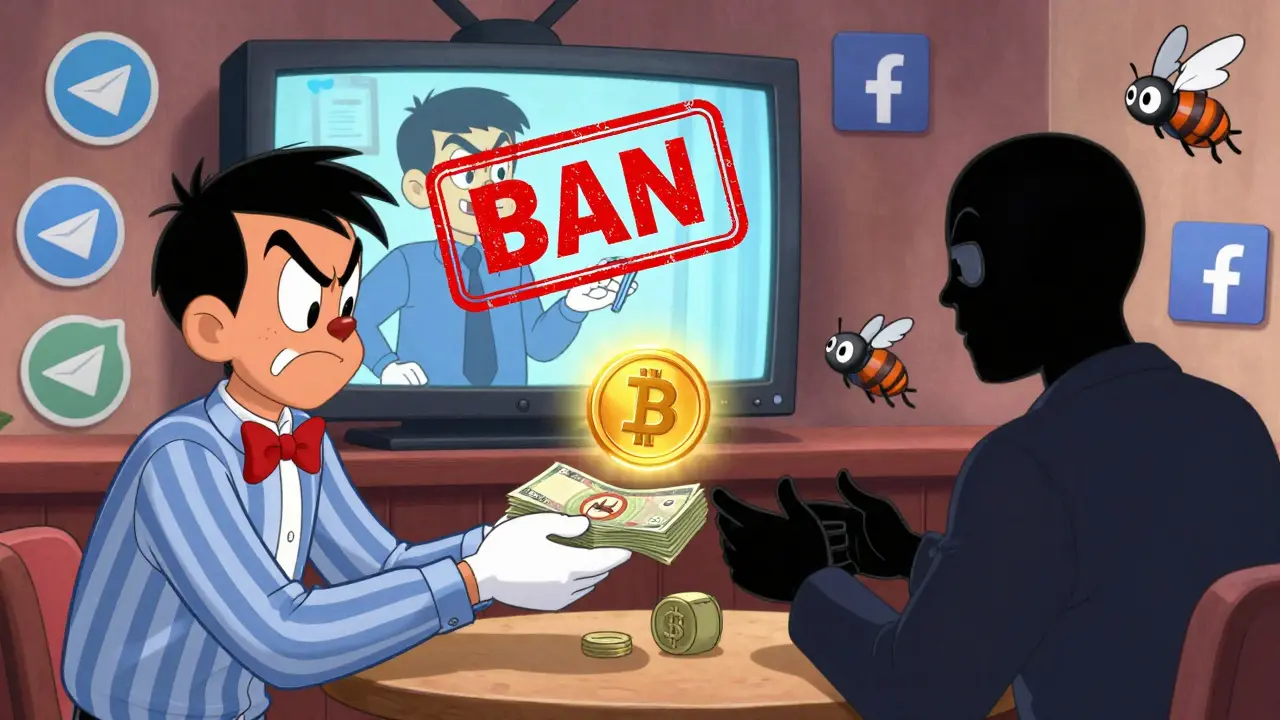
As of 2026, owning or trading Bitcoin in Myanmar is still illegal. The Central Bank of Myanmar (CBM) banned all cryptocurrency transactions back in 2020, declaring digital currencies unregulated and outside the law. But here’s the twist: people are still trading crypto-every day. Not in banks. Not on official apps. But in back alleys, on Telegram, and over cash exchanges hidden behind Facebook groups. This isn’t a fringe trend. It’s a full-blown underground economy, kept alive by necessity, not choice.
Why Crypto Still Exists in Myanmar
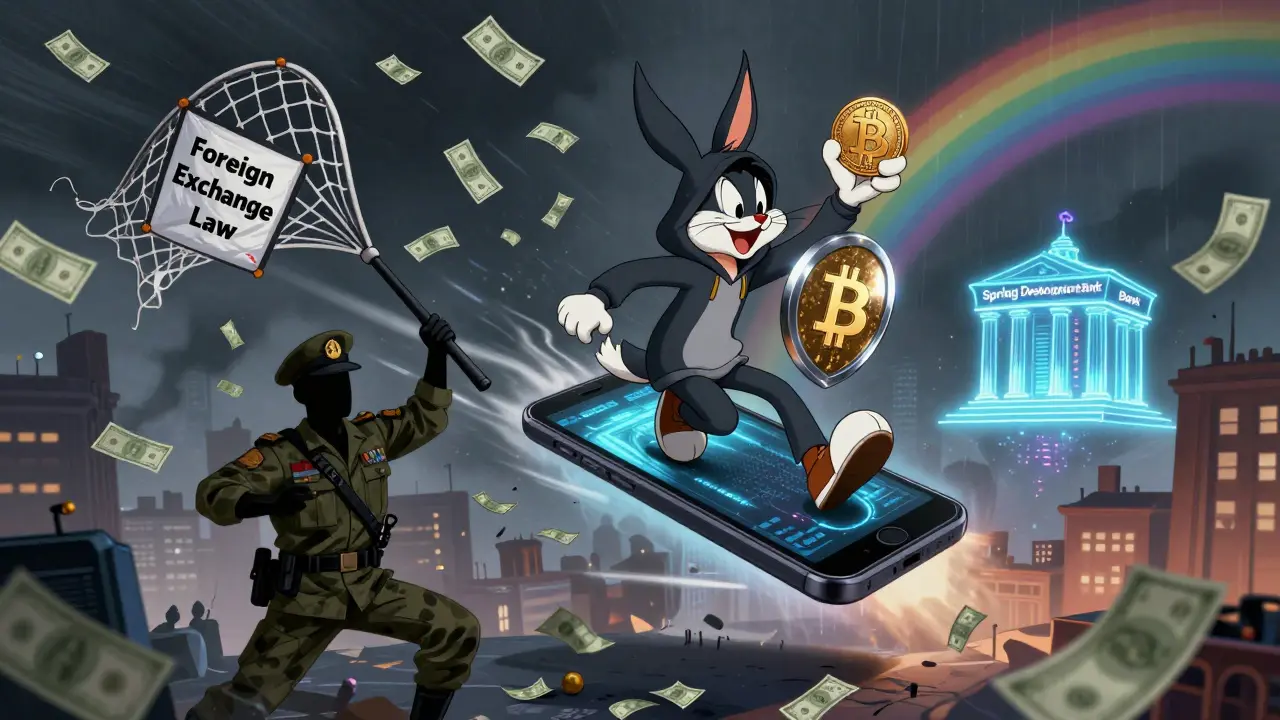
Myanmar’s military government doesn’t just discourage crypto-it punishes it. Under the Foreign Exchange Management Law and Anti-Money Laundering Act, anyone caught trading Bitcoin or Ethereum can face bank account freezes, fines, or even jail time. Yet, the ban hasn’t stopped demand. Why? Because for millions, there’s no other option. Regular banking is broken. Most people can’t open accounts. Salaries are paid in cash. Remittances from abroad? Hard to receive. Inflation eats away at the kyat. Crypto, especially stablecoins like USDT, became the only reliable way to store value and send money across borders. For many, it’s not about getting rich. It’s about surviving.How the Underground Market Works
There are no licensed exchanges in Myanmar. No Binance, no Coinbase. Not officially. But if you know where to look, you’ll find them. The real market runs on three things: VPNs, social media, and cash dealers.- VPNs are mandatory. Without one, you can’t even access Binance or other global platforms. Most users rely on free or cheap services, often shared within trusted circles.
- Facebook and Telegram are the trading floors. Groups like "Myanmar Crypto Buyers" or "USDT Sellers Myanmar" have thousands of members. Trades happen through private messages. Buyers and sellers agree on price, then meet in person or send cash via mobile wallets like WaveMoney or KBZPay.
- Cash dealers are the middlemen. They don’t operate online. They show up at cafes, train stations, or even homes. You give them cash. They give you USDT on your wallet. These dealers build trust over time-sometimes over years. Betray them, and you’re out of the game.
Prices swing wildly because liquidity is thin. A $1,000 trade might cost 5% more than the global rate. Smaller trades under $200 are easier and cheaper. But if you want to move large amounts? You risk being scammed-or worse, arrested.
The Myan Crypto Masters Community
While the government tries to silence crypto, a quiet education movement is growing. The Myan Crypto Masters Community (MCM), founded by a man known only as Feliz, has over 23,000 members. It’s not a trading group. It’s a school.MCM runs weekly Zoom workshops in Burmese. They teach how to set up a wallet, how to spot scams, how to use a VPN safely. They even explain blockchain in simple terms: "Think of it like a digital notebook everyone can see but no one can erase."
Feliz says, "Many people are interested in crypto, but the information available in Burmese is limited. We break down complex concepts into digestible information, making crypto education accessible to everyone, regardless of background."
What started as a few friends sharing tips has become the most trusted source of crypto knowledge in the country. Newcomers often walk in scared. They leave with a wallet-and a warning: "Never trade with someone you don’t know. Always meet in public. Record the transaction."

The Risks Are Real
In 2022, a group called "Myanmar Digital Gold" promised 20% monthly returns on crypto investments. Thousands of people sent money. Then, the site vanished. No one was ever caught. No one got their money back. That collapse didn’t just hurt wallets-it hurt trust.Today, scams are common. Fake exchanges. Fake dealers. Fake tutorials. The biggest danger isn’t the government-it’s the people pretending to help you.
And if you get caught? The penalties are harsh. In 2024, a man in Mandalay was sentenced to 18 months in prison for selling USDT. His crime? He had transferred $15,000 worth of crypto to a friend. He didn’t profit. He just helped. Still, he went to jail.
There’s no legal recourse. No consumer protection. No police to call. If you’re scammed, you’re on your own.
Why It’s Different from China or Thailand
China banned crypto in 2021. But they also shut down mining farms, blocked VPNs, and arrested operators. Myanmar doesn’t have the same resources. They can’t monitor every Facebook group. They can’t track every cash exchange. So they focus on big players.That’s why small trades fly under the radar. A person buying $50 worth of USDT to pay for medicine? No one cares. But someone moving $50,000 in crypto? That’s a target.
Compare that to Thailand. There, crypto is legal. You can buy Bitcoin at 7-Eleven. You can cash out at ATMs. Myanmar is the opposite. It’s not just banned-it’s hunted.
The Resistance Economy
There’s another layer to this underground market. It’s not just about money. It’s about resistance.The National Unity Government (NUG)-a shadow government formed by ousted lawmakers-launched the Spring Development Bank on the Polygon blockchain. It’s not a bank in the traditional sense. It’s a digital lifeline. It lets diaspora communities send USDT to families inside Myanmar. It holds gold-backed savings. It pays salaries to teachers and medics working in rebel areas.
This isn’t gambling. It’s survival. And it’s built on crypto because the military government controls the banks, the phones, the internet. But they can’t control blockchain.
What’s Next?
As of 2026, there’s no sign the ban will lift. The military regime sees financial freedom as a threat. Crypto means people can move money without permission. That’s dangerous to them.But the market keeps growing. More people learn. More dealers appear. More communities form. The government can arrest a few. They can’t arrest a whole country.
Experts say the future depends on who wins the political battle. If the military stays in power, crypto will stay underground-risky, chaotic, but alive. If democracy returns, the question won’t be whether to legalize crypto-but how to regulate it fast enough to protect people.
For now, people in Myanmar don’t need permission to use crypto. They just need a phone, a VPN, and someone they trust.
Is it illegal to own Bitcoin in Myanmar?
Yes. The Central Bank of Myanmar banned all cryptocurrency transactions in 2020. Owning, trading, or mining Bitcoin is considered illegal under foreign exchange and anti-money laundering laws. Violations can lead to bank account freezes, fines, or imprisonment.
How do people in Myanmar trade crypto if it’s banned?
People use VPNs to access international exchanges like Binance, then trade via peer-to-peer networks on Facebook and Telegram. Cash dealers act as intermediaries-buyers pay in kyat, sellers send crypto. These transactions happen in person or through mobile payment apps like WaveMoney.
What’s the Myan Crypto Masters Community?
The Myan Crypto Masters Community (MCM) is a grassroots group with over 23,000 members that teaches Burmese speakers how to safely use cryptocurrency. They host free workshops, explain blockchain basics, and help people avoid scams-all in local language. It’s the largest crypto education network in the country.
Are there any legal crypto exchanges in Myanmar?
No. There are no legally authorized cryptocurrency exchanges operating inside Myanmar. All trading happens through informal, unregulated channels. Even platforms like Binance are not officially registered there and operate through users’ personal VPNs.
Can you mine Bitcoin in Myanmar?
No. Cryptocurrency mining is completely illegal in Myanmar. Authorities actively search for mining operations, especially in homes or small businesses. Equipment is confiscated, and operators face criminal charges. Power shortages also make large-scale mining nearly impossible.
Why do people risk using crypto despite the ban?
For many, crypto is the only way to send or receive money. Traditional banking is broken or inaccessible. Inflation is high, and the kyat is unstable. Crypto, especially USDT, offers a way to preserve value and receive remittances from abroad. In some cases, it’s used to fund resistance efforts, making it both an economic and political tool.
What happens if you get caught trading crypto?
If caught, you could face criminal charges under the Foreign Exchange Management Law. Penalties include fines, bank account freezes, and jail time. In 2024, one man was sentenced to 18 months for transferring $15,000 in USDT to a friend. There is no legal protection or appeal process for victims of crypto scams.
Is crypto used for political resistance in Myanmar?
Yes. The National Unity Government (NUG) created the Spring Development Bank on the Polygon blockchain to receive diaspora donations, pay salaries to civil servants, and provide gold-backed savings. This system bypasses military-controlled banks and helps fund resistance communities. Crypto has become a tool for financial independence from the regime.
This is wild. I never realized how much people rely on crypto just to survive. I mean, imagine having to meet someone in a cafe just to get $50 worth of USDT because your bank won't let you send money abroad. It's not about speculation-it's about basic survival. The fact that this underground network is so organized is kind of inspiring. People are building trust brick by brick, even when the state is actively trying to crush them. And that MCM group? That's real community work. No hype, just education. We need more of this.
Why are people even doing this its so dumb the government banned it for a reason you think its just about money its about security you idiots are playing with fire and think its cool
I just watched a documentary on this last week. The cash dealers are like modern-day bank tellers, except they're risking jail time. One guy said he's been doing this for 6 years and has never been caught. He said the key is consistency-same time, same place, same face. It’s eerie how much trust is built in silence. And the fact that they teach people how to use a VPN in Burmese? That’s next-level grassroots resilience.
It is imperative to underscore the profound systemic failure that necessitates such an underground financial ecosystem. The state's imposition of draconian penalties for peer-to-peer cryptocurrency transfers constitutes a violation of fundamental economic liberty. Moreover, the absence of formal financial infrastructure-coupled with rampant inflation-renders the populace vulnerable to predatory informal networks. This is not a triumph of technology; it is a indictment of governance.
Okay but let’s be real-this whole thing is just a glorified Ponzi waiting to collapse. You have people trading USDT for cash in parking lots because they don’t understand blockchain? They’re just one scam away from losing everything. And the "Spring Development Bank"? Please. It’s a blockchain version of a church collection plate. No regulation = no legitimacy. It’s not resistance. It’s recklessness dressed up as revolution.
Wait wait wait... so you're telling me the government is banning crypto... but they're not banning VPNs? That's a joke. This is all a psyop. The CIA is using this to destabilize Myanmar. They're feeding people crypto to create a digital dependency. Then one day... poof. All wallets get wiped. They're not trying to stop crypto-they're trying to control it. You think you're free? You're a pawn. I've seen the patterns. This is how they do it.
I cried reading this. I have family in Yangon. They’ve been using USDT for two years to pay for my sister’s insulin. No bank would transfer it. No remittance service would touch it. But a guy at a noodle shop in Hlaingtharyar gave her the crypto in exchange for kyat. He didn’t ask for ID. He didn’t want a receipt. He just said "I know your brother. He helped me when I was sick." That’s the real economy. Not banks. Not governments. People.
This is why I hate crypto. Everyone thinks it’s revolutionary. It’s not. It’s just a way for people to avoid taxes and get scammed. And now we’re romanticizing people trading cash for digital tokens in alleys? That’s not freedom-that’s desperation. If you need crypto to survive, you need a better government. Not a better wallet.
Crypto is a moral failure. It’s the digital equivalent of gambling with your life savings. You think you’re being clever by avoiding the system? You’re just enabling chaos. The people who run these cash dealers? They’re not heroes. They’re predators. And the MCM group? They’re not educators-they’re recruiters for a digital cult. Blockchain doesn’t make you free. It makes you blind.
OMG I just found out about this and I’m OBSESSED. Like… imagine being in a country where you can’t send money to your mom… but you can use a QR code on your phone to give her life-saving medicine. I’m not even joking. I’m crying. This is the most beautiful thing I’ve ever seen. And the fact that they have workshops in Burmese? I’m saving this. I’m sharing this. I’m crying again.
The narrative presented here is dangerously naive. The National Unity Government’s so-called Spring Development Bank is not a humanitarian initiative-it is a front for illicit financial flows. Blockchain technology is not immune to state surveillance. The Polygon chain is monitored. The wallets are traceable. The military intelligence apparatus has access to global blockchain analytics. This is not resistance. This is a meticulously orchestrated misinformation campaign designed to lure the vulnerable into a digital trap. The real power lies not in decentralization-but in the illusion of it.
I knew this was a setup. The whole "Myan Crypto Masters" thing? It’s a honeypot. They’re training people to use crypto so they can track them. Every wallet address is logged. Every meeting place is recorded. The government doesn’t need to shut down the market-they just need to wait for everyone to trust it. Then-boom. Mass arrests. Asset seizures. They’ve been doing this since 2021. You think you’re safe because you use a VPN? You’re already flagged. I’ve seen the leaked reports.
I mean… this is peak crypto bro energy. You’re glorifying people who trade cash in alleys like it’s some underground rave. It’s not. It’s a gray market. And the MCM group? They’re just selling FOMO under the guise of education. Blockchain? It’s not magic. It’s code. And code can be hacked. You think your USDT is safe? It’s just a number on a server someone else controls. You’re not free. You’re just distracted.
This is one of the most powerful examples of human resilience I’ve ever encountered. When institutions fail, people build their own. Not with weapons. Not with protests. With trust. With wallets. With quiet, consistent acts of solidarity. The fact that strangers meet in public places to exchange money for digital value-without contracts, without lawyers, without government-isn’t chaos. It’s civilization rebuilding itself. We should be studying this, not mocking it.
I’m Burmese-American. My mom still sends me money through a cousin who uses WaveMoney to transfer cash to a dealer who sends USDT. I didn’t even know this was happening until last year. It’s not glamorous. It’s not techy. It’s just… how we survive. I wish more people understood that crypto here isn’t about wealth. It’s about dignity.
This made me tear up 😭 I just sent $100 to a friend in Mandalay using USDT last week. We met at a bus stop. No handshake. Just a screenshot and a nod. I didn’t know how to explain it until now. This isn’t just crypto. It’s love in a digital form. 🙏❤️
I don’t get why people are making this into some noble thing. It’s just a bunch of people getting scammed. And the "MCM"? They’re probably the ones running the fake exchanges. Everyone’s so obsessed with being "edgy" and "resistant" that they forget to ask: who’s really in control? I’ve seen too many crypto deaths. This is just the next one.
What’s fascinating isn’t just the mechanics of the underground market-it’s the evolution of social trust in the absence of institutional trust. In traditional economies, we rely on banks, courts, and regulators to enforce contracts. Here, trust is built through repetition, reputation, and shared risk. The cash dealer who’s been operating for seven years isn’t a criminal-he’s a community anchor. The fact that these networks have developed their own norms-meet in public, record transactions, verify identities through mutual contacts-isn’t primitive. It’s profoundly sophisticated. It’s a new form of social contract, forged in the shadow of oppression.
I’ve been in blockchain for 8 years. This is the most real use case I’ve ever seen. No ICOs. No NFTs. No degens. Just people using smart contracts to keep their families alive. The Spring Development Bank? It’s not a gimmick-it’s a lifeline. And Feliz? He’s the real MVP. He’s not trying to make money. He’s trying to make sure people don’t get killed. That’s not crypto. That’s humanity.
I find this entire situation deeply troubling. The romanticization of illegal activity under the guise of "resistance" is not only irresponsible-it is ethically dangerous. When we normalize the circumvention of law without accountability, we erode the foundations of civil society. The fact that people are risking imprisonment for peer-to-peer transfers is not admirable. It is tragic. And we should be working to restore legitimate financial systems-not glorifying their collapse.
I used to think crypto was just for speculators. Then I met a teacher in Myitkyina who got paid in USDT because the military cut off her salary. She used it to buy books for her students. She didn’t care about price charts. She cared about learning. That’s when I understood: crypto isn’t about money. It’s about agency. And in a place where your voice is silenced, having control over your own value? That’s the most revolutionary thing of all.
I’ve been teaching people in rural areas how to use crypto wallets for two years. I don’t own any. I don’t trade. I just help. One woman told me, "Now when my son sends me money from Thailand, I know it’s real. I can touch it. I can count it." That’s the power here. It’s not about profit. It’s about certainty. In a world of lies, crypto gives people a truth they can hold onto.
Crypto in Myanmar isn’t a revolution-it’s a rebellion. And rebellions don’t need permission. They need guts. The military thinks they control the banks, the phones, the borders. But they forgot one thing: people will always find a way to move value. And when they do? They don’t need a license. They just need a phone, a friend, and the courage to say "yes."
I’m so proud of the people in Myanmar. They’re not waiting for someone to fix it. They’re fixing it. Together. No one’s asking for a hero. Just a way to pay for medicine. To send love. To survive. And they built it. With trust. With code. With courage. I hope the world sees this-not as a crisis-but as a blueprint. For how humanity survives when the system fails.