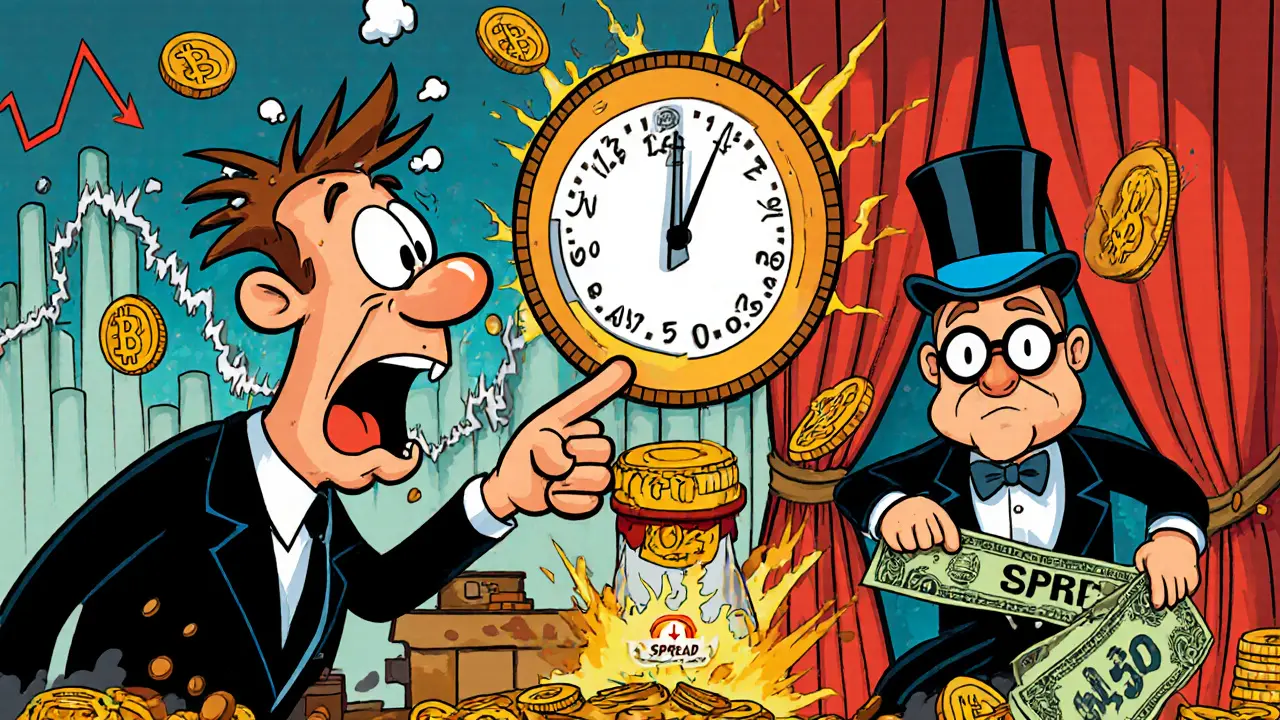
Bid-Ask Spread: What It Is and Why It Matters in Crypto Trading
When you trade crypto, the bid-ask spread, the difference between the highest price a buyer is willing to pay and the lowest price a seller is willing to accept. It's not just a number—it's the hidden cost of every trade. If you're buying a token and the bid is $1.00 and the ask is $1.05, you pay 5 cents extra just to get in. That might seem small, but on a $10,000 trade, that’s $500 gone before the price even moves. On low-volume coins, that spread can be 10%, 20%, or more. You’re not losing because the market went down—you’re losing because the market was broken to begin with.
This isn’t just about price. The liquidity, how easily an asset can be bought or sold without changing its price. It’s the backbone of fair trading. High liquidity means tight spreads. Low liquidity? Wide spreads, fake volume, and traps for beginners. That’s why tokens like MANYU or CATALORIAN have spreads so wide you’d need a GPS to find them. And when you see a coin with $300 in daily volume but a 15% spread, you’re not trading—you’re gambling on a broken system. The order book, the real-time list of buy and sell orders for a trading pair. It shows you who’s really in control. Most people only look at the price chart. Smart traders check the order book first. If there’s a giant buy wall at $1.00 and a tiny sell order at $1.01, you know the price won’t rise until someone breaks that wall. That’s how whales manipulate small traders.
And then there’s slippage, the difference between the expected price of a trade and the price it actually executes at. It’s the cousin of the bid-ask spread. On Curve Finance, slippage is near zero because stablecoins have deep liquidity. On a new DEX like MagicSwap with three trading pairs? You might think you’re buying at $0.002—and end up paying $0.0025. That’s not bad luck. That’s design. Many airdrops—like DSG, PandaSwap, or TOKAU ETERNAL BOND—have zero trading volume, so their spreads are meaningless. They don’t exist as markets. They exist as traps.
You don’t need fancy tools to spot this. Just look at the numbers. If a coin’s price jumps 50% in a day but its volume is under $10,000, the spread is probably huge. If you see a token on an exchange like Globitex or Naijacrypto with no reviews and no clear order book, assume the spread is rigged. The best traders don’t chase pumps. They wait for tight spreads, high volume, and real liquidity. That’s how you avoid paying more than you should. Below, you’ll find real breakdowns of tokens, exchanges, and airdrops where the bid-ask spread tells the whole story—before you lose money to it.