
You want to move your assets faster and pay less. But when you look at the options-sidechains or Layer 2 solutions-it feels like choosing between a private jet and a high-speed train. Both get you there quicker than the main road (Ethereum mainnet), but they operate on very different principles. One relies on the security of the giant it sits on; the other builds its own independent engine. Getting this wrong can cost you time, money, or even your funds if a bridge fails.
This guide breaks down exactly how these two technologies work, where they shine, and where they fail. We are looking at real data from 2024-2026, specific costs, and the technical realities that matter for your wallet and your projects.
The Core Difference: Security Inheritance vs. Independence
At its heart, the debate is about trust. A Layer 2 solution is a protocol built directly on top of the Ethereum mainnet that inherits its security model while processing transactions off-chain. Think of it as an express lane in a highway system. If the highway (Ethereum) collapses, the express lane doesn't exist anymore. You are safe because the foundation is solid.
A Sidechain is a separate blockchain network running parallel to Ethereum, connected via two-way peg systems. It’s like building a completely new, smaller highway next to the main one. It has its own rules, its own police (validators), and its own maintenance crew. If the main highway burns down, the sidechain keeps going. But if the sidechain’s police corrupt or the bridge between them breaks, you’re stuck.
This distinction drives everything else. Layer 2s prioritize safety and compatibility. Sidechains prioritize speed and customization.
How They Work Under the Hood
To understand why one might be better for you, you need to see the machinery.
Layer 2 Architectures Most major Layer 2s use one of two methods:
- Optimistic Rollups: Used by Arbitrum and Optimism. These assume transactions are valid unless proven otherwise. There is a 7-day challenge period where anyone can dispute a bad transaction. Finality takes time, but security is high.
- ZK-Rollups: Used by zkSync and StarkNet. These use complex math (zero-knowledge proofs) to prove validity instantly. Finality is fast, but the tech is harder to build.
Sidechain Mechanics Sidechains like Polygon PoS run their own consensus mechanism. Polygon uses Proof-of-Stake with a set number of validators (around 100 nodes). Because they don’t have to wait for Ethereum to verify every single block, they can finalize transactions in seconds. However, this means you are trusting those 100 validators more than you would trust the thousands of stakers securing Ethereum itself.

Performance and Cost: The Numbers Game
Let’s talk dollars and speed. This is usually why people leave Ethereum mainnet in the first place.
| Metric | Layer 2 (e.g., Arbitrum) | Sidechain (e.g., Polygon PoS) |
|---|---|---|
| Avg. Transaction Cost | $0.05 - $0.50 | $0.005 - $0.02 |
| Finality Time | 1 hour to 7 days | 2 - 3 seconds |
| Throughput (TPS) | 2,000 - 4,000 | 5,000 - 10,000 |
| Security Model | Inherits Ethereum Mainnet | Independent Validator Set |
| Total Value Locked (TVL) | ~$42.7 Billion (All L2s) | ~$7.2 Billion (All Sidechains) |
Notice the cost difference. Sidechains are significantly cheaper. If you are playing a game that requires 50 micro-transactions per minute, Layer 2 fees will eat your profit margin. Sidechains handle that volume easily. But look at finality. On Optimism, moving money back to Ethereum mainnet can take up to 7 days. That is a long time to lock up capital. On Polygon, it’s almost instant. For DeFi traders who need quick exits, this matters.
Developer Experience and Implementation
If you are a developer or a project team, the choice affects your roadmap.
Layer 2s are generally easier to deploy on. Since they mirror Ethereum’s environment closely, most smart contracts work with less than 5% code modification. You write Solidity, test it on Sepolia, and deploy it to Arbitrum or Base. It just works. The documentation for major Layer 2s is also robust, with completeness scores often exceeding 95%.
Sidechains require more adaptation. Polygon’s EVM is slightly modified. You need to account for different gas calculations and validator behaviors. Implementation time averages 4-6 weeks longer than Layer 2 deployments. However, if you need custom features-like a specific privacy feature or a unique token standard-sidechains give you more freedom to tweak the underlying rules.
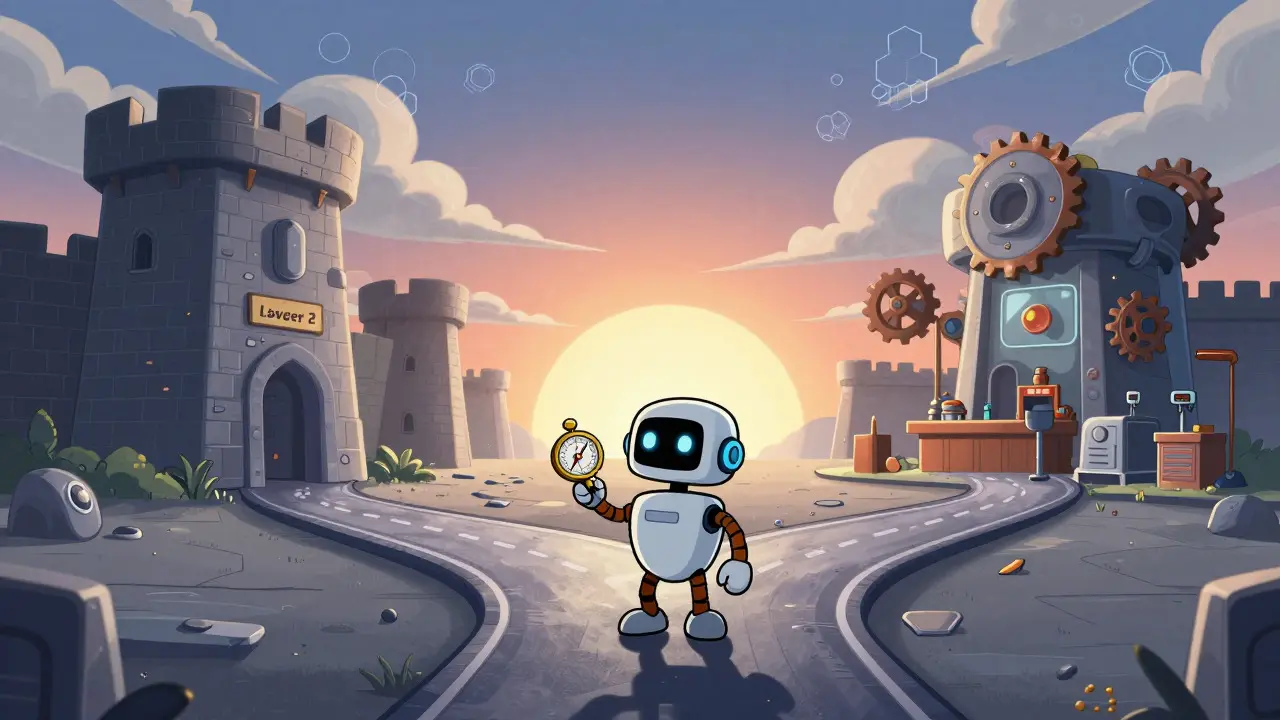
Security Risks: Where Things Go Wrong
No system is perfect. Here is where each approach tends to fail.
Layer 2 Risks: Bridge Complexity The biggest criticism of Layer 2s isn’t the chain itself, but the bridges. Moving assets between Ethereum and a Layer 2 involves smart contracts that can be hacked. While rare, these incidents account for a large portion of lost value in scaling solutions. Additionally, the fragmentation is real. With 30+ active Layer 2s, liquidity gets spread thin. Your tokens might be on Arbitrum, but your friends are on Base. Swapping between them adds friction.
Sidechain Risks: Centralization and Hacks Because sidechains rely on smaller validator sets, they are more susceptible to centralization attacks. If 51% of the validators collude, they can rewrite history. The Harmony bridge hack in 2022 ($600 million loss) is a stark reminder. Also, regulatory scrutiny is higher. The U.S. SEC has hinted that some sidechains might be treated as separate securities offerings, adding legal complexity for global projects.
Which One Should You Choose?
There is no universal winner. It depends on what you are doing.
Choose Layer 2 if:
- You are building serious DeFi applications where security is paramount.
- You want to stay within the Ethereum ecosystem without worrying about bridge hacks.
- Your users care about asset safety more than absolute lowest fees.
- You are an enterprise looking for compliance-friendly infrastructure (78% of Fortune 500 blockchain projects use L2).
Choose Sidechain if:
- You are building a high-frequency gaming application.
- You need immediate finality for user experience.
- You want to experiment with custom consensus or token mechanics.
- Your target audience is price-sensitive and willing to accept slightly lower security guarantees for lower fees.
The future is likely hybrid. Ethereum’s roadmap includes updates that will make Layer 2s even cheaper (potentially 80-90% reduction in costs), which narrows the gap. Meanwhile, sidechains are working on interoperability layers to connect them better. For now, keep your eyes on both. Don’t bet the farm on one; diversify your strategy based on the specific needs of your project or portfolio.
Are sidechains safer than Layer 2 solutions?
Generally, no. Layer 2 solutions inherit the security of the Ethereum mainnet, which is secured by millions of stakers. Sidechains rely on their own, smaller validator sets (often around 100 nodes), making them more vulnerable to centralization and potential forks if validators misbehave. However, sidechains avoid the specific risks associated with complex bridging mechanisms found in some Layer 2 designs.
Why are Layer 2 transaction fees not always lower than sidechains?
Layer 2s still need to post transaction data to the Ethereum mainnet for security. This process consumes gas on the mainnet, which is then passed on to users as part of the L2 fee. Sidechains do not need to post data to Ethereum for every transaction, allowing them to charge significantly less (often 100-200x cheaper than mainnet, compared to 5-50x for L2s).
Can I use my same wallet on both sidechains and Layer 2s?
Yes. Most modern wallets like MetaMask support both. You simply add the specific network (RPC URL) for the sidechain or Layer 2 you wish to use. The private key remains the same, but the network context changes. Just be careful when switching networks to ensure you are sending assets to the correct address format for that specific chain.
What is the impact of Ethereum's Dencun upgrade on this comparison?
The Dencun upgrade (EIP-4844) introduced 'blobs,' which drastically reduced the cost for Layer 2s to post data to Ethereum. This made Layer 2 transactions much cheaper, narrowing the cost gap with sidechains. While sidechains remain cheaper, the advantage is no longer overwhelming, shifting the decision more toward security and finality preferences rather than just raw cost.
Which is better for NFT minting?
It depends on the collector base. If your collectors are deep in the Ethereum ecosystem and value security, a Layer 2 like Base or Arbitrum is preferable due to seamless integration with major marketplaces. If you are targeting casual gamers or mobile users who hate waiting and paying fees, a sidechain like Polygon offers a smoother, faster, and cheaper minting experience.
Oh, the exquisite paradox of our digital age!
One stands upon the shoulders of giants, trembling with inherited weight.
The other dances freely in the void, unburdened but perilously exposed.
It is a tale as old as time, dressed in the shimmering robes of cryptography.
We are all just passengers on this volatile train to nowhere.
Yet here we are, debating the color of the seats while the tracks crumble beneath us.
How beautifully tragic it is to seek security in a system that promises only chaos.
The sidechain whispers of freedom, seductive and dangerous.
The Layer 2 hums with the steady, boring rhythm of compliance.
Which shall we choose? The cage or the cliff?
Perhaps the answer lies in the silence between the blocks.
A profound question for such a fleeting moment in history.
Let us ponder this together, dear friends, before the next fork destroys us all.
its all a con anyway
the L2s are just centralised servers with extra steps
who do u trust more 100 validators or the eth core devs who are obviously rigging the game
sidechains at least have the honesty of being transparently broken
remember harmony? nah they fixed that one right?
prolly not
just another way for whales to dump on retail
Ooh, look at you two already fighting.
Very mature.
Really shows the depth of your understanding.
Just kidding, mostly.
But seriously, stop acting like it's an either/or choice.
You can use both.
Why would you lock yourself into one philosophy when the market is so diverse?
It's like saying you only drink coffee because tea is 'for weaklings'.
Pathetic.
Anyway, nice post, though the table was a bit dry.
Needs more spice.
Maybe some memes?
Just a thought.
Keep going, champ.
You're doing great, really.
Seriously.
Well, almost.
Don't let the haters get to you.
They're just jealous of your clarity.
Probably.
Maybe.
Who knows?
Life is a mystery, isn't it?
I think this is super helpful! 🌟
It really breaks down the technical stuff without making it too complicated.
I’ve been using Arbitrum for my DeFi stuff and the finality time is definitely something I notice when I want to move funds back to mainnet.
It’s annoying, but I guess it’s the price of safety? 🛡️
Does anyone else feel like the bridge hacks are getting less frequent though?
Or am I just ignoring the news? 😅
Anyway, thanks for the detailed comparison!
It’s always good to see real data instead of just hype.
Love seeing these kinds of deep dives. 💖
Keep them coming!
The dichotomy presented herein is not merely technical; it is philosophical.
To choose a Layer 2 is to accept the tyranny of consensus.
To choose a Sidechain is to embrace the anarchy of individual will.
There is no middle ground, only the illusion of compromise.
The Ethereum mainnet is a monument to collective inertia.
It moves slowly because it carries the weight of every transaction ever recorded.
Is that not the definition of bureaucracy?
And yet, we worship it.
We call it 'security'.
We call it 'decentralization'.
But is it not simply the most efficient form of stagnation?
The sidechain, with its hundred validators, is a republic of oligarchs.
It is faster, yes.
It is cheaper, yes.
But does speed matter if the destination is a mirage?
Consider the implications of the Dencun upgrade.
It is not a solution; it is a band-aid on a bullet wound.
The cost reduction is marginal compared to the existential threat of fragmentation.
We are building a thousand islands, each isolated, each vulnerable.
The future is not hybrid; it is fragmented.
And in that fragmentation, we lose the very essence of what blockchain promised: unity.
So, which path do you walk?
The slow road to nowhere, or the fast road to ruin?
Choose wisely.
Or perhaps, choose not at all.
For inaction is also a decision.
And often, the wisest one.
Man, this whole thing feels like a lot of noise for a simple problem.
We just want to send money without paying a fortune, right?
But then everyone starts talking about validators and proofs and bridges and it gets crazy.
I mean, why can't it just work like sending an email?
Instant, cheap, secure.
Maybe we're overcomplicating it by trying to build a perfect system.
Imperfection is part of life, right?
So maybe we should just pick whatever feels comfortable and stick with it.
If you trust Ethereum, go L2.
If you want speed, go sidechain.
No need to be dramatic about it.
Just breathe and make a choice.
It's not the end of the world if you pick wrong.
You can always switch later.
Flexibility is key.
Don't stress too much about the theory.
Focus on what works for your specific needs.
That's all there is to it, really.
Just keep it simple and kind to yourself.
USA first! 🇺🇸
Why are we even listening to foreign tech companies decide how our money moves?
Ethereum is basically a global mess.
Polygon is fine because it's fast and cheap.
Who cares about those 100 validators?
They're probably American engineers anyway.
L2s are just European ideas trying to colonize our wallets.
Arbitrum sounds like a casino, not a bank. 🎰
Sidechains are practical. Real work.
Stop overthinking it with all that math stuff.
Just use what works for YOU.
And support US innovation! 💪
Don't let the nerds tell you what to do.
They don't know anything about real business.
Just buy the dip and move on.
Simple. Easy. American. ✅
quietly reading this from the corner...
it makes sense but i still don't fully get the bridge risk part.
is it really that bad? i've never lost money on a bridge.
but then again, i'm not moving millions around.
just small amounts for fun.
so maybe it doesn't affect me as much?
still, the 7 day wait on optimistic rollups seems brutal.
i'd probably prefer the instant finality of polygon.
even if it's slightly less secure.
speed wins for me, i guess.
anyone else feel the same?
or am i just impatient?
probably both.
honestly ima chill observer here
not gonna argue with the big brains above
but did anyone notice the tvl numbers?
42b vs 7b
thats a huge gap
means people trust l2s way more
which makes sense given the security inheritance thing
sidechains are cool for games though
i play on polygon sometimes and it feels snappy
no lag no high fees
perfect for casual stuff
but for serious defi? yeah l2 is king
im just vibing with whatever chain has the best yield today
no deep ideology needed
just profits and peace of mind
keep it simple fam
Well, well, well...
Look at this.
Another superficial take on a deeply complex architectural challenge.
Did you truly believe that a table of numbers could capture the nuance of distributed systems?
How adorable.
The 'Dencun' upgrade is hardly a silver bullet, you naive child.
It merely shifts the bottleneck, it does not solve it.
And speaking of bottlenecks, have you considered the cognitive load required to parse your own prose?
It is, frankly, exhausting.
The vocabulary is pedestrian.
The structure is predictable.
The insights are non-existent.
One expects more from a guide claiming to be 'ultimate'.
Perhaps you should study the underlying mathematics before attempting to explain them to the masses.
Until then, keep your opinions to yourself.
They are unworthy of our attention.
Do try to improve your writing skills in the future.
We would all appreciate the relief.
Good luck with that.
It will be a long journey.
But then again, so is your career in content creation.
Tragic.
Truly.
Let us dissect this further, shall we?
The author posits a binary choice, yet the reality is a spectrum.
Consider the validator set size.
One hundred nodes is not 'independent'; it is a cartel.
A true independent entity would require thousands, if not tens of thousands.
Therefore, the security model is fundamentally flawed in its premise.
Furthermore, the claim that Layer 2s are 'easier to deploy' ignores the gas abstraction complexities.
Users must manage multiple balances across different chains.
This friction is not negligible.
It is a significant barrier to adoption.
The article fails to address the UX nightmare of multi-chain asset management.
Without solving this, the debate is moot.
Technology is irrelevant if the user cannot navigate it.
Thus, the 'winner' is not defined by TPS or cost.
It is defined by usability.
And currently, neither option excels in this regard.
We are all waiting for the next paradigm shift.
Until then, remain skeptical.
Always.
One assumes the reader possesses a baseline level of intelligence.
However, the tone suggests otherwise.
The explanation of 'blobs' is particularly tedious.
It reads like a lecture delivered to a class of toddlers.
The juxtaposition of 'private jet' and 'high-speed train' is cliché.
It lacks the sophistication expected of a technical analysis.
Moreover, the recommendation to 'diversify your strategy' is vague.
Diversification is a hedge, not a solution.
It implies uncertainty, which is unbecoming of a definitive guide.
The author should commit to a stance.
Ambiguity is the refuge of the indecisive.
Let us hope the next iteration displays greater confidence.
And perhaps, better editing.
The typos are distracting.
Though, one supposes perfection is unattainable.
Still, effort should be evident.
In conclusion, adequate.
Barely.
Do better.
Next time.
Please.
THEY ARE HIDING THE TRUTH FROM YOU!!!
The SEC is watching.
Every sidechain is a securities offering.
They told you it wasn't.
Now they will come for your bags.
The 100 validators are insiders.
They collude to print money.
Layer 2s are just centralized banks with crypto branding.
The bridge hacks were planned.
To consolidate wealth.
Wake up sheeple.
The Dencun upgrade is a trap.
It lowers fees to lure you in.
Then they raise taxes.
Digital taxes.
You know it's true.
Follow the money.
It leads to the elites.
Always.
Save your assets in cold storage.
Trust no chain.
Trust no code.
Only trust yourself.
The matrix is closing in.
Run.
Before it's too late.