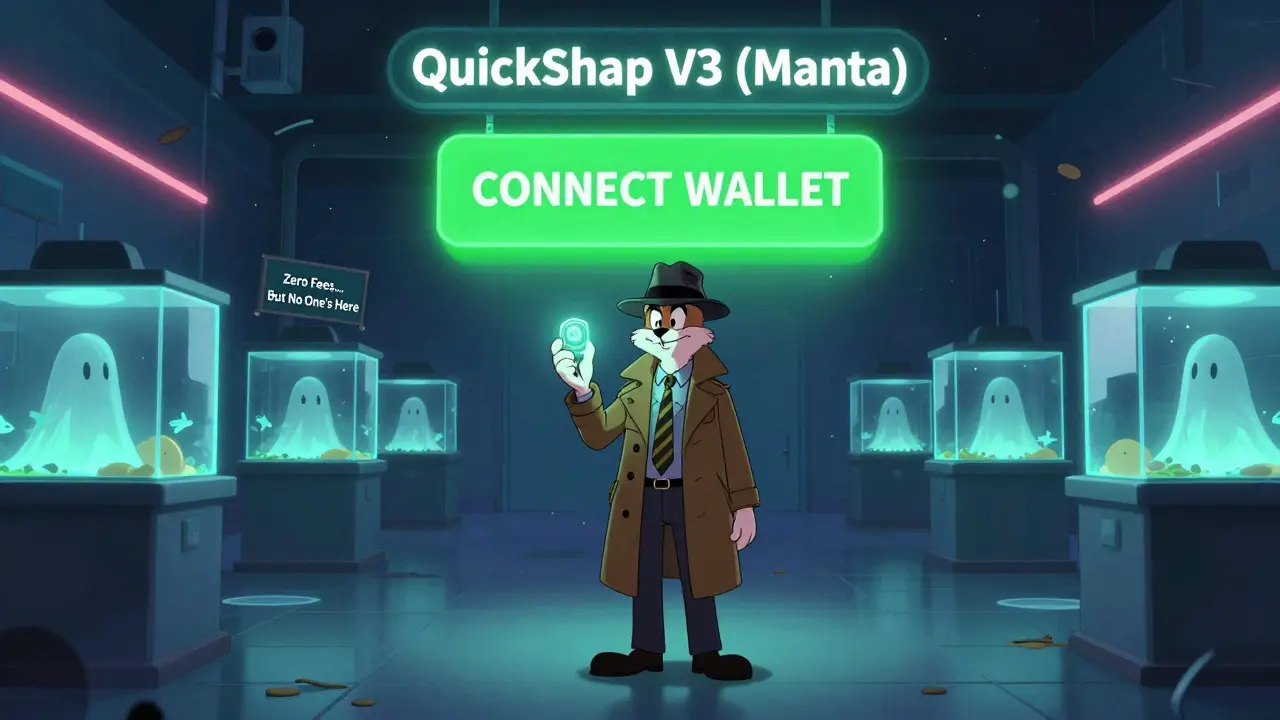
QuickSwap V3 on Manta Network isn't just another crypto exchange. It’s a quiet experiment in radical simplicity: zero trading fees. That’s right - no taker fees, no maker fees, nothing. If you’ve ever paid 0.3% to swap tokens on Uniswap or even on QuickSwap’s own Polygon version, this feels like a glitch in the matrix. But here’s the catch: no one’s using it. At least, not yet.
QuickSwap V3 (Manta) is a fork of Uniswap V3’s concentrated liquidity model, but instead of running on Polygon like its popular sibling, it’s built on Manta Network - a blockchain focused on privacy and scalability using zero-knowledge proofs. This isn’t a marketing gimmick. It’s a real, live DEX. You can connect your wallet, swap tokens, and add liquidity. But if you search for reviews, you’ll find zero user ratings. No forums buzzing about it. No YouTube tutorials. Just a website with a green button that says "Connect Wallet" and a lot of empty space.
How QuickSwap V3 (Manta) Works
At its core, QuickSwap V3 (Manta) uses the same mechanics as Uniswap V3: liquidity providers don’t just deposit tokens across a wide price range. They pick a specific price band - say, between $0.18 and $0.22 for MANTA/ETH - and concentrate their capital there. This makes capital efficiency way higher. If the price stays inside your range, you earn more fees. If it moves outside? Your liquidity stops earning until it comes back.
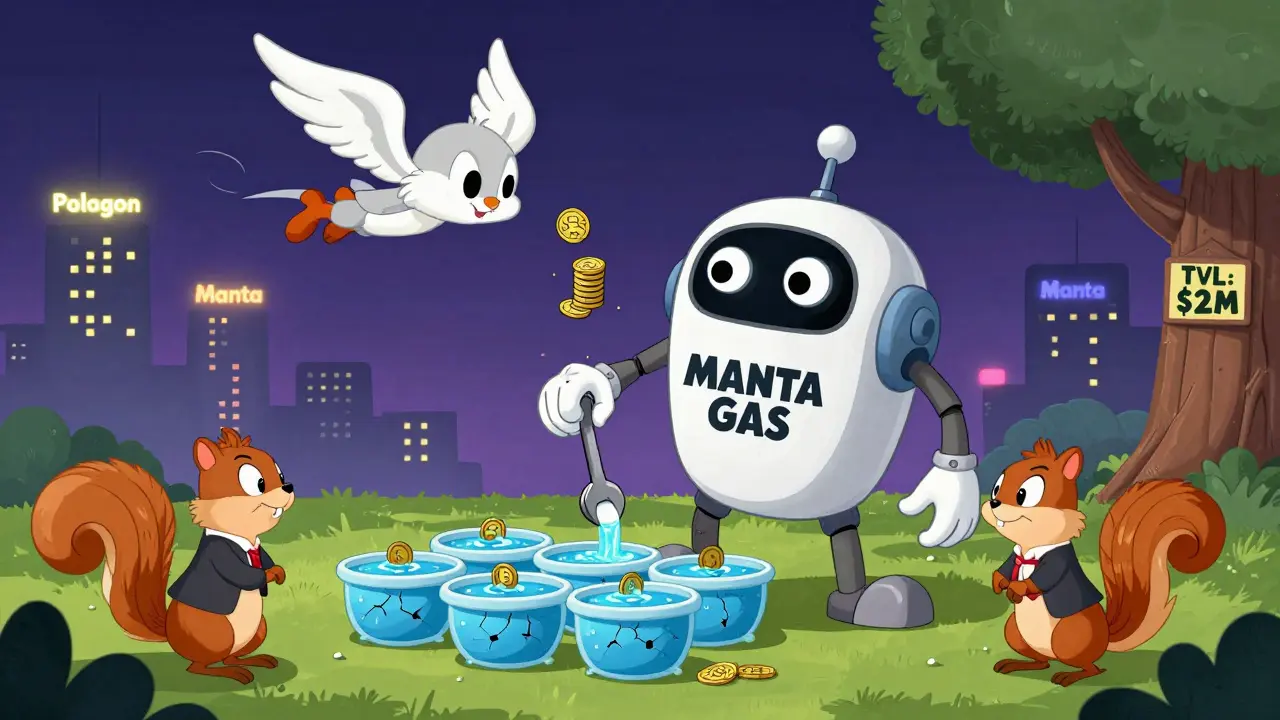
On Polygon, this system works well because there’s tons of liquidity. On Manta? Not so much. The total value locked (TVL) on QuickSwap V3 (Manta) is under $2 million as of early 2026. Compare that to QuickSwap on Polygon, which holds over $1.2 billion. That’s a 600x difference. Most of the trading volume you see on the Manta version comes from bots or short-term arbitrage, not real users.
Why does this matter? Because concentrated liquidity only shines when there’s enough movement in the price range you’ve chosen. If nobody’s trading MANTA against USDC, your liquidity sits idle. And if you’re trying to swap a rare token? Good luck finding a pool. Out of the 300+ tokens listed on QuickSwap’s main site, fewer than 15 have active pools on Manta.
The Zero-Fee Advantage
Let’s talk about the big draw: zero fees. Most DEXs charge 0.3% per trade. Even Layer 2 chains like Arbitrum and Optimism still charge that. QuickSwap V3 (Manta) cuts it to 0.00%. That sounds amazing - until you realize why.
There’s no fee revenue to pay liquidity providers. No yield farming rewards tied to trading volume. No incentive to lock up your tokens. The platform doesn’t issue its own governance token for this deployment. No QUICK tokens are distributed here. That means liquidity providers get nothing back - not even a reward token. You’re just giving your capital to the chain with no compensation.
This isn’t a business model. It’s a test. Manta Network is trying to prove that a DEX can survive without fees by relying on ecosystem growth. If more projects launch on Manta, if more users start trading MANTA, if liquidity flows in… then maybe they’ll introduce fees later. But right now, it’s a graveyard of empty pools.
What You Need to Use It
Using QuickSwap V3 (Manta) isn’t hard - if you already know how to use a DEX. You need:
- A wallet that supports Ethereum Virtual Machine (EVM) chains - MetaMask, Brave Wallet, or Rabby Wallet work.
- The Manta Network RPC added to your wallet. You can find the details on Manta’s official docs (though you’ll need to copy-paste them manually).
- Some MANTA or ETH to pay for gas. Yes, you still pay gas - just not trading fees.
- Understanding of impermanent loss. Concentrated liquidity can amplify losses if prices swing too far.
Here’s where it gets messy: if you want to bring tokens from Ethereum or Polygon over, you need to use Manta’s cross-chain bridge. That’s a separate step. You lock your ETH or USDC on Polygon, wait 10-20 minutes, then claim it on Manta. It’s not instant. It’s not seamless. And if you mess up the bridge, you can lose funds.
There’s no UI for monitoring your liquidity positions like Gamma or DeFiLlama offers for Polygon. You’re on your own. No alerts. No analytics. No dashboard that tells you when your price range is about to get hit.
Who Is This For?
This isn’t for beginners. It’s not even for intermediate DeFi users.
It’s for:
- Researchers testing privacy-focused DeFi
- Developers building apps on Manta Network
- Early adopters who believe in Manta’s zero-knowledge tech
- People who want to experiment with zero-fee trading - and accept zero returns
If you’re looking to earn yield, swap daily tokens, or make a quick trade - look elsewhere. QuickSwap V3 (Manta) doesn’t offer liquidity mining, staking, or rewards. There’s no dQUICK token here. No governance votes. No community incentives.
It’s a bare-bones DEX. No frills. No safety net. Just the raw mechanics of Uniswap V3 running on a blockchain that’s still finding its footing.

The Bigger Picture: Manta Network’s Role
QuickSwap V3 (Manta) isn’t the main event. It’s a side project. Manta Network itself is trying to become the go-to chain for private DeFi. It’s not trying to beat Ethereum. It’s trying to be the chain where you can trade without revealing your balance or history.
The MANTA token - currently trading around $0.21 as of February 2026 - has a market cap of $92 million. That’s small, but growing. Over the last 30 days, MANTA has gained 18%. That’s not a bubble. It’s steady interest from privacy-focused investors.
QuickSwap V3 (Manta) is one piece of that puzzle. If Manta attracts more DeFi protocols, more wallets, more users - then this DEX could become meaningful. But right now, it’s a ghost town.
Real Talk: Should You Use It?
Here’s the truth:
- If you’re curious - go ahead. Connect your wallet. Swap 0.1 ETH for MANTA. See how it feels. It won’t cost you anything.
- If you want to earn - don’t. There’s no yield. No rewards. No token incentives.
- If you’re a liquidity provider - don’t lock up more than you can afford to lose. The pools are thin. The risk is high. The reward is zero.
- If you’re looking for a reliable DEX - stick with QuickSwap on Polygon, Uniswap on Ethereum, or even PancakeSwap on BSC. They have volume, support, and rewards.
QuickSwap V3 (Manta) isn’t broken. It’s just… empty. Like a new restaurant with a great menu but no customers. The food is there. The kitchen is open. But you’re the only one eating.
The future of this DEX depends entirely on Manta Network’s growth. If Manta becomes a top 20 blockchain by TVL by 2027, this exchange will matter. Until then? It’s a fascinating experiment - but not a practical tool.
Is QuickSwap V3 (Manta) safe to use?
Yes, technically. The code is open-source and audited, just like Uniswap V3. But safety here isn’t about code - it’s about liquidity. If you swap tokens, you’re fine. If you provide liquidity, you risk impermanent loss with no rewards. There’s no insurance, no team to contact, and no community support. Use it at your own risk.
Can I earn rewards on QuickSwap V3 (Manta)?
No. Unlike QuickSwap on Polygon, which distributes QUICK tokens as rewards, the Manta deployment has no tokenomics. There are no liquidity mining programs, no staking, and no governance incentives. You trade for free - but you earn nothing.
How is QuickSwap V3 (Manta) different from QuickSwap on Polygon?
QuickSwap on Polygon has over $1.2 billion in liquidity, thousands of daily users, and active reward programs. QuickSwap V3 (Manta) has under $2 million, almost no users, and zero rewards. Both use the same Uniswap V3 tech, but Polygon’s version is a fully functioning exchange. Manta’s is a prototype.
Do I need MANTA tokens to use QuickSwap V3 (Manta)?
You don’t need MANTA to swap, but you do need it to pay gas fees. The Manta Network uses MANTA as its native gas token. You can also use ETH or USDC if you bridge them over, but gas is still paid in MANTA. So yes - you’ll need some MANTA just to make a single trade.
Why is there no user feedback on QuickSwap V3 (Manta)?
Because almost no one is using it. As of early 2026, there are zero verified user reviews across all major platforms. The lack of feedback isn’t because it’s bad - it’s because there’s nothing to review. It’s a DEX with no traffic, no volume, and no reason for users to show up.
If you’re still wondering whether to try QuickSwap V3 (Manta), here’s the bottom line: it’s not a place to make money. It’s a place to watch the future. If you believe in privacy-focused blockchains and think Manta has a shot - go ahead, swap a little, see how it feels. But don’t expect it to replace your main DEX. Not yet.
Zero fees? Cool. Where’s the catch? Oh right - no one’s using it. Classic.
This is a textbook example of how not to design a DeFi protocol. No incentives? No tokenomics? You’re just begging for liquidity to evaporate. This isn’t innovation - it’s negligence.
I love this experiment. Seriously. Think about it - a DEX with zero fees is like a coffee shop that lets you take as many cups as you want… and you’re the only one there. It’s weird, but it’s beautiful. Manta could be the quiet revolution we didn’t know we needed.
I tried it. Swapped 0.05 ETH for MANTA. Took 12 minutes for the bridge. Gas was $1.20. Got my tokens. Nothing happened after. Felt like yelling into a void. But hey - I got a cool story for my next crypto meetup 😊
The real story here isn’t the DEX. It’s Manta Network’s silent growth. Privacy-focused chains are the next frontier. This is just the first brick in the wall.
I’m so done with this. Zero fees? Lmao. Where’s the yield? Where’s the meme coin? I came for the free money, not the philosophy 🙄
If you’re not earning anything, why are you here? This isn’t a DEX. It’s a museum exhibit. 'Look, folks, this is what a failed experiment looks like.'
I think the real issue is that people expect everything to pay them back immediately. But sometimes the value is in the infrastructure. This might not be useful today. But tomorrow? Maybe. I’m not in a rush.
I appreciate the transparency of this post. It clearly outlines the risks and the lack of incentives. For those seeking to understand the future of private DeFi, this is a necessary case study. I encourage students and researchers to engage with this environment, even if only for educational purposes.
I went in with zero expectations and came out impressed. The UI is clean. The gas is cheap. The pools are empty - yeah. But that’s the point. It’s a sandbox. And if you’re into building something new, this is where you start.
I’ve been watching Manta for months. It’s like watching a quiet forest grow. No fireworks. No hype. Just steady roots. QuickSwap V3 is the sapling. Give it time. It doesn’t need to be loud to be important.
This is what happens when you let crypto go woke. No fees? No rewards? That’s socialism for blockchain. We need competition, not charity. This is why America’s tech leads the world - because we don’t give away free stuff.
I’ve been a liquidity provider on multiple DEXs. This one is the most honest. You know exactly what you’re getting - nothing. And sometimes, that clarity is rare.
I added $500 to a MANTA/USDC pool. It’s been 3 weeks. My position is still 100% in range. No fees earned. No alerts. No drama. Just… quiet. I like that. It’s peaceful. Like meditation with crypto 🌿
I just tried to bridge my USDC and I think I lost it 😭 the website said "pending" for 2 hours then vanished. I’m not mad. Just… wow. This is wild.
This is a government backdoor. Zero fees means they’re tracking everything. No rewards means they’re hoarding your data. You think this is open? It’s a trap.
I love how quiet this is. No noise. No influencers. No fake hype. Just code and a few weirdos like me. It’s beautiful. 🌌
The architecture of this DEX is a metaphysical statement on the commodification of liquidity. By removing fee incentives, Manta is forcing us to confront the existential void of value creation in Web3. Are we liquidity providers? Or are we just nodes in a distributed ledger dreaming of yield?
I’ve reviewed dozens of DeFi protocols. This one stands out for its radical honesty. No promises. No rewards. No marketing. Just a clean, minimal interface running on a privacy chain. It’s not for everyone - but for the right person? It’s perfect. I’ve added it to my curriculum for graduate students studying blockchain fundamentals.
I’ve been thinking about this all day. What if the future of DeFi isn’t about maximizing returns - but about minimizing friction? What if the best DEX is the one you forget exists until you need it? Maybe that’s what Manta is building. Not a product. A quiet utility.