
Imagine you are coordinating a group of generals who need to attack a city at the exact same time. Some of these generals might be traitors trying to sabotage the plan by sending conflicting messages. This is the classic Byzantine Generals Problem, a foundational concept in computer science that describes how difficult it is for decentralized parties to agree on a single truth when some participants are malicious or unreliable. For decades, this problem seemed unsolvable for practical applications until 1999, when Miguel Castro and Barbara Liskov introduced Practical Byzantine Fault Tolerance (PBFT). Their paper didn't just solve the theory; it made Byzantine fault tolerance fast enough for real-world systems, achieving performance overheads as low as 3% compared to non-replicated systems.
If you're building or evaluating a permissioned blockchain or a critical financial ledger, understanding PBFT is essential. Unlike Bitcoin's Proof of Work, which prioritizes openness over speed, PBFT prioritizes immediate finality and strong consistency. But it comes with strict rules about network size and participant behavior. This guide breaks down exactly how PBFT works, why it matters, and where it fits in today's technology landscape.
What Is Practical Byzantine Fault Tolerance?
PBFT is a state machine replication algorithm that allows a distributed system to reach consensus even if up to one-third of its nodes fail or act maliciously. In simpler terms, it ensures that all honest computers in a network agree on the order of transactions, regardless of whether some computers are lying, crashing, or behaving unpredictably.
The core constraint of PBFT is mathematical: to tolerate $f$ faulty nodes, you need at least $3f + 1$ total nodes. So, if you want your system to survive two bad actors ($f=2$), you need seven validators ($3(2) + 1 = 7$). If you have eight nodes, you can still only tolerate two faults. Adding more nodes doesn't increase your fault tolerance unless you add them in specific increments. This rigid structure is both PBFT's strength and its biggest limitation.
| Total Nodes (n) | Max Faulty Nodes (f) | Honest Nodes Required |
|---|---|---|
| 4 | 1 | 3 |
| 7 | 2 | 5 |
| 10 | 3 | 7 |
| 13 | 4 | 9 |
How PBFT Reaches Consensus: The Three Phases
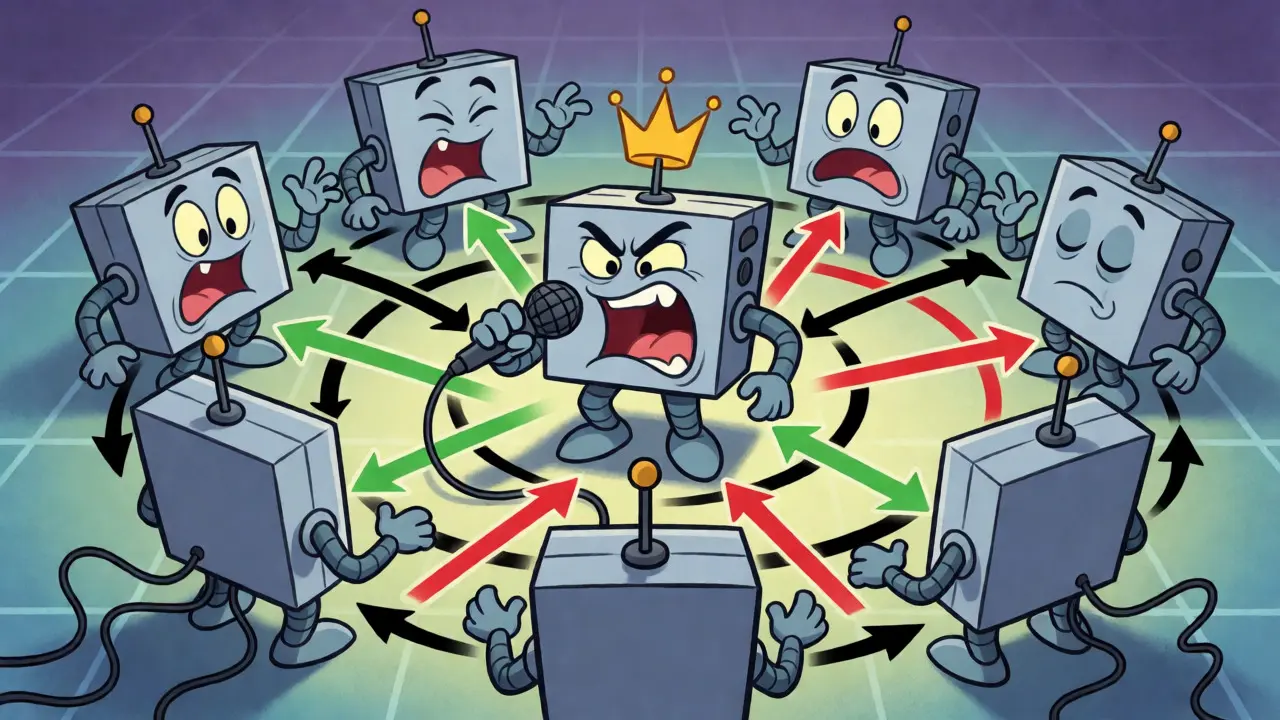
PBFT operates through a rigorous three-phase protocol involving a designated leader node called the "primary." The other nodes are "replicas" or backups. Here is how a transaction gets finalized:
- Pre-prepare Phase: The primary receives a request from a client and broadcasts a pre-prepare message to all replicas. This message includes a sequence number and a view number (which changes if the primary fails). Replicas check if they haven't already accepted a different sequence number for this view. If valid, they sign the message and pass it to the next phase.
- Prepare Phase: Each replica broadcasts a prepare message containing the digest of the pre-prepare message to every other replica. A replica enters the prepared state once it has collected $2f + 1$ matching prepare messages from distinct nodes. This step ensures that no two correct replicas commit different values.
- Commit Phase: Once prepared, replicas broadcast commit messages. When a replica collects $2f + 1$ matching commit messages, it considers the request committed. The result is then returned to the client. Only after this phase does the transaction become irreversible.
This process guarantees safety (all honest nodes see the same order) and liveness (the system continues to make progress), provided the network remains sufficiently synchronous. If the primary crashes or acts maliciously, the system triggers a "view change" protocol, electing a new primary and resetting the sequence numbers.
Why PBFT Matters for Blockchain and Enterprise Systems
In public blockchains like Bitcoin or Ethereum, trust is replaced by expensive computational work. Anyone can join, but finality takes minutes. In enterprise environments, such as banking consortia or supply chain networks, participants are known entities. They don't need to prove they spent electricity to participate; they need certainty that their records match their partners' records instantly.
This is where PBFT shines. It offers deterministic finality. Once a transaction is committed in PBFT, it cannot be reversed or forked away. Compare this to Proof of Stake or Proof of Work, where long-range attacks or reorganizations can theoretically alter history. For a bank settling interbank payments, waiting six blocks for confirmation is unacceptable. PBFT provides sub-second finality, making it ideal for high-frequency trading or real-time settlement systems.
Dr. Ari Juels, former Chief Scientist at Chainlink, noted that PBFT was the breakthrough that made Byzantine fault tolerance practical, though he highlighted that its quadratic communication complexity remains a hurdle for massive scale. Despite this, Gartner reports that PBFT-based systems meet strong consistency requirements for financial market infrastructure under regulations like MiFID II in Europe.
Limitations and Scalability Challenges
You might wonder, "If PBFT is so secure and fast, why isn't everyone using it?" The answer lies in scalability. PBFT requires every node to communicate with every other node during the prepare and commit phases. This creates an $O(n^2)$ communication complexity. As you add nodes, the number of messages grows exponentially, not linearly.
For example, moving from 10 nodes to 20 nodes quadruples the message load. Most PBFT implementations hit a performance wall around 100-200 validators. Beyond this, latency spikes dramatically. A developer working with Hyperledger Fabric reported that adding validators beyond 15 caused significant delays due to this message overhead. Furthermore, PBFT assumes a fixed set of validators. It struggles with dynamic membership-nodes joining or leaving frequently-which makes it unsuitable for permissionless networks where anyone can spin up a node anonymously.
Another vulnerability is Sybil attacks. Since PBFT relies on identity, if one adversary controls multiple validator identities, they can skew the consensus. This is why PBFT is almost exclusively used in permissioned settings where identities are vetted and managed centrally or via a governance body.

PBFT vs. Other Consensus Mechanisms
Choosing the right consensus mechanism depends on your specific needs. Here is how PBFT stacks up against common alternatives:
| Feature | PBFT | Proof of Work (PoW) | Raft/Paxos |
|---|---|---|---|
| Fault Type Handled | Byzantine (Malicious) | Crash & Byzantine (via cost) | Crash only |
| Finality | Immediate/Deterministic | Probabilistic | Immediate |
| Scalability | Low (O(n²)) | High (but slow) | Moderate |
| Network Type | Permissioned | Permissionless | Private/Internal |
| Energy Usage | Low | Very High | Low |
Notice that Raft and Paxos are faster and easier to manage but fail if nodes lie. PBFT handles lies but scales poorly. PoW handles open participation but is slow and energy-intensive. Modern variants like Tendermint (used by Cosmos) modify PBFT to improve scalability and handle dynamic validator sets better, bridging the gap between pure PBFT and public blockchain needs.
When Should You Choose PBFT?
You should consider PBFT if your project meets these criteria:
- Known Participants: All nodes are identified and vetted. There is no anonymity.
- Small Network Size: You expect fewer than 100 active validators.
- Need for Instant Finality: Your application cannot tolerate probabilistic finality or rollbacks.
- High Trust Environment: While malicious behavior is possible, total anonymity is not required.
Conversely, avoid PBFT if you are building a global, open platform where thousands of anonymous users might run nodes. In those cases, sharded PBFT hybrids or newer protocols like Avalanche or HotStuff are often better choices.
Can PBFT work on the public internet?
Technically yes, but it is risky. PBFT assumes bounded message delays (synchrony). On the public internet, delays vary wildly, which can cause timeouts and false failures. Most robust PBFT implementations use hybrid models or fallback mechanisms to handle network partitions gracefully.
Is PBFT energy-efficient?
Yes, PBFT is highly energy-efficient compared to Proof of Work. It relies on cryptographic signatures and message passing rather than computational puzzles. The energy cost is negligible relative to mining hardware.
What happens if the primary node fails?
The system detects the failure via timeouts and initiates a "view change" protocol. Honest replicas elect a new primary from the remaining nodes. During this transition, consensus pauses briefly until the new view is established, ensuring no data is lost.
Does PBFT prevent double-spending?
Yes. Because PBFT enforces a strict total ordering of transactions across all honest nodes, a double-spend attempt would require a majority of nodes to agree on two conflicting orders simultaneously, which is mathematically impossible within the $3f+1$ model.
How many nodes do I need for a basic PBFT setup?
You need a minimum of 4 nodes to tolerate 1 fault. However, for production reliability, most enterprises start with 7 nodes to tolerate 2 faults, providing a safer margin against simultaneous failures.
Great breakdown of the Byzantine Generals Problem! It's so important to remember that PBFT isn't just a theoretical exercise but a practical solution for permissioned ledgers. The distinction between probabilistic finality in PoW and deterministic finality here is crucial for enterprise adoption.
Stop overcomplicating it. The core issue is always trust. If you don't trust the nodes, use PBFT. If you do, use Raft. Simple as that. Why are we still debating this?
yeah totally agree with the points about scalability though
the O(n^2) complexity is a real killer when u try to scale past like 50 nodes... most folks dont realize how fast latency spikes until they hit production load
The article conveniently glosses over the fundamental flaw in PBFT: its reliance on synchrony assumptions which are violently violated in asynchronous WAN environments. By conflating 'bounded delay' with 'synchrony,' the author displays a profound ignorance of distributed systems theory. Furthermore, the dismissal of dynamic membership ignores the reality of modern cloud-native infrastructures where ephemeral nodes are the norm. This is not a limitation; it is a fatal architectural defect for any non-static network topology. Anyone suggesting PBFT for anything other than a static, small-scale consortium is engaging in cargo-cult engineering.
🙄 Another day, another expert explaining why their favorite algorithm is perfect and everything else is garbage. 🤦♀️ While Matthew makes valid points about asynchrony, he forgets that Hyperledger Fabric and others have patched these issues significantly. We don't need perfection, we need utility. 😌
Oh please, spare me the American arrogance thinking they can just slap a label on a math problem and call it solved. Ireland built the foundations of computer science while you were still figuring out how to count on your fingers. PBFT works because it respects structure, unlike your chaotic open networks.
I think the comparison table is really helpful for beginners. It clarifies exactly when you should pick PBFT vs Raft. Good job keeping it neutral.
Ugh, the sheer mediocrity of this discourse is suffocating.
We are discussing Byzantine Fault Tolerance, a concept rooted in the highest echelons of cryptographic rigor, and yet the comments section devolves into tribalism and shallow takes. The quadratic complexity isn't a 'killer'; it's a design trade-off that requires sophisticated sharding strategies to mitigate. To dismiss it as merely 'slow' is intellectually lazy. One must understand the interplay between view changes and message overhead before pontificating on its viability. Truly disappointing depth from this community.
Carey, did you write that in Word or PowerPoint? Your font size seems larger than everyone else's. Relax, it's just a blog post.
This is such an incredibly useful resource for anyone trying to navigate the confusing landscape of blockchain consensus mechanisms! I've been working on a supply chain project recently and we were stuck deciding between a public chain and a permissioned one, and reading through the explanation of the three-phase protocol really helped clarify why immediate finality matters so much for audit trails. It's fascinating how the mathematical constraints of 3f+1 nodes dictate the entire architecture of the system, forcing developers to think about fault tolerance in terms of specific numbers rather than vague concepts of security. I also appreciated the mention of Dr. Ari Juels and the regulatory context like MiFID II, which grounds the technical discussion in real-world business needs. It’s rare to find a post that balances deep technical detail with accessible language without dumbing down the complex ideas about liveness and safety guarantees. Definitely bookmarking this for my team!
They don't want you to know this: PBFT is being phased out by Big Tech to push proprietary consensus algorithms that require more data collection. 🕵️♂️ The 'view change' protocol is actually a backdoor for centralized control. Wake up! 👁️
Please respect the technical nuances here. The point about Sybil attacks is critical for our context in emerging markets where identity verification is hard. Without strict vetting, PBFT fails miserably. We learned this the hard way. 🙏
actually pbft is dead long live tendermint stop living in 1999
Teresa, saying something is 'dead' doesn't make it so. You're just repeating buzzwords you read on Twitter. Go read Castro and Liskov's original paper if you want to talk about legacy code.
There is a quiet elegance in the way honest nodes converge on truth despite chaos. It reminds me of how communities function-trust is earned through consistent action, not just declared intention. 🕊️