Remittance Cost Calculator
Send Money to Bangladesh
Calculate how much you save by using P2P crypto instead of traditional remittance services.
Based on 2025 data: Traditional services charge 3-8% fees, P2P crypto typically under 2%.
Important Notice
Remember: Crypto trading in Bangladesh is not legally protected. This calculator shows potential savings, not guaranteed protection. Always use Binance P2P escrow for maximum security.
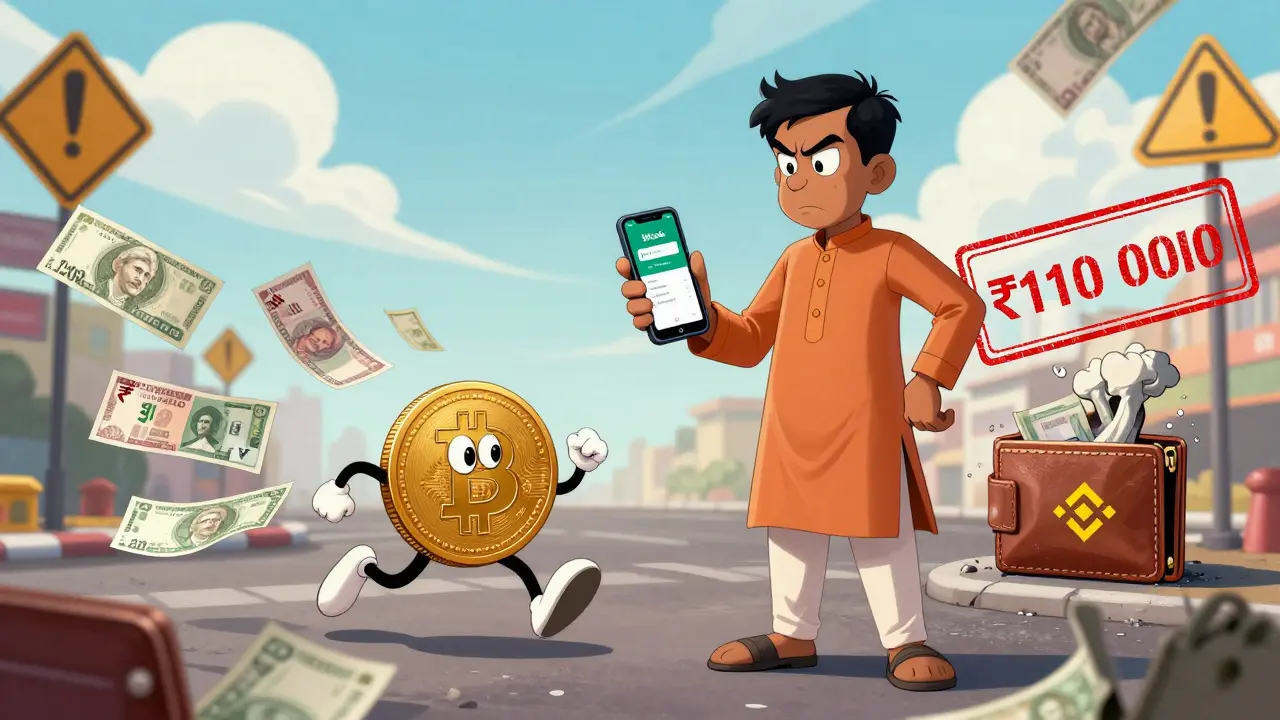
Despite being officially banned by Bangladesh Bank since 2014, peer-to-peer (P2P) crypto trading is alive and thriving across Bangladesh. Over 3.5 million people are using it-not because they’re tech rebels, but because it solves a real problem: sending money home. Every year, Bangladesh receives over $21 billion in remittances from workers overseas. Traditional services like Western Union charge 3% to 8% in fees. P2P crypto? Often under 2%. That’s why, even with government crackdowns, arrests, and blocked websites, people keep trading.
How P2P Crypto Trading Actually Works in Bangladesh
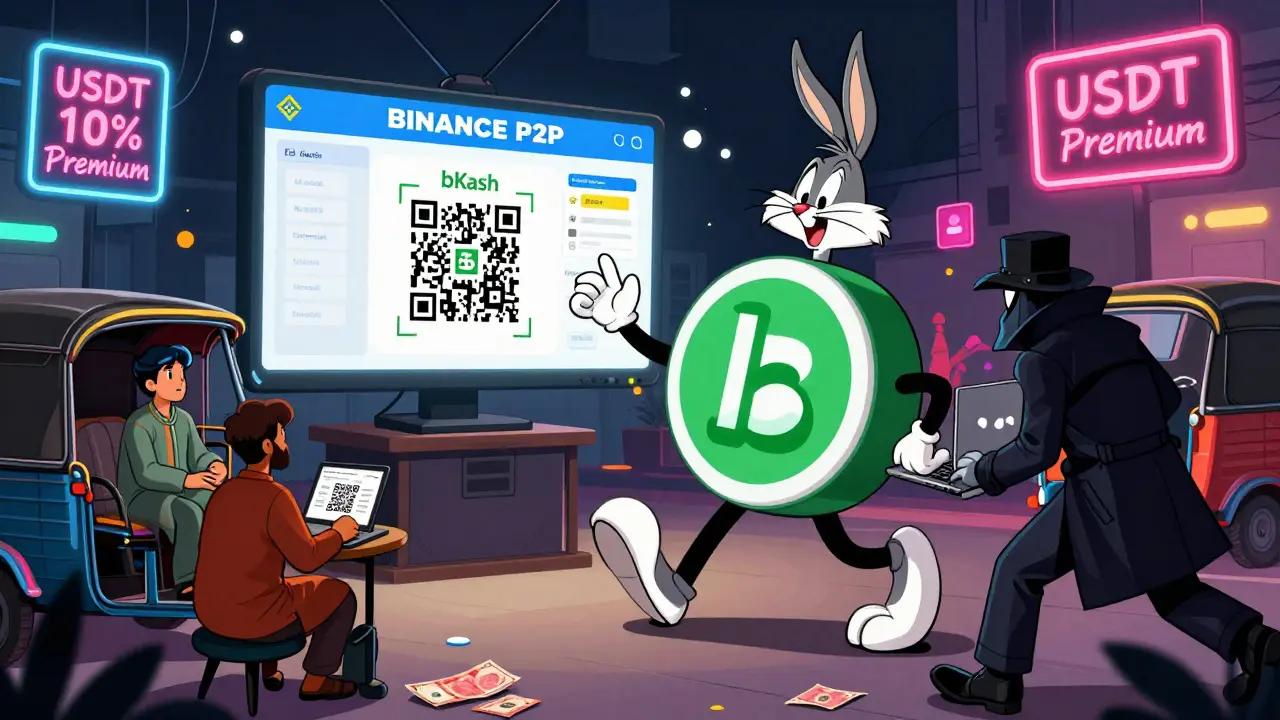
You won’t find a bank that lets you buy Bitcoin with Bangladeshi Taka. But you can buy it from a stranger using bKash or Nagad. Here’s how it works in practice:Most traders use Binance’s P2P platform. You create an account, verify your ID (KYC kicks in if you trade over $1,000), then browse offers from sellers. Say you want to buy $100 worth of USDT. You pick a seller offering it for ৳1,100 per $1 (a 10% premium). You click "Buy," transfer ৳110,000 via bKash, and send the payment screenshot. The platform holds the USDT in escrow. Once the seller confirms receipt, the crypto is released to your wallet. It takes about 8 minutes on average-even during peak hours.
What makes this work? Mobile money. Bangladesh has over 117 million active bKash and Nagad users. These apps are everywhere-villages, markets, rickshaw stands. You don’t need a bank account. You just need a phone. Traders use QR codes, UPI-style payments, or even cash deposits at agent kiosks. It’s fast, familiar, and avoids the banking system entirely.
The Three Main Ways People Trade Crypto in Bangladesh
There are three clear methods, each with trade-offs:- Exchange-based P2P (like Binance, Bybit): Used by 73% of traders. Escrow protection means you’re less likely to get scammed. Binance alone handles 1.2 million monthly trades from Bangladesh. Payment methods? bKash (61%), Nagad (29%), bank transfers (10%). Spreads are 1.2%-3.5% above market price.
- Informal agent networks: These are local people-often bKash agents-who buy and sell crypto for cash. No app needed. You meet them in person, hand over taka, get crypto in return. Spreads are higher (4%-8%), but it’s instant. There are over 12,000 registered agents in Dhaka alone. Risk? Zero protection. If they vanish, you’re out of luck.
- Decentralized exchanges (DEX) like PancakeSwap: Used by only 8% of traders. You need MetaMask, some technical know-how, and BNB for gas fees (about $0.15 per trade). It’s anonymous, no KYC, no middleman. But if you send crypto to the wrong address? Gone forever. And during peak times, the Binance Smart Chain gets slow.
Most beginners start with Binance P2P. It’s the safest entry point. Experienced traders mix methods-using DEX for anonymity, agents for cash, and Binance for volume.
Why People Risk It: Real Stories and Real Savings
The numbers tell one story. The people tell another.One user in Chittagong, "CryptoRiderBD," sent $5,000 to his brother in Dubai. Using Western Union, it would’ve cost $400 in fees. Through Binance P2P, he paid $217. That’s $183 saved in one transaction. He’s done it five times this year.
Another trader, a nurse in Saudi Arabia, uses bKash to send money home every payday. Her sister cashes out via Nagad at a local agent. No delays. No paperwork. No bank waiting times. "I used to wait three days for money to arrive," she said in a Facebook group. "Now it’s 10 minutes. I don’t care if it’s illegal-I care that my family eats."
But it’s not all smooth. One trader in Dhaka lost ৳250,000 ($2,300) when an agent reversed the bKash payment after receiving Bitcoin. He had no proof. No recourse. Binance’s escrow wouldn’t help-he didn’t use their platform.
Another common issue? Transaction limits. Nagad blocks transfers above ৳50,000 if they trigger fraud algorithms. Users have learned to split payments into smaller chunks-three ৳40,000 transfers instead of one ৳120,000. It’s annoying, but it works.
The Legal Trap: You’re Not Protected
This is the biggest risk no one talks about enough.Bangladesh Bank says crypto trading violates Section 33 of the Foreign Exchange Regulation Act. That’s not a warning-it’s a criminal offense. In 2022, 17 traders in Dhaka were arrested under Section 411 of the Penal Code for "possessing stolen property." Their crime? Owning Bitcoin.
There’s no legal recourse if you’re scammed. No consumer protection agency. No ombudsman. If you send taka and the seller ghosts you, the police won’t help. Banks won’t reverse the transaction. You’re on your own.
Even using Binance’s escrow doesn’t make you safe from the law. In 2024, Bangladesh Bank ordered banks to freeze any mobile money account that shows suspicious crypto-linked activity. Over 1,800 accounts were frozen in Q4 alone. Your bKash balance could vanish overnight-not because you did anything wrong, but because the system flagged it.
And the crackdowns are getting worse. Between October 2024 and January 2025, authorities raided 87 crypto trading hubs in Dhaka and Chittagong. They seized laptops, phones, and servers worth ৳32 million. The message is clear: the government is watching.
What You Need to Get Started (Step-by-Step)
If you’re new and still want to try it, here’s how to do it safely:- Create a Binance account. Use a real ID. Don’t use a fake name. You’ll need it for KYC if you trade over $1,000.
- Link your bKash or Nagad. Go to the P2P section, select "Buy," pick a seller who accepts your payment method. Follow the instructions exactly. Don’t use "Cash In"-use "Send Money" in bKash. Many rejections happen because people pick the wrong option.
- Start small. First trade? Do ৳7,500. That’s about $70. Test the process. See how long it takes. Check the seller’s rating. Look for someone with 98%+ positive feedback and 1,000+ completed trades.
- Enable 2FA. Every single user should. 98% of traders do. Use Google Authenticator, not SMS.
- Join the "Crypto BD Guide" Telegram channel. 47,000 members. They update daily with lists of scam agents, payment issues, and new workarounds. It’s the most reliable source of real-time info.
Learning curve? Around 17.5 hours for a complete beginner. Most people get stuck on KYC or payment failures. Don’t give up. Ask for help in the Telegram group. Someone’s been there.

The Future: Regulation or Crackdown?
The government isn’t ignoring this. In February 2025, they formed a 12-member Crypto Asset Task Force, led by Bangladesh Bank’s Deputy Governor. Their goal? To recommend a regulatory framework by December 2025.Meanwhile, Bangladesh Bank is testing its own digital currency-the CBDC. If that pilot succeeds, it could mean one of two things: either the government embraces digital money and creates legal pathways for P2P trading… or it doubles down on banning anything that competes with its own system.
Right now, P2P crypto is growing fast. Volume hit $417 million in Q1 2025-up 38% from last year. Most trades are in USDT because it’s stable. 68% of users are under 35. 83% live in cities. This isn’t a fringe movement. It’s a financial workaround built by millions of ordinary people.
But here’s the truth: if the government cracks down hard next year, this could collapse overnight. No warning. No transition. Just frozen accounts, seized devices, and arrests.
Until then? People will keep trading. Because for them, it’s not about speculation. It’s about survival. It’s about sending money home faster, cheaper, and without begging a bank for permission.
What’s Next for Traders?
If you’re already trading:- Don’t keep large amounts on exchanges. Move crypto to your own wallet (like MetaMask) after each trade.
- Use only verified agents. Check the Telegram blacklist before meeting anyone.
- Never share your 2FA codes or wallet seed phrases. Ever.
- Keep screenshots of every transaction. Even if you think it’s fine.
- Be ready to walk away if things feel off. If a seller pressures you, if the payment feels rushed, if they refuse to use escrow-stop.
If you’re thinking about starting? Do it small. Learn. Watch. Listen. The community is your best teacher.
There’s no legal safety net. No government backing. But there is a network of people-ordinary, resourceful, determined-who’ve built a system that works, despite the rules.
Is P2P crypto trading legal in Bangladesh?
No, it’s not legal. Bangladesh Bank has banned cryptocurrency transactions since 2014 under the Foreign Exchange Regulation Act. Trading crypto using taka violates Section 33. While enforcement is inconsistent, arrests and account freezes have happened. You have no legal protection if you’re scammed.
Can I use bKash or Nagad to buy crypto?
Yes, and most people do. Binance P2P accepts bKash in 61% of trades and Nagad in 29%. You send money through the app, upload a screenshot, and the seller releases crypto. But be careful: banks and mobile wallets can freeze your account if they detect crypto-related activity, even if you didn’t do anything wrong.
Which platform is best for P2P trading in Bangladesh?
Binance is the most popular, with 61% market share. It offers escrow protection, bKash/Nagad integration, Bengali support, and high liquidity. Bybit is good for margin trading, and KuCoin has more altcoins. But for beginners, Binance P2P is the safest and easiest option.
How long does a P2P trade take?
On average, 8.2 minutes during peak hours. Most trades finish in under 15 minutes. But during holidays like Eid, delays can stretch to 47 minutes because mobile banking systems overload. Always allow extra time around major festivals.
What’s the biggest risk in P2P crypto trading?
The biggest risk is not losing money to a scammer-it’s losing everything to the law. Your bank account can be frozen. Your phone can be seized. You can be arrested. Even using Binance’s escrow doesn’t protect you from government action. The second biggest risk is agent fraud-especially with cash deals. Always use escrow when possible.
Should I use a decentralized exchange (DEX) like PancakeSwap?
Only if you’re technically experienced. DEXs like PancakeSwap don’t require KYC and offer anonymity, but they’re harder to use. You need MetaMask, BNB for gas fees, and the ability to copy-paste wallet addresses correctly. Mistakes cost money. 32% of DEX trades fail due to network congestion. For most people, Binance P2P is safer and simpler.
What should I do if I get scammed?
If you used Binance P2P, open a dispute immediately. Platform support usually responds within 12 hours and can recover funds if you followed the rules. If you dealt with an informal agent? There’s no recourse. Report it to the "Crypto BD Guide" Telegram group so others can avoid them. File a police report if you want, but don’t expect results. The system doesn’t protect crypto users.
Will crypto be legalized in Bangladesh soon?
Not in the near term. The government is focused on launching its own digital currency (CBDC). A task force is working on recommendations for crypto regulation, but their goal isn’t to legalize trading-it’s to control it. If they approve anything, it’ll likely be tightly restricted, with heavy oversight. Don’t expect legalization before 2027, if ever.
This is why innovation happens when people are desperate. No bank? No problem. Just use your phone. 🙌
I'm from India and I see so many parallels here. UPI, Paytm, and now crypto P2P-it’s the same story. People just want to move money without bureaucracy. The system fails them, so they build their own. It’s beautiful, really.
I mean, it’s not illegal if no one’s watching, right? The government’s crackdowns are just theater. They know they can’t stop it. The real question is why they’re so afraid of something that helps people.
So let me get this straight-people are risking jail time to save $200 on wire fees? And you call this ‘survival’? No, this is financial illiteracy wrapped in a moral loophole. Someone’s gonna get arrested for using bKash to buy Dogecoin and then we’ll all laugh at the headlines.
I tried this last year. Sent ৳45k via Nagad. Seller vanished. Binance said ‘no dispute possible’ because I didn’t use their ‘Buy’ button correctly. I was so mad I cried in a parking lot. Don’t trust anyone. Not even the platform.
i just want to say thank you for writing this. my cousin in dhaka uses this to send money to his mom every month. she’s diabetic and needs medicine. he doesn’t care if it’s illegal-he cares that she’s alive. that’s not rebellion. that’s love.
There’s a quiet revolution happening here. Not in the streets, not in the parliament-but in the quiet glow of a phone screen at 2 a.m., where a young man in Sylhet sends $100 to his sister in Cox’s Bazar, and for a moment, the state doesn’t exist. That’s the real power of decentralization: it doesn’t need permission to be human.
I’ve read a lot about crypto in the Global South. This is the most grounded, least hype-filled piece I’ve seen. Thank you for showing the real trade-offs-the fear, the ingenuity, the quiet courage.
It is profoundly moving to witness how communities, in the absence of institutional support, create their own systems of care and resilience. The fact that individuals are risking legal consequences to ensure their families receive timely financial support speaks not to lawlessness, but to a deeply rooted moral imperative. This is not a workaround-it is a redefinition of financial dignity.
Let’s be honest: if this were happening in the U.S., it’d be hailed as fintech innovation. But because it’s Bangladesh? It’s ‘illegal.’ The hypocrisy is staggering. We celebrate blockchain in Silicon Valley and criminalize it in Dhaka. Same tech. Different continent. Different moral calculus.
So what happens when the CBDC launches? Do they just replace bKash with a state-run wallet? Or do they let people keep using crypto as long as they pay taxes? I’m betting on the latter. Governments don’t kill innovation-they tax it.
I love how everyone acts like this is some kind of underground rebellion. Nah. It’s just capitalism with a better UX. People don’t care about decentralization-they care about speed, cost, and reliability. If the bank took 8 minutes and charged 0.5%, this wouldn’t exist. It’s not ideology. It’s convenience. 🤷♀️
I’m so proud of these people. They’re not criminals. They’re engineers of survival. Every time someone sends money home via bKash, they’re building a new kind of bank-one that doesn’t ask for paperwork, doesn’t judge, and doesn’t look away. 💪❤️
The most heartbreaking part? The people who get arrested aren’t the big operators. They’re the nurses, the drivers, the students trying to help their parents. The system punishes the vulnerable for trying to survive. And the people who profit from the status quo? They’re never touched. This isn’t about law. It’s about power.
Beginners: Start with $70. Test the flow. Watch the seller’s history. Use 2FA. Save screenshots. Join the Telegram group. You’ll be fine. This isn’t gambling-it’s a skill. And like any skill, it gets easier with practice.
Oh wow. So the solution to Bangladesh’s financial exclusion is… using a foreign platform that’s technically illegal, with no recourse, and relying on strangers who could vanish? And you call this ‘innovation’? I call it a disaster waiting for a headline. The next time someone gets arrested for trading crypto, don’t come crying to me about ‘freedom’.
I’m so glad you included the real stories. Not the stats. Not the spreads. The nurse who just wants her family to eat. That’s what matters. We can debate legality all day-but we can’t debate humanity.
I’ve been trading P2P for 3 years. Used to be scared. Now I just laugh. The government’s trying to stop a tide with a broom. They don’t get it-this isn’t about Bitcoin. It’s about dignity. And dignity doesn’t need a license.
This is why America needs to stop pretending it’s above this. We’ve got people using Cash App to send crypto to Mexico. We’ve got people in Puerto Rico using USDT to pay rent. We’re all just trying to bypass broken systems. But somehow, when it’s Bangladesh, it’s ‘illegal.’ When it’s us? It’s ‘financial freedom.’ Hypocrites.