
For over a decade, if you tried to buy Bitcoin at a bank in Amman, the teller would likely shake their head and point to a sign from the Central Bank of Jordan is the monetary authority responsible for issuing currency and regulating financial institutions in Jordan. Since 2014, the CBJ issued warnings that effectively banned banks from touching digital assets. The fear was real: volatility, fraud, and money laundering made regulators nervous. But the landscape has flipped completely. As of September 2025, Jordan no longer bans crypto transactions; it regulates them. This shift marks one of the most significant policy reversals in the Middle East and North Africa (MENA) region, moving from strict prohibition to a structured legal framework that invites innovation while keeping a tight grip on stability.
The Shift from Ban to Regulation
The turning point was the enactment of Law No. 14 of 2025 is the Virtual Assets Transactions Regulation Law enacted in Jordan on September 14, 2025. Before this law, peer-to-peer trading continued in the shadows, often through informal channels or social media groups. Now, there is a clear path forward. The law doesn't just lift the ban; it creates a specific environment where Virtual Asset Service Providers are companies licensed to offer services like exchange, custody, and advisory for virtual assets (VASPs) can operate legally. This change signals that Jordan wants to be part of the global fintech conversation, not an outlier hiding from it.
This isn't just a technicality. It changes how businesses plan and how individuals access markets. The government, led by high-level figures like Deputy Governor Ziad Ghanma of the CBJ, actively pushed this legislation through the Senate. Their goal? To close regulatory gaps and align Jordan with international standards, ensuring that the country doesn't miss out on the digital economy boom happening right next door in the UAE.
What Banks Can and Cannot Do
You might think the ban is gone means banks can now do everything crypto-related. Not quite. Article 11 of Law No. 14 sets specific boundaries. Licensed banks in Jordan are permitted to engage in two main activities:
- Exchange Services: Swapping virtual assets for fiat currency (like the Jordanian Dinar).
- Custodial Services: Holding digital assets securely for clients.
However, there is a major catch. Banks are not authorized to provide transfer services for virtual assets. Why? It’s a monetary policy safeguard. The CBJ wants to ensure that capital movement remains linked to the existing banking infrastructure and the Dinar, preventing the creation of a parallel, unregulated crypto-only economy. If you want to move crypto between wallets without touching fiat, you’ll likely need to use a specialized VASP rather than your traditional bank.

The Licensing Game: Who Gets the Green Light?
Getting into the game now requires more than just setting up a website. The new framework mandates rigorous compliance. VASPs must obtain licenses and meet strict criteria. Here is what that looks like in practice:
- Know Your Customer (KYC): Comprehensive identity verification for all users.
- Enhanced Due Diligence: Extra scrutiny for high-risk transactions or large amounts.
- Suspicious Activity Reporting: Mandatory reporting to authorities if something looks off.
- Regular Audits: Ongoing checks to ensure compliance with anti-money laundering (AML) rules.
This level of oversight mirrors traditional banking standards. It raises the barrier to entry, which protects consumers from scams but also means smaller, less compliant players will struggle to survive. The Jordan Securities Commission oversees the investment side, while the Anti-Money Laundering Unit ensures the books are clean. This multi-agency approach shows a whole-of-government commitment to getting it right.
Penalties for Playing in the Gray Area
Remember when buying crypto through an unverified friend on Telegram was common? That era is ending. Article 15 of the law introduces serious criminal liability for violations. If you operate a virtual asset business without a license, the consequences are steep:
- Imprisonment for at least one year.
- Fines ranging from 50,000 to 100,000 Jordanian Dinars.
- Closure of business premises.
- Confiscation of equipment.
This is a sharp pivot. What was once a gray area is now a black-and-white legal risk. While ambiguity still exists regarding whether individual users of unlicensed services face personal liability, the message for businesses is clear: get licensed or get shut down. This clarity helps build trust in the market, as investors know the rules of the game are enforced.
Jordan vs. The Region: A Strategic Move
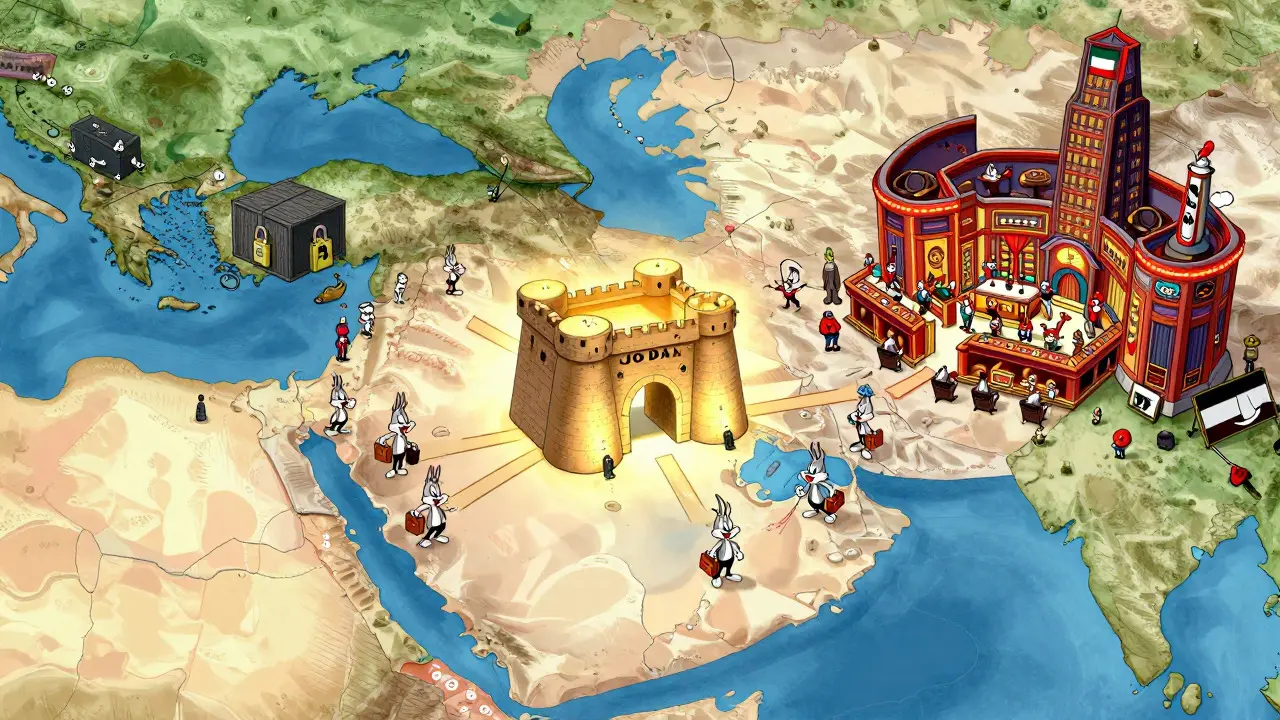
To understand why this matters, look at the neighbors. Countries like Kuwait, Egypt, and Iraq still prohibit virtual assets entirely. Meanwhile, the UAE has become the regional hub, hosting over 500,000 daily crypto traders under a robust federal framework. Jordan’s move positions it strategically. By removing itself from the FATF grey list in October 2023 and achieving 'Compliant' ratings on 32 of 40 recommendations, Jordan proved its AML systems work. Now, with Law No. 14, it’s leveraging that credibility to attract fintech innovation.
| Country | Status | Key Feature |
|---|---|---|
| Jordan | Regulated (2025) | Law No. 14 allows licensed exchanges/custody; banks restricted from transfers. |
| UAE | Highly Regulated | Multi-layered federal framework; major regional hub. |
| Kuwait | Prohibited | No legal framework for retail/institutional use. |
| Egypt | Prohibited | Banks barred from facilitating transactions. |
Jordan isn't trying to outdo the UAE in volume; it’s aiming to be a reliable, compliant gateway for the wider region. The maintenance of the FinTech Regulatory Sandbox since 2018 helped test these ideas before they became law. This practical approach reduces the risk of bad policy and builds confidence among international investors who value stability over hype.
What This Means for You
If you’re a trader, investor, or business owner in Jordan, the days of uncertainty are over. You now have a legal framework to rely on. For individuals, this means safer access to markets through licensed providers. For businesses, it opens doors to integrate digital assets into operations, provided you navigate the licensing requirements. The learning curve for traditional institutions entering this space involves understanding blockchain technology and digital wallet management, but the payoff is access to a growing digital economy.
The road ahead isn’t without challenges. Integrating decentralized systems with traditional finance takes time. Competition from emerging hubs is fierce. But by establishing clear rules early, Jordan is positioning itself to benefit from the long-term growth of digital assets. The question is no longer if crypto will be part of Jordan’s financial future, but how fast the ecosystem can scale within these new boundaries.
Is cryptocurrency legal in Jordan now?
Yes. As of September 2025, cryptocurrency is legal under Law No. 14 of 2025. However, it is regulated. Businesses must be licensed as Virtual Asset Service Providers (VASPs), and banks have limited roles in the process.
Can Jordanian banks transfer crypto directly?
No. Under Article 11 of Law No. 14, banks are permitted to exchange virtual assets for fiat and offer custodial services, but they are not authorized to provide direct transfer services for virtual assets. This restriction aims to keep capital flows tied to the national banking system.
What happens if I trade crypto without a license?
If you operate a business dealing in virtual assets without a license, you face criminal penalties including imprisonment for at least one year, fines of 50,000-100,000 JOD, and potential confiscation of equipment. Individual user liability is still being clarified, but operating unlicensed services is strictly prohibited.
How does Jordan compare to the UAE in crypto regulation?
The UAE is currently the larger hub with over 500,000 daily traders and a mature federal framework. Jordan is newer to comprehensive regulation but offers a strong, stable alternative with strict AML compliance. Jordan aims to be a compliant gateway for the region rather than competing solely on volume.
Does the law cover stablecoins or CBDCs?
Law No. 14 specifically excludes digital securities, digital financial assets, and central bank digital currencies (CBDCs) from its scope. These categories await separate regulatory treatment, indicating that the current law focuses primarily on standard cryptocurrencies and tokens used for payment or investment.
honestly this is a huge deal for the region. i never thought jordan would actually make the jump from banning it to regulating it so fast. feels like they are finally waking up to the fact that you cant just ignore what people are doing in their backyards
another step toward global financial enslavement! They think if they let these digital ponzi schemes in the door, we will all be better off? It is obvious the central banks are working with the big tech guys to strip mine our wealth through volatility and hidden fees. The Dinar was stable because they controlled it now they are opening the floodgates for foreign capital to drain the country dry. Wake up people the crypto ban was there to protect us from the shadowy elites who want to track every single transaction you make
i mean its not like they have much of a choice right? look at the uae next door pulling in all the fintech money. if jordan stays behind too long they will lose out completely. seems like a smart move to me to catch up before its too late
:) Just to add some context for those not familiar with the mechanics here, the restriction on banks handling transfers is actually quite standard in early-stage regulation. It prevents a 'shadow banking' system where fiat currency gets completely decoupled from the central bank's monetary policy controls. By forcing the exchange to happen through licensed VASPs or banks, but keeping the transfer layer separate, they maintain oversight on where the money enters and leaves the system. It’s a bit more complex than just 'legal vs illegal' but it creates a safer environment for retail investors who might otherwise get scammed by unregulated exchanges.
Oh, how delightful. The Middle East descends into the chaotic abyss of speculative gambling, and naturally, the common man must suffer while the elite count their coins. This is precisely why nations fail; they abandon the sanctity of traditional finance for the whims of the digital masses. One can only imagine the sheer incompetence required to draft such a law without realizing it merely invites fraud under a new banner. The audacity of these bureaucrats to believe they can regulate the unregulable is simply breathtaking in its arrogance. We shall see if this 'innovation' brings prosperity or merely another wave of insolvency. Let them play with their shiny objects while the real economy crumbles beneath their feet. It is a spectacle of modern folly, unworthy of serious consideration by any rational mind. The end result will likely be a disaster, as history has repeatedly shown when governments tinker with markets they do not understand. Prepare for the inevitable correction, dear reader. The bubble is already forming, and when it bursts, it will take everyone down with it. A tragic, predictable outcome for a nation chasing ghosts. Do not say you were not warned by the prophets of prudence.
sooo excited about this!! 🎉🎉 it feels like the whole region is shifting gears and jordan is finally getting in on the action which is awesome for anyone living there or doing business across borders. i love seeing countries actually try to create a framework instead of just slapping a ban on everything because its scary. its gonna open up so many doors for startups and even just regular folks wanting to invest safely without worrying about the police knocking on their door 😊✨ really hoping this leads to more local innovation and less reliance on offshore platforms!
You know what your problem is? You're celebrating a loophole for money launderers. :P These 'innovations' are just a way for the rich to hide their dirt while the rest of us pay the tax bill. I bet half these new 'licensed' companies are just fronts for old families to move cash around without scrutiny. Don't be fooled by the fancy language, it's still a rigged game and the little guy always loses. Stay vigilant people, don't let them trick you into thinking freedom means chaos.
The essence of this transition is not merely legal but spiritual... it is the soul of the market awakening from its slumber of prohibition. When we speak of regulation we speak of order imposed upon chaos yet true wisdom lies in understanding that both are necessary facets of the human experience. The ban was a shield against the unknown but now the sword of clarity has been drawn. Is it not fascinating how fear transforms into structure? The individual trader now walks a path illuminated by the light of statutory compliance rather than the dark shadows of uncertainty. This is the evolution of economic consciousness. We must reflect deeply on whether this progress serves the greater good or merely the interests of the few who hold the licenses. The journey of the dinar and the bitcoin intertwine in a dance of destiny. Let us not forget that every regulation is a promise made by the state to its citizens. Will this promise be kept or broken by the winds of change? Only time and the collective spirit of the people will tell. Embrace the uncertainty for it is the mother of all creation.
Did you read article 11 properly? Banks can't do transfers. That's a huge limitation. It means if you want to send crypto to a friend abroad you still need a third party VASP. It's not fully open like people are making it sound. The government is still holding the leash tight to keep control over capital flight. Smart move for them but bad for pure decentralization fans. Don't get your hopes up that this makes Jordan a free-for-all crypto haven. It's a regulated sandbox, nothing more. Read the fine print before you start dreaming about becoming the next Dubai overnight.
finally some sense! i am so tired of hearing about how america is the leader in everything when its clear as day that the middle east is way ahead of us in terms of actual implementation. we are still stuck in congress arguing over definitions while jordan passes a whole new law. it shows our politicians are either incompetent or bought off by the old guard banks who dont want competition. shame on us for being so slow. maybe if we listened to the world instead of just ourselves we wouldnt be falling behind in the digital race. wake up america we are losing ground fast and no one in washington cares
One must observe the intricate regulatory architecture with a degree of scholarly detachment. The juxtaposition of strict custodial mandates against the prohibition of direct transfer services suggests a nuanced approach to monetary sovereignty preservation. It is a calculated risk, balancing the imperative of international competitiveness against the internal stability of the national currency. The licensing regime, whilst rigorous, appears to mirror the Basel III standards for systemic importance, albeit applied to a nascent asset class. However, the enforcement mechanisms remain somewhat opaque, raising questions regarding the operational capacity of the supervisory bodies to handle the velocity of digital transactions. The exclusion of CBDCs from the immediate scope is a pragmatic concession, acknowledging the technological immaturity of such systems in the current fiscal climate. Ultimately, this legislation serves as a barometer for regional economic confidence, signaling a shift from protectionism to selective integration within the global digital economy. The long-term viability hinges on the interoperability between legacy banking infrastructure and emerging blockchain protocols, a challenge that remains largely unresolved in contemporary discourse.
It is highly probable that this legislative maneuver is less about genuine innovation and more about appeasing international investors who are currently favoring the UAE. The timing is suspiciously aligned with recent geopolitical shifts in the region, suggesting a strategic pivot rather than an organic development. One must consider the possibility that the 'regulation' is merely a facade to allow specific, well-connected entities to monopolize the new market. The public interest is rarely the primary driver in such high-stakes financial restructurings. History has shown us that when states embrace volatile assets, the burden of instability falls disproportionately on the lower-income demographics. Therefore, skepticism is not merely warranted; it is essential for maintaining critical distance from official narratives. The true test will be whether the promised consumer protections materialize or if they serve only to legitimize predatory practices under a veneer of legality. Until then, caution is the paramount virtue for any rational observer.
Meh. Another country jumping on the bandwagon. 🙄 It’s not like they’re inventing anything new, just copying whatever works in Singapore or Switzerland. The penalties seem harsh though, jail for trading without a license? That’s pretty extreme for something that used to be a gray area. I guess it depends on how strictly they enforce it. If they crack down hard, it’ll kill the small players, which is probably the goal. But will it attract the big whales? Doubtful. They’ll stay in places with more liquidity and fewer red tape. Still, better than a total ban, I suppose. At least now there’s a rulebook. Whether anyone follows it is another story entirely. 😒
THIS IS SO COOL!!! 🚀 Finally some good news from the region! I have been waiting for this for years. It means we can actually build things here without worrying about getting arrested. Imagine all the new apps and services we can create. It is going to be amazing for jobs too. Let’s go Jordan! 🇯🇴💪
Listen up everyone! This is a massive opportunity and you need to act fast. The window is open now but it won't stay wide forever. Get your licenses sorted, check your compliance, and get ready to launch. The first movers will win big here. Don't sleep on this. The infrastructure is being built right now and if you wait until it's perfect you'll be left behind. Start small, learn as you go, but START NOW. The future belongs to those who prepare for it today. Go get it! 🔥