
Imagine owning a piece of a $10 million office building in New York-not as a shareholder in some distant fund, but as a direct owner of 10 digital tokens, each worth $1,000. You can sell them anytime, track their value in real time, and know exactly who owns what-all without a bank, lawyer, or paperwork stack. This isn’t science fiction. It’s RWA tokenization-and it’s already changing how money moves in the real world.
What Exactly Is RWA Tokenization?
RWA stands for Real-World Asset. That means anything with actual value outside the digital world: a building, a piece of art, a bond, a barrel of oil, even future income from music royalties. Tokenization turns these into digital tokens on a blockchain. Each token represents a claim on a portion of the asset. It’s like slicing a pie into tiny pieces and giving each slice a unique digital ID that can’t be forged or duplicated. This isn’t just about making things digital. It’s about fixing deep problems in traditional finance. Think about buying a house. It takes weeks, dozens of documents, middlemen, fees, and delays. With tokenization, ownership transfers in minutes. The system records every change on a public ledger. No one can alter it. No one needs to trust a third party-because the code does the work.The Five Steps Behind the Scenes
Tokenizing a real asset isn’t magic. It’s a structured process with five clear steps.- Choose the asset. What are you turning into tokens? Real estate? Gold? Corporate bonds? The asset must be legally owned, clearly valued, and eligible for fractional ownership. Not everything qualifies. A family car? Probably not. A commercial building with steady rent? Absolutely.
- Decide on the token type. Most RWAs use ERC-20 tokens-fungible, meaning each token is identical. If you own 50 tokens of a $1 million property, you own 5% of it. For unique items like a rare painting, you’d use ERC-721, where each token is one-of-a-kind. Newer standards like ERC-3643 are designed for regulated assets, adding built-in rules for who can buy or sell.
- Pick the blockchain. Ethereum is the most common. It’s secure, widely used, and supports smart contracts. But it’s slow and expensive for high-volume trading. Some projects use private blockchains for compliance, especially banks. Others use Layer 2 networks like Polygon for faster, cheaper transactions. The choice depends on speed, cost, and legal requirements.
- Connect to real-world data. This is the trickiest part. A token is only as good as the asset behind it. How do you prove the building still exists? That the gold is in the vault? That’s where oracles come in. Chainlink is the industry leader here. It pulls verified data from trusted sources-like property registries or audit reports-and feeds it onto the blockchain. Without this, the token is just a digital promise.
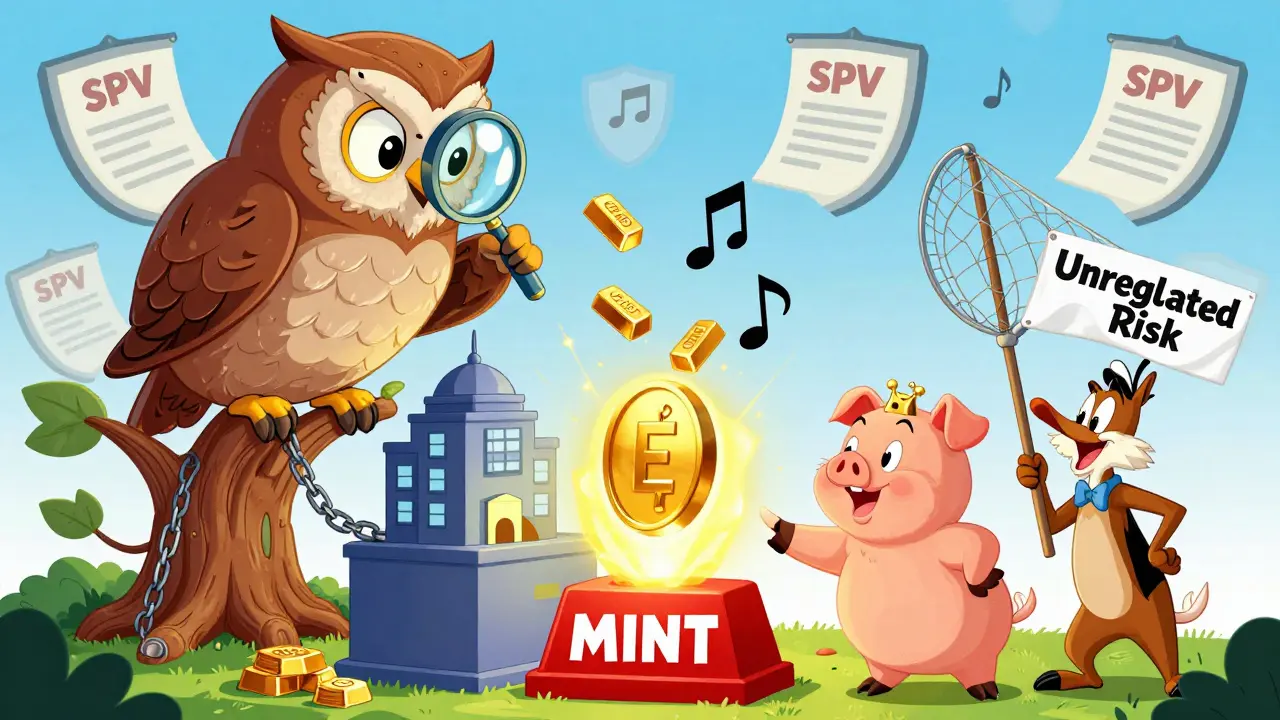
- Issue and lock the asset. The tokens are minted using a smart contract. But the real asset? It has to be held securely. That’s usually done through a Special Purpose Vehicle (SPV)-a legal entity created just to own the asset. The SPV holds the deed, the gold, the bond certificates. The tokens represent ownership of the SPV. This legal layer is non-negotiable. No one wants to buy a token if they can’t prove they own the real thing.
Why This Changes Everything
The benefits aren’t theoretical. They’re measurable. Take real estate. A $1 million property tokenized into 1,000 tokens lets someone invest $500 instead of $1 million. That opens up access to people who never could’ve bought property before. In 2023, RealT tokenized a $22 million commercial building. Settlement time dropped from 30+ days to under 24 hours. Transaction fees fell from 5-7% to 1-2%. That’s not a small improvement-it’s a revolution. Same with bonds. Franklin Templeton tokenized $340 million in money market funds in late 2023. Investors now receive dividends automatically, every day, without waiting for bank processing cycles. BlackRock launched BUIDL in March 2024, a tokenized fund that lets institutions trade bond exposure like crypto. And it’s not just big players. Artists are tokenizing music royalties. One musician raised $3.2 million from 1,200 small investors by selling tokens that paid a share of streaming income. That’s democratization-real, tangible, and happening right now.The Hidden Challenges
Don’t get fooled by the hype. This isn’t a free pass. There are real, serious roadblocks. First, regulation. The U.S. SEC has launched 17 enforcement actions against unregistered RWA projects. In Europe, MiCA (Markets in Crypto-Assets) became law in June 2024, setting the first clear rules. But globally? It’s a patchwork. A token that’s legal in Singapore might be illegal in Brazil. That’s why 78% of failed RWA projects collapsed due to legal issues, not tech. Second, custody. Who holds the real asset? If the SPV goes bankrupt, or the vault gets robbed, what happens to your tokens? Most platforms still rely on centralized custodians. That defeats part of the point of blockchain. Some are building decentralized custody solutions, but they’re early stage. Third, liquidity. Tokens on one blockchain can’t easily trade on another. A real estate token on Ethereum can’t be swapped for one on Solana without a bridge-and bridges are risky. Chainlink’s CCIP 2.0, launched in early 2024, helps by letting tokens move across 14 chains. But adoption is still slow. And finally, trust. Reddit users in r/defi report that 63% of negative experiences involve custody verification issues. People worry: “Is this really backed?” The answer depends on the issuer. Some are transparent. Others? Not so much.
Who’s Leading the Charge?
This isn’t a fringe experiment. Big finance is in. - JPMorgan uses its JPM Coin for instant interbank settlements. It’s not public, but it proves institutions trust blockchain for asset movement. - BlackRock and Franklin Templeton are tokenizing trillions in assets. - Chainlink powers 89% of all RWA oracle services. Without it, most tokenized assets would be unverifiable. - Tokeny and Securitize handle compliance, legal structure, and investor onboarding. Securitize alone manages over $1.2 billion in tokenized assets. Retail investors aren’t left out. Platforms like RealT and Propy let you buy fractional real estate tokens with a credit card. In 2024, retail participation grew 45% year-over-year.What’s Next?
The next big leap? Integration with Central Bank Digital Currencies (CBDCs). Imagine buying a tokenized bond and paying for it instantly with a digital dollar or digital euro-settled in seconds, with zero counterparty risk. Trials are already underway in Singapore and Switzerland. The Bank for International Settlements says this could cut settlement risk by 90%. The World Economic Forum predicts tokenized assets could add $16 trillion to the global economy by 2030. McKinsey agrees. But that future depends on solving three things: global regulation, secure custody, and cross-chain liquidity. Right now, the market is worth $13.5 billion. By 2030, it could hit $2 trillion-or even $16 trillion. The difference? Execution. The tech is ready. The legal and trust frameworks are catching up. The question isn’t if this will grow. It’s how fast.What kinds of assets can be tokenized on blockchain?
Almost any asset with measurable value and legal ownership can be tokenized. Common examples include commercial real estate, residential properties, fine art, gold and other commodities, corporate bonds, government treasury securities, and even intellectual property like music royalties or patents. The key requirements are clear title, verifiable value, and legal permission for fractional ownership. Personal items like cars or jewelry are rarely tokenized because they’re hard to verify, store, and insure at scale.
Are RWA tokens the same as cryptocurrencies like Bitcoin?
No. Bitcoin is a native cryptocurrency with no backing-it’s digital money. RWA tokens represent ownership of real-world assets. A token for a $1,000 share of a building is tied to that building’s value, rent income, and physical existence. If the building burns down, the token’s value drops. Bitcoin’s value isn’t tied to any physical asset. RWA tokens are more like digital stocks or bonds than digital cash.
Can I buy RWA tokens as a regular investor?
Yes, but with limits. Platforms like RealT, Propy, and Securitize allow retail investors to buy tokenized real estate, bonds, and funds with as little as $50. However, many tokenized assets are still restricted to accredited investors due to securities laws. Always check the jurisdiction and compliance status before investing. Some platforms require KYC (Know Your Customer) verification, similar to buying stocks through a broker.
Is RWA tokenization safe?
It’s safer than traditional systems in some ways, riskier in others. The blockchain ledger is tamper-proof and transparent. But the safety of your investment depends on the underlying asset and how it’s held. If the SPV managing the asset goes bankrupt, or the custodian mismanages the physical asset, your tokens could lose value. Always research the issuer, the legal structure, and the custody solution. Look for projects audited by reputable firms and backed by verifiable oracles like Chainlink.
Why do RWA tokens need oracles?
Blockchains can’t see the real world. They don’t know if a building still stands or if gold is in the vault. Oracles bridge that gap. They’re trusted data feeds that pull verified information-like property appraisals, audit reports, or warehouse receipts-and feed it onto the blockchain. Without oracles, tokens would be unbacked promises. Chainlink’s Proof of Reserve is the industry standard because it cryptographically proves asset backing in real time.
What’s the difference between ERC-20 and ERC-721 tokens for RWAs?
ERC-20 tokens are fungible-each one is identical and interchangeable. That’s perfect for dividing up assets like real estate or bonds into equal shares. ERC-721 tokens are non-fungible-each one is unique. They’re used for one-of-a-kind assets like a specific painting or a rare collectible. For example, you’d use ERC-20 to tokenize 100 shares of a $10 million building. You’d use ERC-721 to tokenize a single Van Gogh painting.
How long does it take to tokenize a real-world asset?
The technical part-coding the smart contract, minting tokens-can take days. But the real bottleneck is legal and compliance work. On average, the full process takes 6 to 12 weeks. Legal structuring, regulatory approvals, asset verification, and custody setup account for 65-75% of the timeline. Rushing this step leads to failed projects. Patience and thoroughness are critical.
What happens if the underlying asset loses value?
The token’s value drops with it. That’s the point. If a commercial building’s rent income falls or a gold mine runs dry, the token representing ownership of that asset will reflect the loss. Unlike speculative crypto tokens, RWA tokens are meant to track the actual performance of the real-world asset. This makes them less volatile than Bitcoin but also exposes investors to the same risks as traditional asset ownership-market shifts, interest rates, tenant turnover, or commodity price swings.
man i never thought about how oracles are the real MVP here. like, the blockchain is cool and all, but if the building burns down and no one tells the chain, your tokens are just digital ghosts. chainlink is basically the internet’s watchdog for real stuff. weird how tech needs dirt and bricks to work.
The notion that tokenization inherently democratizes finance is, frankly, a neoliberal fantasy. The SPV structure, while legally necessary, centralizes control under custodians who remain opaque, unaccountable, and subject to jurisdictional arbitrage. One cannot claim decentralization while relying on centralized legal entities to hold the underlying asset. The blockchain merely automates the illusion of transparency.
I love how this breaks it down so clearly. The part about ERC-3643 being built for regulation? Genius. It’s like they finally stopped pretending blockchain is some lawless wild west and started building for the real world. I’ve watched so many projects crash because they skipped the legal layer-like building a house on quicksand and calling it innovation.
I mean, yes, the tech is impressive, but… have you seen the custody risks? One bad actor, one corrupt SPV, one hacked vault, and suddenly your $500 token is a $5 memory card with a pretty picture of a building that doesn’t exist anymore. And don’t even get me started on cross-chain bridges-those are basically digital lottery tickets with extra steps.
i just bought my first tokenized bond last week!! 😊 it was so easy, like buying coffee but with more math. the dividends popped into my wallet automatically-no bank delays, no paperwork. i’m not rich, but i feel like i’m finally part of the game. thank you for explaining this so well!! 🙌
The biggest misconception is that RWA tokens are 'crypto'. They’re not. They’re digitized securities. The blockchain is just the ledger. The asset is still real. That’s why SEC enforcement is happening-these aren’t meme coins. They’re regulated investments with legal obligations. Treat them like stocks, not gambling chips.
America built the financial system. Why are we outsourcing trust to some blockchain code written by kids in Bangalore? We’ve got the best courts, the best banks, the best lawyers. Let’s fix what we have instead of building digital castles in the sky.
The SPV mechanism is a structural necessity, but it introduces a layer of legal opacity that undermines the transparency ethos of blockchain. The asset is held in a juridical shell, which is, by definition, a non-transparent entity. The oracle feeds data, but the ownership chain remains mediated by a legal fiction. This is not decentralization-it’s re-entrenchment with better UI.
It’s so beautiful to see how this opens doors for people who’ve been locked out of real wealth-building for generations. My cousin in Nigeria just bought a slice of a Houston apartment building with $100. She’s never owned anything like this before. This isn’t just finance-it’s dignity.
Tokenization is inevitable. But regulation will make or break it. Too much, and innovation dies. Too little, and it’s a scam fest. The sweet spot? Harmonized global rules. Until then, it’s just digital roulette with better graphics.
i tried to buy a tokenized art piece last month and got scammed. the site looked legit, the oracle said the painting was real, but turns out it was just a photo of a print from etsy. now i’m paranoid about everything. anyone else feel this way? 😔
bro this is wild. i thought blockchain was just for crypto and nfts. turns out its like… the future of buying a house? i’m gonna start small. maybe a token of a coffee shop in delhi. why not? 😎
so basically you’re telling me i can now own a piece of a building without ever seeing it? and some guy in a server farm in switzerland holds the deed? and i’m supposed to trust this? lmao. this is the end of civilization. the elite are just moving their money to a new game where they control the dice and we pay for the chips
The technical architecture is sound, but the real challenge lies in jurisdictional alignment. A token issued under Singaporean law may be deemed a security in the U.S. and a commodity in Brazil. Until standardized global regulatory frameworks emerge, liquidity fragmentation will persist, and investor confidence will remain fragile.
I just got my first RWA dividend payout today-$1.27 from a tokenized Brooklyn parking lot. I’m not rich, but I’m in. This is the future. No banks. No waiting. Just code doing its job. I’m telling all my friends. This is the real crypto revolution. 🚀
They say 'trust the code'-but who codes it? Who audits the auditors? Who holds the SPV accountable? The whole thing is a glorified pyramid scheme wrapped in blockchain glitter. The real goal? To move wealth out of sight, out of tax reach, and into the hands of those who already own everything. Wake up.
i’m just here for the free money. if someone wants to tokenize my grandma’s old couch and i can buy 0.001% of it for $5? sign me up. 🤷♂️😎
The most overlooked part of RWA tokenization is the legal structuring. Without a properly formed SPV, compliant KYC/AML protocols, and audited custody arrangements, the entire structure collapses. Technology alone cannot substitute for legal integrity. This isn’t a startup-it’s a financial institution with a new interface.
So let me get this straight-you’re telling me a bunch of Silicon Valley nerds think they can replace centuries of banking law with a smart contract? And you’re excited? I’m not scared of tech. I’m scared of the people who think tech fixes everything. This is how empires fall.
We’ve traded the tyranny of banks for the tyranny of code. And who writes the code? The same people who designed the derivatives that crashed the economy. The only difference? Now the mistakes are immutable. And the victims? Still the same. You call this progress. I call it repetition with better lighting.
So i just spent 3 hours reading this and now i know how to buy a piece of a building with my credit card but i still dont know if its safe? lol. like… what if the building is haunted? does the token still pay rent? 🤭
They say chainlink is the oracle leader… but what if chainlink gets hacked? what if the fed buys chainlink? what if the oracles are just lying? the blockchain doesn’t care what’s real. it only cares what it’s told. and who’s telling it? 🤔
This is the most hopeful thing I’ve read all year. Imagine a kid in Lagos buying a slice of a solar farm in Texas. Or a single mom in Detroit earning passive income from a tokenized apartment building. This isn’t just finance-it’s justice. We’re building a world where wealth isn’t inherited, it’s accessible. Keep going. 🌱
The elegance of this innovation lies not merely in its technological execution, but in its subversion of colonial economic paradigms. In Nigeria, where capital has long been extracted without reciprocity, the ability to fractionalize and own real assets-whether a Lagos commercial complex or a Kenyan wind farm-is not merely financial empowerment; it is epistemic liberation. The blockchain, here, becomes a vessel for reclamation, not extraction. Let us not mistake liquidity for justice, but let us also not underestimate the power of a token that whispers: 'You belong here too.'