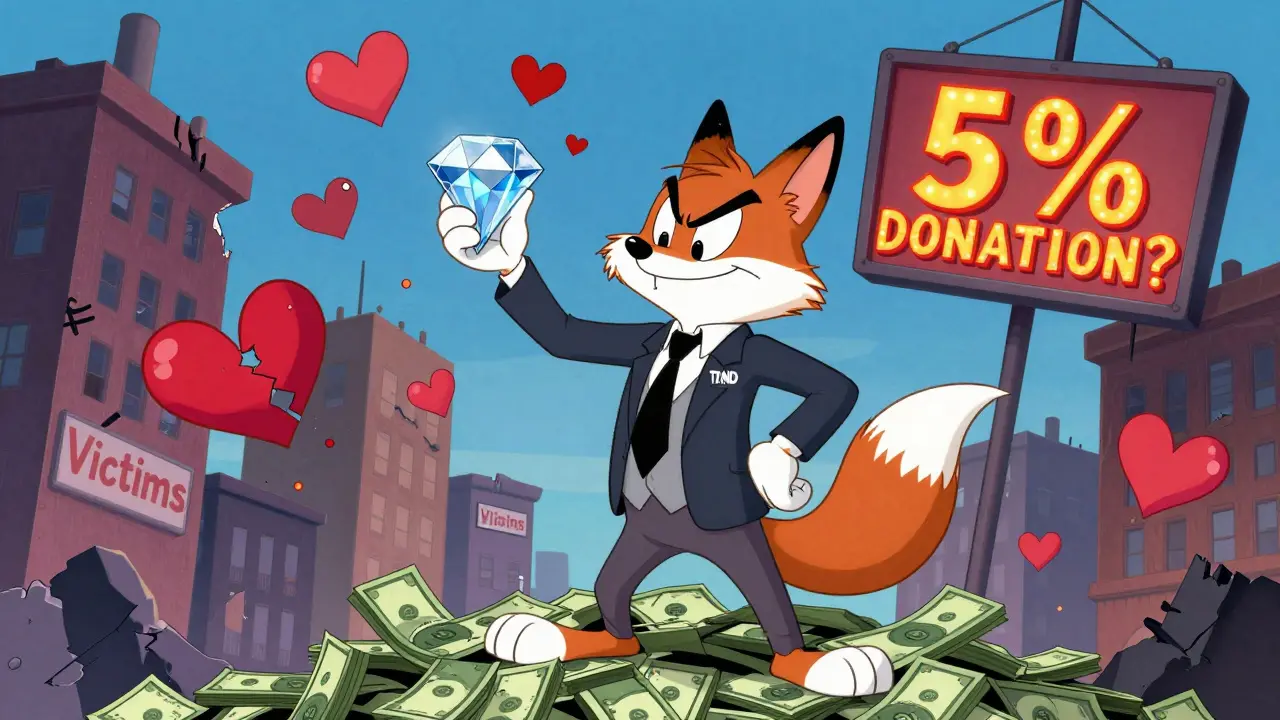
The Tinder Swindler (TIND) crypto coin isn’t a product, service, or investment-it’s a meme wrapped in a moral story, trading on the notoriety of a real-life criminal. Launched in early 2025 on the Solana blockchain, TIND takes its name from Simon Leviev, the man behind the Tinder Swindler documentary. He posed as a wealthy diamond heir, used dating apps to lure women, and stole hundreds of thousands of dollars by convincing them he needed money to unlock his fortune. His crimes were horrifying. His story went viral. And now, someone turned it into a cryptocurrency.
There’s no company behind TIND. No office. No team listed. No whitepaper that explains how the token works beyond vague promises. The entire project rests on one claim: 5% of all proceeds will go to organizations helping women escape abuse and financial exploitation. That sounds noble. But here’s the problem-no one can verify it. There’s no public audit. No lawyer named. No charity partner confirmed. Just a statement on a website that disappears when you click too hard.
Let’s talk numbers. The total supply of TIND is 1 billion tokens. That’s a lot. But here’s the twist: according to CoinMarketCap and other trackers, the circulating supply is also 1 billion. That means every single token is already out there. No mining. No staking. No future releases. If you’re waiting for a new batch to appear, you won’t find one.
Now, the price. It’s a mess. On Binance, TIND hovered around $0.000267 in early 2026. That’s less than a quarter of a cent. But just a few months earlier, it hit $0.007738. That’s a drop of over 96%. On HTX, it bottomed out at $0.0000034. Some exchanges don’t even list it. Crypto.com says it’s not tradable. Coinbase says it’s not listed. CoinCarp warns investors that TIND isn’t on any major exchange-centralized or decentralized. That means if you want to buy it, you’re probably using an OTC desk or a sketchy peer-to-peer platform. No protections. No recourse. No safety net.
Trading volume? Almost zero. Some reports say $0 USD in 24 hours. That’s not illiquidity-that’s abandonment. When a token has zero volume, it doesn’t mean people aren’t trading. It means nobody cares enough to even try. You can’t sell what no one wants to buy. And if you bought TIND at its peak, you’re sitting on a loss of more than 99%.
Why does this matter? Because this isn’t just another crypto experiment. It’s a direct exploitation of trauma. The Tinder Swindler case involved real victims-women who lost their savings, their trust, sometimes their sense of safety. Turning that into a coin feels like monetizing pain. There’s no utility here. No app. No wallet integration. No roadmap. No development updates. Just a logo, a name, and a promise that might not even be real.
Compare this to other tokens that tie themselves to social causes. Dogecoin started as a joke but grew into a community-driven movement with real donations. Shiba Inu built out decentralized exchanges, NFTs, and charity programs with transparency. TIND? Nothing. No GitHub repo. No team bios. No Twitter threads from developers. No Discord with more than 50 people. It’s a ghost project.
And yet, people still buy it. Why? Because of FOMO. Because they saw a headline: “Tinder Swindler Coin Soars!”-even though the price has been falling for months. Because they think, “If I buy now, I’ll be part of the movement.” But movements need community. This has silence.
There’s also a legal gray zone. The original Tinder Swindler was convicted of fraud. The creators of TIND didn’t ask for permission from victims. They didn’t consult charities before claiming they’d donate. And now, they’re selling a token that uses the name of a convicted criminal as its main selling point. That’s not activism. That’s branding.
If you’re thinking of investing, ask yourself: What am I buying? A coin? Or a story? If you want to support women’s rights, donate directly to a verified organization like the National Network to End Domestic Violence or Women’s Aid. You’ll know where your money goes. You’ll get a receipt. You won’t lose it all because the price dropped 67% in three months.
TIND isn’t a failure because it’s new. It’s a failure because it’s empty. No tech. No transparency. No trust. Just a name, a blockchain, and a warning: not all coins are created equal-and some shouldn’t exist at all.
Is TIND listed on Binance or Coinbase?
No, TIND is not listed on Binance, Coinbase, Kraken, or any major centralized exchange. It’s also not available on decentralized exchanges like Uniswap or Raydium. Some OTC traders may handle it privately, but there’s no official trading pair. That means you can’t buy or sell it through standard platforms.
Can I trust that TIND donates to women’s charities?
There is no verifiable proof. The project claims 5% of proceeds go to women’s rights organizations, but no names, no audit reports, no bank statements, and no public records have been released. Without third-party verification, this claim is unproven and likely marketing.
What happened to TIND’s price?
TIND peaked at $0.007738 in late 2025, then dropped sharply. By early 2026, it was trading around $0.000267-a drop of over 96%. Over 90 days, it lost 67% of its value. Trading volume is near zero, indicating little to no demand. The decline suggests the initial hype has faded, and no new buyers are stepping in.
Is TIND a scam?
It’s not officially labeled a scam, but it checks every box for a high-risk, low-transparency project: no team, no audit, no exchange listing, no community, and a name tied to criminal activity. While it may not be fraudulent by law, it’s extremely risky and ethically questionable. Most experts advise against investing.
How do I buy TIND if it’s not on exchanges?
You can’t buy it on any major platform. Some users report finding TIND through peer-to-peer marketplaces or Telegram groups, but these are unregulated and carry high risk of fraud. You’d need a Solana wallet, the contract address (XjUFGq...QPtind), and someone willing to sell directly. There’s no guarantee you’ll get the token-or that it will have any value later.
Is TIND built on Ethereum or Solana?
TIND is built on the Solana blockchain. Its contract address is on Solana, and transactions use SOL as gas. It is not an ERC-20 token on Ethereum. This means you need a Solana-compatible wallet like Phantom or Solflare to hold it.
Are there any official updates or roadmaps for TIND?
No. There is no official website with updates, no GitHub repository showing development, and no public roadmap. The project appears stagnant since its launch in early 2025. All promotional material stops at the initial announcement.
Why does TIND still exist if no one trades it?
It exists because crypto projects don’t need to be successful to launch. All you need is a name, a blockchain, and a story. TIND capitalized on viral fame. Without real utility or community support, it’s likely just a placeholder-waiting for someone to abandon it, or for the contract to be abandoned on-chain.
This isn't crypto. It's a horror story with a blockchain. Someone made a token out of trauma and called it 'investing.' The fact that people still trade it is the real scam.
You know what's worse than a scam? A scam that pretends to be a social movement. This coin doesn't help victims-it exploits their pain for clicks. And the people buying it? They think they're 'supporting a cause.' No. You're just funding a meme that shouldn't exist.
I'm not even mad. I'm just... disappointed. There are so many ways to raise awareness for survivors of abuse. This? This is the lazy, cynical, performative version. It's not activism. It's a brand. And brands don't heal people.
I spent an hour reading this post and I still don't know if I should laugh or cry. There's a whole generation out there who thinks buying a $0.0002 coin with no utility is somehow 'making a statement.' It's not a statement. It's a cry for attention. And the worst part? No one's even listening anymore. The volume's zero. The community's gone. It's just a ghost in the blockchain.
I used to think crypto was a mess. Now I realize it's a mirror. TIND doesn't reflect the blockchain. It reflects us. The desperation. The need to turn pain into profit. The belief that if you put a label on suffering, it becomes something you can own. We're not buying a coin. We're buying the illusion that we're not part of the problem.
In India, we have a saying: 'Don't sell the wound to heal the wound.' This coin is the perfect example. You can't fix exploitation by monetizing it. Real change comes from direct support-donations, shelters, education. Not a token with a vague promise and zero transparency.
I just checked the contract address. The dev wallet holds 98% of the supply. The '5% donation'? Probably never happened. And the rest? Likely dumped by the same people who launched it. This wasn't a charity project. It was a pump-and-dump dressed up like a TED Talk.
You think this is bad? Wait till the next one. Someone's already working on 'FyreFestCoin' and 'EnronEthereum'. The internet doesn't learn. It just repackages trauma with a new token symbol. And we keep clicking.
The legal implications here are staggering. Using the name of a convicted felon as a financial instrument without consent may constitute defamation, trademark infringement, and potentially fraud. The fact that no regulatory body has stepped in is a failure of oversight. This should not be allowed to exist.
I'm not saying don't invest. I'm saying don't invest in this. If you want to help women escape abuse? Give to Women's Aid. Or RAINN. Or your local shelter. Don't gamble on a ghost coin with a backstory. Your money will actually do something.
I mean... it's kinda beautiful? Like, in a tragic, ironic way. A coin born from deception, trading on the back of a liar, pretending to help victims? It's art. Dark art. But art, nonetheless. 😅
The ethical vacuum here is not merely concerning-it is, in fact, an existential indictment of the decentralized finance ecosystem. One cannot ethically justify the commodification of interpersonal trauma under the guise of philanthropy when no third-party verification exists. The absence of audit trails, coupled with zero liquidity, renders the entire construct not merely speculative, but fundamentally incoherent.
I read this whole thing and thought-why does this even exist? Then I remembered: because someone thought they could make a quick buck off a viral documentary. That’s the real tragedy. Not the coin. The fact that we’re still surprised when someone tries to monetize pain.
I just checked the website again. The 'donation page' is just a static image of a woman holding a sign. No links. No contact info. No tax ID. That's not a charity-it's a prop.
And yet... people still buy it. I saw a Reddit thread last week where someone said, 'I bought TIND because I believe in justice.' Bro. You didn't buy justice. You bought a token that can't even be traded on Binance. You're not helping anyone. You're just feeding the algorithm.
Wait-so if I have a Solana wallet and I buy TIND, what exactly am I holding? A number in a blockchain? Or a moral dilemma?
This is what happens when you let viral outrage drive product development. No product. No team. No plan. Just a name, a logo, and a prayer. It’s the crypto version of a TikTok trend that disappears after 72 hours.
i think the real issue here is that people want to feel like they're part of something bigger-even if it's fake. tind gives them that. sad, but true. maybe we need better ways to channel that energy.
In my culture, we say: 'Don't turn grief into gold.' This coin isn't just bad crypto-it's bad karma. No one wins here. Not the victims. Not the buyers. Not even the creators. It's all just noise on the chain.
I'm not even surprised anymore. Crypto has become a graveyard for bad ideas with pretty logos. TIND is just the latest tombstone. Rest in peace, you stupid coin.
The tokenomics are a non-starter. Total supply = circulating supply. Zero emission. Zero utility. Zero liquidity. This isn't a DeFi project-it's a static NFT with a ticker symbol. And yet, somehow, people are still holding it. I don't understand the psychology, but I'm terrified of it.
If you're thinking of buying this, just donate $5 to a real org instead. You'll feel better. And your money won't vanish into thin air.