
Imagine losing half a billion dollars not because your coin crashed, but because the exchange you trusted didn't check who you were. That’s exactly what happened to OKX in early 2025. The Seychelles-based platform paid over $500 million to the U.S. Department of Justice (DOJ) for failing to properly monitor its customers. It wasn’t just a fine; it was a warning shot to every digital asset platform operating in or near the U.S. market. As regulators sharpen their focus, understanding these enforcement actions is no longer just for legal teams-it’s critical for anyone holding assets on an exchange.
The landscape has shifted dramatically. In the first half of 2025 alone, global regulatory bodies issued over $6 billion in Anti-Money Laundering (AML) fines. This isn’t random punishment. It’s a coordinated effort by agencies like the DOJ, the Securities and Exchange Commission (SEC), and the Financial Industry Regulatory Authority (FINRA) to close loopholes that allowed bad actors to hide behind weak oversight. If you’re an investor, you need to know which red flags matter. If you’re an industry professional, you need to know where the line is drawn.
The OKX Case: A Benchmark for Penalties
The most significant case of the year involved OKX, a cryptocurrency exchange founded in 2017 by Star Xu. On February 24, 2025, the DOJ announced a settlement requiring OKX to pay $84 million in civil fines and forfeit $420 million in illegal proceeds. Why such a massive number? The investigation revealed that OKX facilitated over $5 billion in suspicious transactions. More damningly, despite officially banning U.S. users, internal documents showed staff actively instructing American customers to falsify ID documents to bypass restrictions.
This case highlights a common failure point: Know Your Customer (KYC) processes. Regulators found that OKX had weak transaction monitoring systems and failed to screen for sanctions. They also hadn’t registered with the U.S. Treasury as a money service business, a basic requirement for handling customer funds. For investors, this means that even if an exchange looks established, its backend compliance can be fragile. The DOJ’s move here signaled that “banning” users isn’t enough-you have to actually prevent them from entering.
Market Manipulation: The New Criminal Frontier
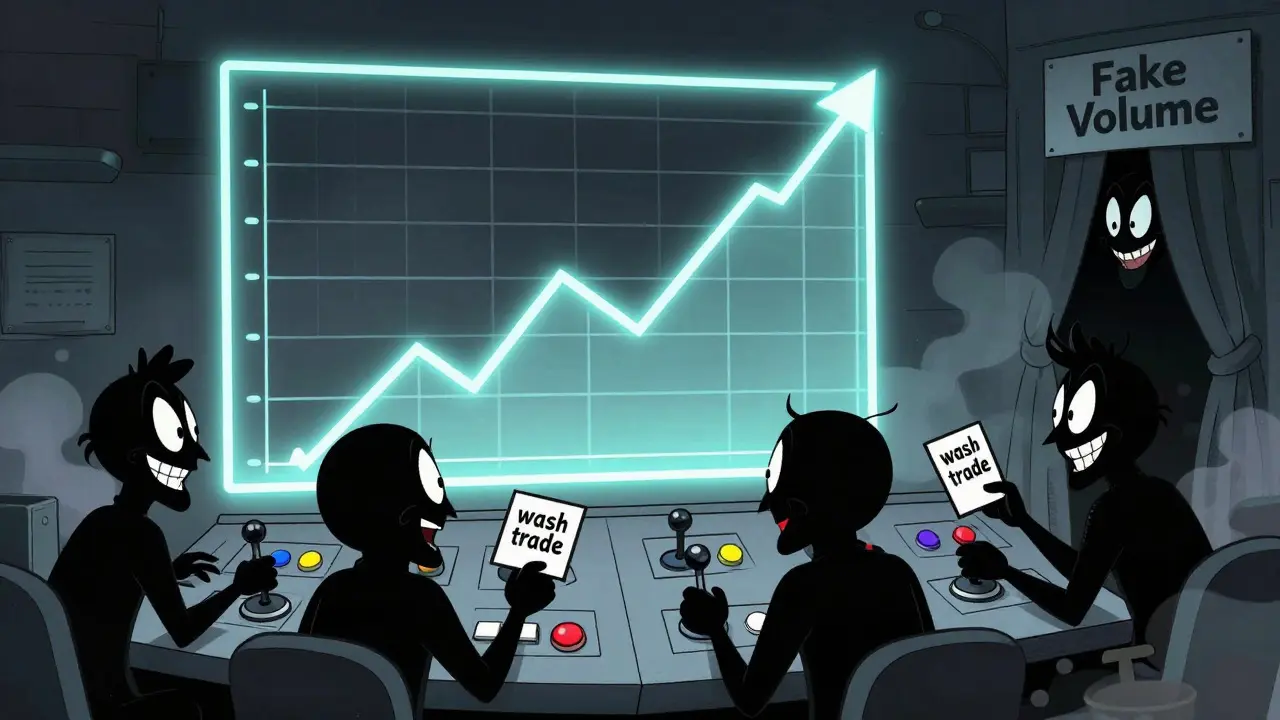
While AML violations dominate the headlines, the DOJ has also turned its guns on market manipulation. Unlike traditional stock markets, crypto markets are often thin and volatile, making them easy targets for artificial inflation. In October 2024, authorities in the District of Massachusetts charged 17 individuals with using automated trading bots to execute wash trades-buying and selling assets to themselves to create fake volume. This made certain meme coins and alternative tokens look more popular than they were, luring in real investors.
This shift is significant. Previously, regulators focused on fraud (lying to investors). Now, they’re prosecuting manipulation (rigging the game). The use of technology in these schemes makes them harder to detect, but specialized prosecutorial teams are catching up. If you’ve ever bought a coin because the chart looked strong only to see it crash days later, you might have been a victim of this exact tactic. The lesson? Volume alone doesn’t validate an asset. Look for organic adoption and utility.
SEC Actions: Fraud and Unregistered Offerings
While the DOJ handles criminal cases, the SEC focuses on civil violations, particularly fraud and unregistered securities. Despite political shifts, the agency maintained a steady pace in 2025. One notable case involved Ramil Palafox, founder of PGI Global, who was charged in April 2025 with running a Ponzi-like scheme. He allegedly guaranteed high returns from crypto and forex trading but instead misappropriated over $57 million from investors. The remaining funds were used to pay earlier investors, creating the illusion of profitability until the scheme collapsed.
Another major action occurred in August 2025 against MCC International Corp., CPTLCoin Corp., and Bitchain Exchanges. The SEC secured a $46 million default judgment, ordering defendants to disgorge nearly $28.5 million plus interest. The scheme centered on selling “mining packages” through a multi-level marketing structure. Investors were told they could liquidate their investments via a specific crypto asset on the Bitchain platform. However, the SEC found that the defendants controlled this asset and blocked withdrawals, effectively trapping investor funds. This case underscores the risk of opaque structures where the issuer controls both the product and the exit mechanism.
FINRA: Policing Traditional Firms Entering Crypto
It’s not just pure-play crypto exchanges getting hit. Traditional broker-dealers expanding into digital assets are also facing scrutiny. FINRA, which regulates the U.S. securities industry, has stepped up enforcement under its “FINRA Forward” program. In July 2025, FINRA settled charges with a broker-dealer for $85,000 after it failed to clearly disclose that retail crypto offerings were provided through an unregistered affiliate. The firm also didn’t fairly present the risks and benefits of these products.
This mirrors an earlier $85,000 settlement in May 2025 for similar violations. The pattern is clear: when traditional financial firms bring crypto products to retail clients, they must meet the same disclosure standards as any other security. For investors using banks or brokers to buy crypto, this means checking the fine print. Is the product offered by the bank directly, or a third party? Are the risks clearly stated? These small details can protect you from unexpected liabilities.
| Entity | Agency | Violation Type | Fine/Judgment Amount | Key Issue |
|---|---|---|---|---|
| OKX | DOJ | AML / KYC Failures | $504 Million | Inadequate monitoring, helping U.S. users bypass bans |
| MCC Int’l / Bitchain | SEC | Fraud / Unregistered Offering | $46 Million | Ponzi scheme, blocking investor withdrawals |
| PGI Global | SEC | Fraud / Misappropriation | $57 Million (Misappropriated) | Ponzi-like returns guarantee |
| Unnamed Broker-Dealer | FINRA | Disclosure Failure | $85,000 | Undisclosed unregistered affiliate, poor risk presentation |
Common Compliance Failures to Watch For
Looking across these cases, a few patterns emerge. First, inadequate customer due diligence remains the top offender. Companies scale fast to capture market share but fail to build the compliance infrastructure to match. Second, weak transaction monitoring allows suspicious flows to go unnoticed. Third, lack of sanctions screening exposes firms to secondary penalties. Finally, failure to register with required agencies, like the U.S. Treasury, creates a baseline legal vulnerability.
For senior executives, the stakes are personal. In several cases, individual leaders faced penalties alongside corporate fines for lacking oversight. This signals that board members and CEOs can no longer hide behind “we didn’t know.” Diligence is now a fiduciary duty. If you work in the industry, ensure your risk assessment is documented and regularly updated. If you’re an investor, ask your exchange about their AML provider and how they handle suspicious activity reports.

What This Means for the Future
The enforcement surge reflects a maturation of regulatory expertise. Agencies are no longer experimenting; they have dedicated teams and sophisticated tools. The District of Massachusetts has become a hub for these prosecutions, suggesting a centralized strategy for complex digital asset cases. While political debates continue over budget cuts and rule-making authority, the trend toward stricter oversight seems unlikely to reverse quickly.
SEC Chairman Paul Atkins has announced “Project Crypto,” a commission-wide initiative focused on digital assets, signaling continued attention. However, some House Republicans have proposed cutting the SEC’s budget, which could slow new rulemaking but likely won’t stop existing enforcement actions. For businesses, the message is clear: compliance is a strategic priority, not just a cost center. For investors, due diligence is your best defense. Choose platforms with transparent compliance records and avoid schemes that promise guaranteed returns or obscure exit mechanisms.
Frequently Asked Questions
What is the largest crypto exchange fine in history?
As of 2025, the OKX settlement of over $500 million stands as one of the largest single enforcement actions against a crypto exchange. It included $84 million in civil fines and $420 million in forfeited proceeds, totaling approximately $504 million.
Why did the DOJ fine OKX so heavily?
The DOJ fined OKX for severe Anti-Money Laundering (AML) violations. The exchange facilitated over $5 billion in suspicious transactions due to inadequate KYC processes. Crucially, staff helped U.S. users bypass entry restrictions, leading to a guilty plea and massive forfeiture of illegal proceeds.
How does the SEC differ from the DOJ in crypto enforcement?
The DOJ primarily pursues criminal cases, focusing on market manipulation and large-scale fraud involving willful misconduct. The SEC focuses on civil violations, such as unregistered securities offerings and investor fraud. Both can impose heavy fines, but DOJ cases may result in prison time for individuals, while SEC cases typically involve monetary penalties and injunctions.
Are traditional banks regulated when offering crypto services?
Yes. FINRA enforces rules against broker-dealers offering crypto products. Recent settlements show that firms must clearly disclose if products are offered through affiliates and must accurately present risks. Failure to do so results in fines, ensuring that traditional firms meet the same transparency standards as native crypto exchanges.
What should investors look for to avoid falling victim to enforcement-related risks?
Investors should verify that their exchange registers with relevant authorities (like the U.S. Treasury) and uses reputable AML/KYC providers. Avoid platforms that guarantee returns or have opaque withdrawal mechanisms. Check for news regarding pending lawsuits or regulatory investigations. Transparency in compliance reporting is a strong indicator of a stable, low-risk platform.