Have you ever tried to move tokens from one blockchain to another, only to watch your funds vanish into the ether of bridge fees and slippage? You are not alone. The fragmented nature of decentralized finance (DeFi) means that moving assets between networks like Ethereum, Polygon, or Avalanche often feels like solving a puzzle while someone else is changing the rules. Enter AliumSwap, a multi-chain decentralized exchange (DEX) promising to simplify this chaos with its hybrid liquidity model. But does it actually deliver on that promise, or is it just another shiny new tool in an already overflowing toolbox?
In this review, we are going past the marketing fluff. We will look at the real numbers, the actual user experiences, and the technical realities of using AliumSwap in early 2026. Whether you are a seasoned DeFi veteran looking for niche cross-chain routes or a newcomer wondering if this platform is safe for your savings, here is what you need to know before you connect your wallet.
What Exactly Is AliumSwap?
AliumSwap is a non-custodial, multi-chain decentralized exchange built within the Alium Finance ecosystem. Unlike traditional exchanges where you hand over your keys to a company, AliumSwap lets you trade directly from your wallet. It supports major networks including Ethereum, Binance Smart Chain (BSC), and Polygon, with plans to expand further.
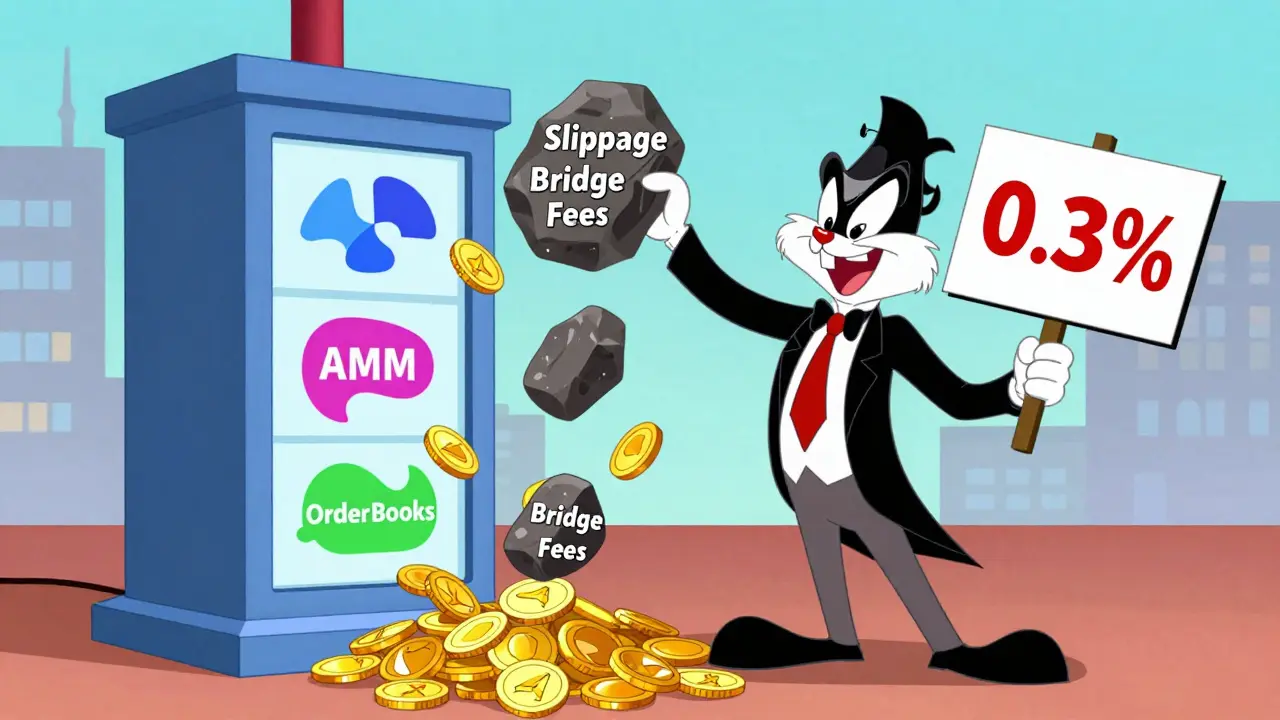
The core selling point here is the "hybrid liquidity model." Most DEXs use either Automated Market Makers (AMMs) like Uniswap, which rely on liquidity pools, or order books, which match buyers and sellers. AliumSwap tries to do both. The idea is to give you the instant execution of an AMM with the price efficiency of an order book. In theory, this should mean better prices and less slippage. In practice, as we will see, the results are mixed.
Trading Fees, Slippage, and Hidden Costs
Let's talk money. When you trade, every basis point counts. AliumSwap charges a standard trading fee of 0.3%. If you hold their native token, ALM (Alium Finance Token), you get a 20% discount, bringing that down to 0.24%. On paper, that sounds competitive. However, when you compare this to aggregator platforms like 1inch or Matcha, which often find routes with effective fees between 0.15% and 0.25%, AliumSwap starts to look expensive.
But the base fee is only part of the story. The real killer in cross-chain swaps is slippage and bridge fees. Many users have reported unexpected losses during high-volume periods. For example, a Reddit user documented swapping 500 USDC from Polygon to Avalanche and ending up with only 487 USDC equivalent after all costs were deducted. That is a 2.6% loss on a single transaction, far exceeding the advertised fee structure. If you are trading large amounts, these hidden costs can eat into your profits significantly.
| Platform | Base Trading Fee | Native Token Discount | Cross-Chain Complexity |
|---|---|---|---|
| AliumSwap | 0.3% | 20% (with ALM) | High (Hidden bridge fees common) |
| Uniswap | 0.3% | N/A | Low (Single chain focus) |
| 1inch (Aggregator) | Variable (0.15%-0.25%) | Yes (1INCH) | Medium (Optimized routing) |
| PancakeSwap | 0.25% | Yes (CAKE) | Low (BSC focused) |
Liquidity and Market Depth: The Real Bottleneck
Liquidity is the lifeblood of any DEX. Without it, you cannot trade without massive slippage. As of February 2026, AliumSwap has a Total Value Locked (TVL) of approximately $86.3 million. To put that in perspective, Uniswap holds over $6.2 billion. This massive gap matters because it means fewer tokens are available for immediate swap on AliumSwap.
If you are trading popular pairs like ETH/USDT on Ethereum, you might be fine. But if you try to swap a lesser-known token or move assets between less connected chains, you will likely hit dry spots. Users frequently complain about "insufficient liquidity" for niche pairs. According to CoinGecko rankings, AliumSwap sits at #28 among DEXs with a daily volume of $24.7 million. While respectable, it pales in comparison to leaders like PancakeSwap ($843 million daily volume). This lack of depth makes AliumSwap risky for large trades.
Security and Audits: Are Your Funds Safe?
Security is non-negotiable in crypto. AliumSwap underwent a third-party audit by CertiK in Q4 2025. The good news? No critical vulnerabilities were found. The bad news? Security researcher Alex Johnson from Trail of Bits noted that the cross-chain messaging implementation has several medium-risk issues. These could potentially be exploited during network congestion-a time when security breaches are most damaging.
Remember, an audit is a snapshot in time. It checks the code at a specific moment. It does not guarantee future safety against new attack vectors. Given the complex nature of cross-chain bridges, which have historically been prime targets for hackers, proceed with caution. Never invest more than you can afford to lose, and consider using a separate wallet for interacting with newer platforms like AliumSwap.
User Experience and Interface
Does it work smoothly? For experienced DeFi users, yes. The interface is clean, built with React.js, and responsive. However, for beginners, the learning curve is steep. You need to understand gas fees on multiple chains. To make a cross-chain swap, you must have native tokens (like ETH for Ethereum, MATIC for Polygon) in your wallet to pay for transactions on both the source and destination networks. This catches many new users off guard, leading to failed transactions and wasted gas.
Customer support is available via Telegram and email, but only during business hours (9 AM - 5 PM UTC, Monday-Friday). If you have an issue at 2 AM on a Saturday, you are on your own. Response times average 37 minutes, which is decent, but limited availability is a significant drawback for a global crypto platform.

Staking and Earning Rewards
AliumSwap encourages you to lock up your assets through staking. They offer tiered rewards with APYs ranging from 8.5% for basic pools to 24.7% for ALM-native pools. Sounds tempting, right? Be careful. One user reported seeing a 12.3% APY on the dashboard but earning only 7.8% after accounting for gas costs. Always calculate the net return, not just the gross APY. Additionally, there is a 14-day minimum lock-up period, and withdrawing early incurs a 1.5% penalty. This illiquidity risk is something you must weigh against the potential rewards.
Verdict: Who Is AliumSwap For?
AliumSwap is not for everyone. If you are a casual trader wanting simple, cheap swaps, stick with established aggregators like 1inch or major DEXs like Uniswap. However, if you are an advanced user who frequently moves assets between specific non-EVM chains (like Fantom to Optimism) where direct liquidity is scarce, AliumSwap fills a genuine niche. Its specialized cross-chain functionality works well for these specific scenarios, despite the higher fees and lower liquidity.
Just be aware of the risks. The ALM token is currently showing bearish signals, and the platform's TVL is relatively low. Use it as a tool for specific jobs, not as your primary exchange. And always double-check those fees before hitting confirm.
Is AliumSwap safe to use in 2026?
AliumSwap has passed a CertiK audit with no critical vulnerabilities found. However, experts note medium-risk issues in its cross-chain messaging protocol. While generally safe for small transactions, the complexity of cross-chain bridges always carries inherent risk. Use a dedicated wallet and never store long-term holdings on the platform.
How much does it cost to swap on AliumSwap?
The base trading fee is 0.3%, reducible to 0.24% if you hold ALM tokens. However, cross-chain swaps incur additional bridge fees and potential slippage. Users have reported total effective costs exceeding 2% for certain niche pairs due to liquidity fragmentation.
Can I use AliumSwap for beginner-friendly trades?
Not really. The platform requires understanding of gas fees on multiple chains and manual wallet management. Beginners often face failed transactions due to insufficient native tokens for gas. Established aggregators or centralized exchanges are better starting points for novices.
What blockchains does AliumSwap support?
As of early 2026, AliumSwap primarily supports Ethereum, Binance Smart Chain, and Polygon. It covers approximately 15 networks in total, with planned expansions to Solana and Polkadot later in the year. This is fewer than competitors like THORSwap, which supports over 30 networks.
Is the ALM token a good investment?
Technical indicators for the ALM token are largely bearish as of February 2026, with all major EMAs signaling 'SELL'. Analysts predict significant hurdles for growth, noting that reaching previous price targets would require unlikely market conditions. Treat it as a utility token for fee discounts rather than a speculative investment.
hey guys, just read this review and it seems like aliunswap has some real issues with the hidden fees. i tried swapping a small amount from eth to polygon last week and lost almost 3% in bridge costs which was super frustrating. the interface is okay but not great for beginners.
It is frankly astonishing that anyone would trust a platform with such opaque fee structures without doing their own due diligence. The article clearly states that slippage can exceed advertised rates by significant margins. If you are trading large volumes, you should be using established aggregators like 1inch or sticking to Uniswap where the liquidity depth is actually verified and substantial. This hybrid model sounds like marketing fluff designed to lure in inexperienced retail investors who do not understand the mechanics of cross-chain messaging protocols.
I really appreciate how detailed this breakdown is because navigating DeFi can feel overwhelming at times especially when you are trying to move assets between different chains. It helps to know exactly where the friction points are so we can avoid losing money on unnecessary gas fees. I think for most people starting out it might be better to stick with simpler platforms until they get more comfortable with wallet management.
i totally agree with the part about customer support being a nightmare if you have an issue outside of business hours. its crazy that a crypto platform operates like a normal office job when the market never sleeps. i had a tx fail once and waited forever for a response only to find out i didnt have enough matic for gas. super annoying experience overall.
the whole concept of centralized control over decentralized finance is ironic isnt it? they claim to be non-custodial yet rely on bridges that act as single points of failure. i think people forget that every time you use a bridge you are trusting a piece of code written by humans who make mistakes. its basically gambling with your keys handed over to a black box algorithm that nobody fully understands
While I understand the skepticism surrounding newer DEXs, it is important to consider that innovation often comes with initial growing pains, and AliumSwap appears to be attempting to solve a genuine problem regarding liquidity fragmentation across various blockchain networks, which is a significant hurdle for many users today. The fact that they have undergone a CertiK audit provides some level of assurance, even if medium-risk issues were noted, because it shows a commitment to transparency and security standards that many other projects completely ignore during their launch phases. Furthermore, the tiered staking rewards could potentially offset the higher transaction costs for long-term holders, provided one carefully calculates the net return after accounting for gas fees and potential impermanent loss, which is a crucial step that many novice investors overlook entirely.
you guys are all sheep following the mainstream narrative again. aliunswap is probably backed by some shadowy cabal trying to consolidate control over cross chain transfers before the next big crash. look at the tvl numbers compared to uniswap and tell me that doesnt seem suspiciously low for a project getting this much hype. i bet the audits were paid for by insiders to cover up backdoors in the smart contracts. always keep your funds in cold storage and never touch these new shiny toys unless you want to get rugged by the elites.
Look, I have been in DeFi since the early days and I can tell you that liquidity depth is king. If you are moving serious capital, you cannot afford the slippage described here. Stick to the majors. However, for niche pairs on smaller chains, this might actually work if you are careful. Just don't expect miracles. Do your own research and test with small amounts first.
The technical architecture behind the hybrid liquidity model is intriguing but the execution seems flawed based on user reports. As a developer, I see the challenge in maintaining order book efficiency while leveraging AMM pools across heterogeneous chains. The latency issues in cross-chain messaging protocols are still unsolved problems in the industry. Until they optimize the oracle feeds and reduce the confirmation times, the slippage will remain high for volatile assets. We need better interoperability standards like CCIP to mature before these DEXs can truly compete with aggregated solutions.
It is imperative to note that the security implications of cross-chain bridges cannot be overstated. While the CertiK audit is a positive step, the medium-risk vulnerabilities identified by Trail of Bits suggest potential attack vectors that could be exploited during periods of network congestion. Users must exercise extreme caution and utilize dedicated wallets with minimal funds when interacting with such platforms. The historical precedent of bridge hacks serves as a stark reminder of the inherent risks associated with trusting third-party infrastructure for asset transfers.
I think the comparison table is very useful for understanding where AliumSwap stands. The 0.3% fee is standard but the hidden bridge costs are the real issue. I prefer using PancakeSwap for BSC trades because the liquidity is deeper and fees are lower. For Ethereum, Uniswap is still the best option. AliumSwap might be okay for specific niche cases but not for general trading.
This review raises some valid concerns about the usability for beginners. The requirement to hold native tokens for gas on multiple chains is a common pain point that frustrates new users. It would be helpful if the platform implemented meta-transactions or sponsored gas fees to improve the user experience. Until then, it remains a tool for advanced users who understand the intricacies of multi-chain ecosystems.
typical crypto scam vibes here. another platform promising easy money with high apy staking rewards. remember when those rug pulls happened last year? same story different day. stay safe out there folks and dont let greed blind you to the obvious red flags. keep your money in the bank or buy gold instead of playing with digital casino chips :)
boring review. nothing new here. everyone knows cross chain swaps are messy. why bother writing 2000 words about it? just tell us if its safe or not. also the ui looks dated compared to newer dexes. prob gonna skip this one.
If you are going to use AliumSwap, make sure you understand the lock-up periods for staking. The 14-day minimum and early withdrawal penalty can trap your capital if the market turns bearish quickly. I recommend testing the swap functionality with a small amount first to gauge the actual slippage you experience versus what is quoted. Liquidity varies significantly depending on the time of day and network congestion levels.
The philosophical implication of fragmented liquidity is that we are creating silos of value rather than a unified global marketplace. Each chain becomes an island, and bridges are merely rafts that leak. AliumSwap attempts to build a boat, but if the hull is compromised by poor code or malicious actors, the passengers suffer. We must question whether true decentralization requires such complex intermediaries or if we should focus on layer-two scaling solutions that unify state rather than bridging disparate ledgers.
I am absolutely stunned by the lack of basic consumer protections in this space. Losing 2.6% on a simple swap is unacceptable in any other financial sector. The fact that customers are left stranded at 2 AM on a Saturday highlights the fundamental disconnect between traditional service expectations and the current state of DeFi. Until platforms prioritize user support and transparent pricing models, they will remain niche tools for the technically savvy rather than mainstream financial instruments.