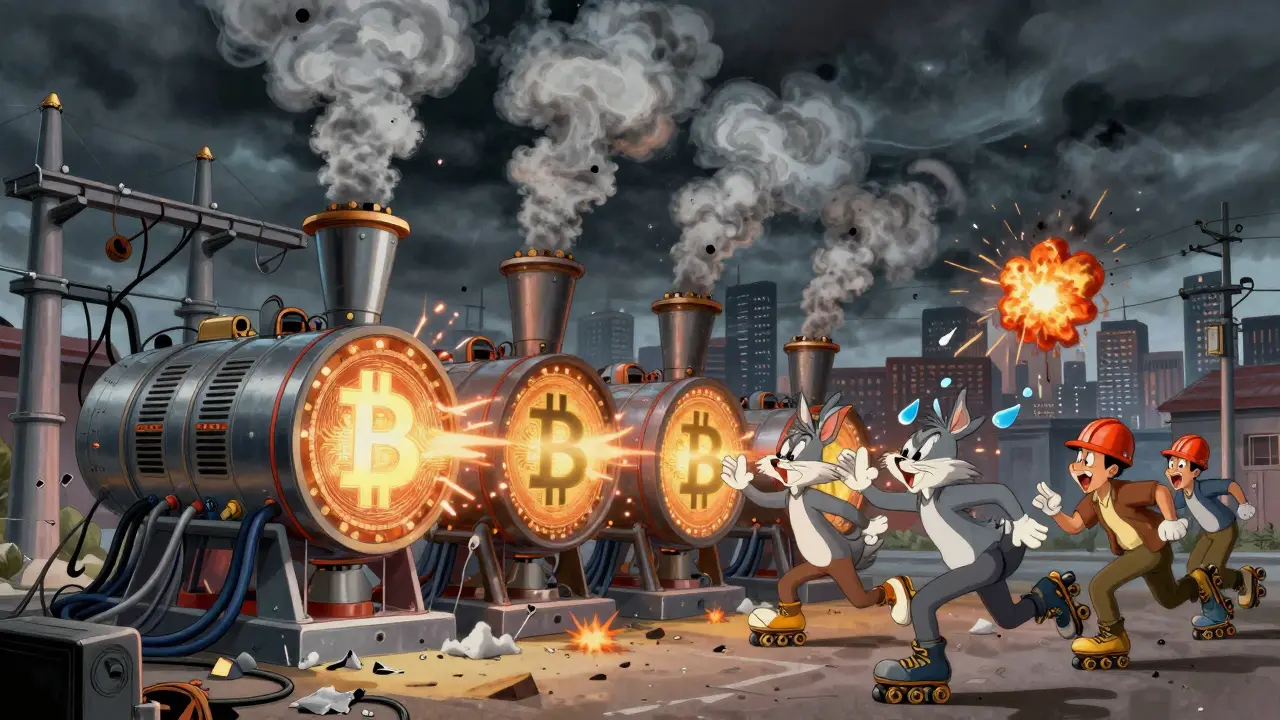
By early 2025, Kazakhstan’s power grid was on the edge. Cities like Almaty and Nur-Sultan were rolling blackouts every other week. In rural areas, people waited hours for electricity to come back on after outages that lasted all day. The reason wasn’t just aging wires or winter storms. It was crypto mining.
Kazakhstan had become the second-largest hub for Bitcoin mining in the world after the U.S. in 2022. When China cracked down on mining in 2021, thousands of rigs moved across the border. They didn’t bring jobs or innovation. They brought massive, constant power drains - 24/7, year-round. By 2023, crypto mining was using over 4.5 billion kWh of electricity annually. That’s more than the entire annual consumption of Latvia or Croatia. And it was all happening on a grid built in the 1970s.
The Grid Was Already Failing
Kazakhstan’s power system wasn’t broken because of crypto. It was already crumbling. Over one-third of its 220 power plants were 70-90% worn out. Transmission lines in the south and west had losses as high as 18% - meaning for every five kilowatts sent, nearly one vanished before reaching homes. In Oral, a city in the north, engineers reported losing 18% of their output just from old transformers and corroded cables. The national grid operator, KEGOC, knew this. But no one had the money or political will to fix it.
Then the miners arrived. They didn’t ask permission. They didn’t pay fair rates. They just plugged in. Many connected directly to regional substations, bypassing meters. Some used illegal connections. Others paid local officials to look the other way. The Ministry of Energy estimated that by 2023, up to 30% of the electricity consumed by miners was unmeasured - essentially stolen from the grid.
The Breaking Point
In December 2023, temperatures dropped to -35°C across western Kazakhstan. Homes turned on heaters. Factories kept running. And the miners? They kept mining. The grid couldn’t handle the load. In Pavlodar, a major industrial city, transformers exploded. Power lines melted. For three days, 1.2 million people had no electricity. Schools closed. Hospitals ran on generators. The government declared a state of emergency.
That’s when the Ministry of Energy made its move. On January 15, 2024, they announced a temporary ban on new crypto mining licenses. By March, they extended it to all existing operations. Miners had to either shut down or prove they were using only renewable energy - and even then, only if they paid double the standard tariff.
It wasn’t a full ban. It was a chokehold. The goal wasn’t to kill crypto mining forever. It was to force miners off the aging grid and onto new, dedicated lines - or out of the country entirely.
Who Got Hit the Hardest?
The miners who left weren’t just big Chinese firms. Many were local entrepreneurs who’d bought second-hand ASIC rigs for $2,000 and set them up in garages. One man in Karaganda told reporters he’d spent his life savings on 120 mining rigs. He hired three people to watch them. He paid $1,200 a month in electricity - before the price hike. When the ban hit, he sold everything for scrap metal. His profit? Zero.
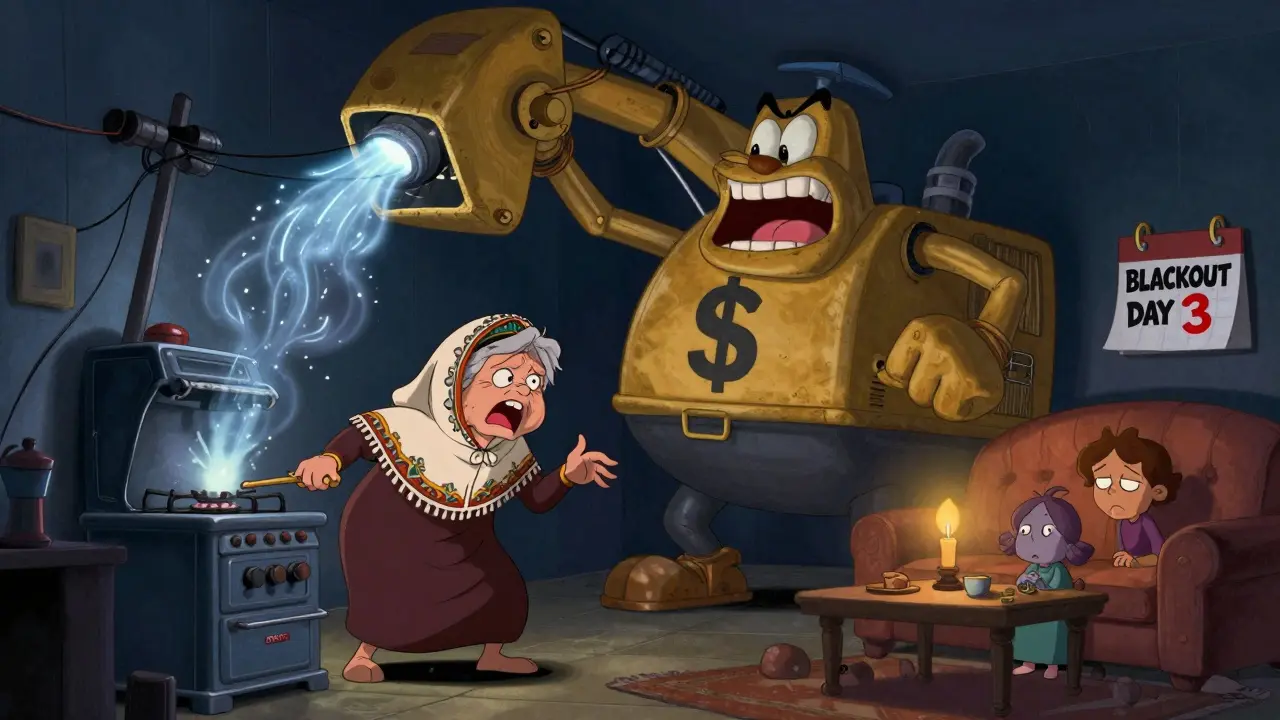
But the real victims were ordinary families. In 2024, electricity prices jumped 50% compared to 2023. The government said it was to fund grid repairs. But the money didn’t reach the villages. In the Atyrau region, where oil and mining overlap, people started rationing power. One grandmother said she only used her electric stove once a week - to boil water for tea. The rest of the time, she cooked on a gas stove she’d bought in 1998.
The Renewable Promise - And the Reality
Kazakhstan says it’s building three 1-gigawatt wind farms. It’s investing over $2.6 billion in solar and wind. The plan sounds bold. But here’s the catch: those projects won’t be online until 2027 at the earliest. Meanwhile, the grid still relies on coal for 65% of its power. Coal plants can’t ramp up or down quickly. They’re like giant steam engines - once they’re on, they stay on. That makes it impossible to balance intermittent solar and wind.
Even if renewables were ready, most households can’t afford rooftop solar. A 5-kilowatt system costs $5,000. The average monthly wage in Kazakhstan? $550. The government offers no subsidies. No tax breaks. No loans. So while the law says “net metering” is allowed, no one can actually use it.
What Happened to the Miners?
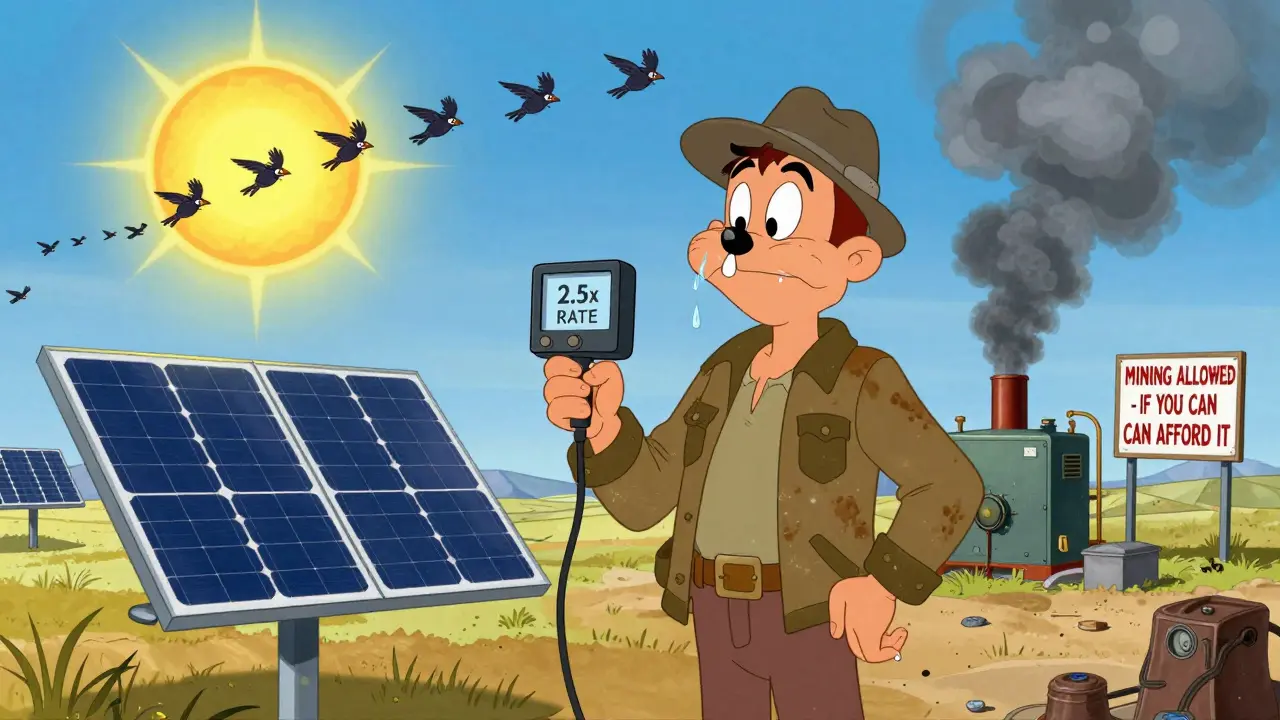
Most left. Some went to Russia. Others to Georgia and Azerbaijan. A few moved to Uzbekistan, which is quietly building its own crypto mining industry with cheaper, more reliable power. A handful stayed - but only if they could prove they were using wind or solar. One company in the Mangystau region now runs its entire operation off a 10-megawatt solar farm it built next to its warehouse. It’s the only one in the country doing it legally.
But even that’s a gamble. The solar farm only produces power during daylight. At night, they still draw from the grid - and now, they pay 2.5 times the normal rate. Their profit margins are razor-thin. One operator told me: “We’re not mining Bitcoin anymore. We’re mining survival.”
The Bigger Picture
Kazakhstan’s story isn’t just about crypto. It’s about what happens when a country with a broken infrastructure gets flooded with demand it can’t handle. The miners didn’t cause the grid’s collapse. But they exposed it. They forced the government to choose: keep letting miners drain the system, or risk angering thousands of small business owners and families who depended on them.
The government chose control. They didn’t fix the grid. They just turned off the biggest load. And now, they’re hoping the world forgets about Kazakhstan as a mining hub. But the underlying problems remain. The transformers are still old. The lines still leak. The coal plants still burn. And the people? They’re still paying for it.
What’s Next?
Kazakhstan plans to connect to the CASA-1000 energy project by 2028, which will let it export surplus power to Afghanistan and Pakistan. But that won’t help its own citizens unless the internal grid is fixed. The North-South HVDC Line - a 2,000 MW transmission project - is supposed to be finished by 2029. But construction has already been delayed twice. The last update from KEGOC? “Work continues under budget constraints.”
Meanwhile, crypto mining is slowly coming back. Not as a flood. But as a trickle. Miners are now using smaller, more efficient rigs. They’re running them in warehouses with their own backup generators. Some are even buying diesel generators and running them at night - when electricity is cheaper. It’s inefficient. It’s dirty. But it’s legal. For now.
Kazakhstan didn’t ban crypto mining because it’s evil. It banned it because the grid was dying. And when a country’s power system fails, it doesn’t matter what you’re powering. You’re still left with blackouts, broken lives, and a future that’s harder to build.
Why did Kazakhstan ban crypto mining?
Kazakhstan banned new crypto mining operations and restricted existing ones in early 2024 because the country’s aging power grid couldn’t handle the massive, constant electricity demand. Crypto mining was using over 4.5 billion kWh annually - more than entire countries - and much of it was drawn illegally from overloaded regional grids. After a major blackout in December 2023 that left over a million people without power, the government acted to stop the grid from collapsing entirely.
Was crypto mining the main cause of Kazakhstan’s energy crisis?
No. The grid was already failing before miners arrived. Over one-third of power plants were 70-90% worn out. Transmission losses reached 18% in some regions - far above the 10-12% acceptable level. But crypto mining acted like a pressure test. It exposed how fragile the system was. Miners didn’t create the problem, but they made it impossible to ignore.
Are crypto miners still operating in Kazakhstan?
Yes, but in very limited numbers. Miners can still operate if they use only renewable energy and pay 2.5 times the standard electricity rate. A few have built their own solar farms. Others run diesel generators at night. Most large-scale operations have left the country. What’s left are small, inefficient setups that barely break even.
Did electricity prices go up after the ban?
Yes. Electricity prices rose 50% between 2023 and April 2025. The government said the increase was to fund grid repairs. But many households say the money never reached them. Rural areas still suffer frequent outages. The cost of living went up, but the reliability of power didn’t improve.
Is Kazakhstan building a better power grid?
Plans are in motion, but progress is slow. The government is building a 2,000 MW North-South HVDC transmission line between 2024 and 2029 and investing $2.6 billion in wind and solar. But these projects won’t be fully operational until 2027-2030. Meanwhile, the grid’s core problems - old transformers, high losses, and coal dependency - remain unchanged.
Why can’t people install solar panels at home?
The law allows net metering, but the upfront cost is too high. A basic 5-kilowatt solar system costs $5,000. The average monthly wage in Kazakhstan is $550. There are no government subsidies, tax credits, or low-interest loans. So while the policy looks good on paper, no one can afford to use it.
Where did the miners go after the ban?
Most moved to Russia, Georgia, Azerbaijan, and Uzbekistan. Uzbekistan, in particular, is quietly becoming a new mining hub with better grid reliability and lower electricity costs. A few miners stayed in Kazakhstan but now rely on private diesel generators or off-grid solar - at a much higher cost and lower efficiency.
Can Kazakhstan’s grid handle renewable energy now?
Not yet. The grid lacks flexibility. Coal plants can’t turn on and off quickly to balance solar and wind. There’s no real-time balancing market. Transmission lines can’t handle variable flows. Even if all the new wind farms were online tomorrow, the system would still struggle to integrate them without major upgrades to dispatch control and storage.
What’s the long-term outlook for energy in Kazakhstan?
Without urgent investment in grid modernization, Kazakhstan risks rolling blackouts becoming the norm by 2030. The country’s electricity demand is projected to grow 4% per year. Renewables can help - but only if paired with smart grids, storage, and transmission upgrades. Right now, the government is prioritizing exports over domestic reliability. That’s a dangerous gamble.
Is crypto mining banned permanently in Kazakhstan?
No. The ban is conditional. Miners can return if they use only renewable energy and pay premium rates. The government hasn’t ruled out allowing mining again - but only if it doesn’t strain the grid. For now, the message is clear: no more free power. If you want to mine, pay for your own infrastructure.
Kazakhstan didn't ban crypto because it's evil - it banned it because the grid was literally falling apart. People were freezing in -35°C winters while miners ran rigs in unheated warehouses. This isn't a moral issue. It's a basic infrastructure failure. The miners were the symptom, not the disease.
And now? The government's pretending they're fixing things with wind farms that won't be online until 2027. Meanwhile, grandmas are still boiling tea on 1998 gas stoves. That's not policy. That's neglect dressed up as progress.
There's a philosophical irony here: the same forces that promise decentralization and liberation - blockchain, crypto - ended up reinforcing centralized power structures. The miners thought they were escaping state control, only to become the very burden the state needed to crush to survive.
It’s not about capitalism or regulation. It’s about entropy. Systems collapse when demand outpaces resilience. Kazakhstan didn’t fail because of miners. It failed because it never had the will to build something that could endure.
US miners don't pay for electricity like this. We have cheap power, modern grids, and regulations. Kazakhstan’s mess is their own fault. No one forced them to let unregulated rigs plug into 50-year-old transformers. If you can't manage your grid, don't invite the energy vampires.
The structural inefficiencies in Kazakhstan’s transmission and distribution network - specifically the 18% technical losses in southern regions - represent a classic case of infrastructure decay compounded by exogenous demand shocks. The crypto influx wasn’t merely an energy load; it was a non-linear stressor on an already subcritical grid topology.
Moreover, the absence of real-time metering and load-balancing mechanisms rendered the system incapable of dynamic response. This is not a crypto problem. It’s a grid architecture failure.
Imagine your house is held together by duct tape and hope. Then someone shows up with a 20,000-watt space heater and says, ‘I’ll pay you in Bitcoin.’ You don’t say no. You just pray the wires don’t catch fire.
Kazakhstan didn’t ban mining. They banned the moment their collective denial finally snapped. The miners didn’t break the grid. They broke the lie that it still worked.
It’s heartbreaking to think about that grandmother in Atyrau cooking on a 26-year-old stove just to boil water. But here’s the thing - this story isn’t over. Change is slow, but it’s possible.
Look at how some miners are now building their own solar farms. That’s innovation born from desperation. And if Kazakhstan can redirect even a fraction of that energy toward community microgrids, maybe - just maybe - they can turn this crisis into a chance to rebuild something better. Not perfect. But fairer.
Miners left. Grid still broken. Prices up. People still suffer. Classic case of solving the wrong problem. Fix the grid, not the miners.
Honestly, I feel bad for the guy in Karaganda who spent his life savings on 120 rigs. That’s the kind of dream you don’t get to have twice. But I also feel bad for the kid in Almaty who can’t turn on the heat. No one’s a villain here. Just a system that broke before anyone had the money to fix it.
Oh wow, Kazakhstan banned crypto mining? What a shocker. Next they’ll ban breathing during winter. At least the miners were paying something. Now the government’s just robbing people with 50% price hikes and zero service. Classic.
Let me guess - the U.S. and China are still mining like crazy but no one talks about it. This is a Western media smear job. Kazakhstan got played. The real story? Crypto was the only thing keeping their economy alive after oil prices crashed. Now they’re starving their own people to look good for the IMF. They’re not fixing the grid. They’re covering up corruption.
Some of those miners are my cousins back home in Punjab. They sold their land to buy rigs. Now they’re driving trucks in Georgia. It’s not just about electricity. It’s about people’s dreams getting crushed by bad timing and worse infrastructure. I hope they find something better. 🙏
Oh please. This is just the beginning. The U.S. is quietly buying up Kazakhstan’s old mining rigs for pennies and relocating them to Texas under ‘data center’ labels. The whole thing’s a shell game. Kazakhstan got robbed. The real miners? They’re still here. Just under different names. And guess who’s still paying for the power? You are.
Here’s the beautiful part - Kazakhstan didn’t ban crypto. They banned free energy. And suddenly, people had to choose: pay for your own power, or go home. That’s not repression. That’s responsibility. The miners didn’t get punished. They got a wake-up call. Maybe now, someone will finally fix the damn grid.
It’s wild how the same tech that promises financial freedom ends up exposing the cracks in real-world systems. Crypto didn’t break Kazakhstan - it revealed how much of the country was already broken. The real question isn’t whether mining should be allowed. It’s: why did no one fix the grid before the miners showed up?
Why are we even talking about this like its a tragedy? Miners were stealing power. People were freezing. The government finally did something. Stop crying for the rich guys who thought they could just plug into a crumbling grid and call it entrepreneurship. If you can't afford your own power plant then don't mine
So the government banned mining and raised prices. Great. Now the poor pay more while the rich build solar farms. This isn’t a solution. It’s a rebranding of the same old inequality. They didn’t fix the grid. They just made the victims pay for the silence.
So let me get this straight - the country banned Bitcoin because people were too cold, then raised electricity prices so people could stay cold but now they’re ‘paying their fair share’? Brilliant. I’m starting a crowdfunding campaign to send grandma a new stove. With Bitcoin.
This is textbook neoliberal collapse. The state abdicates responsibility, private actors exploit the vacuum, then the state reasserts control with punitive measures - all while the public bears the cost. The miners were pawns. The real winners? The oligarchs who bought up the old infrastructure at fire-sale prices post-ban.
It’s important to recognize that the ban wasn’t about stopping innovation - it was about protecting basic human needs. When schools close and hospitals run on generators, you don’t debate ethics. You act. The miners were a symptom. The grid was the disease. And now, finally, someone’s trying to treat it.
Let’s be real - this is just the first step. The West will keep blaming ‘rogue states’ for crypto’s energy use while their own data centers guzzle power from coal plants. Kazakhstan didn’t ban mining because it’s evil. They banned it because they’re tired of being the world’s dirty battery.
One must acknowledge the structural impediments inherent in Kazakhstan’s energy infrastructure, which, prior to the advent of cryptocurrency mining, exhibited profound systemic vulnerabilities. The imposition of stringent regulatory controls upon mining operations was, in fact, a necessary, albeit temporally delayed, intervention to preserve the integrity of the national power distribution network. The absence of prior investment in grid modernization constitutes a failure of governance, not an indictment of technological innovation.
I keep thinking about that one miner who said, ‘We’re not mining Bitcoin anymore. We’re mining survival.’ That line haunts me. It’s not about crypto. It’s about dignity. When your only option is to run a diesel generator at night just to keep your lights on - you’re not an entrepreneur. You’re a person trying to stay alive in a system that forgot you exist.
And the worst part? We’re all complicit. We keep buying Bitcoin without asking where the power comes from. We let the grid rot. We let the people suffer. Maybe the real crime isn’t mining. It’s looking away.
Okay so imagine this: you’re a single mom in Astana, working two jobs, trying to keep your kids warm. You get your electric bill - up 50% - and you realize the money that was supposed to fix the grid? It went to some fancy new transmission line nobody’s even using yet. Meanwhile, your neighbor’s garage is humming with a bunch of rigs he bought off Craigslist, running on a dodgy connection. You’re not mad at him. You’re mad at the whole system. And you’re tired. So tired. I just wish someone would admit this isn’t about crypto. It’s about who gets to have heat. And who doesn’t.
the miners were just trying to make it 😔 but the grid was already falling apart like my old laptop. now everyone's paying more and still getting blackouts. i hope they fix it soon. 🙏
The conditional nature of the mining ban - permitting operations only under renewable energy and premium tariffs - represents a pragmatic, if imperfect, attempt to externalize the cost of grid maintenance onto the highest-impact users. While the transition is painful, it aligns with the economic principle of marginal cost pricing. The real failure lies not in the ban, but in the absence of parallel investments in storage and smart grid technologies to enable sustainable integration of intermittent renewables.