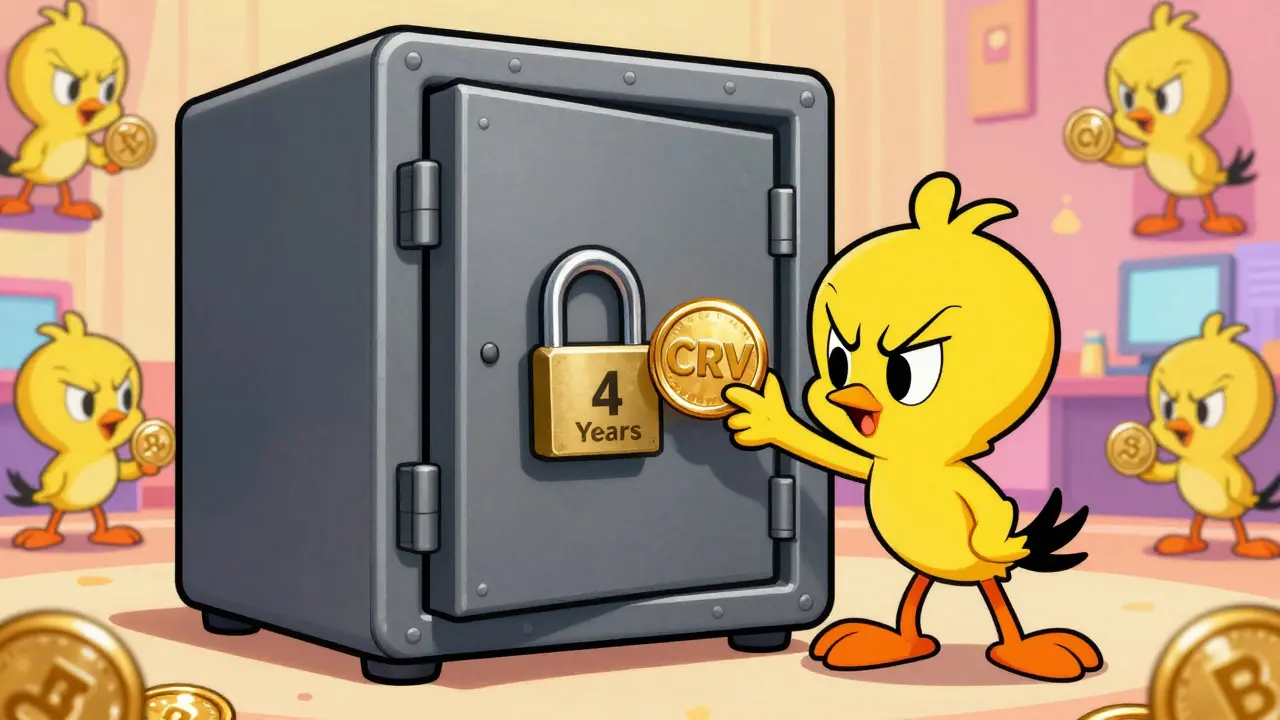
Imagine you want to vote on the rules of a community, but the only way to get a voice is to lock your membership card in a safe for four years. You can't trade it, you can't sell it, and you definitely can't use it elsewhere. That was the reality for many Curve Finance users. They held CRV tokens, the governance currency of one of DeFi’s biggest decentralized exchanges, but getting real influence meant sacrificing liquidity entirely.
This is where Stake DAO CRV comes in. Known by its ticker SDCRV, this token is designed to solve that exact problem. It lets you participate in Curve’s governance and earn rewards without locking your assets away forever. In short, it turns an illiquid commitment into a flexible asset.
The Problem with Traditional Voting Power
To understand why SDCRV exists, we first need to look at how veCRV works. In Curve Finance, holding CRV isn’t enough to vote. You have to lock those CRV tokens for up to four years. The longer you lock them, the more voting power you get. This locked version is called veCRV (voting escrow CRV).
The catch? Once you lock your CRV, it’s gone from your wallet. You can’t sell it if the market crashes. You can’t move it to another protocol to earn better yields. You are stuck until the lock expires. For long-term believers, this is fine. But for traders or people who want flexibility, it’s a major hurdle.
Stake DAO stepped in to fix this. Founded by Alex Theopolis, the team built a "liquid locker" system. Instead of locking your CRV yourself, you deposit it into Stake DAO. In return, you get SDCRV. This token represents your share of the locked pool, but unlike your original CRV, SDCRV is liquid. You can trade it, lend it, or swap it whenever you want.
How SDCRV Works: Liquidity Meets Governance
So, what do you actually get when you hold SDCRV? Two main things: voting power and yield.
First, let’s talk about voting. When you convert CRV to SDCRV, Stake DAO locks your underlying CRV on your behalf. Because they keep re-locking these tokens continuously, your SDCRV gives you steady voting power. Specifically, holding SDCRV grants you approximately 80% of the maximum voting power you would get if you had locked your CRV for the full four years. To put that in perspective, it’s equivalent to having locked your CRV for two years.
Second, there’s the money part. While your CRV is working hard to secure votes for the Curve ecosystem, you aren’t sitting idle. SDCRV holders earn rewards. These come from trading fees generated by the sdCRV/CRV pool on Curve, as well as incentives paid out by Stake DAO itself. As of late 2023, staking SDCRV offered an annual reward rate hovering around 19-20%, depending on market conditions. This makes it attractive for yield farmers who want exposure to Curve’s growth without tying up their capital indefinitely.

The Big Catch: It’s Irreversible
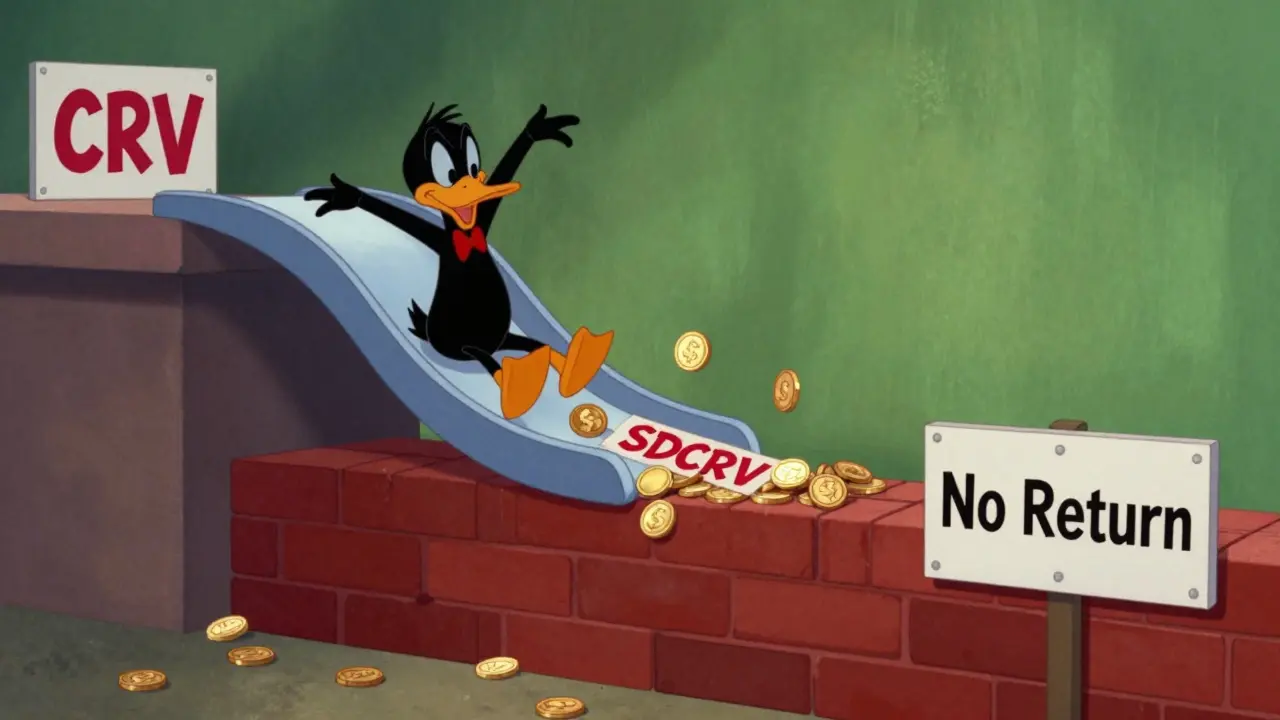
Here is the most important thing you need to know before touching SDCRV: converting CRV to SDCRV is irreversible.
You cannot take your SDCRV back and turn it into CRV again. Not directly. If you decide you no longer want to be part of this system, you have to sell your SDCRV on the secondary market (like swapping it for ETH or USDC) rather than redeeming it for the underlying CRV.
Why is it set up this way? It ensures stability. If everyone could instantly redeem their SDCRV for CRV, the locked pool might drain quickly, causing the voting power to fluctuate wildly. By making the conversion one-way, Stake DAO guarantees that the voting power remains consistent and reliable for the Curve ecosystem. However, this has been a point of frustration for some users who didn’t realize they were committing permanently to the derivative form.
| Feature | Direct veCRV (Locking CRV) | SDCRV (Liquid Staking) |
|---|---|---|
| Liquidity | None (Locked for up to 4 years) | High (Tradeable on markets) |
| Voting Power | Up to 100% (if locked 4 years) | ~80% (Equivalent to 2-year lock) |
| Reversibility | No (Must wait for unlock) | No (Cannot convert back to CRV) |
| Yield Source | Trading fees + incentives | Pool fees + SDT incentives |
| Complexity | Low (Simple lock) | Medium (Requires understanding derivatives) |
Who Should Use SDCRV?
Not every crypto investor needs SDCRV. It serves a specific niche in the DeFi world. Here is who benefits most:
- Medium-term holders: If you plan to hold CRV for 6 to 24 months but don’t want to lose the ability to exit quickly, SDCRV is ideal. You get most of the voting power without the 4-year handcuffs.
- Yield seekers: Investors looking for passive income will appreciate the ~20% APY potential. It’s higher than just holding CRV in a cold wallet.
- Governance participants who value flexibility: If you care about Curve’s future but also want to diversify your portfolio later, SDCRV lets you vote now and sell later.
On the flip side, SDCRV is probably not for you if:
- You want maximum voting power: If you are a whale trying to sway major proposals, the 80% cap matters. You should lock CRV directly for 4 years.
- You need guaranteed redemption: If you think you’ll need your CRV back in a specific amount regardless of price, the inability to reverse the conversion is a dealbreaker.
Risks and Considerations
Like all DeFi products, SDCRV carries risks. The biggest one is dependency. SDCRV’s value is tied directly to Curve Finance. If Curve loses its dominance in the stablecoin exchange space, the demand for veCRV drops, which hurts the value of SDCRV.
There is also smart contract risk. Stake DAO’s code has been audited, but bugs happen. Additionally, regulatory uncertainty looms over governance tokens. If regulators decide that veCRV or SDCRV constitutes a security, it could impact liquidity and usage.
Finally, consider the user experience. Newcomers often stumble on slippage settings when swapping for SDCRV. During volatile periods, you may need to adjust your slippage tolerance to 0.8-1.0% to ensure transactions go through. Always double-check the interface warnings about irreversibility before confirming any transaction.
The Future of SDCRV
Stake DAO isn’t standing still. Recognizing the friction caused by the irreversible model, the team has been working on updates. Plans for "sdCRV v2" include partial conversion capabilities, which would allow users to redeem portions of their SDCRV back to CRV while maintaining the integrity of the voting pool. This aims to address the #1 complaint from new users.
Furthermore, SDCRV has expanded beyond Ethereum mainnet. It is now accessible on Layer 2 networks like Optimism and Arbitrum. This reduces gas fees significantly, making it easier for smaller investors to participate without paying $50 in transaction costs. As cross-chain adoption grows, SDCRV could capture a larger slice of Curve’s governance market, potentially reaching 25% by end of 2024 according to some analysts.
Can I convert SDCRV back to CRV?
No, the conversion from CRV to SDCRV is currently irreversible. You cannot redeem SDCRV for the underlying CRV. To exit, you must sell your SDCRV on a secondary market like Uniswap or Curve itself.
How much voting power does SDCRV give me?
Holding SDCRV grants you approximately 80% of the maximum voting power available. This is equivalent to locking your CRV for two years. It is less than the 100% power you get from a 4-year direct lock, but it offers much greater liquidity.
Is SDCRV safe?
SDCRV relies on Stake DAO's smart contracts, which have undergone audits. However, all DeFi protocols carry smart contract risk. Additionally, SDCRV's value is dependent on the health and popularity of Curve Finance. Diversification is always recommended.
What is the difference between SDCRV and veCRV?
veCRV is non-transferable voting power obtained by locking CRV directly. SDCRV is a liquid token that represents a claim on locked CRV within Stake DAO. SDCRV can be traded; veCRV cannot. SDCRV offers ~80% voting power; veCRV can offer up to 100%.
Do I need to stake SDCRV to earn rewards?
Yes, to maximize returns, you typically stake your SDCRV within the Stake DAO protocol. This allows you to earn trading fees from the sdCRV/CRV pool and additional incentives paid in SDT tokens. Simply holding SDCRV in your wallet does not generate these active yields.