
Most people think of Bitcoin when they hear "crypto," but the reality is that Bitcoin isn't actually private-it's pseudonymous. Your transactions are public, traceable, and linked to your wallet address forever. If you've ever wondered how to send money without leaving a digital trail, Navio (NAV) is a privacy-centric blockchain platform designed to make private applications accessible to everyone. Originally launched in 2014 as Navcoin, it rebranded to Navio in 2024 to reflect its evolution into a fully decentralized privacy ecosystem.
Unlike the giants of the crypto world, Navio doesn't just hide your identity; it hides everything. Sender, receiver, amount, and even token balances are concealed. In a world where financial surveillance is becoming the norm, Navio offers a rare commodity: true anonymity. But what makes it tick? And is it worth your attention?
The Core Technology: Proof-of-Private-Stake
To understand Navio, you have to look at its engine. Most blockchains use Proof-of-Work (like Bitcoin) or standard Proof-of-Stake (like Ethereum). Navio uses something unique called Proof-of-Private-Stake (PoPS). This is the world's only consensus mechanism built specifically for full privacy.
Here’s why that matters. In standard Proof-of-Stake, if you stake coins, your balance is visible on the blockchain. Anyone can see who holds the most power. With PoPS, your staking activity is also private. No one knows how much you’re staking, and no one can link blocks back to you. It combines the efficiency of staking with the secrecy of encrypted messaging.
Under the hood, Navio leverages the blsCT protocol, a proprietary technology that ensures these privacy features don’t compromise speed or scalability. Transactions remain fast and cost-effective, operating peer-to-peer without intermediaries. For users tired of high gas fees and slow confirmation times on other networks, this is a significant upgrade.
The Token Ecosystem: NAV, xNAV, and wNAV
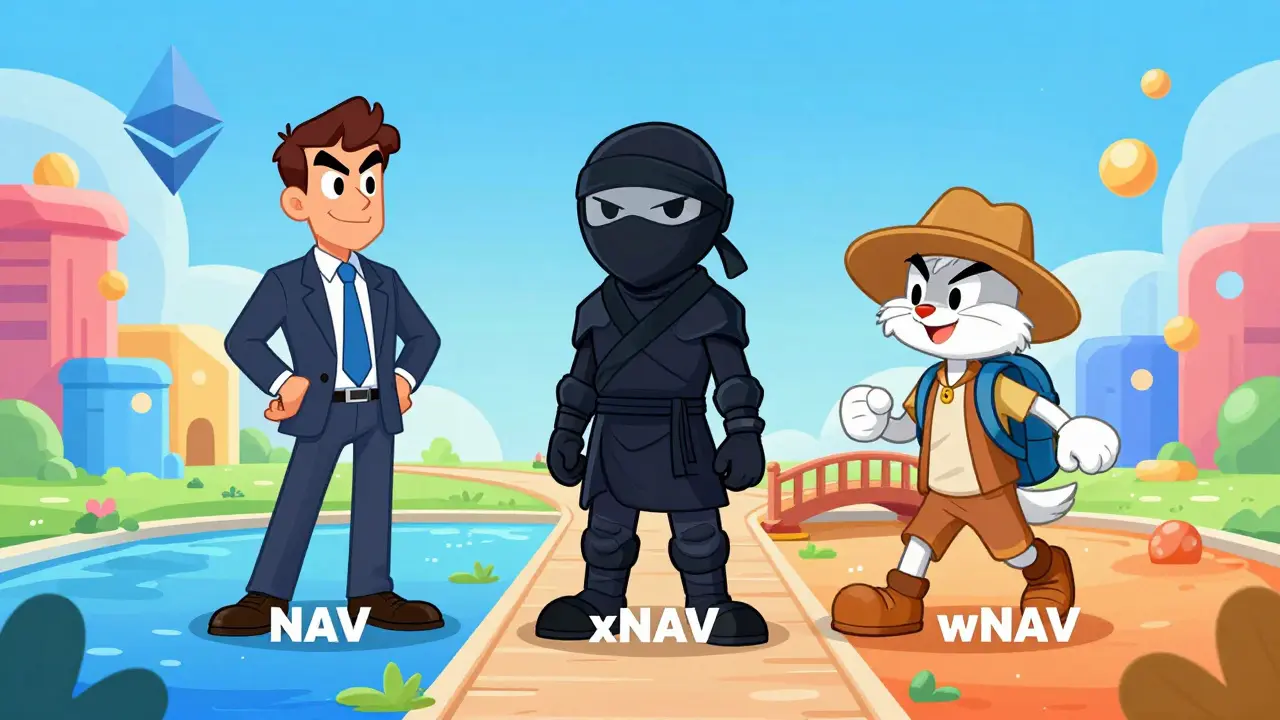
Navio isn’t just one coin; it’s a system of three distinct tokens, each serving a specific purpose. Understanding this triad is key to using the platform effectively.
- NAV: The primary token used for public transactions and network governance. This is the base currency you’ll likely interact with first.
- xNAV: Designed specifically for private transactions. When you want maximum anonymity, you move funds into this layer.
- wNAV: A wrapped version of NAV that allows it to function within decentralized applications (dApps) on other chains.
This structure solves a common problem in crypto: liquidity versus privacy. Usually, you have to choose between being on a popular chain (public) or a privacy chain (illiquid). Navio bridges this gap by allowing users to bridge existing tokens from Ethereum, Avalanche, and Binance Smart Chain onto the Navio blockchain. Once bridged, these tokens inherit Navio’s privacy protections. You can send USDT or ETH on Navio, and no one will know the source, destination, or amount.

Real-World Features: Private NFTs and Anonymous Staking
If you’re into digital art or collectibles, you might be skeptical about privacy coins. How do you prove ownership if nothing is visible? Navio answers this with Private NFTs.
Traditional NFTs are public records. Everyone can see who owns which artwork and what they paid for it. Navio’s private NFTs protect ownership details and metadata while still maintaining secure on-chain validation. You own it, the network verifies it, but the rest of the world stays out of your business. This is huge for high-value collectors who value discretion.
Then there’s Anonymous Staking. On most platforms, large stakeholders are easy targets for analysis or attack because their holdings are transparent. On Navio, you can stake without disclosing your identity or the amount. Each block remains untraceable, obfuscating links between blocks from the same staker. This creates a more secure and equitable network where whales can’t easily be tracked or targeted.
Market Performance and Trading Landscape
Let’s talk numbers. As of May 2026, Navio operates in a niche market segment. Pricing varies across exchanges due to lower liquidity compared to major caps. Coinbase lists NAV around $0.0570, while CoinMarketCap reports closer to $0.0397. This discrepancy highlights the importance of checking multiple sources before trading.
| Metric | Value / Range | Context |
|---|---|---|
| Current Price | $0.039 - $0.063 | Varies by exchange |
| Market Cap | $3.08M - $4.40M | Micro-cap status |
| Total Supply | 76,939,361 NAV | Fully diluted valuation ~$4.39M |
| All-Time High | $5.53 (Jan 2018) | -99% decline from peak |
| 24h Volume | $57K - $590 | Low liquidity warning |
The all-time high of $5.53 in 2018 was during the last major crypto bull run. Since then, like many altcoins, it has corrected significantly. However, it sits well above its all-time low of $0.0005 in 2014. The low trading volume (often under $100k daily) means that large buys or sells can cause sharp price swings. This is not a coin for day traders looking for deep liquidity. It’s better suited for long-term holders who believe in the privacy thesis.
Governance and Community Control
Navio wasn’t born from a venture capital pre-mine or an ICO. It started in 2014 with a fair distribution model. Today, it runs as a Decentralized Autonomous Organization (DAO). Any NAV holder can stake coins and vote on future developments.
The ecosystem includes tools like NavPool for staking and governance participation, and NavBridge for cross-chain swaps. There’s also NavAlias, which facilitates rapid token transfers. These services aren’t controlled by a central team; they are maintained by the community. This decentralization is crucial for a privacy project-if a company controls the code, they can potentially introduce backdoors. With Navio, the community holds the keys.
Why Privacy Matters Now More Than Ever
You might ask, "Do I really need a private coin?" Consider this: every transaction on Bitcoin or Ethereum is permanent and public. Governments, corporations, and hackers can analyze your spending habits, net worth, and connections. Financial freedom implies control over your data, not just your money.
Navio positions itself as essential infrastructure for the next generation of finance. Whether you’re a business protecting trade secrets, an individual safeguarding personal wealth, or a creator selling private NFTs, the ability to transact without exposure is a powerful tool. While regulatory scrutiny on privacy coins is increasing globally, projects like Navio that emphasize open-source transparency and user sovereignty continue to find dedicated audiences.
Is Navio (NAV) safe to use?
Navio is open-source, which allows the community to audit its code. Its PoPS consensus mechanism is designed to prevent tracking. However, as with any micro-cap cryptocurrency, there are risks related to liquidity and market volatility. Always store your assets in a non-custodial wallet that supports NAV.
How does Navio differ from Monero (XMR)?
Monero focuses primarily on private payments using ring signatures. Navio offers a broader ecosystem including private NFTs, anonymous staking, and the ability to bridge other tokens (like ETH or USDT) to maintain their privacy. Navio also uses a unique Proof-of-Private-Stake consensus, whereas Monero uses Proof-of-Work.
Can I buy Navio on Coinbase?
Availability changes frequently. While some data sources list Coinbase as having NAV pairs, others indicate limited or no direct trading. Due to low liquidity, it is often easier to find NAV on decentralized exchanges or smaller centralized platforms that support privacy coins. Always check current listings before attempting a purchase.
What happened to Navcoin?
Navcoin was the original name of the project, launched in 2014. In 2024, the project underwent a major rebranding to Navio to reflect its expanded capabilities beyond simple payments, including private NFTs and cross-chain bridging. The underlying technology and history remain the same.
Are private NFTs legal?
Privacy technologies themselves are not illegal in most jurisdictions, though regulations vary widely. Navio provides the technical capability for privacy. Users are responsible for complying with local laws regarding financial transactions and asset ownership. The open-source nature of Navio means the software cannot be shut down, but access points may be restricted in certain regions.