
You’ve probably seen the ticker KIP pop up in your feed or on a tracker. But what is it? Is it just another meme coin riding the AI hype train, or is there actual tech underneath?
The short answer: KIP isn’t just a token. It’s the native currency of the KIP Protocol, which is a decentralized AI framework and Web3 base layer designed to let owners of AI applications, models, and knowledge bases deploy, connect, and monetize their assets on-chain. Think of it as the plumbing that allows artificial intelligence to own things, get paid, and interact with blockchain networks securely.
If you are wondering whether this project has legs beyond the buzzwords, we need to look past the price charts. We need to look at the problem it solves, the team building it, and the hard data regarding its market performance. Here is the no-nonsense breakdown of KIP Protocol.
The Core Problem: Who Owns the AI?
In the current web, if you build an AI model, you host it on a server owned by a big tech company. If you curate a dataset, that data lives in a silo. You don’t truly “own” these digital assets in a way that lets you trade them or license them automatically via code.
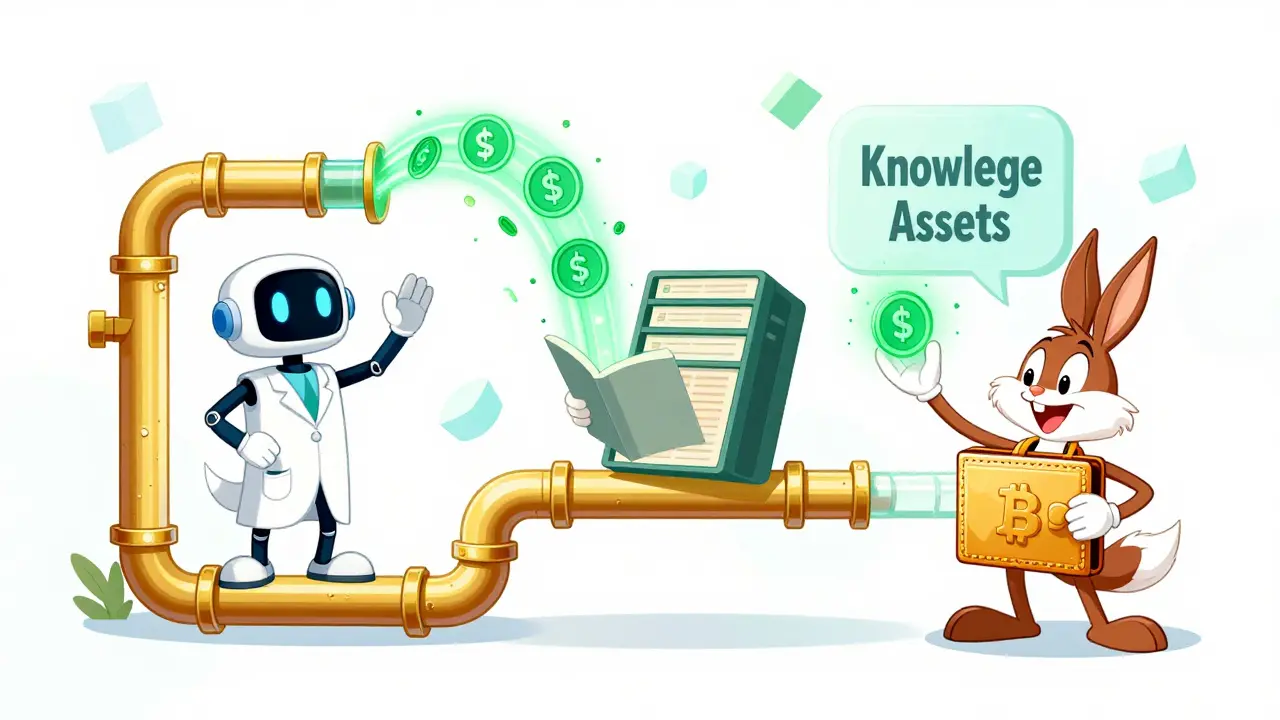
KIP Protocol flips this script. It introduces the concept of Knowledge Assets. These aren’t just files; they are AI models, datasets, and applications treated as property rights on the blockchain. The protocol provides the infrastructure for developers to tokenize these assets. Once tokenized, an AI model can be rented out, sold, or used to power other applications, with payments handled automatically through smart contracts.
This is part of the broader "DeAI" (Decentralized AI) movement. While many projects focus on decentralized compute (renting out GPU power), KIP focuses on the intellectual property side. It asks: How do we prove I created this model, and how do I get paid every time someone uses it?
Who Is Behind KIP Protocol?
In crypto, the team matters more than the whitepaper. A lot of projects are vaporware built by anonymous devs who vanish when the funding dries up. KIP Protocol claims a different pedigree.
The project states it was founded by AI PhDs and industry veterans. More importantly, they claim their underlying technology has been commercially battle-tested since 2022. This means the tech existed before the token launched in 2024. According to their official materials, clients using this infrastructure include governments, NGOs, universities, and large Web3 organizations.
Credibility markers also include:
- Hackathon Wins: KIP was a winner of the 2023 Chainlink Hackathon. Chainlink is a major oracle network, so winning their hackathon suggests technical competence in connecting off-chain data to on-chain contracts.
- Venture Backing: The project lists backing from Animoca Ventures and Tribe Capital. Animoca is one of the most prominent investors in the blockchain gaming and metaverse space, known for picking early winners like The Sandbox and Axie Infinity.
This background suggests KIP is not a weekend project. It appears to be an institutional-grade attempt to bridge traditional AI development with Web3 economics.
How Does the Technology Work?
You don’t need to be a coder to understand the flow, but knowing the mechanics helps explain the value proposition. KIP acts as a base layer. Here is the simplified process:
- Deployment: An AI developer takes their model or dataset and registers it on the KIP Protocol. This creates a verifiable record of ownership (a Knowledge Asset).
- Connection: Other apps or agents want to use this model. They connect to it via the KIP pipeline.
- Monetization: When the model is used, the protocol executes a micro-payment in KIP tokens to the owner. No middleman, no invoice chasing.
A flagship example of this in action is KIP’s on-chain autonomous AI trading agent. This isn’t a bot that just buys low and sells high based on simple rules. It is an AI agent that plans, executes, and optimizes trades independently. Crucially, it shares its full "Chain of Thought" on-chain. This transparency is rare in AI, where models are usually black boxes. By putting the reasoning process on the blockchain, users can audit why the AI made a specific decision.
KIP Tokenomics and Market Reality
Now, let’s talk numbers. This is where things get messy, and why you need to read carefully. KIP is a small-cap asset, and data aggregators often disagree on exact figures due to timing and liquidity pool differences. However, three facts remain consistent across all major platforms (CoinMarketCap, CoinGecko, Coinbase, Bitget):
| Metric | Value / Range |
|---|---|
| Max Supply | 10,000,000,000 (10 Billion) KIP |
| All-Time High (ATH) | $0.045 (Reached Dec 11, 2024) |
| All-Time Low (ATL) | $0.00004535 (Reached May 6, 2026) |
| Current Price Range | $0.000045 - $0.0006 (Highly volatile) |
| Market Cap Estimate | $80k - $1.04M (Depending on source) |
The drawdown is severe. From its peak in late 2024 to its low in May 2026, the price fell roughly 99.8%. Bitget explicitly labels KIP as "high-risk" because of this volatility. If you bought at the top, you have lost almost everything. If you are looking at it now, you are looking at a micro-cap asset with thin liquidity. Daily trading volume hovers around $12,000 to $15,000, which is tiny compared to major AI coins like Render or Fetch.ai.
Circulating supply reports vary wildly-some sources say 1.24 billion, others say 2 billion, and some show zero due to tracking errors. This represents roughly 12% to 20% of the total supply. The rest is likely locked, vested for the team, or reserved for future ecosystem incentives.

Risks vs. Potential: Is It Worth Your Attention?
We need to separate the technology from the token speculation. The tech has potential; the token carries extreme risk.
The Bull Case: If the world moves toward decentralized AI, someone needs to handle the property rights of models. KIP has early traction with serious entities (governments, universities). If their autonomous agents become standard tools for DeFi traders, demand for the KIP token (used for fees and access) could rise significantly. The backing from Animoca gives it a safety net of credibility that most random AI tokens lack.
The Bear Case: The market cap is microscopic. Liquidity is poor, meaning a single large sell order could crash the price further. The competition is fierce. Projects like Bittensor (TAO) and Artificial Superintelligence Alliance (FET) dominate the narrative and have billions in market cap. KIP is fighting for scraps in a crowded field. Furthermore, regulatory scrutiny on AI and crypto is increasing. Selling "digital property rights" to AI models might attract legal attention depending on how jurisdictions classify these assets.
Social sentiment data from Coinbase shows a community that is cautiously optimistic. About 26% of tweets are bullish, while only 3% are bearish, with the majority neutral. This suggests a quiet, dedicated core group rather than a viral hype cycle. That can be good for stability, but bad for explosive growth.
How to Approach KIP Protocol
If you are a developer, ignore the price. Look at the documentation. Can you integrate their SDK into your AI app? Does their chain-of-thought transparency feature solve a problem for your users? If yes, the utility exists regardless of the token price.
If you are an investor, treat KIP as a venture capital bet, not a savings account. The 99% drop from ATH shows that this asset can wipe out portfolios. Only allocate money you are prepared to lose entirely. Do not average down blindly. Wait for clear signs of increased adoption, such as major partnerships or significant increases in daily active addresses, before committing capital.
Keep an eye on the circulating supply unlocks. As more tokens enter the market, selling pressure will increase unless demand grows proportionally. Track the vesting schedules closely.
Is KIP Protocol a scam?
There is no evidence suggesting KIP Protocol is a scam. It has identifiable founders (AI PhDs), venture capital backing (Animoca Ventures), and a track record of commercial use since 2022. However, "not a scam" does not mean "safe investment." The token has experienced extreme volatility and a 99%+ drop from its all-time high, making it a high-risk asset.
What is the difference between KIP Protocol and other AI coins?
Most AI coins focus on decentralized computing power (GPU rental) or general AI services. KIP Protocol specifically focuses on "Knowledge Assets"-the intellectual property of AI models and data. It aims to create a system where AI models can be owned, licensed, and monetized directly on the blockchain, emphasizing digital property rights and transparent reasoning (chain-of-thought) for autonomous agents.
Where can I buy KIP tokens?
KIP is listed on several exchanges including Coinbase, Bitget, and potentially others tracked by CoinMarketCap and CoinGecko. However, liquidity is low. Always verify the contract address before buying to avoid fake tokens. Due to low volume, slippage can be high, meaning you may pay more than the displayed price.
What is the maximum supply of KIP?
The maximum supply of KIP is fixed at 10,000,000,000 (10 billion) tokens. Approximately 1.24 to 2 billion tokens are currently in circulation, representing roughly 12-20% of the total supply. The remaining tokens are likely held in treasuries, team vests, or reserved for ecosystem development.
Who backs KIP Protocol?
KIP Protocol is backed by notable Web3 investors including Animoca Ventures and Tribe Capital. The founding team consists of AI PhDs and industry veterans. The project also won the 2023 Chainlink Hackathon, indicating technical recognition within the developer community.