Privacy in cryptocurrency used to mean one thing: hiding your transactions from everyone. But as regulations tighten and institutions enter the space, that definition is shifting. Horizen (ZEN) is a blockchain platform that sits right at this intersection. It offers privacy features for users who want confidentiality but also provides the tools for businesses to comply with financial laws. Originally launched as ZenCash in 2017, it has evolved into a complex ecosystem of sidechains, nodes, and decentralized applications.
If you are wondering whether ZEN is just another copycat coin or if it has real utility, you need to look past the price charts. The value of Horizen lies in its technical architecture-specifically how it balances zero-knowledge proofs with regulatory compliance. This guide breaks down what Horizen actually does, how its network works, and why its recent migration to the Base blockchain matters for your portfolio.
From ZenCash to Horizen: The Evolution
To understand where Horizen is today, you have to look at where it started. The project began as a fork of Zcash on January 9, 2018. At that time, the team wanted more flexibility than Zcash offered. They renamed the project ZenCash and introduced a new node system that allowed for greater decentralization and community governance.
In 2020, the rebranding to Horizen signaled a shift in strategy. The goal was no longer just to be a private currency like Monero or Zcash. Instead, Horizen aimed to become a platform for building privacy-preserving applications. This meant moving beyond simple peer-to-peer payments to creating an environment where developers could build dApps (decentralized applications) that protect user data by default.
The most significant change came recently. As of late 2025, Horizen completed a major migration to the Base blockchain. This move transformed ZEN from a standalone native coin into an ERC20 token. Why does this matter? Because it allows ZEN to interact seamlessly with the broader Ethereum ecosystem, including popular DeFi protocols, while still maintaining its unique privacy features. It’s a strategic pivot to access liquidity and users without sacrificing the core identity of the project.
How Horizen Works: Technology and Architecture
Horizen’s technology stack is built on three main pillars: consensus mechanisms, privacy cryptography, and modular sidechains. Understanding these components helps explain why the network operates the way it does.
Consensus and Mining
The main chain uses a modified Proof-of-Work (PoW) algorithm called Equihash. This is the same algorithm used by Zcash, designed to be ASIC-resistant initially, though specialized hardware now exists. Miners solve complex mathematical problems to secure the network and validate transactions. In return, they receive block rewards. However, unlike Bitcoin where miners get 100% of the reward, Horizen splits the pie differently to support its unique infrastructure.
Zero-Knowledge Proofs
The heart of Horizen’s privacy feature is zk-SNARKs (Zero-Knowledge Succinct Non-Interactive Arguments of Knowledge). This cryptographic method allows a sender to prove they have enough funds to make a transaction without revealing their balance, address, or the amount being sent. Think of it like showing a bouncer your ID to prove you’re over 21, but doing so through a window so they can’t see your name or photo-just the fact that you meet the requirement. This makes transactions confidential by default, yet verifiable by the network.
The Node Hierarchy
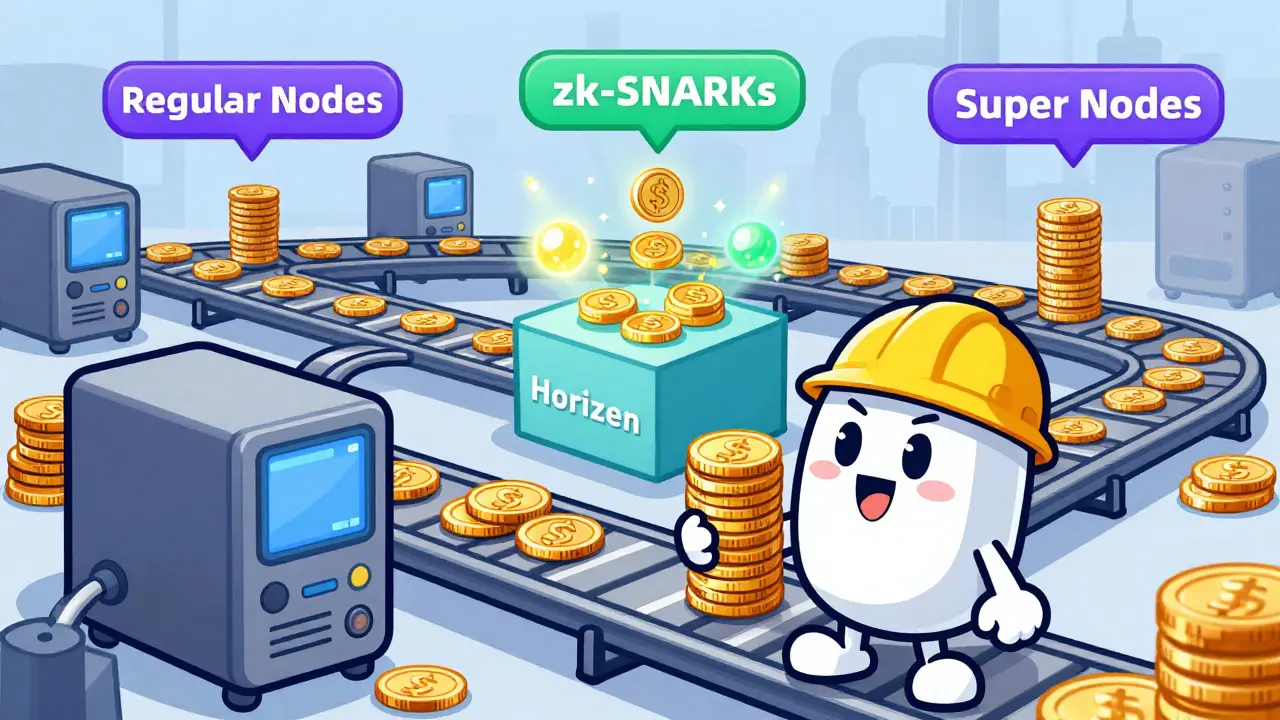
What sets Horizen apart from many other PoW chains is its tiered node system. Not all nodes do the same work. The network relies on three types:
- Regular Nodes: These maintain a copy of the blockchain and help propagate transactions. They require minimal resources.
- Secure Nodes: These act as gatekeepers. They verify that transactions follow the rules before passing them to the rest of the network. To run one, you must stake 42 ZEN and keep your server online 92% of the time with a quick response time to challenges.
- Super Nodes: These are the heavy lifters. They manage the sidechains and handle complex operations. Running a Super Node requires staking 500 ZEN, having 8GB RAM, 100GB storage, and maintaining 96% uptime.
This structure ensures that the network remains secure and efficient. It also creates a passive income opportunity for those willing to invest in the hardware and stake the tokens.
Zendoo: The Sidechain Solution
One of Horizen’s most innovative features is Zendoo, its sidechain framework. Main blockchains like Bitcoin or Ethereum can be slow and expensive to modify. If a developer wants to create a specific application with custom rules, they often face limitations.
Zendoo solves this by allowing developers to spin up independent blockchains that connect to the main Horizen chain. Each sidechain can have its own consensus mechanism, transaction fees, and privacy settings. For example, a gaming dApp might need fast, low-cost transactions with public leaderboards, while a healthcare app might need strict privacy and slower, more secure verification. Both can exist under the Horizen umbrella via Zendoo.
This modularity is crucial for institutional adoption. Banks and enterprises often cannot use fully anonymous coins due to anti-money laundering (AML) laws. With Zendoo, a company can build a private ledger where only authorized parties can view transaction details, satisfying both privacy needs and regulatory requirements. This flexibility is Horizen’s key competitive advantage over rigid competitors.
ZEN Tokenomics and Distribution
The ZEN token is the fuel that powers the Horizen ecosystem. Its design follows a deflationary model similar to Bitcoin, with a hard cap of 21 million tokens. There was no pre-mine or initial coin offering (ICO), which appeals to purists who believe in fair launch principles.
Reward Distribution
When a new block is mined, the rewards are split among three groups:
- Miners (60%): They provide the computational power to secure the main chain.
- Node Operators (30%): Secure and Super Nodes receive a share for maintaining network integrity and managing sidechains.
- Horizen DAO Treasury (10%): This fund supports ongoing development, grants, and ecosystem growth.
This distribution model incentivizes participation at every level. It prevents centralization of power among miners alone and rewards those who contribute to the network’s operational health.
Utility of ZEN
You don’t just hold ZEN for speculation. It has several practical uses:
- Transactions: Pay for goods and services with optional privacy.
- Staking: Lock up ZEN to run Secure or Super Nodes and earn rewards.
- Governance: Holders can vote on proposals related to the DAO treasury and protocol upgrades.
- DApp Interaction: Use ZEN to pay for gas fees and interactions within the Horizen ecosystem and connected DeFi platforms on Base.
Market Position and Price Outlook
As of mid-2026, Horizen trades around $7.00-$7.70 per ZEN, ranking roughly 306th in the cryptocurrency market. This position reflects a niche but dedicated user base. It doesn’t have the mainstream hype of Solana or the brand recognition of Bitcoin, but it serves a specific audience: those who prioritize privacy and technical sovereignty.
Competitive Landscape
Horizen competes in two spaces simultaneously. On one side, it faces pure privacy coins like Monero and Zcash. Monero forces privacy on every transaction, making it untraceable but harder for exchanges to list due to regulatory pressure. Zcash offers optional privacy but lacks Horizen’s flexible sidechain infrastructure. On the other side, Horizen competes with smart contract platforms like Ethereum and Polygon, but with a privacy-first twist.
Price Predictions
Crypto analysts remain cautiously optimistic. Some models suggest ZEN could reach an average of $56.28 by 2030, driven by increased adoption of privacy-compliant DeFi. However, these predictions depend heavily on regulatory clarity. If governments crack down on privacy features, ZEN’s value could suffer. Conversely, if institutions adopt Horizen’s compliant sidechains for internal ledgers, demand for ZEN could surge.
| Feature | Horizen (ZEN) | Monero (XMR) | Zcash (ZEC) |
|---|---|---|---|
| Privacy Model | Optional (zk-SNARKs) | Mandatory (Ring Signatures) | Optional (zk-SNARKs) |
| Sidechains | Yes (Zendoo) | No | Limited |
| Regulatory Compliance | Built-in tools for KYC/AML | Difficult for institutions | Moderate |
| Consensus | PoW + Staking Nodes | PoW | PoW |
| Max Supply | 21 Million | Unlimited (Tail Emission) | 21 Million |
How to Buy and Store ZEN
Getting started with Horizen is straightforward for basic users, but running nodes requires technical skill. Here is how you can participate.
Buying ZEN
Since the migration to Base, ZEN is available as an ERC20 token on major decentralized exchanges (DEXs) like Uniswap and Aerodrome. You can also find it on centralized exchanges such as Binance and Coinbase. If you are buying for long-term holding, consider using a cold wallet that supports Ethereum-compatible tokens, ensuring you store the correct contract address for the post-migration ZEN.
Running a Node
If you want to earn passive income, you can operate a Secure or Super Node. This requires:
1. Downloading the Sphere by Horizen client.
2. Setting up a server with sufficient RAM and storage (especially for Super Nodes).
3. Staking the required amount of ZEN (42 for Secure, 500 for Super).
4. Maintaining high uptime to avoid penalties.
For institutional investors, there is also the Grayscale Horizen Trust, which offers regulated exposure to ZEN without the hassle of self-custody.
Future Roadmap and Challenges
Horizen’s future hinges on execution. The migration to Base was a bold move to integrate with larger DeFi ecosystems. The next steps involve expanding the library of privacy-ready dApps in gaming, AI, and finance. The team is focusing on enhancing trusted execution environments to make it easier for developers to build compliant apps.
However, challenges remain. Regulatory uncertainty is the biggest threat. Governments worldwide are scrutinizing privacy coins. Horizen’s ability to offer "compliant privacy" is its shield, but it must continuously adapt to changing laws. Additionally, competition is fierce. Newer Layer 2 solutions on Ethereum are offering faster and cheaper transactions, even if they lack deep privacy features. Horizen must prove that privacy is not just a luxury for criminals, but a necessity for modern digital rights.
Is Horizen (ZEN) a safe investment?
Like all cryptocurrencies, ZEN carries risk. Its safety depends on your risk tolerance and belief in the privacy narrative. Horizen has a strong technical foundation and a fair launch history, but it ranks outside the top 100 cryptos, meaning higher volatility. Always do your own research and never invest more than you can afford to lose.
Can I mine ZEN with my home computer?
Mining ZEN requires GPUs optimized for the Equihash algorithm. While possible with a powerful gaming PC, profitability is low for individual miners due to competition from large mining farms. Most individuals prefer buying ZEN or running nodes instead.
What is the difference between ZEN and Monero?
Monero enforces privacy on every transaction, making it completely untraceable. Horizen offers optional privacy, allowing users to choose between transparent and shielded transactions. This flexibility makes Horizen more appealing to businesses and regulators who need some level of auditability.
Why did Horizen migrate to Base?
The migration to Base allows ZEN to function as an ERC20 token, enabling seamless integration with Ethereum’s vast DeFi ecosystem. This increases liquidity, accessibility, and interoperability while retaining Horizen’s unique privacy features through its underlying architecture.
How much ZEN do I need to run a Super Node?
You need to stake 500 ZEN to run a Super Node. Additionally, you must maintain a server with at least 8GB RAM, 100GB storage, and ensure 96% uptime to receive rewards.