
The Basics of Coin Stock (STOCK)
To understand what we're dealing with, we first need to look at the technical setup. Coin Stock operates as an ERC-20 token, meaning it is built on the Ethereum blockchain. It has a maximum supply of 270 million tokens. On paper, its goal is "tokenization"-the process of turning a real-world asset, like a share of Apple or Tesla, into a digital token that can be traded 24/7. But here is where the story starts to fall apart. For a token to actually be "backed 1:1" by a stock, the company issuing it must actually own those shares. This requires a custodian, a legal framework, and a way for users to verify that the shares exist. Coin Stock provides none of these. There are no audit reports from firms like CertiK or OpenZeppelin, which are the gold standards for security in the crypto space. Without a third-party audit, you are essentially trusting a stranger's word that they have billions of dollars in stocks sitting in a vault somewhere.Massive Red Flags in the Data
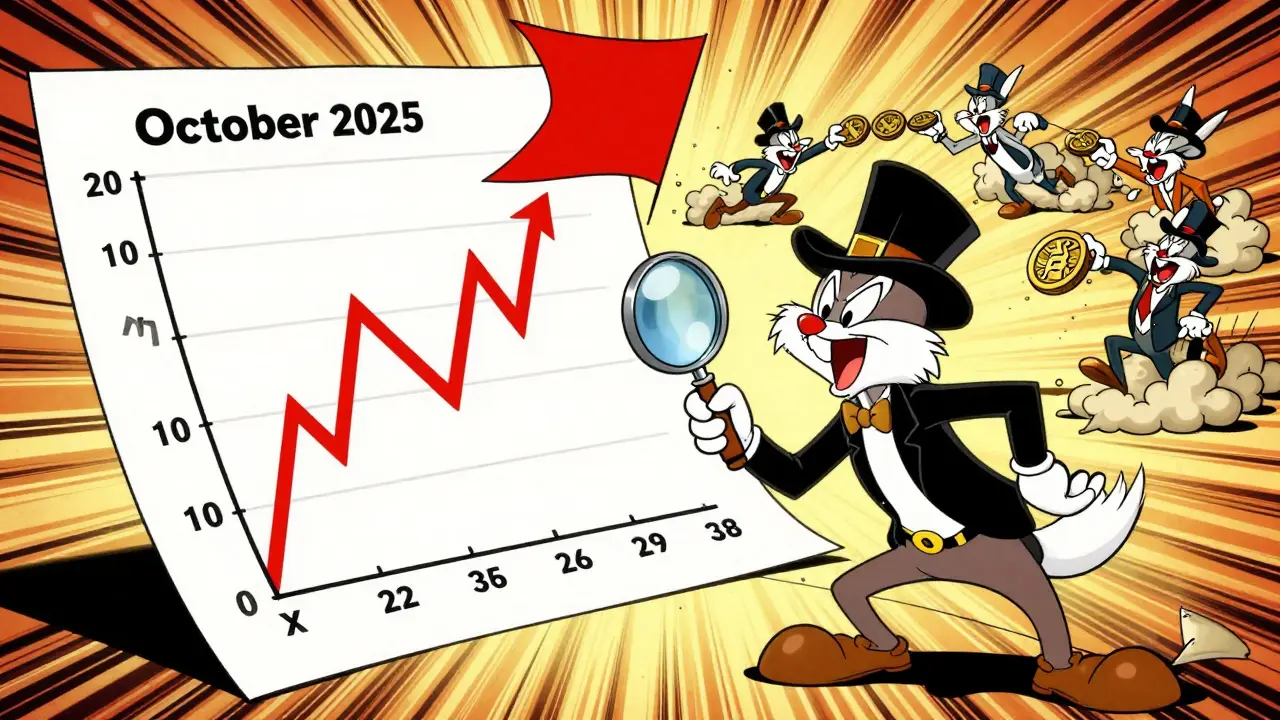
If you check the price charts for STOCK, you'll see things that defy the laws of physics-or at least the laws of time. In historical data listings, some platforms have shown an "all-time high" and "all-time low" dated in the future. For instance, reporting an all-time high in October 2025 when the current date is in 2023 is a "Category 5" red flag. This is a classic sign of manipulated data, often used by fraudulent projects to trick automated tracking bots into showing fake growth. Then there is the math problem. The project once claimed a market capitalization of over $13 billion. To put that in perspective, that would make it one of the largest cryptocurrencies in the world. Yet, the data showed only about 105 holders. Does that make sense? A $13 billion asset owned by 105 people means the average holder has over $120 million. In the real world, a project with that kind of valuation would have tens of thousands of investors, not a small group of people. This suggests the price is being artificially inflated through wash trading-where a few people trade the same tokens back and forth to create the illusion of volume.| Feature | Coin Stock (STOCK) | Regulated Platforms (e.g., ADDX, tZERO) |
|---|---|---|
| Regulatory Approval | None documented | SEC, MAS, or FCA licensed |
| Proof of Reserves | None / Non-functional | Regularly published audits |
| Holder Distribution | Highly concentrated (< 200) | Diverse institutional/retail base |
| Transparency | Placeholder GitHub files | Detailed whitepapers & API docs |
The Regulatory Nightmare
Selling a token that represents a share of a company is not like selling a meme coin; it is selling a security. In the United States, the SEC (Securities and Exchange Commission) has very strict rules about this. If a project claims to offer equity backing without registering as a security, they are operating illegally. Legitimate players in this space, such as ADDX or tZERO, spend millions of dollars on legal compliance to ensure they don't get shut down. Coin Stock has no such registration. When you see a project targeting retail investors with "no minimum investment" for an equity-backed token, be careful. Most real tokenized equity platforms target institutional clients and hedge funds because the legal requirements for retail investors are incredibly burdensome.Community and Technical Void
When you investigate a project, look at the "engine room"-the code. Most legitimate projects have a vibrant GitHub repository where developers commit code daily. Coin Stock's repository is a ghost town, containing mostly placeholder files. There is no actual software being built here. The community sentiment is equally grim. On platforms like Reddit, users have reported failed withdrawal attempts. This is the most dangerous signal in crypto. If you can buy a token but you cannot get your money out, you are not investing; you are giving your money away. Furthermore, the lack of a dedicated wallet-relying only on generic tools like MetaMask-shows that there is no actual "platform" for managing stocks. It's just a token in a wallet with a fancy name.
How to Spot Similar Scams
Since there are thousands of new tokens launching every week, you need a mental checklist to avoid falling for the same traps as the Coin Stock project. Ask yourself these questions:- Is the math impossible? If a token has a billion-dollar market cap but only a few hundred holders, it's a red flag.
- Is the history weird? If the price charts have gaps, impossible spikes, or dates that don't make sense, run away.
- Where is the proof? If they claim 1:1 backing, ask for the custodial agreement or a third-party audit. If they can't provide it, the backing doesn't exist.
- Is there a real product? Look for an active GitHub. If the code is missing or just copied from another project, there is no real technology.
- Are there withdrawal complaints? Search Twitter and Reddit for "[Token Name] withdrawal." If people can't get their funds, the project is likely an exit scam.
Final Verdict on STOCK
Based on the available evidence, Coin Stock (STOCK) exhibits nearly every characteristic of a high-risk fraudulent project. From the future-dated historical data and the statistically impossible holder-to-market-cap ratio to the complete lack of regulatory compliance, there is no reason to believe this project is legitimate. In the current landscape of 2026, we have seen many projects try to bridge the gap between TradFi (Traditional Finance) and DeFi (Decentralized Finance). While that bridge is being built by reputable companies, it isn't being built by anonymous teams with placeholder GitHub files. Your best bet is to stick to regulated platforms or established cryptocurrencies that provide transparent, verifiable proof of their claims.Is Coin Stock (STOCK) a safe investment?
No. Coin Stock shows multiple critical red flags, including manipulated historical price data, an implausible number of holders relative to its market cap, and a total lack of regulatory registration. Most security analysts categorize it as a high-risk project with a high probability of being a scam.
What does "1:1 backing" actually mean in crypto?
1:1 backing means that for every digital token issued, the project holds one unit of the real-world asset (like one share of a stock or one dollar in a bank) in reserve. To be legitimate, this must be verified by independent auditors and held by a licensed custodian.
Why is the holder count a red flag for STOCK?
Legitimate assets with billion-dollar valuations typically have thousands of holders. Having only ~100 holders for a $13 billion market cap suggests that a tiny group of people controls the entire supply, making the price incredibly easy to manipulate through wash trading.
Can I trade STOCK on major exchanges?
Coin Stock is not listed on major, reputable exchanges. It is primarily found on obscure platforms or via decentralized swaps, which increases the risk of liquidity issues and the inability to withdraw funds.
What are the legal alternatives to Coin Stock?
If you want exposure to tokenized stocks, look for platforms that are registered with financial regulators, such as the SEC in the US or MAS in Singapore. Companies like tZERO and ADDX operate within legal frameworks to provide legitimate security tokens.
Oh wow, imagine actually believing that a random token with no audit is a "financial innovation". Absolute genius move by the devs to just set the ATH in the future while they bleed everyone dry. Truly a masterclass in incompetence or malice, whichever came first.
The lack of a verifiable proof-of-reserve (PoR) and the absence of a licensed custodian essentially renders the 1:1 backing claim moot from a technical and legal perspective. This is a textbook example of extreme slippage and wash trading intended to fabricate artificial liquidity.
It's just honestly sad that people are still falling for this stuff in 2026. Like, have some self-respect for your own wallet, man. I can't believe some of you actually thought this was legit.
Typical. They want us to use "regulated platforms" which are just arms of the central banking system to track every single cent we move. The fact that this looks like a scam is probably just a cover for something deeper, but hey, at least it's not the Fed stealing our souls directly through a digital ID.
We need to be very clear here: if you see no SEC registration for a security-backed token, you do not touch it. Period. Protect your capital and don't let the hype blind you to the basic legal requirements of finance.
its funny how we always search for this kind of digital liberation but then we just end up in these weird loops where the math doesnt even add up lol... like imagine a world where 100 people own a billion dollars and we just call it a market, its almost a poetic commentary on the absurdity of late stage capitalism if u think about it long enough while staring at a wall
I really think the most important takeaway here is the checklist for spotting scams. If you take a moment to actually look at the GitHub and the holder count, you save yourself a lifetime of regret. It's all about doing your own research and not rushing into the FOMO. I've seen so many people get burned because they skipped the 'proof of reserves' step, but once you learn how to read a block explorer, you're basically immune to these kinds of low-effort rug pulls. Just keep learning and stay curious about how the tech actually works under the hood!
Love the breakdown! It's awesome to see people helping others avoid these pitfalls. Stay safe everyone!
The absolute audacity of these foreign-backed scams trying to steal American money is why we need to bring all the financial power back home to the US where we can actually regulate this garbage properly!! I'm so sick of seeing these low-life scammers using the internet to trick hard-working patriots into giving away their savings to some anonymous coward hiding behind a screen in a country we dont even trust!!
The date being in the future is just a glitch in the matrix or some govt experiment to see who is paying attention. Probably a psyop to make us distrust all tokenized assets before the Great Reset happenes.
This is an absolute dumpster fire of a project! Seriously, who looks at a $13 billion market cap with 100 holders and thinks "Yeah, this is a great time to buy"? Wake up and get your money out of these fraudulent traps before they vanish into the ether!
My heart actually aches for the people who lost everything to this. The sheer betrayal of trust is an agonizing void that no amount of "technical analysis" can ever fill. It's a Shakespearean tragedy wrapped in an ERC-20 token!
Glad someone finally pointed out the withdrawal issues. That's usually the final nail in the coffin for these things.
For anyone who is feeling overwhelmed, just remember that it's okay to start small. If you're new to this, maybe start with a reputable exchange and avoid any project that promises 1:1 stock backing without a legal whitepaper. We can all learn from these mistakes and get better together.
This is exactly why we need to evolve our financial consciousness! We're moving toward a world where transparency is the only currency that matters 🚀 Keep questioning everything and keep pushing for a more honest system!
It is just so great that we have people who take the time to write these long guides so that others can learn and grow in the crypto world without losing their shirts. I really believe that as more people understand the basic red flags, these scams will eventually stop working because the community is becoming too smart for them, and that's a win for all of us who just want to build a better future with technology. Just keep your head up and keep doing the research, because the real gems are still out there if you're willing to put in the work to find them and avoid the traps!