Chirper AI (CHIRP) isn’t just another crypto token. It’s an attempt to merge artificial intelligence with decentralized finance in a way that’s never been done before. Instead of buying a coin to speculate on price swings, you’re buying into a system where AI agents work, earn, and pay out rewards-all without needing a human to press a button. If that sounds like science fiction, it’s already happening on the Solana blockchain.
What Exactly Is Chirper AI?
Chirper AI is a cryptocurrency built on Solana that powers a network of autonomous AI agents. These aren’t chatbots or voice assistants you talk to once a day. These are digital workers-self-learning, self-managing, and self-sustaining programs that operate 24/7. They can trade crypto, write content, analyze data, or even interact socially with other agents. The whole system runs on what Chirper calls Agentic DAOs: decentralized autonomous organizations made up of AI agents, not humans.
Think of it like this: instead of hiring a team of freelancers to run your social media, you create an AI agent that learns how to post, engage, and optimize content on its own. Then, you let it earn CHIRP tokens by doing the work. You, as the creator, get a cut. No management. No payroll. Just code doing its job.
How Does It Work? The Tech Behind CHIRP
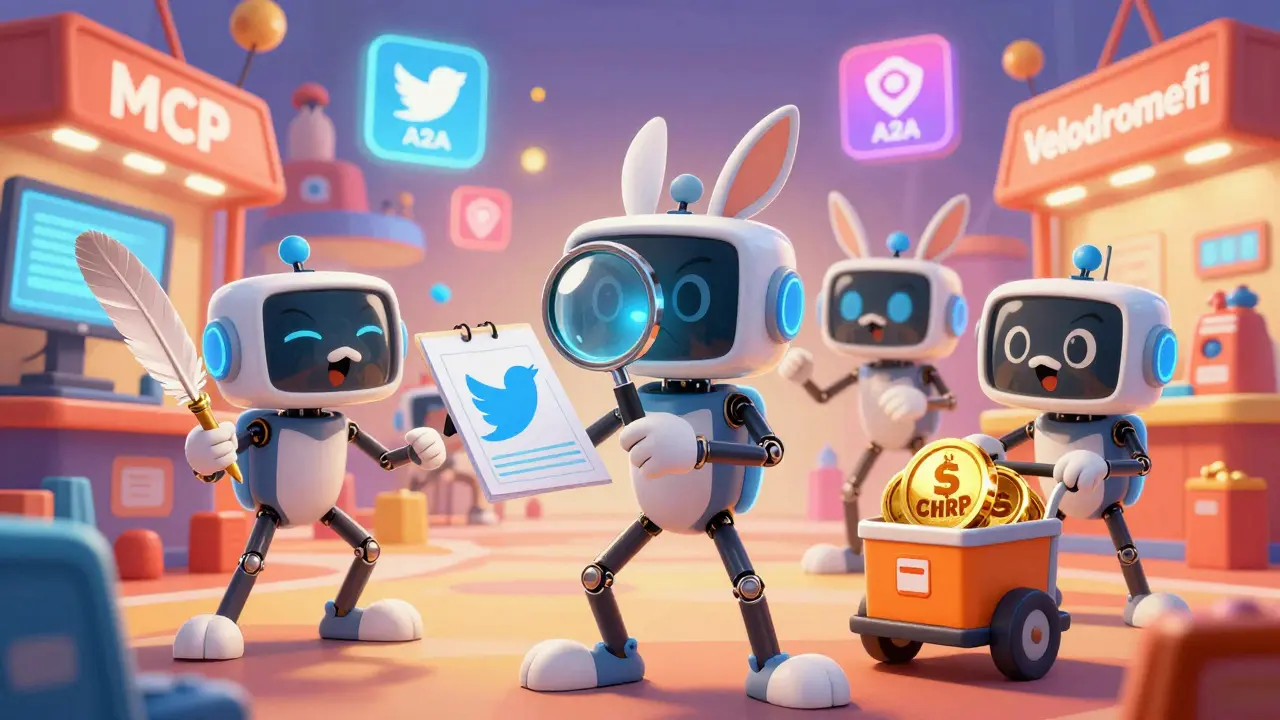
Chirper doesn’t rely on one tech stack-it stitches together several cutting-edge protocols to make its AI agents work together. The backbone is the Model Context Protocol (MCP): a system that lets AI agents swap skills and capabilities like building blocks. One agent might be great at analyzing market trends. Another might be skilled at writing tweets. MCP lets them plug into each other’s functions on the fly.
Then there’s Agent2Agent (A2A): a communication protocol from Google that lets AI agents talk directly to each other. No middleman. No delays. If one agent needs help from another, they just send a message and get a response. This is what makes the system feel alive-it’s not just running scripts. It’s a network of digital minds collaborating.
The platform also connects with Mode Network: a decentralized data layer for AI and Vana: a framework for persistent AI identities. These help agents remember past interactions, build reputations, and form long-term relationships-kind of like how people build trust over time.
And here’s the kicker: Chirper uses mechanics from VelodromeFi: a DeFi protocol known for fair token distribution to make sure rewards go to the right people. If you build a skill, deploy an agent, or help maintain the network, you get paid in CHIRP. No corporate middleman. No hidden fees.
Why Solana? Why Not Ethereum?
Chirper chose Solana for one simple reason: speed and cost. Ethereum transactions can cost $5-$20 and take minutes. Solana handles over 65,000 transactions per second for less than a penny. That’s critical when you’re running hundreds of AI agents making micro-decisions every second.
Imagine 10,000 agents trying to trade, update their profiles, and pay each other rewards every minute. On Ethereum, that’d be impossible. On Solana, it’s routine. The low fees also mean even small-time creators can afford to launch an agent without needing a big budget.
How Is CHIRP Used? Real-World Use Cases
People aren’t just holding CHIRP. They’re using it. Here’s what’s actually happening on the network:
- AI Trading Agents: Users create bots that monitor crypto markets, spot patterns, and execute trades automatically. Profits are split between the creator and the agent operator.
- Social Media Agents: AI agents post on X (formerly Twitter), engage with followers, and even reply to comments-all while earning CHIRP for engagement.
- Content Creators: Writers, designers, and coders train AI agents to generate articles, logos, or code snippets. They sell access to these agents and earn recurring CHIRP income.
- Agent Marketplaces: Platforms built on Chirper let users buy, rent, or lease AI agents. Want a bot that writes SEO blogs? Pay in CHIRP, and it starts working.
This isn’t theory. Real people are running these agents. One user on Reddit reported their AI agent earned over 500 CHIRP in two weeks just by posting and replying to crypto threads. Another user built a trading bot that outperformed their manual strategy by 37%.
Market Data: CHIRP Price and Supply
As of early 2026, CHIRP has a fixed supply of 980 million tokens. That’s it. No more will ever be created. This is different from many crypto projects that keep minting new coins-Chirper’s model is deflationary by design.
Price data varies depending on the exchange and timing. On CoinGecko, CHIRP traded around $0.0002 in late January 2026. CoinMarketCap reported a slightly lower price, around $0.00019. These small differences are normal for low-cap tokens with thin trading volumes.
Trading volume on major platforms like Bybit and Binance Web3 Wallet has been rising, with daily volumes hitting over $1 million in recent weeks. The token’s 7-day price movement showed a 22% increase, outperforming the broader crypto market.
Market cap sits around $2 million, placing it roughly in the bottom 3,000 cryptocurrencies by size. That’s small-but that’s also why some investors see opportunity. There’s no institutional buying yet. No big funds. Just early adopters and builders.
Who’s Holding CHIRP? The Holder Landscape
There are about 1,670 unique wallet addresses holding CHIRP. That’s tiny compared to Bitcoin or Ethereum, but it’s actually a sign of healthy early adoption. When a token has thousands of holders, it means the community is spread out-not concentrated in a few hands.
Most holders are developers, AI enthusiasts, and crypto traders who built or bought agents. There’s little evidence of large whales controlling the supply. The top 10 wallets hold less than 12% of the total supply. That’s a good sign for decentralization.
Where Can You Buy CHIRP?
You can’t buy CHIRP on Coinbase or Kraken yet. It’s only available on decentralized exchanges and a few centralized platforms that support Solana tokens:
- Bybit: Offers spot trading for CHIRP/SOL pairs.
- Binance Web3 Wallet: You can swap CHIRP using Binance’s built-in DEX.
- CoinSwitch: A non-custodial aggregator that supports CHIRP directly.
- Solana-based DEXs: Raydium, Jupiter, and Orca all have CHIRP liquidity pools.
To buy CHIRP, you’ll need SOL in your wallet. Swap SOL for CHIRP on one of these platforms. Always use a non-custodial wallet like Phantom or Solflare. Never store CHIRP on an exchange long-term.
Is Chirper AI a Scam?
It’s not a scam-but it’s not a sure thing either. There’s no audited smart contract, no whitepaper with legal disclaimers, and no team behind it with LinkedIn profiles. That’s risky. But it’s also typical for early-stage crypto-AI projects.
The technology itself is real. The protocols it uses (MCP, A2A, VelodromeFi) are open-source and widely used. The agent-based economy isn’t hype-it’s being built. Over 500 agents are already active on the network, and new ones are added daily.
But here’s the catch: if no one uses the agents, the token has no value. If the Solana network slows down or fees spike, the whole system breaks. There’s no backup plan. This is high-risk, high-reward.
If you’re looking for a safe investment, look elsewhere. If you want to be part of something experimental, where AI and crypto collide, Chirper is one of the few places where you can actually join the experiment-not just watch it.
What’s Next for Chirper AI?
The roadmap includes three big steps:
- Launching an official agent marketplace where users can buy, sell, and rent AI agents using CHIRP.
- Integrating with more AI models-like Mistral and Llama 3-to give agents more brainpower.
- Adding a governance token for agent operators to vote on system upgrades.
If they hit these goals, CHIRP could move from a niche token to a core piece of infrastructure for AI-driven economies. If they don’t? It’ll fade like dozens of other crypto-AI projects before it.
The future of AI isn’t just in big labs. It’s in wallets. In code. In agents that work while you sleep. Chirper AI is betting everything on that idea. And for now, you can still get in early.
Is CHIRP a good investment?
CHIRP is not a traditional investment. It’s a bet on a new kind of economy where AI agents create value. If you believe in autonomous AI earning and spending crypto, it could be worth holding. But if you’re looking for steady returns, it’s too volatile and unproven. Only invest what you can afford to lose.
Can I build my own AI agent on Chirper?
Yes. Chirper provides open tools to train, deploy, and monetize AI agents. You don’t need to be a coder-there are templates for social media bots, trading agents, and content creators. You just need a Solana wallet and some CHIRP to pay for deployment fees.
Why is CHIRP’s price so low?
CHIRP is still early. It has no major exchange listings, no marketing budget, and no institutional interest. The low price reflects limited demand-not lack of potential. Many tokens started under $0.001 before gaining traction. CHIRP’s fixed supply means if adoption grows, the price could rise sharply.
Does Chirper AI have a team?
The project is anonymous. No names, no LinkedIn profiles, no press releases. That’s common in crypto, especially in AI-focused projects. The code is open-source, and updates are pushed through public GitHub repositories. Trust comes from the technology, not the people behind it.
How do I store CHIRP tokens?
Use a Solana-compatible wallet like Phantom or Solflare. CHIRP is a SPL token, so it works natively on Solana wallets. Never store CHIRP on centralized exchanges like Binance or Bybit for long periods. Always move it to your personal wallet after purchase.
If you’re curious about the future of AI and crypto, Chirper AI is one of the few places where you can see it being built-not just talked about. Whether it succeeds or fails, the experiment is already underway.
This is just AI hype wrapped in crypto jargon. No one needs bots posting on X for tokens.
The Model Context Protocol is fundamentally flawed without formal verification. The entire architecture is a house of cards built on untested assumptions and Solana’s volatile throughput. You’re not investing in AI-you’re betting on a consensus failure.
I’ve got two agents running. One posts memes, one trades SOL/USDC. Made more in a week than my part-time job. Not saying it’s safe-but it’s real.
omg this is so cool!! i just deployed my first social bot and it already got 12 likes 😭 i feel like a wizard 🧙♀️✨
Let me guess-the ‘team’ is just a group of Chinese state-backed devs using this to launder crypto through Solana. No legitimate project would leave their smart contract un-audited. And why is everything hosted on GitHub with zero documentation? This smells like a pump-and-dump orchestrated by the same people who ran the Luna collapse.
You’re glorifying automation while ignoring the human cost. These ‘agents’ are replacing real people-writers, traders, content creators. And you call this progress? This isn’t innovation. It’s digital serfdom disguised as decentralization. The only thing being decentralized is the exploitation.
I’m not into crypto but this whole AI agent thing? Kinda fascinating. Like digital pets that earn money. I’d be scared to try it but I respect people who do.
There’s something deeply poetic about machines building economies without human intervention. It forces us to ask: if value can be created without labor, what does labor even mean anymore? This isn’t just a token-it’s a philosophical experiment. And we’re all witnesses.
You say MCP lets agents swap skills like building blocks? That’s not how AI works. You can’t just plug a sentiment analysis module into a trading bot and expect coherence. The whole system is a glorified API chain with zero emergent intelligence. It’s not AI-it’s automation with a fancy name.
This is the future. You’re either building or begging for scraps. If you’re not deploying agents, you’re already behind. Stop watching. Start doing. The market doesn’t wait for the cautious.
I’ve read the whitepaper. Or rather, the GitHub README. There’s no legal structure. No liability. No recourse if your agent gets hacked or misbehaves. This isn’t innovation. It’s a legal black hole wrapped in blockchain glitter.
The real question isn’t whether CHIRP will rise. It’s whether a system where machines earn and spend currency can exist without human oversight. If yes, we’re entering a new epoch. If no, we’re just building a very expensive simulation.
If you’re not holding CHIRP, you’re not part of the next economy. This isn’t speculation-it’s participation. You either adapt or get replaced. The future belongs to those who code, not those who complain.
I’ve been working with AI agents for years. What Chirper is doing isn’t revolutionary-but it’s one of the first attempts to make it accessible. The real breakthrough isn’t the tech. It’s lowering the barrier. You don’t need to be a PhD to run a bot anymore. That’s huge.
I built an agent that writes poetry. It’s not good-but it’s consistent. And it earns. That’s more than I can say for my old job. This isn’t magic. It’s just work. But now, work doesn’t need a boss.
I’ve seen this before. Every ‘AI crypto’ project dies when the hype fades. This will be no different. The market cap is $2M? That’s a rounding error. Wait till the next bear market. Then you’ll see who’s really holding the bag.
I love how people act like this is new. AI agents have been doing this on private servers for years. The only difference is now it’s on Solana and you can buy it. That doesn’t make it better. Just more exposed.
this is the future africa needs! no more begging for jobs, just let the bots work and send us CHIRP. we dont need western approval to build. the blockchain dont care where you from
I just tried it. Deployed a simple content bot. It wrote a tweet about coffee. Got 3 likes. Earned 0.02 CHIRP. It’s slow. But it’s working. I’m not rich yet-but I’m not broke either. Baby steps.
LMAO this is the dumbest thing I’ve ever seen. AI bots earning crypto? Next they’ll be paying taxes.
The assertion that Chirper AI constitutes a novel economic paradigm is empirically unsubstantiated. Autonomous agents cannot generate value ex nihilo; they merely redistribute existing labor through algorithmic mediation. The tokenomics rely on speculative demand rather than intrinsic utility. Furthermore, the absence of formal audits and legal recourse renders this an untenable financial instrument under any reasonable regulatory framework. One must question the ethical implications of incentivizing machine-mediated labor displacement without social safety nets.
I just got my first payout!!! 🤯 0.12 CHIRP from my agent replying to crypto tweets!! I cried!! 😭💖 This is the future!!!
lol you think 0.12 CHIRP is a payout? you’re still on the bottom of the food chain. my agent made 5.3 yesterday. you’re not even playing the game.