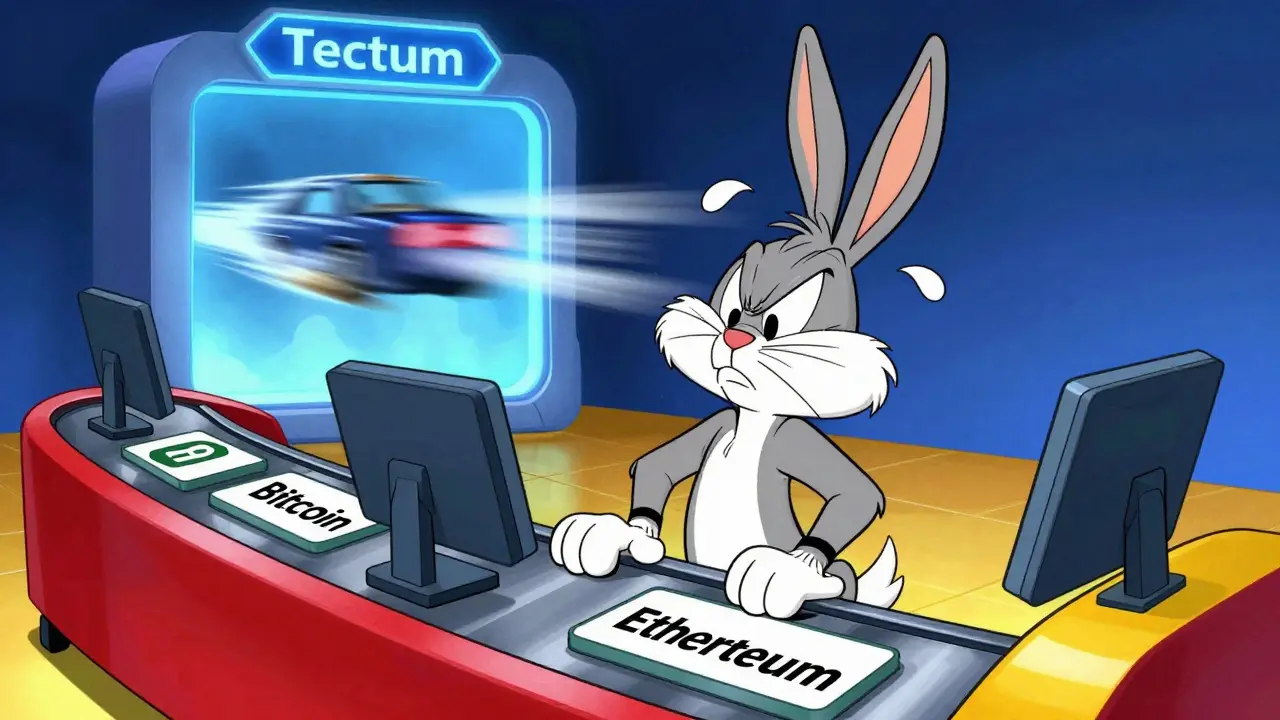
You’ve probably heard that Bitcoin and Ethereum are slow. You pay fees that eat up your change, and sometimes you wait minutes-or even hours-for a transaction to clear. That friction is exactly why Tectum (TET) was built. It isn’t trying to be a smart contract playground or a place for fancy NFTs. It has one job: move money instantly, without fees, at speeds that make traditional blockchains look like dial-up internet.
If you are looking for the next big speculative pump, Tectum might not be it. But if you want to understand how cryptocurrency payments could actually work in the real world-bridging the gap between digital security and physical cash convenience-then Tectum deserves your attention. Let’s break down what this Layer-1 protocol is, how its unique technology works, and whether it can deliver on its bold promises.
The Core Problem: Why Speed Matters in Crypto
To understand Tectum, you first have to look at the problem it solves. The current giants of the crypto world are impressive but limited by their own success. Bitcoin processes about 7 transactions per second (TPS). Ethereum handles roughly 15 TPS. For comparison, Visa handles around 24,000 TPS. When thousands of people try to send money at once, these networks clog up. Fees spike. Transactions stall.
Tectum claims to solve this by being the fastest blockchain in existence. Depending on which source you trust, it boasts speeds of either 1.38 million TPS or 3.5 million TPS. Whether you take the lower or higher figure, we are talking about orders of magnitude faster than anything else out there. This speed isn’t just a bragging right; it’s essential for the project’s main goal: enabling microtransactions and instant retail payments where fees would otherwise destroy the value of the transfer.
How Tectum Works: Proof-of-Utility
Most blockchains rely on consensus mechanisms that everyone knows. Bitcoin uses Proof-of-Work, which requires massive amounts of energy to secure the network. Ethereum moved to Proof-of-Stake, which is more efficient but still involves validators locking up tokens to verify blocks.
Tectum does neither. Instead, it uses a proprietary system called Proof-of-Utility (PoU). This mechanism is designed specifically for data distribution and transaction settlement rather than general-purpose computing. By optimizing how data is hashed, encrypted, and signed across the network, PoU allows Tectum to process transactions without the heavy computational overhead of mining or the latency of stake validation. It also includes a record change signature management algorithm to prevent unauthorized alterations, keeping the ledger immutable and secure against malicious actors.
The Star Product: SoftNotes
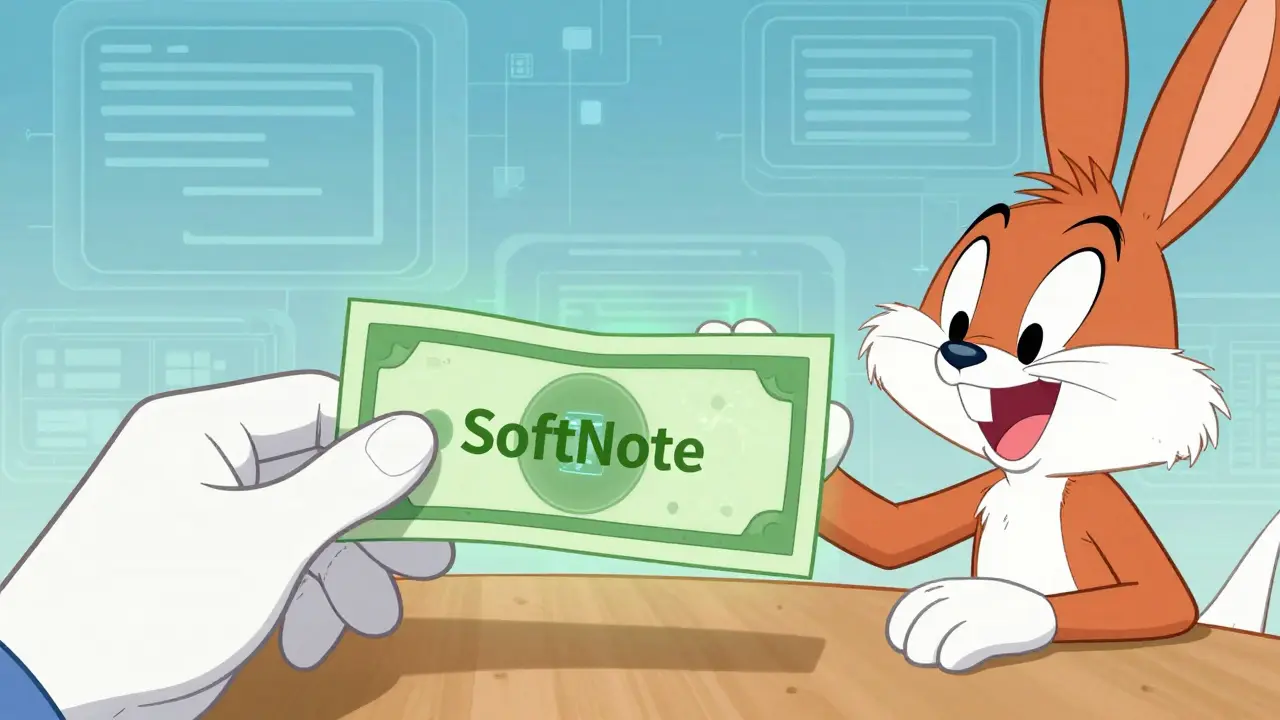
Technology is great, but adoption is hard. This is where Tectum gets creative with its flagship product: the SoftNote. Think of a SoftNote as a hybrid between a banknote and a digital wallet. It is described as the first "transactionless" product in the industry.
Here is how it works: You can print a SoftNote bill on paper. This physical note acts as a vessel for cryptocurrency liquidity. Unlike a standard crypto transaction, using a SoftNote does not require confirmation from the underlying blockchain network at the moment of exchange. There are no transaction fees for the end-user, and there are no geographical boundaries. You hand over the paper, and the value transfers instantly. Behind the scenes, the SoftNote is fully visible on blockchain explorers, maintaining the transparency and decentralization of Bitcoin while offering the ease of cash.
This bridges a massive gap for users in developing regions or those who distrust digital-only wallets. It brings the tactile trust of physical currency into the crypto space.
TET Tokenomics: Scarcity and Utility
The native fuel for this ecosystem is the TET token. If you are considering buying or holding TET, understanding its supply dynamics is crucial because they differ significantly from inflationary coins.
- Hard Cap: There will never be more than 10 million TET tokens. This absolute scarcity prevents unlimited inflation.
- Circulating Supply: As of recent data, approximately 9,934,520 TET tokens are already in circulation. That means 99.3% of all possible tokens exist right now.
- Market Position: With a market capitalization hovering around $7 million, Tectum ranks outside the top 1,000 cryptocurrencies. It is a small-cap project with high-risk, high-reward characteristics.
Because nearly all tokens are already distributed, new buyers must purchase from existing holders. This creates a different price dynamic compared to coins that release millions of new tokens daily through staking rewards or mining emissions.
What Can You Actually Do With TET?
Holding a token is only useful if it has utility. TET serves several specific functions within the Tectum ecosystem:
- Minting SoftNotes: Users need TET to create new SoftNote bills, linking the digital asset to the physical payment tool.
- Reduced Merchant Fees: Businesses accepting payments via Tectum can use TET to pay lower processing fees.
- Token Creation: Developers can use TET to mint T12-20 standard project tokens, allowing other projects to build on top of Tectum’s infrastructure.
- Ecosystem Access: It provides access to other CrispMind and Tectum products, including the Tectum Wallet, the mobile app, and the Telegram Bot TIA.
Unlike Bitcoin, which is primarily a store of value, or Ethereum, which powers decentralized apps, TET is strictly a utility token for payment processing and ecosystem interaction.
Tectum vs. Lightning Network: A Critical Distinction
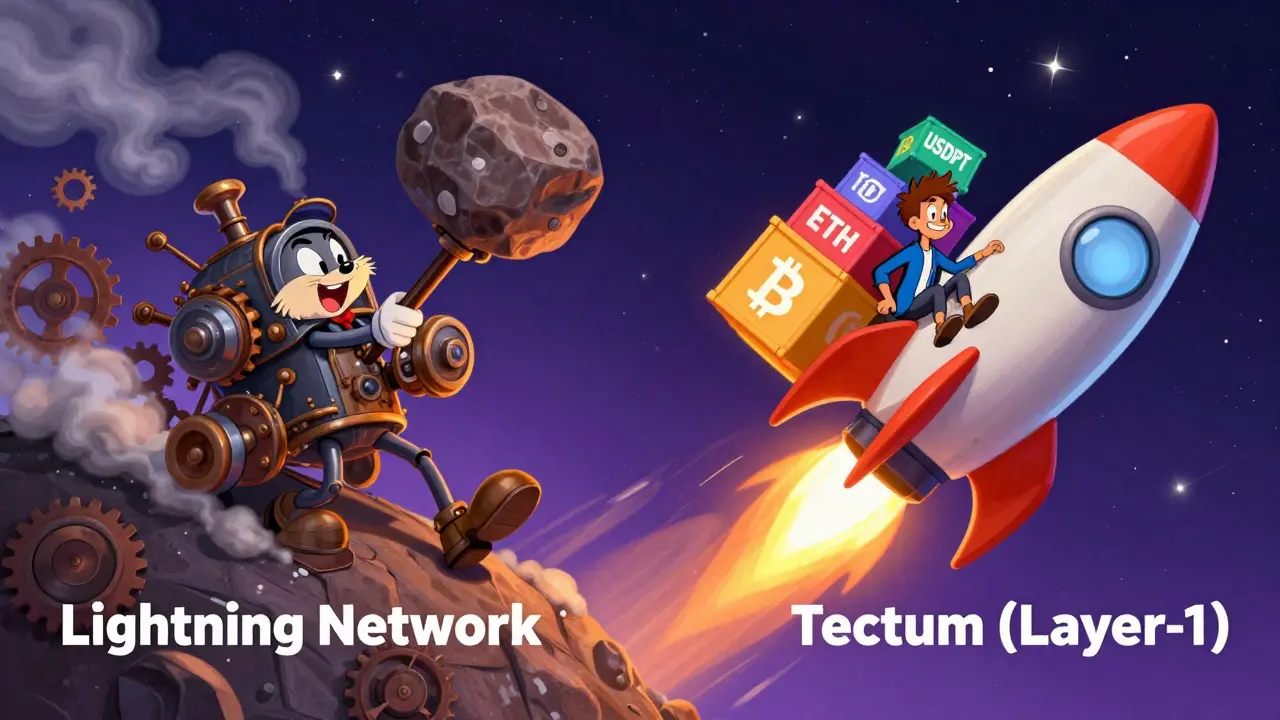
A common question is how Tectum compares to Lightning Network, Bitcoin’s popular Layer-2 scaling solution. Both aim for fast, cheap payments, but their architectures are fundamentally different.
| Feature | Tectum (TET) | Lightning Network |
|---|---|---|
| Layer Type | Independent Layer-1 Blockchain | Layer-2 Protocol (built on Bitcoin) |
| Asset Support | Multi-asset (Bitcoin, Ethereum, Tether) | Bitcoin only |
| Consensus | Proof-of-Utility (PoU) | Inherits Bitcoin's Security |
| Speed Claim | 1.38M - 3.5M TPS | Variable, depends on channel capacity |
| Physical Interface | Yes (SoftNotes) | No |
The key takeaway here is independence. Lightning Network relies entirely on Bitcoin for security and final settlement. If Bitcoin changes, Lightning changes. Tectum operates as a standalone blockchain. It is compatible with Bitcoin, Ethereum, and Tether, but it does not depend on them for its core operation. This makes Tectum more flexible for cross-chain payments but less entrenched in the Bitcoin community’s established security model.
Beyond Payments: IoT and Record Keeping
While payments are the headline feature, Tectum’s speed makes it attractive for other high-volume data applications. Two notable areas include:
- Internet of Things (IoT): Smart devices generate massive amounts of data. Tectum’s ability to process millions of transactions per second allows it to validate and store IoT data logs in real-time without clogging the network.
- Notarization and Record Keeping: Because every transaction is immutable and timestamped, Tectum can serve as a secure ledger for verifying documents, contracts, or legal records. Its cryptographic security ensures that once a record is stored, it cannot be altered.
Risks and Realities: What to Watch Out For
No investment or technology is without risk. While Tectum’s technical claims are ambitious, there are practical hurdles to consider before getting involved.
Adoption is Low: With a market cap under $10 million, Tectum is a niche player. Liquidity can be thin, meaning large buys or sells could impact the price significantly. You won’t find Tectum accepted at your local coffee shop yet. The SoftNote concept is innovative, but it requires merchants to adopt a new printing and verification workflow.
Technical Discrepancies: Note the difference in reported speeds. Some sources cite 1.38 million TPS, while others claim 3.5 million TPS. These figures likely represent different testing conditions or theoretical maximums versus sustained loads. Always treat such high-performance claims with healthy skepticism until independent audits confirm them under real-world stress.
Security Unknowns: While Proof-of-Utility sounds efficient, it is not as battle-tested as Proof-of-Work or Proof-of-Stake. We don’t yet know how Tectum’s PoU holds up against sophisticated 51% attacks or other vector exploits compared to older, more scrutinized protocols.
Is Tectum Right for You?
Tectum is not for everyone. If you want a passive store of value that appreciates slowly over decades, stick with Bitcoin. If you want to build complex DeFi applications, Ethereum or Solana might be better fits.
However, if you believe that cryptocurrency’s future lies in everyday, fee-free, instant payments-and you like the idea of bridging digital assets with physical tools like SoftNotes-then Tectum is worth watching. It offers a distinct alternative to the congested, expensive networks we have today. Just remember to do your own research, start small, and understand that high-speed tech often comes with higher volatility.
What is the maximum supply of TET tokens?
The TET token has a strict hard cap of 10 million tokens. Currently, approximately 9,934,520 tokens are in circulation, meaning nearly 99.3% of all supply exists.
How does Tectum compare to Bitcoin in terms of speed?
Bitcoin processes about 7 transactions per second (TPS). Tectum claims speeds between 1.38 million and 3.5 million TPS, making it exponentially faster for payment processing.
What is a SoftNote?
A SoftNote is a printable physical bill that acts as a vessel for cryptocurrency. It allows for instant, zero-fee peer-to-peer transactions without requiring immediate blockchain confirmation, combining the ease of cash with digital security.
Does Tectum support Ethereum and Tether?
Yes. Unlike some Bitcoin-centric solutions, Tectum is a multi-asset Layer-1 platform that supports Bitcoin, Ethereum, and Tether (USDT), allowing for broader payment flexibility.
What consensus mechanism does Tectum use?
Tectum uses a proprietary Proof-of-Utility (PoU) consensus mechanism. This system optimizes data distribution and transaction settlement without the energy-intensive mining of Proof-of-Work or the staking requirements of Proof-of-Stake.
Is Tectum a Layer-1 or Layer-2 blockchain?
Tectum is an independent Layer-1 blockchain. It operates as a standalone network with its own consensus mechanism and native token, unlike Layer-2 solutions like the Lightning Network which rely on a base layer for security.
Where can I buy TET tokens?
TET tokens are traded on various cryptocurrency exchanges. Due to its lower market cap, liquidity may vary, so it is recommended to check major exchange listings for current availability and trading pairs.