
Web3 vs Web2 Cost & Ownership Calculator
Compare Your Digital Activity
Your Comparison Results
Web2 Platform
Cost per transaction: $0.00
Total monthly cost: $0.00
Transaction speed: Milliseconds
Ownership: Your data is owned by the platform
Value of assets: None
Web3 Platform
Cost per transaction: $0.15
Total monthly cost: $0.00
Transaction speed: 3-5 seconds
Ownership: Your assets are yours to keep and sell
Value of assets: $0.00
Key Trade-offs
Web2: Free transactions but you lose control of your data and digital assets.
Web3: Small transaction fees but full ownership and potential value creation from your assets.
With your activity, Web3 provides:
Potential asset value: $0.00
Total cost savings: $0.00
Web2 costs:
Data ownership value: $0.00
Think about how you use the internet right now. You scroll through social media, post photos, watch videos, buy stuff online. You don’t own any of it. Your data? The platform does. Your digital items? Locked inside their servers. That’s Web2-the internet we’ve lived with for the last 20 years.
Now imagine a different version. One where you truly own your content, your digital stuff, even your identity. Where no company can delete your post, freeze your account, or sell your data without your say. That’s the promise of Web3. It’s not just a tech upgrade. It’s a power shift.
Web2: The Centralized Internet We Know
Web2 is the internet of Facebook, YouTube, Instagram, and Twitter. It’s the internet where you create content, but the platform owns the infrastructure, the data, and the rules. You sign up with an email. You post. You get likes. You get ads. And you never really get to take your stuff elsewhere.
Under the hood, Web2 runs on client-server architecture. Your phone or laptop (the client) talks to a giant server owned by Google, Meta, or Amazon. That server stores everything: your photos, your messages, your purchase history. If that server goes down-like Uber’s 2022 crash-you lose access. If the company changes its policy-like Meta’s 2023 update giving itself broad rights to your content-you have no real say.
Web2 made the internet interactive. But it also made users the product. Advertisers pay billions to target you based on your behavior. And you? You get free access in exchange for your attention and your data. It’s a trade-off most people never even thought about-until they started seeing how much control these companies had.
Technically, Web2 relies on JavaScript, HTML, and CSS. It’s fast. It’s reliable. Google’s 2023 benchmarks show most Web2 sites load in under half a second. Millions of developers know how to build for it. It’s mature. It works. But it’s built on trust-trust that the company won’t abuse its power. And history shows that trust is often broken.
Web3: The Internet You Own
Web3 flips the script. Instead of trusting a company, you trust code. Instead of storing your data on a server, you store it on a blockchain. Instead of letting a platform control your digital assets, you hold them in a wallet only you can access.
At its core, Web3 is built on blockchain technology-specifically platforms like Ethereum, Solana, and Polygon. These aren’t just databases. They’re decentralized networks where thousands of computers around the world verify every transaction. No single company runs it. No CEO can shut it down.
When you post something on a Web3 social platform like Lens Protocol, it’s stored on IPFS (InterPlanetary File System), a peer-to-peer network. Your post can’t be deleted by a corporate policy team. It can only be removed if you choose to. And you own the rights to it-not the platform.
Web3 uses cryptographic wallets (like MetaMask or Phantom) instead of usernames and passwords. These wallets hold your digital identity and your assets: cryptocurrencies like ETH or SOL, NFTs representing art, music, or in-game items. You control the private key. Lose it? You lose access. No customer service can recover it. That’s the trade-off: total ownership, total responsibility.
Web3 also introduces smart contracts-self-executing code that runs automatically when conditions are met. Need to pay a creator the moment their NFT sells? That’s coded into the contract. No middleman. No fee. No delay.
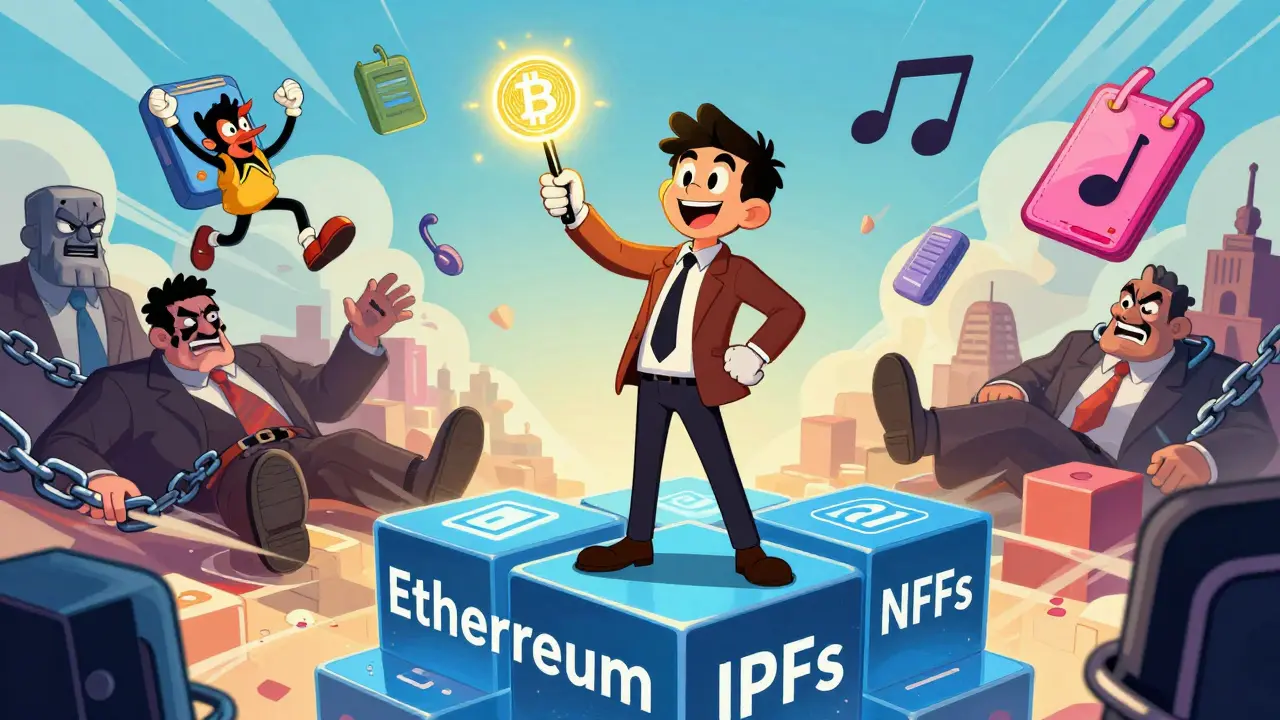
Ownership: Who Really Controls Your Stuff?
This is the biggest difference. In Web2, your digital life belongs to the platform. Your YouTube videos? They can be demonetized. Your Instagram account? They can ban you without warning. Your Fortnite skins? You can’t sell them. Ever. They’re locked to the game’s server.
In Web3, your digital items are yours. If you buy an NFT from a game like Pixels or Lumiterra, it’s stored in your wallet. You can sell it on any marketplace. You can use it in other games that support the same standard. That’s called interoperability-and it’s impossible in Web2.
Real-world impact? In 2024, Web3 gaming generated $1.7 billion in secondary sales of NFT assets. Players weren’t just playing-they were earning, trading, and building value. Contrast that with Steam, which handled $7.2 billion in game sales in 2024, but gave zero ownership back to users.
Web3 doesn’t just give you ownership-it gives you control over your identity. Decentralized identity systems (like those built on Ethereum) let you prove who you are without handing over your birth certificate or social security number. You can log into apps, verify your age, or access services-all without a central authority holding your data.
Speed, Cost, and the Trade-Offs
Web3 isn’t perfect. And it’s not faster.
Web2 pages load in milliseconds. Web3 apps? They take 3-5 seconds on average. Why? Because every action-sending a token, minting an NFT, voting in a DAO-needs to be verified by dozens or hundreds of computers across the globe. That’s called consensus. It’s secure. It’s slow.
Transaction fees used to be brutal. In 2021, sending ETH could cost $50. Today, thanks to upgrades like Ethereum’s Prague update and Layer-2 networks like Arbitrum, fees are down to $0.15. Still, that’s more than the $0.00 you pay on PayPal.
And scalability? Web2 giants like Visa handle 24,000 transactions per second. Ethereum? 15-45. That’s why Web3 isn’t replacing your bank app yet. But it’s not trying to. It’s building new systems: decentralized finance (DeFi), creator monetization, token-gated communities-things Web2 can’t do without middlemen.
Security is another trade-off. Web2 has teams of 650+ engineers monitoring for threats. Web3? You’re on your own. In 2024, $1.8 billion was lost to smart contract exploits. That’s terrifying. But it’s also a learning curve. As tools improve and audits become standard, these risks drop.

Who’s Using Web3-and Why?
As of 2025, 153 million unique blockchain wallets are active worldwide. That’s not everyone. But it’s growing fast. Web3 reached 1 billion users in just 4 years-half the time Web2 took.
It’s not just speculators. Gamers are using it. Artists are using it. Developers are building on it. Reddit’s blockchain-based Community Points, used by 18.2 million people, let users earn tokens for contributing to forums. Those tokens can be spent on perks, traded, or even converted to cash.
Gen Z is driving adoption. Newzoo’s 2025 report found 45% of young gamers want true ownership of in-game items. They’re tired of paying $60 for a game, then being told they can’t resell their hard-earned gear.
Enterprise adoption is rising too. 68% of Fortune 500 companies now have blockchain initiatives. Some are using it for supply chain tracking. Others for secure document signing. A few are testing tokenized loyalty programs.
But the biggest shift? Web3 is moving away from “get rich quick” crypto hype. In 2025, 70% of new Web3 projects are non-financial: decentralized identity, creator tools, open-source governance, and public infrastructure. The focus is on utility-not price charts.
The Future: Web2 and Web3 Coexisting
Web3 won’t replace Web2 overnight. And it doesn’t need to.
Most people will still use Facebook, Google, and Amazon. But more and more will also use Web3 tools alongside them. Think of it like email and texting. You don’t pick one. You use both for different things.
Twitter (now X) lets you tip in ETH. Reddit lets you earn tokens. Even Shopify now supports crypto payments. Web2 platforms are adding Web3 features because users are asking for them.
Meanwhile, Web3 is getting easier. Wallets now auto-suggest gas fees. Onboarding flows are improving. FreeCodeCamp’s Web3 curriculum has over 50,000 monthly learners. Ethereum.org’s learning portal has a 4.2/5 rating from 1,800+ users.
The real question isn’t “Which is better?” It’s “What do you want?”
If you want speed, simplicity, and free services? Web2 works.
If you want control, ownership, and the ability to build value that stays yours? Web3 is the future.
It’s not magic. It’s not a bubble. It’s a new way to build the internet-one where users aren’t the product. They’re the owners.
Is Web3 just cryptocurrency?
No. Cryptocurrency is one part of Web3, but Web3 is much bigger. It’s about owning your data, identity, and digital assets through blockchain technology. You can use Web3 to create a decentralized social network, build a token-gated community, or verify your identity without a government ID-all without ever trading crypto.
Can I use Web3 without a wallet?
Not really. Wallets are the key to Web3. They’re how you prove you own your digital assets and sign transactions. But new tools are making wallets easier-some apps now let you sign in with email and automatically create a wallet behind the scenes. Still, you’re always in control of the private key.
Is Web3 safe?
It’s safer in some ways and riskier in others. Your data isn’t stored on a central server, so hackers can’t breach one company to steal millions of records. But if you lose your wallet key, there’s no reset button. And bad code in smart contracts can lead to theft. Always use trusted wallets, double-check addresses, and never share your seed phrase.
Why is Web3 so slow?
Because every action needs to be verified by hundreds of computers across the globe, not just one server. That’s called decentralization. It’s slower than Web2, but it’s also more secure and censorship-resistant. Upgrades like Ethereum’s Prague update and Layer-2 networks are cutting delays and costs dramatically.
Will Web3 replace Web2?
Not completely. Web2 will still dominate for simple, fast, free services. But Web3 is growing in areas where ownership, transparency, and user control matter-like gaming, content creation, finance, and digital identity. The future is hybrid: Web2 for convenience, Web3 for control.
Web3 isn’t magic, but it’s the first time the internet’s given users real leverage. I’ve been using Lens Protocol for my photography - my posts are on IPFS, I own the NFTs, and I’ve sold a few to collectors overseas. No platform can delete them. No ad algorithm can bury them. It’s small, but it’s mine.
And yeah, the fees suck sometimes, but Layer-2s like Polygon zkEVM cut it to pennies. You don’t need to be a crypto bro to use this stuff. Just download MetaMask, connect it to a Web3 app, and go. No hype, no FOMO.
Web2 gave us convenience. Web3 is giving us dignity.
Look I get it Web2 is convenient but it’s also a prison built on data harvesting and corporate whims and Web3 is the key to unlocking that prison even if it’s clunky and slow and the gas fees used to be insane but now they’re better and honestly I think we’re in the early days of something way bigger than just crypto or NFTs it’s about ownership and autonomy and if you’re not thinking about that then you’re just scrolling past your own life like a ghost in someone else’s machine
Web3 is a Ponzi scheme wrapped in blockchain jargon. The only people making money are the devs who sold their tokens before the public showed up. Your ‘ownership’ means nothing when 90% of NFTs are worthless JPEGs and your ‘decentralized social network’ still needs centralized infrastructure to load images. You think Meta won’t buy Lens Protocol and shut it down? They already tried. They just waited for the hype to cool. This isn’t liberation. It’s financial theater for tech bros who think they’re rebels.
They’re lying to you. Web3 is just the NSA’s new tool. Every wallet you create? They track it. Every transaction? Logged. They don’t need to own the servers anymore - they just need to own the blockchain. That’s why they pushed Ethereum. That’s why they funded the devs. That’s why they let the ‘freedom’ narrative spread. You think you’re free? You’re just a data point with a private key. They’ll shut it all down when they’re done harvesting your behavior. Wake up.
Web2 is fast. Web3 is slow. Web2 is free. Web3 costs money. Web2 works. Web3 breaks. But Web3 lets you own your stuff. That’s the trade-off.
The elites control Web3 too... they just hide it behind ‘decentralized’ labels... the blockchain is a digital cage... the keys are given to those who know the right people... the rest of us? We’re just the fuel... the gas fees? That’s our blood money... they want us to think we’re free... but we’re just the ones paying to be watched...
Web3 is a Western tech fantasy. In Nigeria, we don’t need fancy wallets. We need stable internet, electricity, and banks that don’t freeze accounts for no reason. You talk about owning your data? My data is already stolen daily by fake loan apps and SMS scams. Web3 won’t fix that. Fix our infrastructure first. Then talk about decentralization.
There’s a philosophical shift here that gets lost in the noise. Web2 was built on attention economics - you are the product. Web3 attempts to reframe the relationship between human and machine: you are not a data point, you are a stakeholder. This isn’t about technology. It’s about redefining value. If you can own your digital existence, then your labor, creativity, and identity become assets - not commodities. That’s radical. Even if the tech is messy, the idea is revolutionary. We’re not just building apps. We’re building a new social contract.
I used to think Web3 was just crypto with extra steps. Then I started using a decentralized note-taking app that stores my journals on IPFS. No company can read them. No algorithm can sell them. No server crash can erase them. I didn’t need to buy an NFT. I didn’t need to trade ETH. I just needed to trust code over corporations. And for the first time, my digital life felt... mine. Not rented. Not licensed. Owned. That’s not hype. That’s peace of mind.
For anyone new to this - don’t get overwhelmed. Start small. Use a Web3 app that lets you earn tokens for posting, like Reddit’s Community Points. Try sending a friend $0.10 in ETH using a simple wallet like Rainbow. Watch how it works. Don’t chase gains. Just experience ownership. You don’t need to be a coder or a trader. You just need to be curious. And if you’re not sure? Wait. There’s no rush. The internet didn’t disappear when you weren’t using it. Neither will Web3.
I’ve been on both sides. Used to run a Web2 blog. Got demonetized for a post about mental health. No warning. No appeal. Then I switched to a Web3 platform. Posted the same thing. Got tipped in DAI. Got reshared. Got replies from people in Brazil and Japan. No one deleted it. No one shadowbanned me. I didn’t make money, but I felt heard. That’s worth more than ads. Web3 ain’t perfect but it’s the first time the internet felt like it was made for people, not profits.
Web3 is slow. Fees are still too high. Most projects are scams. But the idea of user-owned digital space? That’s real. And it’s growing. Ignore the hype. Watch the tools. The ones that solve real problems - not price charts - will survive. The rest? They’ll vanish like MySpace.
Stop waiting for permission. Stop waiting for it to be easy. Web3 is not waiting for you. It’s already here. Your art? Put it on-chain. Your music? Tokenize it. Your voice? Build a community with tokens. You don’t need to be rich. You don’t need to be technical. You just need to start. One transaction. One NFT. One post on Lens. That’s how revolutions begin. Not with grand speeches. With quiet, stubborn action. You got this.
Let me tell you what’s really happening. Web2 is dying a slow, corporate death. Every algorithm is more manipulative. Every platform is more greedy. Every update feels like a betrayal. Meanwhile, Web3? It’s messy. It’s confusing. But it’s alive. Real people are building real things - not for ads, not for IPOs, but for each other. A musician in Detroit is selling her album as an NFT and giving 30% of resale royalties to her fans. A teacher in Manila is using a decentralized ID to verify her credentials without a government portal. A kid in Lagos is earning crypto for translating community posts. This isn’t about money. It’s about dignity. It’s about rebuilding the internet from the ground up - not with venture capital, but with community. Yeah, it’s slow. Yeah, it’s hard. But it’s honest. And for the first time in 20 years? That’s enough.