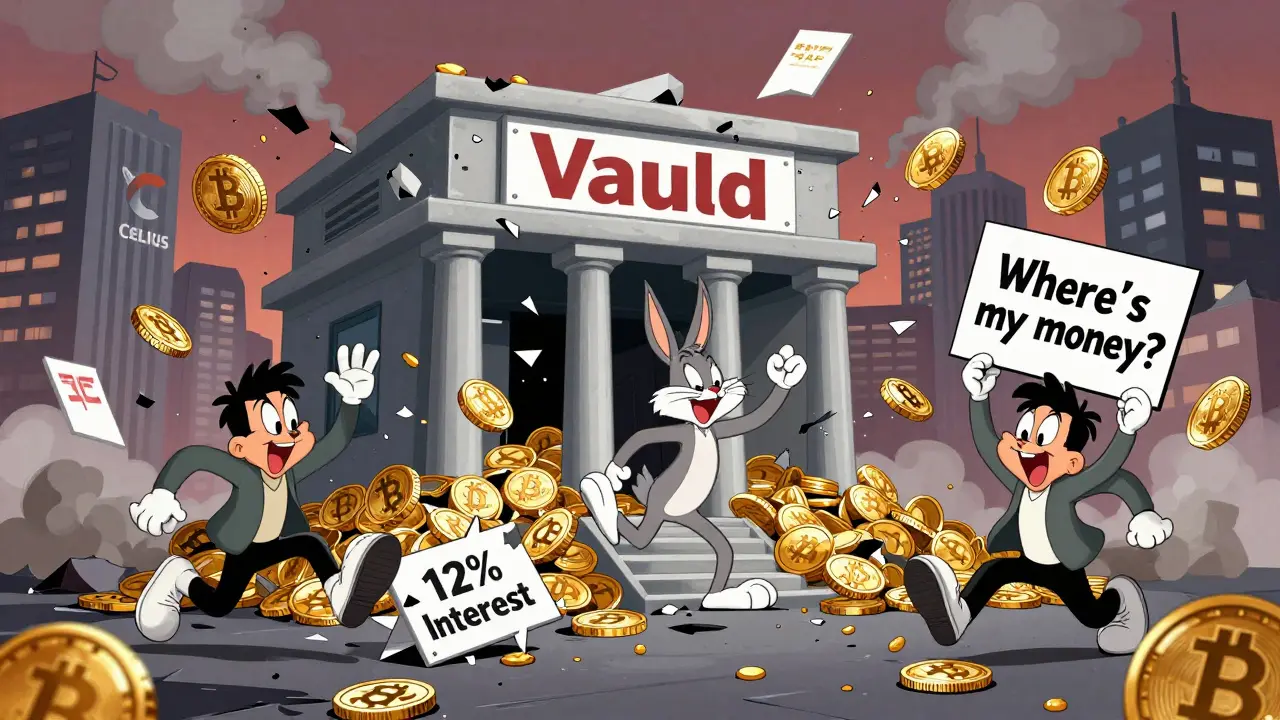
Vauld crypto exchange was once one of the most talked-about platforms in the crypto lending space. It promised high interest rates, easy trading, and a banking-style experience for holding digital assets. But by June 2022, everything changed. The platform shut down overnight. Users couldn’t withdraw their money. Support vanished. And what was left was a trail of angry users, frozen funds, and unanswered questions.
How Vauld Worked Before the Collapse
Vauld started as Bank of Hodlers in 2018 and rebranded to Vauld in 2020. It wasn’t just another exchange. It called itself a "crypto bank"-a place where you could deposit Bitcoin, Ethereum, or even lesser-known tokens and earn interest on them. The platform offered up to 12% annual interest on deposits, with payouts every week. That was way higher than traditional banks and even most other crypto platforms at the time.Users could also trade over 275 cryptocurrencies directly on Vauld. It had two trading modes: a simple Instant Swap for quick conversions, and a Pro Trading interface for more experienced users who wanted limit orders and basic charts. Trading fees were 0.10% for both makers and takers-on par with Binance.
There was no minimum deposit. You could start with just $1. Withdrawals to bank accounts were free, which was rare. Fixed-term deposits locked funds for 1, 3, or 6 months but offered better rates-and even if you pulled out early, there was no penalty, just lower interest. It sounded too good to be true. For many, it was.
The Business Model That Cracked Under Pressure
Vauld didn’t make money by charging trading fees or taking a cut of swaps. Its real income came from lending out user deposits. If you put in $1,000 in USDC, Vauld would lend that money to other crypto firms-often hedge funds or lending platforms-that promised high returns. The difference between what Vauld paid you and what it earned from borrowers was its profit.This model worked fine when markets were rising. But when Terra/Luna collapsed in May 2022, everything unraveled. Many of the companies Vauld lent to-like Celsius Network and Three Arrows Capital-went bankrupt. Their collateral (crypto assets backing the loans) crashed in value. Vauld couldn’t recover the money it had lent out.
Here’s the scary part: Vauld never disclosed who it lent to. Users had no idea their funds were tied to failing firms. When those borrowers defaulted, Vauld didn’t have enough cash to cover withdrawals. It had over $190 million in user funds stuck in bad loans, according to blockchain analytics firm Elliptic. Recovery estimates? Less than 30%.
Why Vauld Was So Popular Before It Failed
Before the crash, Vauld had strong appeal. It supported 275+ cryptocurrencies-far more than competitors like Matrixport (15+) or BlockFi (around 50). That made it a go-to for users holding obscure tokens. Weekly interest payouts were another big draw. Most competitors paid monthly. Vauld paid every Friday. For users relying on crypto income, that mattered.The interface was simple. Designed to look like a banking app, it made crypto feel familiar. Onboarding took 15-20 minutes. KYC required ID and proof of address, which built trust. Reddit threads from early 2022 were full of praise. One user wrote: "Got my USDC interest every Friday like clockwork." Trustpilot ratings were around 4.2/5.
Its partnership with BitGo for custody and Binance for trading gave it credibility. Investors like Pantera Capital and Coinbase Ventures backed it. It seemed safe. It looked professional. And it grew fast. From 2020 to 2021, Vauld’s user base exploded 40x. Assets under management jumped 10x. The team grew from 40 to 200 people, with most based in India. Indian users alone contributed $10-15 million in daily trading volume.
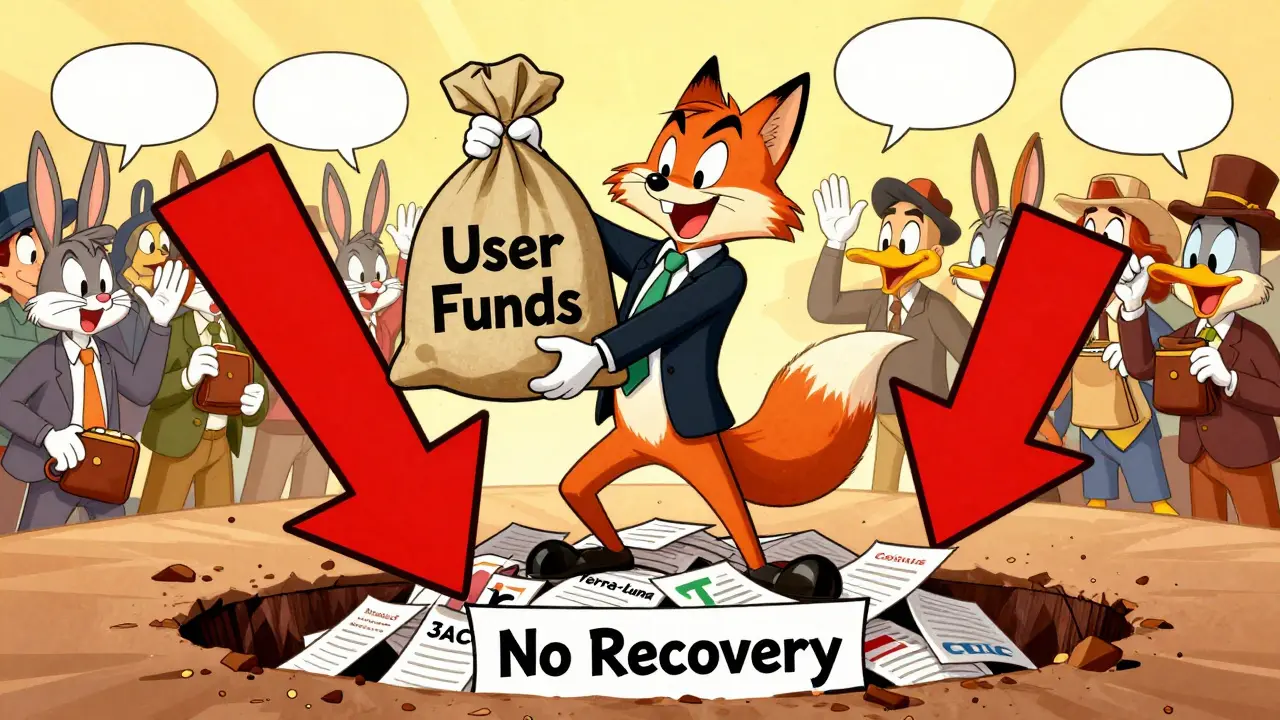
The Collapse: What Happened in June 2022
On June 27, 2022, Vauld stopped all operations. No more deposits. No more withdrawals. No more trading. The homepage went dark with a message citing "extreme market conditions."At first, customer support replied. They promised fixes within 72 hours. Then silence. By mid-July, emails went unanswered. The website stopped loading. All educational content-FAQs, videos, guides-was wiped.
Users in India and the U.S. filed over 1,200 complaints with cybercrime portals. Reddit threads like "What happened to our funds?" filled up with despair. One user posted: "I had 2.3 BTC locked in a 3-month fixed deposit. No response. No updates. Just ghosted."
Trustpilot ratings crashed to 1.1/5. 89% of recent reviews said "funds frozen" and "no communication."
What Made Vauld Different-and More Dangerous
Compared to other crypto lenders, Vauld had one major weakness: opacity. While BlockFi and Celsius also failed, they at least disclosed some of their lending partners. Vauld didn’t. Users didn’t know their money was going to risky firms with shaky balance sheets.Also, Vauld didn’t hedge its risk. If Bitcoin dropped 30%, and a borrower’s collateral fell below 150%, Vauld was supposed to liquidate it. But during the Terra collapse, prices fell so fast that liquidations couldn’t keep up. Thousands of loans went underwater at once. Vauld didn’t have enough reserves to cover the gap.
Experts pointed out another flaw: it relied too much on stablecoin lending. Most user deposits were in USDT or USDC. Vauld converted those into other stablecoins and lent them out. But when the whole market panicked, even stablecoins lost pegs temporarily. That triggered a chain reaction. No one could get their money back.

What Users Lost and What They Can Do Now
As of early 2026, Vauld is officially dead. No recovery plan. No official communication. No legal resolution. The $190 million in lost funds remains trapped.Some users formed class-action lawsuits in India and the U.S. But legal action moves slowly. Lawyers say recovery chances are slim. Elliptic’s 2022 report estimated less than 30% of funds might ever be recovered-likely through asset sales of Vauld’s remaining holdings.
There’s no official portal to file claims. No email address to reach. No phone number. The website is gone. The company’s social media accounts are inactive. All that’s left are archived forum posts and screenshots of old emails.
Lessons Learned: Why You Should Avoid High-Yield Crypto Platforms
Vauld’s collapse wasn’t an accident. It was predictable.- **High interest rates = high risk.** If a platform offers 10%+ on crypto deposits, ask: where’s that money coming from? If they can’t explain it clearly, walk away.
- **Don’t trust opacity.** If a company won’t tell you who it lends to, or how it manages risk, it’s not safe.
- **Diversify your holdings.** Don’t put all your crypto in one lending platform-even if it looks trustworthy.
- **Cold storage beats yield.** If you’re not actively trading, keep your crypto in a hardware wallet. No interest is worth losing everything.
Vauld was never a scam. It was a gamble that went wrong. But for thousands of users, the gamble cost them everything.
Is Vauld still operating in 2026?
No, Vauld ceased all operations on June 27, 2022. Its website no longer functions, customer support has disappeared, and no updates have been released since mid-2022. It is considered permanently defunct.
Can I get my money back from Vauld?
Recovery chances are extremely low. Over $190 million in user funds were lost due to defaults from failed borrowers like Celsius and Three Arrows Capital. Blockchain analytics firm Elliptic estimated less than 30% of funds might be recovered, likely through asset liquidation. No official claims process exists, and legal efforts have made little progress.
Why did Vauld offer such high interest rates?
Vauld lent user deposits to other crypto firms, often hedge funds or lending platforms, that promised high returns through arbitrage and leveraged trading. The difference between what Vauld paid users and what it earned from borrowers was its profit. But this model collapsed when those borrowers defaulted during the 2022 market crash.
Was Vauld secure before it failed?
Vauld used BitGo for institutional-grade custody, which was a positive sign. However, security doesn’t mean safety from business risk. The platform’s main vulnerability wasn’t hacking-it was poor financial management. It overextended by lending too much to unstable partners without proper risk controls.
How many users were affected by Vauld’s collapse?
Vauld had over 1 million users at its peak, with Indian users making up 20% of total assets under management. Over 1,200 formal complaints were filed with India’s cybercrime portal alone. The total user base affected is estimated in the hundreds of thousands, with losses concentrated among those who held fixed deposits or large balances.
I still remember when I first deposited my USDC on Vauld. Weekly payouts felt like a gift. No stress, no drama. Just money growing while I slept. I trusted them because they looked so professional - BitGo, Binance, all the logos. Never thought it'd vanish like smoke. But hey, I learned. Now I keep 90% in cold storage. Small losses teach big lessons.
It’s heartbreaking to see how many people lost everything. Not because they were greedy, but because Vauld made it look safe. The interface, the branding, the weekly interest - it was engineered to feel secure. People didn’t take risks; they trusted a system that was never built to last. We need better regulation, not just better caution.
High yield isn't a feature. It's a red flag with a marketing budget. Vauld didn't fail because of bad luck. It failed because its business model was a Ponzi in all but name. Lending out deposits without transparency? That's not finance. That's gambling with other people's money.
i cant believe people got mad when vauld went under like duh if its 12% interest its probaly a trap
Honestly? The real lesson isn't about Vauld. It's about how we treat crypto like a bank. We want interest, we want ease, we want it all to feel normal. But crypto isn't banking. It's wild west with a UI. If you're not holding your own keys, you're not owning anything.
Why do people keep falling for this? They see high returns and forget to ask where the money comes from. Vauld was a trap wrapped in a banking app. I told my cousin to avoid it. He didn't listen. Now he's broke. Don't be him.
RIP Vauld 🕯️ I had 5 BTC in fixed deposit. 3 months. 11.5% APY. Gone. No warning. No email. Just silence. I still check their site sometimes. Like a ghost haunting my own dumb decision.
i used vauld because it supported my weird altcoins no one else had and the weekly interest was fire but now i just use coinbase wallet and sleep better
The structural vulnerability lay in the lack of collateralization transparency and the over-reliance on stablecoin arbitrage flows. When Terra depegged, the systemic leverage cascaded through Vauld’s counterparty exposure matrix, triggering insolvency via liquidity mismatch. This was not an operational failure - it was a macroeconomic exposure event.
You people are so naive. You think a startup with 200 employees and a pretty app is safe? Newsflash: crypto is a pyramid. Vauld was just the latest layer. The only reason you lost money is because you didn't short it. You should've bet against them. That's how you win in this space.
Let us not forget the deeper philosophical implications of Vauld's collapse. It is not merely a financial failure, but a metaphysical indictment of modern humanity's addiction to passive income. We have outsourced our financial sovereignty to algorithmic intermediaries dressed in corporate branding. The true tragedy is not the loss of funds, but the loss of autonomy.
I had 100k in USDC. I thought I was being smart. I read the whitepaper. I checked the audits. I trusted the team. Turns out, none of that matters when you're lending to Three Arrows. I'm not mad. I'm just disappointed in myself. I thought I was sophisticated. Turns out I was just another sheep with a wallet
lol i knew this was gonna happen i told everyone on reddit to avoid vauld 12% interest on stablecoins? please i kept mine in a ledger peace out
I still think about the people who lost everything. Not just the money - but the trust. The belief that something could be safe. That a company could be real. Vauld didn't just break promises. It broke faith. And that's harder to recover from than any crypto price. 🌱