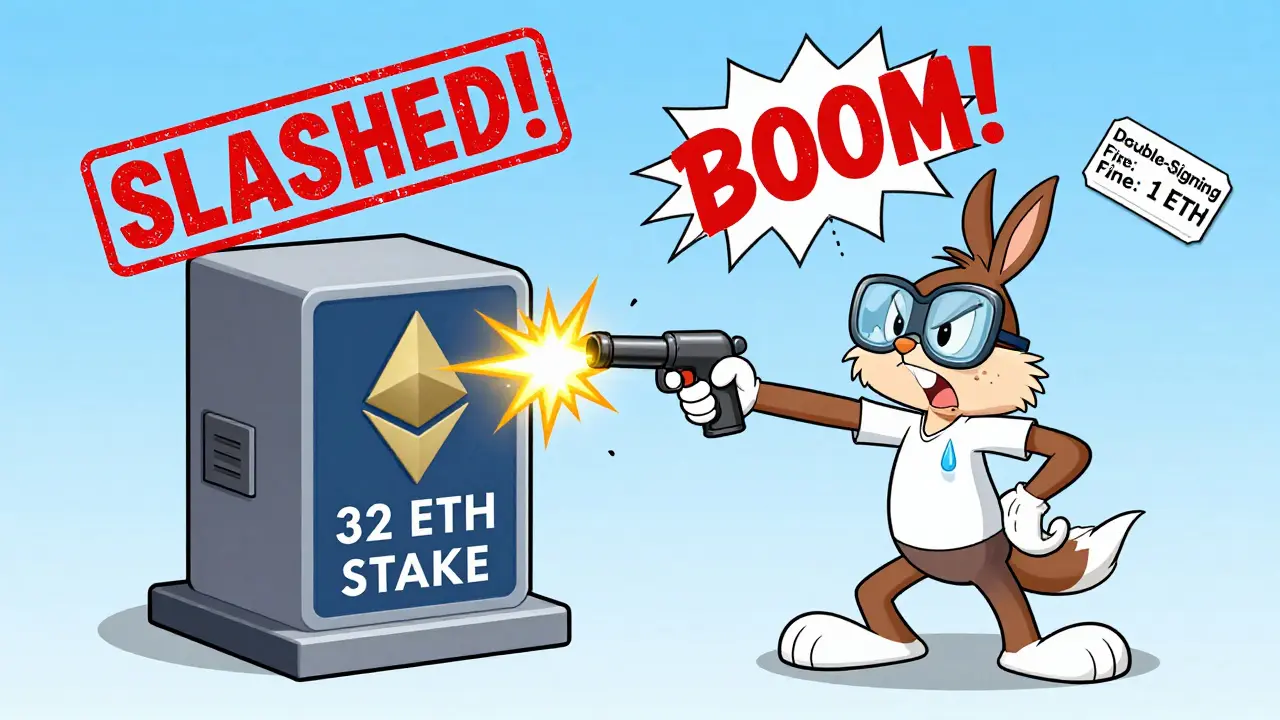
Ethereum Slashing Penalty Calculator
Notes: Double-signing incurs a 1 ETH penalty + 0.07 ETH over 36 days. Downtime penalties apply after 18 hours with 0.000008 ETH per epoch.
When you stake cryptocurrency on a proof-of-stake blockchain, you’re not just earning rewards-you’re also putting your money at risk. One wrong move, and a portion-or all-of your stake can be instantly slashed. This isn’t a bug. It’s by design. Blockchain slashing is the system that punishes validators who break the rules, and understanding it could save you thousands of dollars.
What Exactly Is Slashing?
Slashing is an automatic financial penalty built into proof-of-stake (PoS) blockchains. If a validator-someone who runs the software that helps confirm transactions and secure the network-commits a serious error or acts maliciously, the protocol takes away part of their staked tokens. The goal? To make cheating or carelessness too expensive to be worth it. Think of it like a parking ticket, but for the blockchain. If you double-park (sign two conflicting blocks), you get fined. If you leave your car running overnight (go offline for too long), you get a smaller fine. If you try to crash the system, you lose your entire car. This isn’t theoretical. In 2024, over $180 million in Ethereum staking rewards were slashed due to misconfigured validators. Most of those losses weren’t from hackers-they were from people who didn’t know how to set up their nodes properly.How Slashing Penalties Work on Ethereum
Ethereum’s slashing rules are the most documented and widely followed. If you’re staking ETH, this is what you need to know. Every validator on Ethereum stakes 32 ETH. That’s your total stake. If you’re caught double-signing-meaning you sign two different blocks for the same slot-you get hit with an immediate penalty of about 1 ETH. That’s not a guess. It’s exactly 1/32 of your stake, calculated by the protocol. But that’s just the start. After the initial penalty, you enter a 36-day exit period. During that time, you keep losing small amounts-about 0.000008 ETH every 6.4 minutes-for every epoch you miss. Over the full exit period, that adds up to another 0.07 ETH. So total loss? Around 1.07 ETH for a single double-signing offense. Worse, if multiple validators slash at the same time, Ethereum triggers a “correlation penalty.” This means the more validators misbehave together, the bigger the penalty for everyone involved. If 10% of the network goes down at once, you could lose up to your entire 32 ETH stake. That’s not common-but it’s possible.Other Blockchains Have Different Rules
Ethereum isn’t the only game in town. Cosmos, Polkadot, Solana, and others all use slashing too-but their rules are different. Cosmos uses a “slashing fraction” system. If you’re offline for more than 10 minutes, you lose 0.01% of your stake. If you double-sign, you lose 5%. That’s a big difference from Ethereum’s fixed 1 ETH penalty. Polkadot slashes up to 10% for downtime and up to 100% for malicious behavior, depending on the severity and whether it’s a repeat offense. The key takeaway? There’s no universal slashing rule. Each network has its own penalty structure. You can’t assume what works on Ethereum applies to Solana. Always check the documentation for the chain you’re staking on.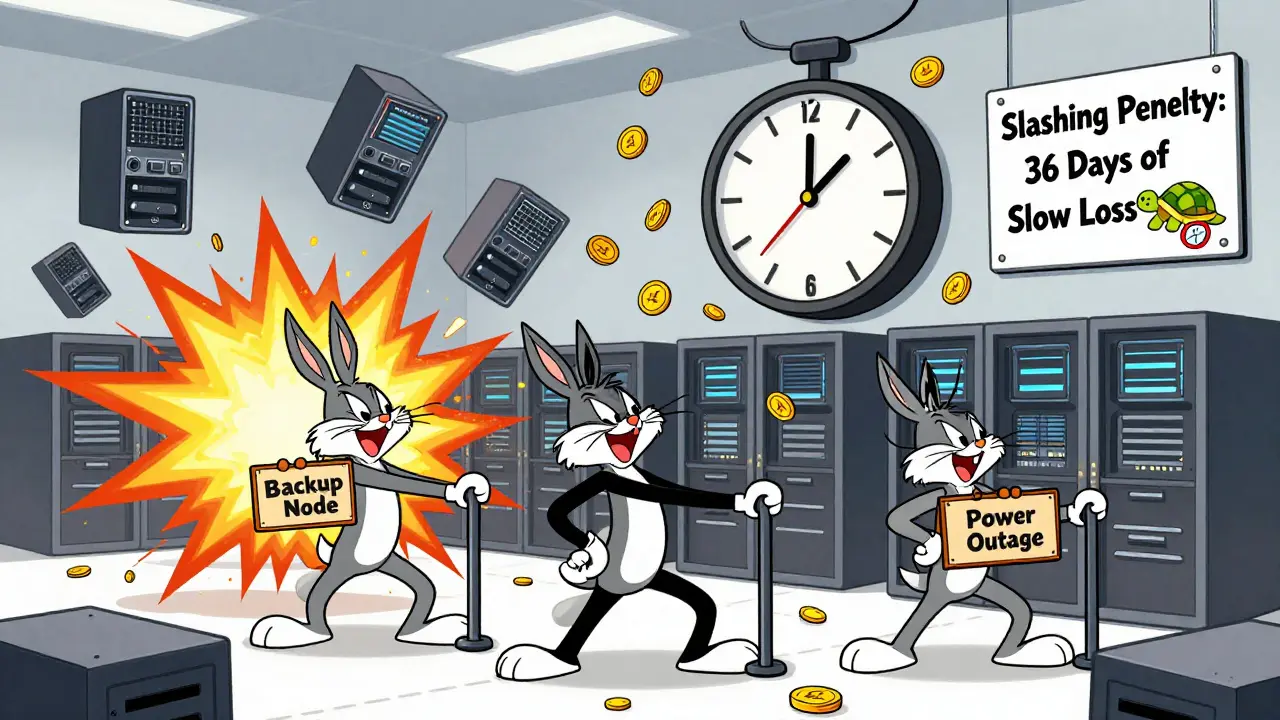
What Triggers a Slashing Penalty?
Not every mistake gets punished. Only specific, protocol-defined actions trigger slashing. There are three main types:- Double-signing: Signing two different blocks or attestations for the same slot. This is the worst offense. It can break consensus and is always punished severely.
- Downtime: Going offline for too long. Most networks allow brief outages, but if you miss too many epochs in a row, you start losing small amounts. Ethereum gives you a grace period, but after 18 hours, penalties kick in.
- Network manipulation: Trying to rewrite history, create forks, or trick the network into accepting invalid blocks. This is rare but catastrophic. It usually results in total stake loss and permanent banning.
How to Avoid Getting Slashed
Avoiding slashing isn’t hard-it just requires discipline and the right tools. First, never run two validators from the same machine or same cloud provider. If your server crashes, both validators go down. If you use a backup node, make sure it’s on a completely separate network with its own hardware. Second, use a slash protection database. Tools like Prysm’s slash protection or Lighthouse’s validator database store a record of every signature your validator has made. If you try to sign something conflicting, the system blocks it. This is non-negotiable. Skip this, and you’re gambling with your stake. Third, use a sentry node architecture. Instead of connecting your validator directly to the internet, route traffic through a separate, hardened server. This protects against DDoS attacks and accidental misconfigurations. Fourth, monitor your validator. Set up alerts for downtime, signature errors, or missing attestations. Tools like validators.monitor, Dune Analytics dashboards, or even simple Telegram bots can notify you within seconds if something goes wrong. Finally, if you’re new, use a reputable staking service. Companies like Coinbase, Kraken, or Lido handle all this for you. You give them your ETH, they run the node, and you get your rewards minus a small fee. You don’t get full control, but you also don’t risk losing your stake to a misconfigured server.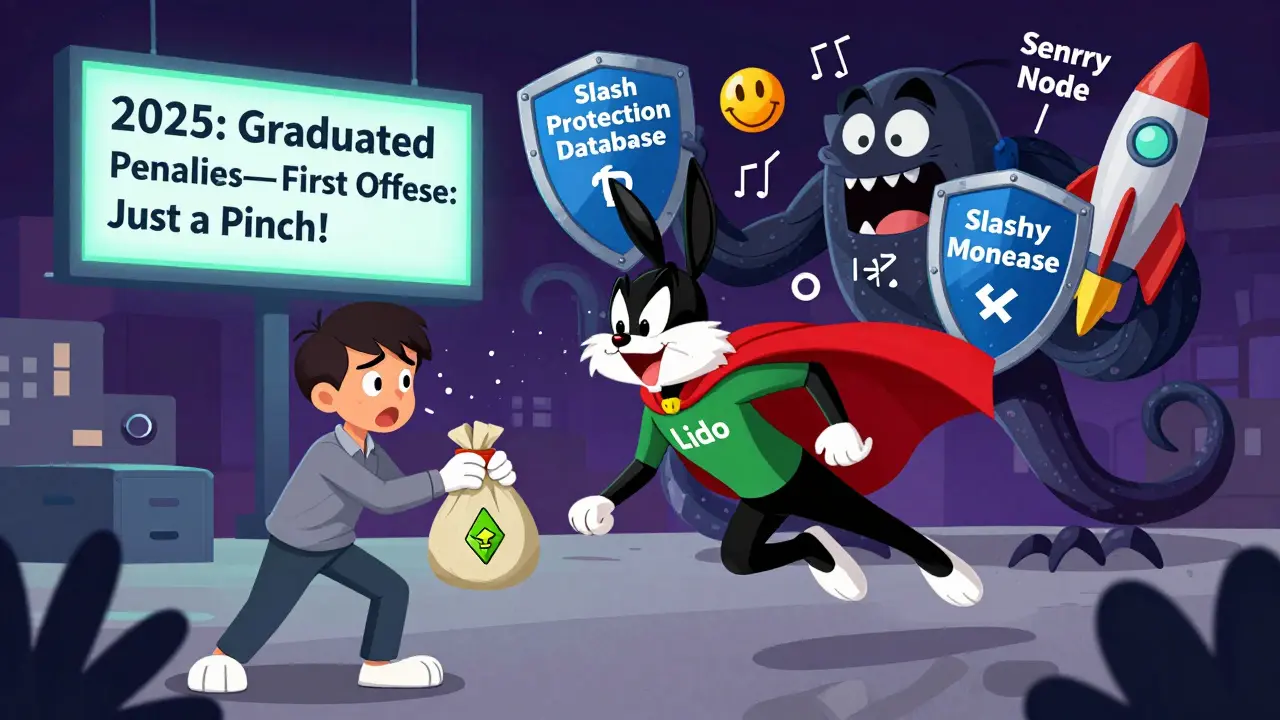
Why Slashing Matters Beyond Your Wallet
Slashing isn’t just about protecting your money. It’s about protecting the entire network. If slashing didn’t exist, validators could afford to be lazy. They could go offline for days, skip attestations, or even collude to manipulate the chain. Without penalties, there’s no real cost to bad behavior. Slashing turns security into an economic game. The more people stake, the more valuable the network becomes-and the more it’s worth protecting. That’s why Ethereum’s slashing mechanism is one of the most robust in crypto. It’s also why staking services now offer slashing insurance. If you’re a professional validator or institutional investor, you can buy policies that cover your losses if you get slashed. These aren’t cheap, but they’re growing in popularity. In 2025, over $1.2 billion in staked assets were covered by third-party slashing insurance.What’s Changing in 2025?
The blockchain world is evolving. Slashing rules are getting smarter. Newer networks like Celestia and EigenLayer are testing “graduated penalties.” Instead of a one-size-fits-all fine, penalties now scale based on your history. First offense? 1% stake loss. Second? 5%. Third? Full slash. This rewards good behavior and gives people a chance to recover from honest mistakes. Liquid staking protocols like Lido and Rocket Pool are also changing how slashing works. Instead of the validator bearing the full loss, the penalty is spread across all token holders. That’s good for users who don’t run nodes-but it means your staked ETH might lose value even if you didn’t do anything wrong. Ethereum’s developers are also discussing adjusting penalty amounts based on network congestion and validator reputation. If you’ve been reliable for 6 months, maybe you get a small grace period for one mistake. The trend is clear: slashing is becoming more nuanced. It’s no longer just “break the rule, lose everything.” It’s becoming a system that tries to distinguish between incompetence and malice.Final Reality Check
If you’re running your own validator, you’re in the top 1% of crypto users. Most people don’t understand staking, let alone slashing. But that doesn’t mean you’re safe. One misconfigured backup, one power outage, one software update gone wrong-and you could lose a significant chunk of your stake. The math is brutal: a 1 ETH penalty on a 32 ETH stake is a 3% loss. That’s more than most people make in a year from staking rewards. The good news? You don’t need to be a developer to avoid slashing. You just need to use the right tools, follow best practices, and never skip the slash protection setup. If you’re not ready to manage the risk, don’t run your own node. Use a trusted service. Your wallet will thank you.What happens if I get slashed on Ethereum?
You lose at least 1 ETH immediately, plus up to 0.07 ETH over the next 36 days as your validator exits. If other validators are slashed at the same time, your penalty could grow to include your entire 32 ETH stake. You’ll also be permanently removed from the validator set and can’t rejoin without re-depositing ETH.
Can I get slashed for being offline?
Yes, but only after prolonged downtime. Ethereum allows short outages-up to 18 hours-before penalties begin. After that, you lose a small amount of ETH per epoch (every 6.4 minutes) until you come back online or exit. It’s not a full slash, but it adds up over time.
Do all blockchains slash the same way?
No. Ethereum uses fixed penalties based on stake size. Cosmos uses percentage-based slashing fractions. Polkadot adjusts penalties based on validator history. Solana has a different model entirely, with penalties tied to vote timing. Always check the specific network’s rules before staking.
Is slashing insurance worth it?
For professional validators or those staking large amounts, yes. Insurance typically costs 1-3% of your stake per year. If you’re staking $100,000 worth of ETH, paying $1,000-$3,000 to avoid a potential $32,000 loss makes sense. For small stakers, it’s usually overkill.
Can I recover after being slashed?
You can’t recover the lost ETH. Once it’s slashed, it’s burned permanently. But you can rejoin the network by depositing new ETH and becoming a validator again. Many people do this after learning from their mistake. The network doesn’t ban you for life-just the old validator key.
How do I know if my validator is at risk?
Use a monitoring tool like validators.monitor, Beaconcha.in, or a custom Telegram bot. Look for warnings about missing attestations, duplicate signatures, or high downtime. If your validator’s performance drops below 95% for more than 24 hours, you’re at risk. Set alerts for anything under 98% uptime.
Should I use a managed staking service?
If you’re not comfortable managing servers, keys, and monitoring systems, yes. Services like Coinbase, Kraken, and Lido handle slashing protection, updates, and uptime for you. You give up some control, but you eliminate the risk of accidental slashing. For most users, that trade-off is worth it.
If you're running your own node and get slashed, you deserve it. No excuses. Period.
Slashing? More like the fed quietly stealing your crypto under the guise of 'security'. 🤡
I don't trust these blockchain rules they change them whenever they want. This is just another way to control us.
Use the tools. Set alerts. Don't overcomplicate it. You got this.
Simple. Effective. Done.
People think crypto is freedom but it's just a new way to get fined by computers. lol
The 1 ETH penalty on Ethereum is precisely calculated as 1/32 of the 32 ETH stake, which aligns with the protocol's economic model. No ambiguity.
There's a quiet beauty in how blockchain turns trust into mathematics. We're not just staking coins-we're staking our belief in decentralized systems. And when we fail, the code doesn't judge. It just counts. And then it corrects. That’s not cruel. That’s fair. That’s how we build something that lasts longer than any bank, any government, any human institution. We don't need forgiveness. We need consistency. And that’s what slashing gives us.
It’s not about punishment. It’s about integrity. It’s about making sure the network doesn’t become a playground for the lazy or the careless. Every validator is a guardian. And guardians don’t get to nap on the job.
I’ve seen people panic because they thought a 3% loss was devastating. But think of it this way: if you staked $100k, losing $3k is less than what most people lose in a bad stock trade. And you still have 97% left. That’s not ruin. That’s a lesson.
What’s heartbreaking isn’t the slash-it’s when someone refuses to learn. When they blame the chain instead of their backup node. When they skip slash protection because ‘it’s too technical’. That’s not crypto. That’s gambling with someone else’s security.
I’ve helped new stakers set up their first validators. I’ve seen the fear in their eyes. I’ve also seen the pride when they realize they’ve been online for 90 days without a single missed attestation. That’s the real reward. Not the ETH. Not the APY. The confidence that you didn’t break the system.
And yes, insurance exists. And yes, it’s worth it if you’re staking life savings. But don’t buy insurance because you’re scared. Buy it because you’re responsible. There’s a difference.
Slashing isn’t the enemy. Complacency is. So keep monitoring. Keep updating. Keep caring. The chain will thank you.
They say slashing prevents attacks... but what if the whole system is designed to drain small stakers so big players can dominate? CoinDesk just reported 80% of slashed ETH came from solo operators. Coincidence? I think not.
The correlation penalty mechanism is particularly fascinating-it introduces a systemic risk component that incentivizes validator decentralization. If 10% of validators go offline simultaneously, the penalty scales non-linearly to disincentivize homogenous infrastructure deployments, such as those using the same cloud provider. This is a brilliant economic safeguard that aligns individual incentives with network health.
Slashing is just crypto’s version of ‘you broke the rules, now pay the price’ 💪🧠
But honestly? The fact that you can get slashed for a bot update gone wrong… it’s wild. We’re trusting code to not mess up like humans do. And sometimes… it does. 😅
In India, most people still don't know what staking is. But when they do, they'll need simple guides-not technical manuals. Maybe we should translate these best practices into local languages. Knowledge shouldn't be locked behind English.
The elegance of slashing lies in its symmetry: it turns security into a market mechanism. Validators are not just nodes-they’re economic actors with skin in the game. This isn’t just protocol design; it’s a new form of social contract written in code. The beauty? It doesn’t rely on trust. It relies on math. And math doesn’t lie.
When you see someone lose 1 ETH for double-signing, don’t laugh. See it as a lesson in incentive alignment. The network didn’t punish them because it’s mean. It punished them because it’s smart. And the fact that they can rejoin after re-depositing? That’s not cruelty-it’s redemption architecture.
Compare this to traditional finance: a bank can fail, and you lose everything with no recourse. Here, you lose a fraction, learn, and try again. That’s progress.
And the emergence of graduated penalties? That’s the next evolution. It’s not binary anymore. It’s nuanced. It recognizes that a rookie mistake isn’t malice. That’s wisdom. That’s maturity in protocol design.
Let’s stop calling it punishment. Call it calibration. The network is recalibrating its trust-and it’s doing it without a single human bureaucrat.
I appreciate how thorough this breakdown is. I’ve been staking on Ethereum for over a year now, and I use Prysm with slash protection enabled. I also run a sentry node setup through a VPS in Frankfurt and a backup in Singapore. It’s not cheap, but peace of mind is priceless. I’ve never been slashed, and I never will be. It’s just good hygiene.
So if you mess up, you lose money. That’s it. No drama. No yelling. Just math. And if you’re scared of losing money, maybe don’t stake. Or use a service. Simple. No need to overthink it. Just do the thing. Set up the protection. Monitor. Done.
People make it so complicated. It’s not rocket science. It’s like locking your front door. You don’t need a PhD to do it. You just need to remember to do it.
You think this is bad? Wait till they start slashing for using a VPN. Or for having your validator on a weekend. Or for breathing too loudly. This is how control starts.
Let’s be real: 95% of these ‘slashing prevention’ guides are just crypto bros patting themselves on the back for not being dumb. Meanwhile, the average user has no clue what an attestation is. This whole system is a luxury for the tech-savvy elite. The rest of us? We just get to watch our gains evaporate while you write essays about ‘incentive alignment’.
Thank you for the comprehensive overview. The distinction between downtime and double-signing penalties is critical for operational clarity. I recommend all validators consult the official Ethereum documentation and validate their configurations using open-source audit tools prior to activation.