
Most people think of blockchains as single, all-in-one systems-like Bitcoin or Ethereum-where everything happens in one place: transactions, rules, storage, and agreement. But that’s changing. A new design is rising, and it’s called modular blockchains. Instead of one giant chain doing everything, modular blockchains split the job into smaller, specialized parts. Think of it like building a car: instead of one mechanic trying to make the engine, tires, and radio all at once, you have experts handling each piece separately. That’s the core idea behind modular blockchains-and it’s solving problems monolithic chains can’t touch.
Why Monolithic Blockchains Hit a Wall
Bitcoin and early Ethereum were built as monolithic systems. One chain handled transaction execution, data storage, consensus, and final settlement-all together. That worked fine when there were a few hundred users. But today, with millions transacting daily, the system gets clogged. Why? Because every node has to process every single transaction, store every byte of history, and vote on every new block. The more users, the heavier the load. Hardware costs rise. Speed drops. Fees spike. This isn’t just a technical glitch-it’s a design flaw. Monolithic chains try to be perfect at everything, but end up being average at all. You can’t make a chain both ultra-fast and perfectly decentralized without trade-offs. That’s the blockchain trilemma: you can pick two out of security, scalability, and decentralization-but not all three. Modular blockchains flip this. They don’t try to solve all three at once. They solve each one separately, on its own optimized layer.The Four Jobs of a Blockchain
Every blockchain, no matter how simple or complex, does four basic things:- Execution: Running transactions and smart contracts. This is where you send ETH, swap tokens, or play a game on-chain.
- Consensus: Agreeing on what’s true. Who gets to add the next block? How do nodes confirm it’s valid?
- Data availability: Making sure all transaction data is stored and accessible. If you can’t check the data, you can’t verify the chain.
- Settlement: The final, unchangeable record. This is where disputes are settled and transactions become permanent.
How Modular Blockchains Work Together
Imagine you’re ordering a custom pizza. You pick the crust from one place, the sauce from another, the toppings from a third, and the oven from a fourth. Each part is chosen for quality, not because it’s the only option. Modular blockchains work the same way. Take a typical setup today: a Layer 2 rollup like Optimism handles execution. It processes thousands of transactions quickly and cheaply. But it doesn’t store the data itself. Instead, it sends a compressed summary to Celestia, which specializes in data availability. Celestia makes sure that data is stored and accessible to anyone who wants to verify the transactions. Then, Optimism posts a cryptographic proof to Ethereum, which acts as the settlement layer-making the final call that the transaction is valid and can’t be reversed. Each part is doing one thing, and doing it better than if it had to do everything. Celestia doesn’t care about smart contracts. It just makes sure data is available. Optimism doesn’t waste energy on consensus-it borrows Ethereum’s security. Ethereum doesn’t need to process every transaction-it just verifies the final proof. This separation cuts costs, boosts speed, and improves security. You get the strength of Ethereum’s network without its bottlenecks.
Types of Modular Blockchains
Not all modular systems are the same. Experts classify them into four levels:- Monolithic: Bitcoin, Solana, Tron. One chain does all four jobs.
- Polylithic: Cosmos, Polkadot, Avalanche. Multiple chains, but they’re still tightly linked under one umbrella. Each chain handles its own execution and consensus, but they rely on shared security models.
- Semi-modular: Post-sharding Ethereum, Near, Tezos. They’ve started splitting functions internally-like Ethereum’s data sharding-but still handle most tasks themselves.
- Fully modular: Celestia (data), ZkSync and Arbitrum (execution), Polygon CDK (customizable stacks). These chains are built to work with others. They don’t try to be complete on their own.
Why Modular Blockchains Are Better for Scaling
The biggest win? Scalability without sacrifice. In monolithic chains, adding more users means every node has to store more data. Over time, that makes running a node expensive. Only big companies or well-funded groups can afford it. That leads to centralization. Modular blockchains break that cycle. With Celestia handling data availability, nodes don’t need to store years of transaction history. They just need to check that the data was published. That reduces hardware requirements by 90% or more. Suddenly, regular laptops and even phones can validate the chain. That keeps decentralization alive. Execution layers like ZkSync can process 2,000+ transactions per second using zero-knowledge proofs. That’s 100x faster than Ethereum’s original design. And because they’re not handling consensus or data storage, they don’t need massive computing power. They’re lean. Efficient. Focused. This isn’t theory. It’s live. In 2025, over 60% of new blockchain projects are built on modular stacks. Rollups like Arbitrum and Optimism now process more daily transactions than Ethereum’s main chain. Celestia’s data availability layer is used by more than 20 execution chains.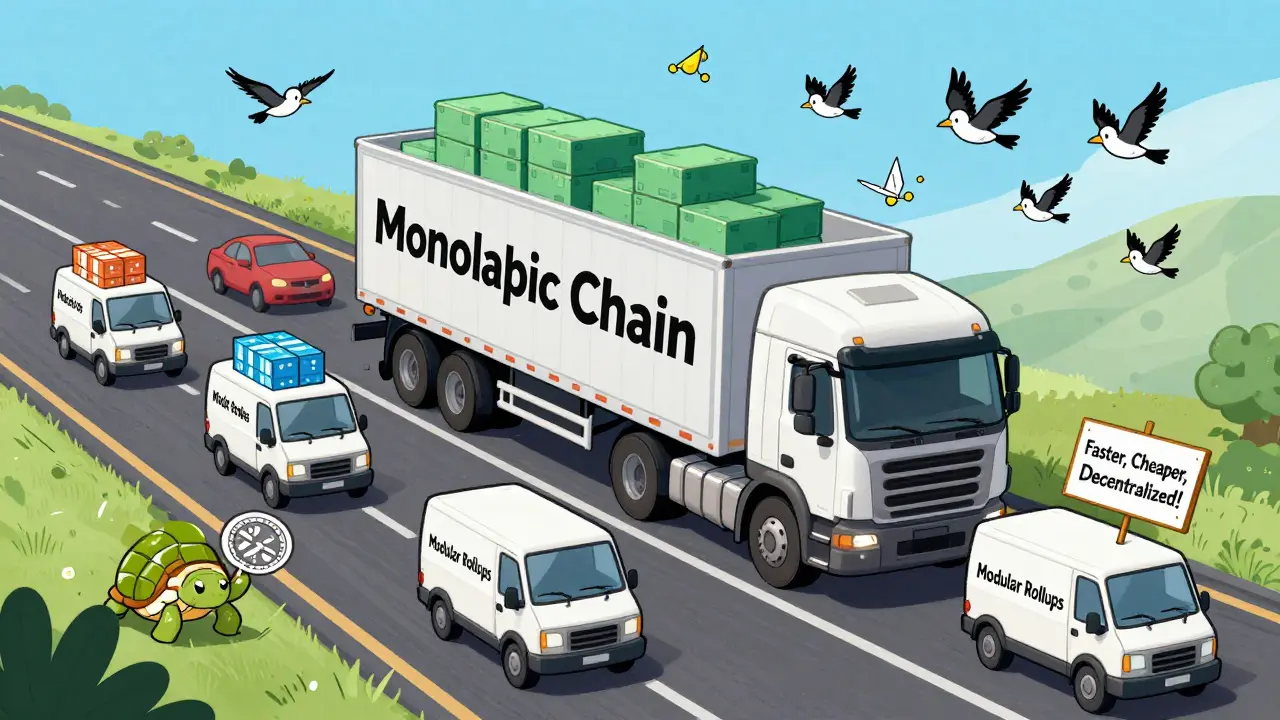
The Trade-Offs: Complexity and Security Risks
Modular doesn’t mean perfect. It introduces new challenges. When you split functions across chains, you create more connection points. If one layer fails or gets compromised, it can affect others. A data availability layer going offline could freeze all the rollups relying on it. A faulty settlement layer could delay finality for days. That’s why security is critical. Modular systems rely on strong cryptographic guarantees. Zk-rollups use zero-knowledge proofs to prove execution correctness without revealing data. Optimistic rollups use fraud proofs and 7-day challenge windows. These aren’t perfect, but they’re mathematically sound. The bigger risk is fragmentation. If every chain uses a different standard, interoperability becomes a nightmare. That’s why developers are pushing for open protocols-like the Ethereum Data Availability Layer standard-to make sure everything can talk to each other.What’s Next for Modular Blockchains
The next 12-24 months will focus on three things:- Standardization: Making it easy for any execution layer to plug into any data availability layer.
- Security bridges: Better ways to share security across chains without relying on one central validator set.
- Developer tools: Simpler frameworks to build on modular stacks-no need to be a cryptography expert.
Who Benefits the Most?
- Developers: Build apps without worrying about network congestion or high fees. Pick your own stack. - Users: Pay cents, not dollars. Get faster transactions. Still enjoy Ethereum-level security. - Companies: Launch private or public blockchains tailored to their needs-without building from scratch. - Node operators: Run a validator on cheaper hardware. No need for $10,000 servers. Modular blockchains aren’t just an upgrade. They’re a reset. They turn blockchain from a rigid, one-size-fits-all system into a flexible toolkit. The goal isn’t to replace Ethereum-it’s to make Ethereum stronger by offloading what it shouldn’t carry.Are modular blockchains the same as Layer 2 solutions?
No. Layer 2s are one part of modular blockchains-usually the execution layer. Modular blockchains include multiple layers: execution, settlement, data availability, and consensus. A Layer 2 like Arbitrum handles execution but still needs a settlement layer (like Ethereum) and a data availability layer (like Celestia). Modular blockchains are the full architecture that makes Layer 2s possible.
Is Ethereum moving to a modular design?
Yes. After the Merge and the introduction of data sharding, Ethereum is becoming semi-modular. It still handles execution and consensus, but it’s offloading data storage to shards. In the future, Ethereum may act primarily as a settlement and data availability layer, letting rollups handle most execution. This is the core of Ethereum’s long-term roadmap.
What’s the role of Celestia in modular blockchains?
Celestia is a data availability layer. It doesn’t execute transactions or run smart contracts. It only ensures that transaction data is published and accessible to anyone who wants to verify it. This lets execution layers like ZkSync or Arbitrum operate without storing massive amounts of data, making them faster and cheaper. Celestia’s innovation is separating data availability from execution-a first in blockchain history.
Can I build my own modular blockchain?
Yes. Tools like Dymension, Cosmos SDK, and Polygon CDK let developers launch custom execution chains with built-in settlement and data availability options. You don’t need to code from scratch. You pick your components-like a software stack-and deploy in hours. This is making blockchain development as easy as deploying a website.
Do modular blockchains make crypto more secure?
It depends. Modular systems can be more secure because they isolate risks. If a rollup gets hacked, the data availability layer isn’t affected. But they also create more attack surfaces. Security relies on strong cryptographic proofs and well-designed bridges. When done right, modular blockchains offer better security than monolithic chains because they reduce the attack surface on each individual layer.
This is actually kind of a game changer. I used to think blockchains had to be monolithic to be secure, but seeing how Celestia and rollups split the work? Mind blown.
It’s like upgrading from a hammer that does everything poorly to having a whole toolkit where each tool is perfect for its job.
India will dominate this. 🇮🇳🔥
YESSSS this is the future!! 🚀 I’ve been waiting for this for years. No more $50 gas fees just to swap tokens! Let’s goooo!!
i love how this makes blockchain feel less like a magic black box and more like lego blocks you can build with 🤗
I’ve been reading up on this for months and this is the clearest explanation I’ve seen. The pizza analogy? Perfect. I finally get why rollups aren’t just ‘Ethereum hacks’-they’re building blocks.
Oh so now we’re doing modular blockchains because the monolithic ones were too... *boring*? 🙄 I mean, sure, Ethereum’s slow, but at least it’s not some Frankenstein’s monster of 7 different chains whispering to each other through cryptographic smoke signals.
Okay but let’s be real-this is the ONLY way forward. Monolithic chains are like trying to run a Netflix server on your toaster.
Modular = efficiency. Celestia for data? Genius. ZkSync for execution? Perfect. Ethereum for settlement? Of course.
And yes, the security trade-offs are real, but zk-proofs are math, not magic. If you’re still scared of fragmentation, you’re not looking at the open standards being built right now. This isn’t chaos-it’s orchestration.
The notion that splitting functions constitutes 'progress' is a fallacy rooted in technocratic hubris. The blockchain was never meant to be a modular commodity. It was meant to be a sovereign, indivisible ledger. What you call 'efficiency' is merely the erosion of atomic integrity. We are not building a better system-we are building a brittle ecosystem of dependencies.
I... I just... wow.
It's like... the internet went from dial-up to fiber... but for trustless systems.
And I'm not even joking. The way Celestia handles data availability? That's... that's the quiet hero of this whole architecture. Nobody talks about it, but without it? Everything collapses.
It's beautiful.
Thank you for this.
This is the kind of stuff that makes me excited about crypto again. No more ‘one chain to rule them all’ nonsense. Let the best tool win for each job.
And to devs: you don’t need to be a cryptographer anymore. Just pick your stack, deploy, and go build something cool. The infrastructure’s here.
YOU THINK THIS IS NEW?! I told my cousin in Bangalore this would happen 3 years ago!! He didn’t believe me!! Now everyone’s copying me!! I’m a GENIUS!! 😭😭😭
This is a government plot. They want us to think blockchain is ‘modular’ so we stop asking why the Fed’s buying up all the data centers. Celestia? More like C.I.A.-tia. They’re storing everything. Don’t trust the ‘data availability’.
MODULAR? MODULAR?! YOU CALL THIS A SOLUTION?!?!?!!??
EVERYONE IS JUST RUNNING OFF TO THEIR OWN LITTLE CHAINS AND LEAVING ETHEREUM AS A GHOST!
IT’S NOT A SYSTEM-IT’S A MESS!
AND CELESTIA?!?! WHO EVEN IS CELESTIA?!?!
WHY IS NO ONE TALKING ABOUT THE FACT THAT IF CELESTIA GOES DOWN, EVERYTHING CRUMBLES?!?!?!
I’ve been riding this wave since 2021. Modular? Nah. This is the *real* DeFi revolution. The old guard is screaming about ‘decentralization’ while they’re stuck on 15 TPS. Meanwhile, ZkSync is handling 2000 tx/sec and I’m buying NFTs for 0.0001 ETH.
They hate it because they can’t monetize the chaos anymore.
The architectural decoupling of consensus, execution, and data availability introduces non-trivial trust assumptions across cross-layer verification primitives. While the theoretical throughput gains are non-linear, the operational attack surface expands exponentially due to inter-component dependency chains. This is not scalability-it’s distributed fragility.
Ah yes. The ‘modular blockchain’ narrative. Another Silicon Valley fairy tale where engineers think they can outsmart physics with a whitepaper.
Let me guess-next they’ll tell us we can ‘modularize’ gravity.
Meanwhile, real people can’t even afford to send a single transaction on Ethereum. This isn’t innovation. It’s distraction.
this made me so happy 😭 thank you for explaining it like i’m 5... i finally get it!! and i’m not a techie!!
also celestia is my new crush 🥺❤️
Solid breakdown. Modular is the only path that preserves decentralization at scale. Everything else is just optimization theater.
Let me be the one to say it: modular blockchains are not a breakthrough-they are a capitulation. You’ve admitted defeat. You’ve surrendered to the trilemma. You’ve abandoned the dream of a single, sovereign, incorruptible ledger. Instead, you’ve created a patchwork quilt of trust assumptions stitched together by cryptographers who think they’re gods.
Bitcoin didn’t split its responsibilities. It trusted the math. You? You trust middlemen. You trust Celestia. You trust ZkSync. You trust Ethereum.
That’s not innovation. That’s institutionalization. And institutionalization is the death of decentralization.