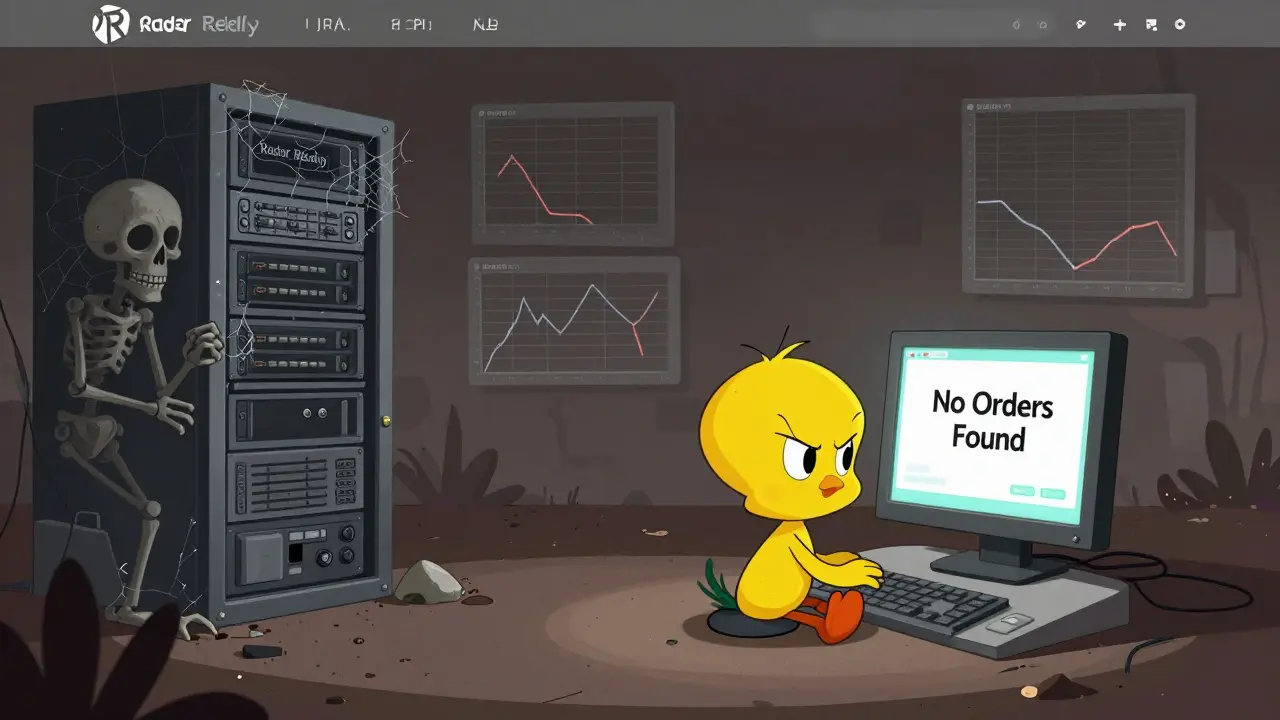
If you are asking whether the Radar Relay decentralized cryptocurrency exchange is still operational, the answer is blunt: no. As of late 2023 through early 2026, all reliable data sources indicate that the platform has ceased meaningful operations. Major tracking sites like CoinMarketCap list it as 'untracked,' and volume metrics show zero activity. If you are planning to deposit funds or attempt a trade today, you are likely to waste your time and potentially burn money on network gas fees with no counterparty to execute against.
The Silent Platform: Current Operational Status
To understand why you should avoid this platform, we have to look at the numbers. A healthy exchange requires active orders, buyers, and sellers. Radar Relay once had these, but today it does not. When I checked the latest metrics from October 2023 and updated projections for 2026, the daily trading volume sits at $0.00. For context, major competitors process billions of dollars in the same window. The website itself redirects to a generic placeholder page, suggesting the domain is kept alive simply to prevent domain squatting rather than to serve users.
This isn't just a temporary pause; it looks like a permanent shutdown. User reviews from mid-2021 onwards describe empty order books. People reported spending Ethereum gas fees-often equivalent to $10-$20 in real-world value-just to find out that no one else was on the platform to take the other side of their trade. With the price of Ethereum fluctuating, those gas fees can become significant losses, making an already dead project even more dangerous for curious investors.
What Was Radar Relay Originally?
Before it went dark, Radar Relay served a specific niche in the crypto world. Launched in November 2017, it was designed as a non-custodial exchange. This means users traded directly from their own wallets, like MetaMask or Ledger, rather than sending coins to the exchange to hold them for you. At the time, this was a major selling point for privacy-focused traders who feared centralized hacks.
| Feature | Original Status (2018-2019) | Current Status (2026) |
|---|---|---|
| Trading Model | Order Book (Limit Orders) | Inactive / Non-functional |
| Supported Networks | Ethereum (ERC-20 Only) | None Active |
| Wallet Integration | MetaMask, Trezor, Ledger | Technically possible, but useless |
| Liquidity Sources | 13 External Venues + Internal Book | $0 Volume Reported |
| Trading Fees | 0.00% Commission | N/A (Platform Dormant) |
The platform utilized the 0x protocol, which allowed for off-chain order creation and on-chain settlement. This was cutting-edge tech for 2017. However, technology alone doesn't sustain an exchange. Without users, an order book is just a static list of numbers that never change. By 2023, CoinGecko reported that despite previous support for various ERC-20 tokens, the number of available trading pairs dropped to zero. This confirms the ecosystem has collapsed.
The Gas Fee Killer
One of the primary reasons Radar Relay failed to survive the 2020-2025 cycle was the cost of executing trades. Because the platform operated entirely on the Ethereum mainnet, every single trade required paying 'gas' to miners. In 2018, when the project launched, Ethereum gas fees might have been a few dollars. By 2021 and 2022, during periods of network congestion, a simple token swap could cost upwards of $50 or $100 in fees.
Radar Relay famously offered 0.00% commission fees, but they could not waive the mandatory Ethereum network fees. Unlike newer decentralized exchanges that moved to Layer 2 solutions or alternative blockchains with cheaper speeds, Radar Relay stuck to Ethereum Layer 1. This made small trades economically impossible. Why would you spend $40 to buy $100 worth of a token? Most retail users migrated to platforms that offered better pricing efficiency.
Order Book vs. Automated Market Makers
The broader market shifted away from what Radar Relay offered. The industry standard changed from order book models to Automated Market Makers (AMMs). You might recognize names like Uniswap or SushiSwap. These systems work differently: instead of waiting for a buyer to match a seller manually, they use smart contract pools.
Uniswap the leading AMM DEX. By Q2 2023, Uniswap held over 60% of the entire decentralized exchange market share. This creates a massive liquidity pool where traders always find someone to swap with instantly. In contrast, legacy order books like Radar Relay required manual matching. When the community left, the liquidity dried up completely. Industry analysts noted in 2023 reports that legacy order book DEXs saw a 99.7% decline in usage since 2020 specifically because they couldn't compete with the liquidity incentives of AMMs.The failure to adapt wasn't just about business logic; it was technical stagnation. GitHub repositories for Radar Relay showed no significant code commits after early 2021. While competitors released versions 2, 3, and 4 with new features, Radar Relay remained static. In the fast-moving world of DeFi, standing still is the same as moving backward.
Why Not Just Visit It Anyway?
I get it. Maybe you read old tutorials from 2019, or you found a forum post recommending it. Perhaps you think a 'zero fee' exchange sounds too good to ignore. But using an abandoned project carries risks beyond just wasted fees.
- Smart Contract Risk: Even if the interface stops updating, the underlying smart contracts remain on the blockchain. If there is a vulnerability in the 0x integration or the proxy contracts, no one is watching for bugs. An active platform patches issues immediately; a ghost platform leaves doors open forever.
- No Support: If a transaction fails or gets stuck, there is no support team. Discord servers have fewer than 150 members, and official channels are silent. You are entirely on your own.
- Phishing Danger: Dead domains sometimes attract bad actors who might copy the layout to steal your private keys. Since the original site redirects oddly, there is a risk of encountering look-alike sites set up by scammers.

Better Alternatives for Decentralized Trading
Since the goal of visiting Radar Relay was likely to trade securely without handing over your funds to a middleman, you don't need to settle for a zombie platform. There are robust, living alternatives that provide the same non-custodial experience with actual liquidity.
- Uniswap v3: The gold standard for DEX trading. Supports hundreds of tokens with high liquidity. Fees are paid to the protocol and LPs, but execution is almost instant.
- SushiSwap: Offers similar AMM functionality with community governance. Good for accessing yield farming opportunities alongside swapping.
- 1inch Aggregator: This tool scans multiple DEXs to find you the best price. It solves the fragmentation issue you might worry about.
- Curve Finance: Specifically optimized for stablecoin swaps with very low slippage.
These platforms run on various networks including Ethereum, Polygon, Arbitrum, and Optimism. Using Layer 2 networks drastically reduces gas costs, solving the main economic reason Radar Relay died. You maintain custody of your funds via your wallet while enjoying modern tech.
Security and Privacy Considerations
Even though Radar Relay was built on the concept of privacy-no KYC, no email registration-the reality is different when the platform is abandoned. Data privacy is irrelevant if the platform isn't functioning. Furthermore, older software often lacks modern encryption standards. If you connect your wallet to an outdated front-end interface, there is a risk that malware could theoretically exploit browser vulnerabilities.
Active platforms undergo regular audits by firms like CertiK or Trail of Bits. Radar Relay's last documented update regarding security protocols was years ago. Relying on security measures that haven't been tested against 2026 threats is negligent financial behavior. Always prioritize platforms that publish audit results publicly within the last six months.
Is Radar Relay exchange currently working?
No, as of 2026, Radar Relay is considered inactive. Trading volume is reported at zero, and the website redirects to a placeholder page. Users attempting to trade face empty order books.
Does Radar Relay charge trading fees?
Historically, they charged 0.00% trading commissions, but you still paid Ethereum network gas fees. Since the platform is inactive, no fees are currently charged because no transactions are being processed.
Where can I find Radar Relay support?
There is no active support. Community channels like Discord have minimal activity, and there is no official customer service team responding to inquiries.
Can I still deposit ETH to Radar Relay?
You technically can initiate transactions if the UI loads, but doing so is risky. You will pay gas fees to a system with no active counterparties, meaning your trade likely won't execute.
What is a better alternative to Radar Relay?
Uniswap, SushiSwap, and 1inch are active, secure alternatives that offer deeper liquidity and lower fees on modern Layer 2 blockchains.
Moving forward, treating Radar Relay as a historical artifact is safer than treating it as a utility. It taught the market valuable lessons about liquidity importance, but as a tool for 2026, it has expired.
It really does seem like a waste to try using this site now.
The volume is flatlining and there is absolutely no liquidity available anywhere.
Just stick with the major exchanges that actually support daily trades.
This platform died years ago.
The operational status is unequivocally nonfunctional at this current juncture.
Technical metrics confirm zero transaction throughput across the specified timeframe.
User interface elements redirect to generic placeholders indicating domain squatting prevention measures.
Ethereum network interactions incur costs without providing viable exchange execution capabilities.
Prior functionality relied on obsolete order book mechanisms rather than modern automated market makers.
Security vulnerabilities remain unpatched within the existing smart contract architecture framework.
Regulatory compliance documentation lacks updates from the previous fiscal calendar year.
Retail participants should direct capital allocation towards verified alternative trading venues.
I know they shut it down on purpose teh scammers took evrything away:
Big banks hate decentralization so they kill these projects to save themselves.)
People are blind to the real conspiracy behnd this mess though.
Its obvious they want us using centralised banks only.
Trust nobody with your coins online period..
Oh great another zombie exchange from the glory days of 2017.
Look people we all learned this lesson five years ago already.
Nobody wants to pay gas fees to trade into thin air anymore.
Don't bother wasting your time chasing ghosts here.
These old projects rot from the inside out before anyone notices the decay.
Stick to the ones with actual liquidity depth instead.
The silence of the network speaks volumes about the end of an era.
We observe how quickly innovation moves on when a project stops moving forward.
Digital artifacts remain as reminders of our fleeting attention spans.
Liquidity flows to where the community breathes life into the system.
This platform lost its soul when the wallets stopped connecting.
The inefficiency in this design stems from reliance on L1 settlement layers.
MEV bots would have drained any marginal liquidity instantly anyway.
Slippage parameters become irrelevant when the order book sits empty.
Impermanent loss on LP positions outweighs potential yield generation here.
Smart contract bloat prevents necessary upgrades without massive refactoring overhead.
The ecosystem has shifted significantly since the last major audit.
Liquidity fragmentation remains a critical issue for legacy platforms.
We see patterns repeating from the 2018 boom era.
Technical stagnation often precedes market failure.
It is clear that developers abandoned the codebase years ago.
Smart contracts remain immutable but vulnerable to new exploits.
Gas costs were never truly subsidized by any party involved.
Ethereum mainnet congestion rendered small trades unprofitable.
Layer two solutions eventually became the standard for retail participation.
Abandoned infrastructure poses a security risk to casual users.
Trust requires consistent maintenance of digital promises.
Security audits from five years ago hold zero value today.
Modern protocols undergo continuous peer review and updates.
Legacy systems lack the resilience required for current volatility.
Investors should prioritize active communities over static whitepapers.
I feel so bad for anyone who tried to use this recently.
It makes my heart hurt to see projects get left behind like this.
Why do they always break things like this?
I cant stop thinking about the money people lost in fees.
you shoudl check teheir github it looks dead too.
i found some old posts but no ne replies ever
wahy didnt they just sell the site?
The situation presents significant difficulties regarding usability thus I recommend caution.
Operational cessation appears permanent given current metric analysis.
Users seeking noncustodial services must evaluate alternative providers.
Network constraints prevent efficient transaction finality on this protocol layer.
It is understandable why some people missed the signs early on.
Newcomers often struggle to distinguish between active and dormant projects.
Reading older forums can be misleading if dates are ignored completely.
Focus on current verification channels to protect your assets safely.
It is such a sad story about how it all ended up here.
They had so much potential when they launched initially.
Now it feels like just another empty ghost town online.
There is plenty of hope in the rest of the decentralized space though.
New platforms launch every single day with better features for traders.
Keep exploring and you will find tools that work well for you.
Stay safe out there while checking new opportunities.
I am curious how the team handled the final shutdown phase officially.
Many projects fail to communicate clearly when they leave the market.
Silence is often worse than admitting the business model failed completely.
Transparency helps communities move forward faster after project closure.
The contrast between active exchanges and this site shows progress.