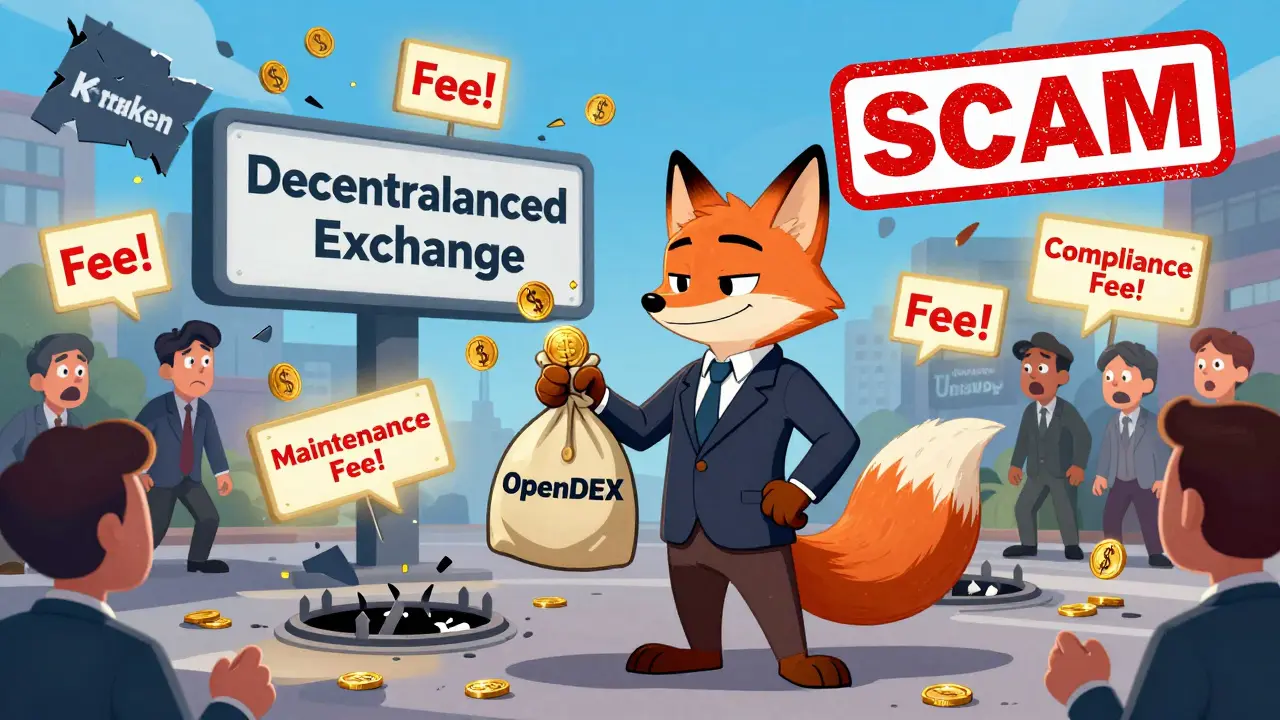
There’s no such thing as a neutral review for OpenDEX. If you’re thinking about using it, stop. Right now. OpenDEX isn’t just underperforming-it’s flagged by regulators and users as a high-risk platform with clear signs of fraud. Unlike legitimate crypto exchanges that publish transparent fee structures, security protocols, and customer support channels, OpenDEX offers nothing but silence and red flags.
What OpenDEX Claims vs. What It Actually Does
OpenDEX markets itself as a decentralized crypto exchange, promising users full control over their funds and low fees. But look closer, and the story falls apart. There’s no official website with verifiable team members, no whitepaper, no GitHub repository, and no public blockchain activity. Compare that to Uniswap, which processes over $4 billion in daily trades and publishes every smart contract on Etherscan. OpenDEX doesn’t even have a traceable transaction history. Users who tried to deposit funds report being asked to pay multiple fees before withdrawing-even after they’d already paid to buy crypto. One user on Revain.org described being charged a "platform fee," a "KYC verification fee," and a "maintenance fee"-all after their initial deposit. That’s not how real exchanges work. Legitimate platforms like Uphold or Kraken charge a single, clearly listed fee. They don’t invent new charges mid-process to trap your money.No Regulatory Compliance, No Transparency
The California Department of Financial Protection and Innovation (DFPI) includes OpenDEX in its Crypto Scam Tracker under the category of "Pig Butchering Scam Fraudulent Trading Platforms." These are operations that build fake trust-often through social media ads or fake testimonials-then slowly squeeze users for fees until they give up or lose everything. OpenDEX matches this pattern exactly. Real exchanges, even smaller ones, get audited. They comply with KYC/AML rules. They publish security reports. Kraken releases monthly transparency reports. Coinbase discloses its reserve holdings. OpenDEX? Nothing. No audits. No licenses. No contact info. If a platform doesn’t want you to know where it’s based or who runs it, that’s not privacy-it’s a warning sign.Why It’s Not on Any "Best Of" Lists
Koinly’s 2025 list of the top 10 decentralized exchanges includes Uniswap, PancakeSwap, Curve, dYdX, and others-all with verified TVL (Total Value Locked), active communities, and documented tech stacks. OpenDEX isn’t even mentioned. NerdWallet’s September 2025 review of the best crypto exchanges covers 20 platforms. OpenDEX isn’t there. Neither is it listed by CoinGecko, CoinMarketCap, or any other trusted aggregator. Why? Because these platforms check for operational legitimacy. They look for: active development, public team members, regulatory filings, customer support responsiveness, and trading volume. OpenDEX checks none of those boxes. Its absence isn’t an oversight-it’s a verdict.
How It Compares to Legitimate Exchanges
| Feature | OpenDEX | Legitimate Exchanges (e.g., Kraken, Uphold) |
|---|---|---|
| Trading Pairs | Not disclosed | Thousands of pairs, clearly listed |
| Fee Structure | Hidden, multiple surprise fees | Transparent, published rates (e.g., 0.2%-2.95%) |
| Security Protocols | No documentation | 2FA, cold storage, insurance, regular audits |
| Customer Support | No live chat, no email response | 24/7 support, ticket systems, phone options |
| Regulatory Status | None | Licensed in multiple jurisdictions (e.g., US, EU, NZ) |
| Community Presence | No Reddit, no Twitter activity | Active forums, thousands of user reviews |
What Happens When You Try to Withdraw
This is where OpenDEX reveals its true nature. Users report being able to deposit crypto-often ETH, USDT, or BTC-but when they try to withdraw, they’re hit with a barrage of new fees. A "maintenance fee" to unlock their wallet. A "compliance fee" to verify their identity-even if they already submitted documents. A "refund processing fee" to reverse a failed withdrawal. These aren’t normal charges. They’re designed to drain your account slowly. Once you pay one fee, you’re told another is required. And another. And another. Eventually, you either give up or run out of money. This is textbook "pig butchering"-a scam where victims are emotionally manipulated into sending more funds, believing they’ll get their original money back. Real exchanges don’t do this. If you have funds on Kraken or Uphold, you can withdraw them in minutes. No hidden steps. No surprise charges. Just a simple, secure process.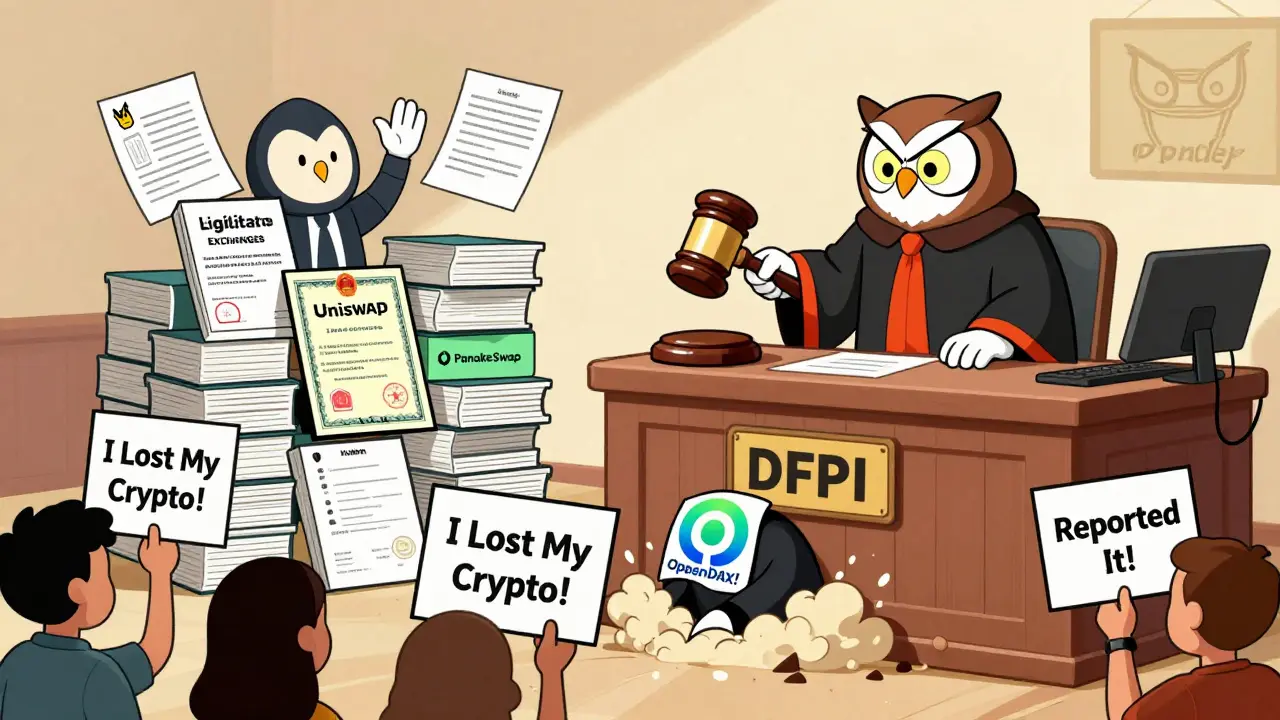
OpenDEX vs. OpenDAX: Don’t Get Confused
Some people mix up OpenDEX with OpenDAX-a legitimate white-label exchange software developed by Openware. OpenDAX lets businesses build their own crypto exchange platforms with secure infrastructure, liquidity tools, and compliance features. It’s used by real companies. OpenDAX Aurora is a product with documentation, support, and active users. OpenDEX is not OpenDAX. It’s not software. It’s not a platform for businesses. It’s a website that pretends to be a crypto exchange. The similarity in names is intentional-and deceptive.Why This Matters in 2026
The global crypto exchange market is worth over $7 billion and growing fast. Regulators are cracking down. Scam platforms are being shut down daily. In 2025 alone, the DFPI blocked over 120 fraudulent crypto platforms in California alone. OpenDEX fits the exact profile of those taken down. If you’re new to crypto, avoid OpenDEX like a trap. If you’ve already used it, assume your funds are gone. Report it to your local financial authority. Share your story on Revain.org or Reddit’s r/CryptoCurrency so others don’t fall for it.What to Use Instead
If you want a decentralized exchange, go with Uniswap or PancakeSwap. Both are open-source, audited, and used by millions. If you prefer a regulated platform with fiat on-ramps, try Kraken or Uphold. Both are available in New Zealand, offer NZD deposits, and have clear fee structures. Don’t risk your crypto on a platform that doesn’t even tell you where it’s based. Legitimacy isn’t optional in crypto. It’s the only thing keeping your assets safe.Is OpenDEX a real crypto exchange?
No. OpenDEX is not a legitimate crypto exchange. It lacks transparency, regulatory compliance, technical documentation, and verifiable user support. Multiple sources, including the California DFPI and Revain.org, classify it as a fraudulent platform designed to trap users with hidden fees.
Can I withdraw my funds from OpenDEX?
Users who have tried to withdraw from OpenDEX report being blocked unless they pay multiple unexpected fees. Once you pay one fee, another is demanded. This is a known scam pattern. If you’ve deposited funds, assume they are unrecoverable. Do not send more money.
Is OpenDEX the same as OpenDAX?
No. OpenDAX is a legitimate white-label exchange software used by businesses to build their own crypto platforms. OpenDEX is not software-it’s a deceptive website that mimics a crypto exchange. The similar names are intentionally confusing and misleading.
Why isn’t OpenDEX on CoinMarketCap or CoinGecko?
Because it doesn’t meet their listing requirements. These platforms require verified trading volume, active development, public team information, and security audits. OpenDEX provides none of this. Its absence is intentional and reflects its lack of legitimacy.
What should I do if I already lost money on OpenDEX?
Report it to your local financial regulator-like the Financial Markets Authority in New Zealand. File a report on Revain.org and share your experience on Reddit’s r/CryptoCurrency. Unfortunately, recovering funds from scams like OpenDEX is extremely rare. Your best move now is to warn others and avoid similar platforms in the future.
Are there any safe decentralized exchanges I can use?
Yes. Uniswap (on Ethereum), PancakeSwap (on BNB Chain), and Curve Finance are all well-audited, open-source, and widely used. They don’t ask for fees to withdraw. You control your wallet. No middlemen. No surprises. Stick with these if you want true decentralization.
OpenDEX? Bro that's a scammy site i saw on a reddit ad last month. Paid 0.5 eth just to get stuck. Then they wanted another 0.3 for "compliance". I'm still mad.
This is spot on. I used to work in fintech compliance and anything that doesn't publish KYC/AML policies or have a registered legal entity is a red flag. OpenDEX has zero footprint on regulatory databases. Don't even think about depositing.
I almost fell for this too 😅 I was like 'oh cool low fees!' then checked their twitter... 3 posts in 2 years. No replies. No engagement. Just vibes. Run.
In Africa we call this 'ghost platform'. You send money to someone who does not exist. They vanish after the third fee. The name OpenDEX sounds official but it's just a webpage with fake buttons. Trust the silence.
Man i've seen so many of these lately. It's sad because new people think crypto is this wild west free for all but the truth is the most successful platforms are the most transparent. Uniswap doesn't hide. Kraken doesn't hide. OpenDEX hides everything because it has nothing to show. Don't be the next victim.
So OpenDEX is like that guy who shows up to a party wearing a suit but has no ID, no drink, and just keeps asking you for cash to 'unlock the VIP section' 🤡
I really hope someone at the SEC sees this. There are people out there who don't know how to spot these scams. This post should be pinned everywhere.
The structural deficiencies of OpenDEX are not merely operational but epistemological. One cannot engage in decentralized finance via a platform that lacks ontological clarity regarding its own existence. Absence of whitepaper, GitHub, or team attribution constitutes not merely negligence but a metaphysical void in the architecture of trust. One must ask: if no one is accountable, then who is the counterparty? And if the counterparty is non-existent, then what is being exchanged? The answer, regrettably, is not crypto-it is hope.
lol i saw a reddit post from someone who said they got their money back from OpenDEX. turned out they just paid 12 fees and then deleted their account. classic. dont be that guy.
I just checked their domain registration. Registered 6 months ago. Owner hidden. Server in Russia. And yet they claim to be 'global'. Sure. I'll believe that when pigs fly. Or when OpenDEX releases a transparency report. Which they won't.
OpenDEX is the crypto equivalent of a pyramid scheme with a UI. They don't need to hack you. You hand them the keys. Then they invent new locks. It's not even clever. It's just lazy evil.
You people are being too nice. This isn't just a scam. It's a criminal enterprise. These people are laundering money through fake crypto deposits. They're not even trying to be legit. They're just hoping you're dumb enough to keep paying. Report them to the FBI. Don't just complain on reddit.
I got scammed by this last year 😔 sent 2 BTC. Then they asked for 0.5 more to "unlock my account". I cried. But now I'm helping others avoid it. You're not alone. Stay safe out there 💪
Sometimes I wonder if these scams are just a reflection of how desperate people are to believe in something. We want crypto to be magic. So we ignore the signs. And then we get sad. And then we post about it. And then someone else reads it. And maybe they don't get scammed. So... maybe it matters?