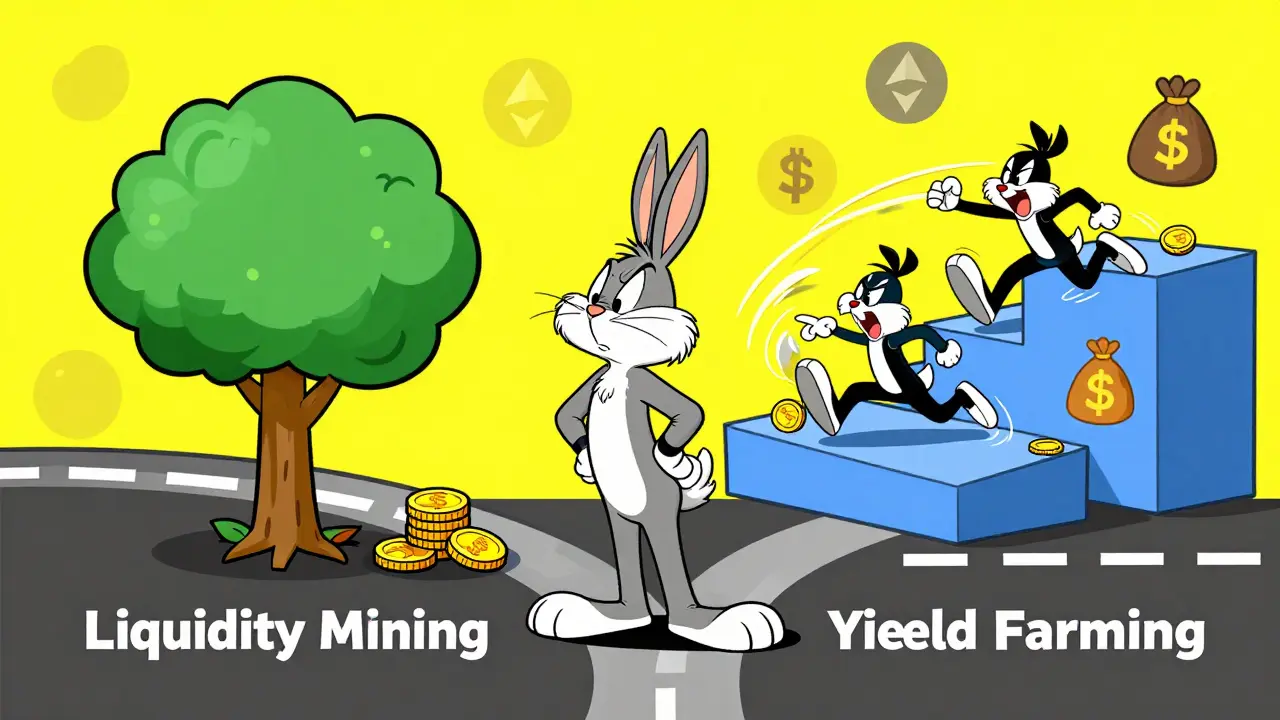
You’ve seen the headlines. "Earn 50% APY." "Passive income with crypto." It sounds too good to be true, and honestly? It often is. But beneath the flashy numbers lies a real opportunity for those who understand the mechanics. The confusion starts right at the door: Liquidity Mining versus Yield Farming. Are they the same thing? Can you do both? And more importantly, will you lose your money trying?
In the world of Decentralized Finance (DeFi), a financial system that operates without central intermediaries like banks, these terms are used interchangeably so often that even seasoned investors get tangled up. They are related, yes. But they are not identical twins. One is a subset of the other. Understanding the difference isn’t just academic-it’s the difference between profitable passive income and a painful lesson in impermanent loss.
The Core Difference: Liquidity vs. Strategy
Let’s cut through the jargon. At its simplest, liquidity mining is about providing fuel. You deposit assets into a pool so that traders can swap tokens. In return, you get paid fees and sometimes bonus tokens. It’s static. You put money in, you wait, you take money out.
Yield farming, on the other hand, is active hunting. It’s a broader strategy where you move your capital around different protocols-lending platforms, exchanges, borrowing services-to chase the highest possible return. It’s dynamic. You’re constantly shifting gears.
Think of it this way: Liquidity mining is planting a tree and waiting for fruit. Yield farming is picking apples from every tree in the orchard, selling them, buying seeds, and planting new trees before the season ends. Both involve agriculture, but one requires significantly more sweat equity.
How Liquidity Mining Works
To understand liquidity mining, you first need to understand how Decentralized Exchanges (DEXs), platforms that allow peer-to-peer trading of cryptocurrencies without a central authority operate. Unlike traditional stock markets with order books, most DEXs use something called an Automated Market Maker (AMM).
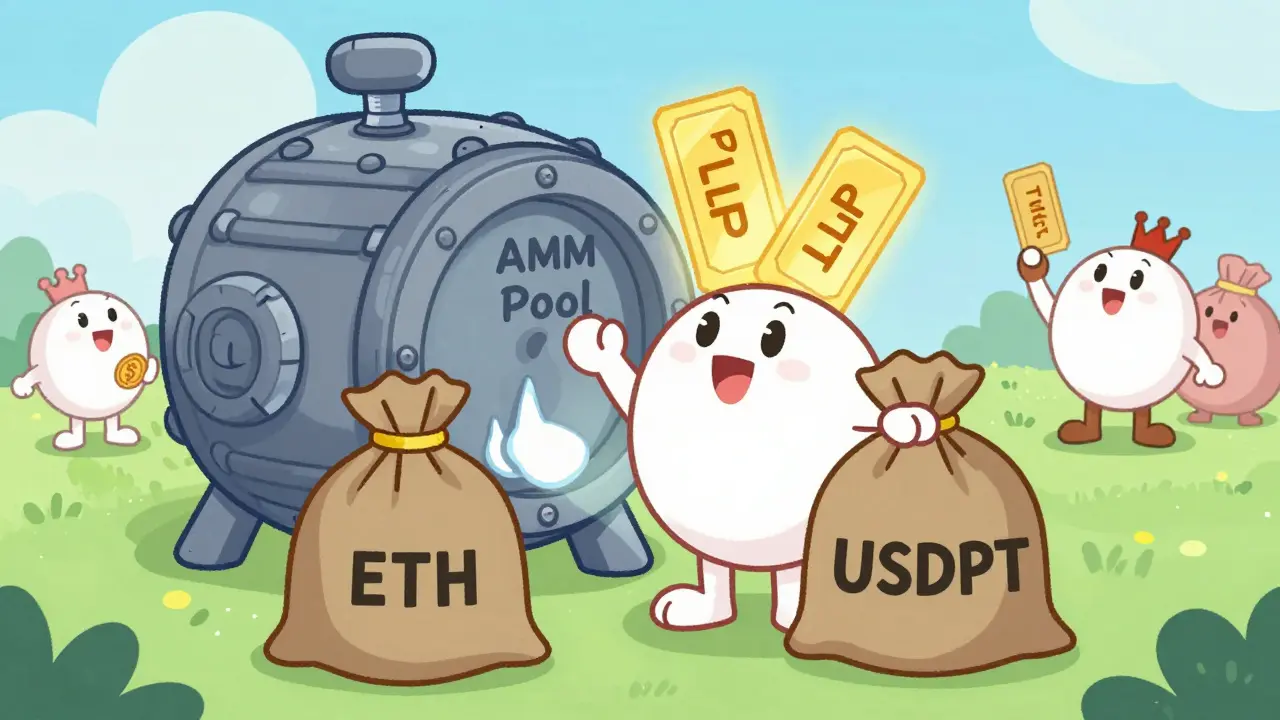
An AMM needs liquidity to function. Without it, there’s no one to buy or sell against. This is where you come in. You deposit two tokens-say, Ethereum (ETH) and Tether (USDT)-into a liquidity pool. These must be equal in value. If ETH is $3,000, you deposit $1,000 worth of ETH and $1,000 worth of USDT.
In exchange, you receive LP Tokens (Liquidity Provider Tokens). These tokens represent your share of the pool. When traders swap ETH for USDT in that pool, they pay a fee. That fee is distributed proportionally to all LPs based on their share. Additionally, many protocols incentivize you further by rewarding you with their own governance tokens. This dual reward structure-trading fees plus protocol incentives-is the heart of liquidity mining.
Platforms like Uniswap, SushiSwap, and Curve Finance pioneered this model during the "DeFi Summer" of 2020. Today, it remains the backbone of decentralized trading.
The Mechanics of Yield Farming
If liquidity mining is the foundation, yield farming is the skyscraper built on top of it. Yield farming encompasses any activity in DeFi designed to generate yield. This includes liquidity mining, but also extends to lending, borrowing, and complex multi-step strategies.
A typical yield farming cycle looks like this:
- You lend your stablecoins on a platform like Aave or Compound to earn interest.
- You take that interest (or additional borrowed funds) and provide liquidity to a DEX pool.
- You claim the governance tokens earned from that liquidity provision.
- You stake those governance tokens in another protocol to earn more rewards.
- You repeat the process, often compounding automatically.
This is where tools like Yearn Finance, a suite of DeFi products offering automated yield aggregation strategies become valuable. Yearn uses smart contracts to automate this chasing of yields. Instead of you manually moving funds every week, the vault does it for you. However, automation doesn’t eliminate risk; it just shifts the complexity from your browser to the code.
The key distinction here is intent. In liquidity mining, you are primarily supporting the market’s functionality. In yield farming, you are optimizing for maximum personal return, regardless of which specific mechanism generates it.
Risk Profiles: Where Things Go Wrong
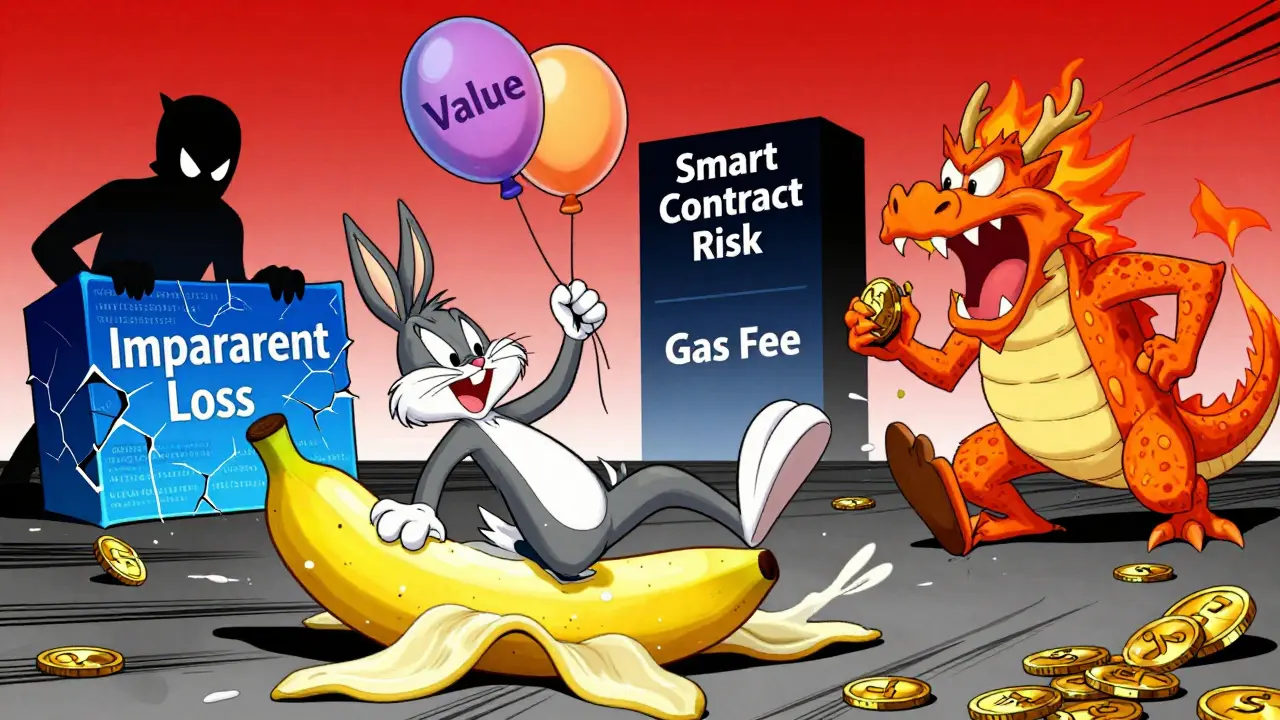
High returns always come with high risks. In DeFi, the risks aren’t just market volatility-they’re structural. Let’s break down the three biggest threats.
Impermanent Loss
This is the silent killer of liquidity providers. Impermanent loss occurs when the price of the deposited tokens changes relative to each other. If you deposited ETH and USDT, and ETH doubles in price, the automated market maker will sell some of your ETH to maintain the 50/50 ratio. When you withdraw, you’ll have less ETH than if you had just held it in your wallet, even though the total dollar value might be higher due to fees and rewards. It’s called "impermanent" because if prices revert, the loss disappears. But if they don’t, it becomes permanent.
Liquidity mining exposes you directly to this risk. Yield farming can mitigate it by using stablecoin pairs (e.g., USDC/DAI), where price divergence is minimal, but this usually results in lower APYs.
Smart Contract Risk
All these interactions happen via code. If there’s a bug in the contract, a hacker can drain the pool. This has happened repeatedly. In 2022 alone, billions were lost to exploits. Neither liquidity mining nor yield farming is immune. However, yield farming often involves interacting with more complex, interconnected contracts, potentially increasing the attack surface.
Protocol Risk and Rug Pulls
New projects often launch with unsustainable APYs to attract liquidity quickly. Once enough users are hooked, the developers might dump their tokens or shut down the project-a "rug pull." Established platforms like Curve or Uniswap are safer bets, but even they face governance attacks or economic model failures.
| Feature | Liquidity Mining | Yield Farming |
|---|---|---|
| Primary Goal | Provide liquidity for trading | Maximize returns across protocols |
| Complexity | Low to Medium | High |
| Time Commitment | Passive (set and forget) | Active (frequent adjustments) | d>
| Key Risks | Impermanent loss, smart contract bugs | Impermanent loss, reentrancy attacks, gas costs |
| Typical Platforms | Uniswap, SushiSwap, Curve | Yearn Finance, Aave, Compound |
| Best For | Beginners, long-term holders | Experienced users, active managers |
Gas Fees and Network Costs
You can’t talk about DeFi without talking about gas. On networks like Ethereum, transaction fees can skyrocket during peak usage. A simple liquidity provision might cost $50 in gas. A complex yield farming strategy involving five different swaps could cost $500.
This makes yield farming expensive for small accounts. If you’re only investing $1,000, paying $200 in gas fees wipes out 20% of your principal instantly. This is why many farmers have migrated to Layer 2 solutions like Arbitrum or Optimism, or alternative chains like Polygon and BNB Chain. These networks offer faster transactions and negligible fees, making smaller-scale yield farming viable.
Liquidity mining is less sensitive to gas frequency since you typically deposit once and hold for weeks or months. Yield farming, with its constant rebalancing, burns through gas rapidly.
Which Strategy Fits Your Profile?
There’s no single "best" option. It depends on your goals, risk tolerance, and technical comfort.
If you are new to DeFi, start with liquidity mining on established pairs. Stick to blue-chip assets like ETH/USDC on Uniswap or Curve. Understand impermanent loss. Watch what happens when the market moves. Don’t chase the highest APY-that’s usually a trap.
If you have experience and time to manage positions, explore yield farming. Use aggregators like Yearn to simplify the process. Focus on stablecoin farms to reduce impermanent loss risk. Always check the audit status of the contracts you interact with. Never invest more than you can afford to lose.
Remember, DeFi is still experimental. Protocols change. Regulations evolve. What works today might be obsolete tomorrow. Stay informed, stay cautious, and never let greed override due diligence.
Is liquidity mining safe?
No investment is entirely safe, especially in DeFi. Liquidity mining carries risks like impermanent loss, smart contract vulnerabilities, and token devaluation. While established platforms like Uniswap or Curve are relatively secure, newer protocols pose higher risks. Always research the protocol's audit history and community reputation before depositing funds.
What is the main difference between yield farming and staking?
Staking involves locking up tokens to support a blockchain network's consensus mechanism (like Proof of Stake) and earning rewards. It’s generally lower risk and offers steady, predictable returns. Yield farming involves actively moving assets between DeFi protocols to maximize yields, often involving lending, borrowing, and liquidity provision. It’s higher risk, more complex, and potentially higher reward.
Can I lose my entire investment in yield farming?
Yes. Risks include smart contract hacks, rug pulls by malicious developers, extreme impermanent loss, and the collapse of the underlying asset's value. If a protocol is exploited, funds can be drained completely. Diversification and using audited, reputable platforms are essential mitigations.
Do I need a lot of money to start yield farming?
Not necessarily, but it helps. High gas fees on Ethereum make small investments inefficient. However, using Layer 2 networks like Arbitrum or Polygon, or chains like BNB Chain, allows you to start with smaller amounts ($100-$500) while keeping transaction costs low. Aggregators like Yearn also help optimize small deposits.
What are LP tokens?
LP (Liquidity Provider) tokens are receipts you receive when you deposit assets into a liquidity pool. They represent your share of the pool. You can redeem them later to withdraw your original assets plus any accrued fees. They can also be used as collateral in other DeFi protocols or staked for additional rewards.