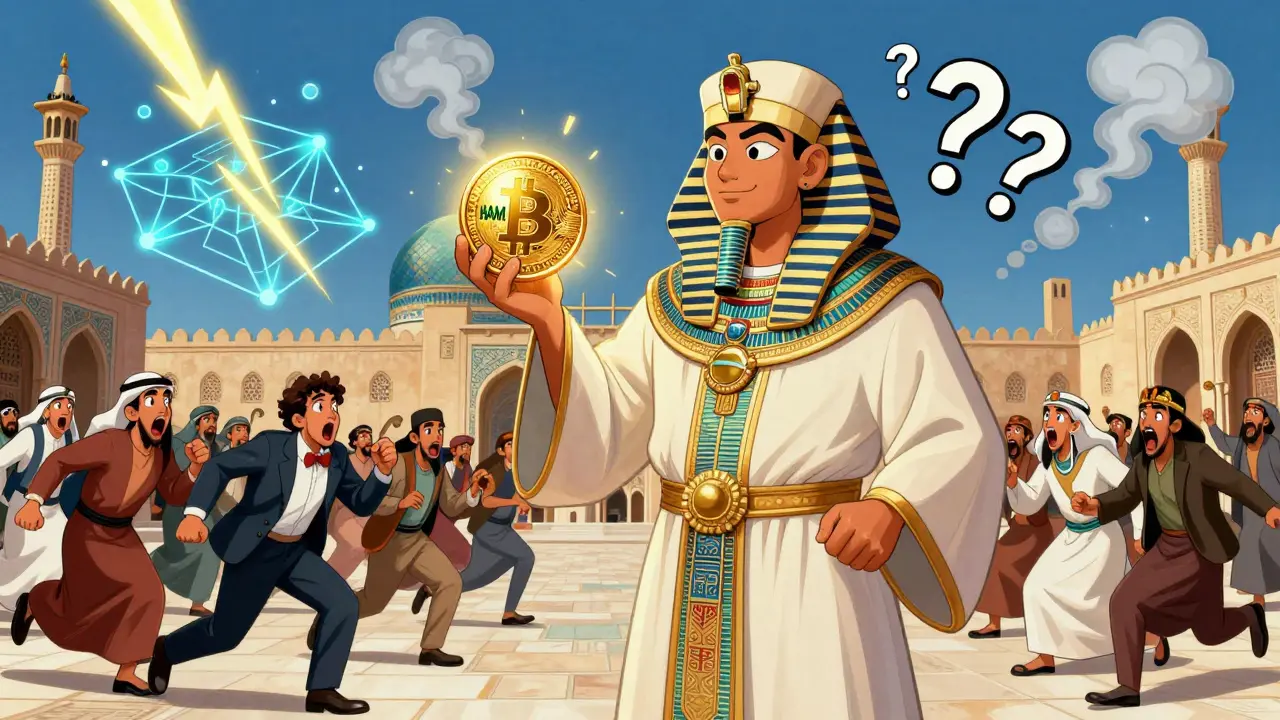
When Egypt’s Grand Mufti, Dr. Shawky Ibrahim Allam, issued a fatwa in December 2017 declaring Bitcoin and all cryptocurrencies haram, it sent shockwaves through Muslim communities worldwide. This wasn’t just a religious opinion-it was a full legal ruling backed by Dar al-Ifta, the official Islamic legal body tied to al-Azhar University, one of the most respected institutions in Sunni Islam. For millions of Muslims who follow Egyptian religious guidance, this meant one thing: no buying, selling, mining, or even holding cryptocurrency. But why? And does this ban still make sense today, years after Bitcoin’s price crashed and governments started regulating digital assets?
What the Fatwa Actually Said
The fatwa didn’t just call Bitcoin bad. It laid out a detailed legal case against it under Sharia law. According to the ruling, Bitcoin fails three core Islamic financial principles: certainty, backing by real value, and regulated oversight. Unlike gold or paper currency issued by a government, Bitcoin has no physical form, no central authority, and no recognized value under Islamic law. The fatwa called it an “entirely electronic currency exchanged only via the Internet,” making it impossible to verify ownership, prevent fraud, or ensure fair trade.It also pointed to the danger of gharar-Islamic term for excessive uncertainty. In traditional Islamic finance, contracts must be clear. You can’t sell something if you don’t know what you’re selling, how much it’s worth, or when delivery will happen. Bitcoin’s wild price swings, lack of standardized valuation, and anonymous transactions make it the perfect example of gharar. One day it’s $20,000, the next it’s $15,000. Who decides what’s fair? No one.
Security Risks and Illicit Use
The Egyptian fatwa didn’t stop at financial theory. It went straight to real-world harm. It explicitly named Bitcoin’s use by terrorist groups like ISIS, drug cartels, and money launderers as a major reason for the ban. In 2017, Bitcoin was still widely seen as a tool for darknet markets. The fatwa called it a “penetration tool for cybersecurity threats” and warned that its decentralized nature made it impossible for authorities to track or control.This wasn’t just theological-it was political. Egypt, like many governments at the time, feared losing control over its financial system. If people could move money without banks, without oversight, and without taxes, it threatened national security and economic stability. The fatwa framed cryptocurrency not just as religiously wrong, but as a national risk.

Why This Ruling Stands Out
Not all Islamic scholars agreed. In fact, many did the opposite. Mufti Faraz Adam, a leading expert in Islamic fintech, argued that Bitcoin could be considered a legitimate digital asset if used responsibly. He said classical scholars would judge something by its outcome, not its technology. If people use it to buy food, pay rent, or send money to family-just like money-then why ban it? He even said Muslims should pay zakat (the 2.5% Islamic charity tax) on crypto holdings, treating it like cash.Other scholars in Malaysia, Indonesia, and the UAE took similar positions. They didn’t ban crypto-they created Sharia-compliant crypto funds, audited tokens, and blockchain-based Islamic finance platforms. The Egyptian ruling was the outlier: total, blanket prohibition. No exceptions. No gray area.
The Flaws in the Egyptian Logic
Critics inside Islamic academia have questioned whether the fatwa followed proper legal reasoning. Islamic jurisprudence has tools to handle new situations: maslahah (public interest), urf (custom), and sadd al-dhara’i (blocking harmful means). Did the Grand Mufti consider that crypto could one day be regulated? That exchanges could be licensed? That blockchain could reduce corruption in remittances?Not really. The fatwa focused on what Bitcoin was in 2017-unregulated, volatile, and risky. It didn’t ask: “What could it become?” That’s a major gap. Islamic law isn’t frozen in time. It’s meant to adapt. If gold was once the only accepted currency, and now we use plastic cards and mobile payments, why can’t digital assets be next?

What This Means for Muslims Today
Fast forward to 2026. Bitcoin is no longer just a tool for criminals. It’s traded on regulated exchanges in the U.S., Europe, and even Saudi Arabia. Central bank digital currencies (CBDCs) are being tested in over 100 countries. Some Islamic banks now offer crypto-backed investment products with Sharia boards. The world moved on. But Egypt’s fatwa didn’t.For Muslims in Egypt and countries that follow its religious guidance, the ban still stands. They can’t use crypto apps. They can’t mine Bitcoin. They can’t accept it as payment. That means missing out on global financial innovation, remittance tools that cut fees by 80%, and investment opportunities that younger Muslims are exploring elsewhere.
Meanwhile, Muslims in Turkey, Pakistan, and Nigeria are using crypto to protect savings from inflation. In Indonesia, over 10 million people now hold digital assets. They’re not breaking Sharia-they’re following scholars who say crypto can be halal if it’s used ethically, taxed properly, and not for gambling.
The Bigger Picture: Religion vs. Technology
This isn’t really about Bitcoin. It’s about how religious institutions respond to change. The Egyptian fatwa was a warning sign: “We don’t trust this.” But trust can be built. Regulation can bring clarity. Transparency can remove risk.The real question isn’t whether crypto is haram. It’s whether religious leaders are willing to engage with technology instead of rejecting it out of fear. If Islamic finance wants to stay relevant, it can’t just say “no.” It needs to ask: “How can we make this work?”
Is Bitcoin really haram according to all Muslims?
No. The Egyptian Grand Mufti’s 2017 fatwa is one of the strictest rulings, but it’s not universal. Scholars in Malaysia, Indonesia, and the UAE have issued fatwas saying cryptocurrency can be halal if it’s used responsibly, backed by real value, and subject to zakat. Mufti Faraz Adam, for example, argues that crypto functions as money in practice and should be treated like currency-not speculation. Many Muslims follow these opinions and hold digital assets legally under Sharia.
Can Muslims trade Bitcoin if they pay zakat?
According to scholars who permit crypto, yes. If Bitcoin is treated as a form of money (not gambling or speculation), then zakat applies to it just like cash or gold. You pay 2.5% annually on holdings above the nisab threshold. This is the position of Islamic fintech experts like Mufti Faraz Adam and institutions like the Islamic Financial Services Board. However, Egyptian authorities reject this entirely, saying no form of crypto can be owned or traded under Sharia, regardless of zakat.
Why did Egypt ban crypto when other Muslim countries didn’t?
Egypt’s ban was shaped by its political and security environment in 2017. At the time, Bitcoin was heavily linked to terrorism financing, ransomware, and underground markets. The Egyptian government, like many others, feared losing control over its financial system. Dar al-Ifta focused on the risks-lack of regulation, anonymity, volatility-rather than potential benefits. Other countries took a more pragmatic approach, seeing crypto as a tool for financial inclusion, especially for the unbanked.
Does the fatwa apply to stablecoins like USDT or CBDCs?
The Egyptian fatwa uses broad language: “any and all uses of cryptocurrency.” That means it technically covers stablecoins, even those pegged to the U.S. dollar, and central bank digital currencies. But scholars outside Egypt argue that stablecoins backed by real assets and regulated by authorities may meet Islamic criteria for certainty and value. CBDCs, being government-issued, are even more likely to be seen as legitimate. So while Egypt’s ruling doesn’t distinguish, other Islamic scholars do.
Can I use crypto to send money to family in Egypt?
Technically, no-if you follow the Egyptian fatwa. Sending or receiving crypto in Egypt violates the ruling, even for humanitarian reasons. But many Egyptians still use crypto privately, especially for remittances from abroad, because traditional banks are slow and expensive. Enforcement is patchy. The ban exists on paper, but in practice, people find ways around it. The real conflict isn’t between religion and tech-it’s between official doctrine and everyday need.
Is mining Bitcoin haram too?
Yes, according to the Egyptian fatwa. Mining is considered a form of participation in the cryptocurrency system, which includes “buying, selling, leasing, or any other act.” Even if mining doesn’t involve direct trading, the fatwa sees it as enabling the system. Other scholars who permit crypto say mining is like digital labor-earning income through effort, which is permissible. But again, in Egypt and places that follow its rulings, mining is banned.
idk why people care so much about this fatwa lol. bitcoin is just digital money. if u wanna say its haram fine but like... why? its not magic. its code. bruh.
this whole debate is kinda funny. we banned alcohol and gambling centuries ago but now we're panicking over code? if the intent is ethical and the outcome helps people, why not adapt? islamic finance has always been about justice, not fear.
egypt is just scared. they dont understand tech and they dont want people to escape their control. its not about religion its about power.
you know what's worse than bitcoin? the fact that this fatwa is still being treated like some sacred text in 2026. we're living in the future and some institutions are still stuck in 2017. the blockchain doesn't care about your dogma.
obviously the fatwa was written by guys who still think the internet is a fad. 🤡 next they'll ban smartphones because they have cameras. #zionistcryptoconspiracy
It's important to remember that religious rulings are often context-specific. The 2017 fatwa reflected the fears and realities of its time. Today, with regulated exchanges and clear frameworks, many scholars are revisiting these positions. Change is slow, but it's happening.
The real issue isn't crypto. It's whether religious authorities are willing to engage with innovation rather than retreat into certainty. Sharia has always evolved. This moment tests whether it still can.
bitcoin is not money because it has no intrinsic value. gold has value because it is used in industry and jewelry. crypto is just numbers on a screen. this is why the fatwa makes sense.
I just don't get why people are so obsessed with this... like... I mean, it's just money, right? 😅 why does it matter if it's digital or not? I'm just trying to send money to my cousin without paying 30% in fees.
To suggest that cryptocurrency can be halal is to fundamentally misunderstand the nature of financial ethics in Islam. The absence of tangible backing, centralized authority, and regulatory oversight renders any digital asset inherently suspect. This is not a matter of interpretation-it is a matter of principle.
lol imagine being scared of bitcoin in 2026. we have ai that writes sermons now. what's next? a blockchain mosque? 🤣
The concept of gharar in classical fiqh is nuanced and context-dependent. Contemporary scholars applying maqasid al-sharia have demonstrated that algorithmic consensus mechanisms and regulated on-chain audits can mitigate uncertainty to acceptable levels. The Egyptian fatwa, while authoritative, represents a static interpretation that fails to account for evolving risk architectures.
Oh wow. So now we're supposed to be impressed that some 'scholars' in Malaysia are okay with crypto? How quaint. The real question is why anyone in their right mind would trust a decentralized system built on pseudonymous actors and energy-hungry mining rigs. It's not innovation-it's financial anarchy dressed up in blockchain buzzwords.