
Imagine logging into your favorite crypto app one morning, only to find a blank screen where your portfolio used to be. For thousands of Filipino investors, this wasn't just a glitch-it was the result of a regulatory hammer dropping on unlicensed cryptocurrency exchanges operating without proper authorization in the country. While headlines often cite specific numbers like "10" or "20," the core story is about a fundamental shift in how the Philippines treats digital assets. The Securities and Exchange Commission (SEC) has moved from watching the space to actively enforcing strict rules, blocking major international platforms that failed to register locally. If you hold crypto in the Philippines, this isn't just news; it's a direct impact on your access, your taxes, and your safety.
The Regulatory Hammer: Why the Crackdown Happened
To understand why so many popular names were blocked, you have to look at the rules they broke. In July 2025, the SEC implemented two critical memorandum circulars: MC No. 4 and MC No. 5. These documents didn't just add minor tweaks; they created a new category called Crypto Asset Service Providers (CASPs). Under these rules, any platform allowing Filipinos to buy, sell, or swap crypto must meet three heavy hurdles:
- Local Incorporation: The exchange must physically exist within the Philippines.
- Capital Requirement: A minimum reserve of PHP 100 million (roughly $1.76 million) is mandatory.
- Fund Segregation: Customer funds must be kept strictly separate from company assets.
This last point is crucial. When global exchanges collapsed in recent years, it was often because customer coins were mixed with company cash. By forcing segregation, the SEC aims to protect you from total loss if an exchange goes bankrupt. Platforms like OKX, Bybit, KuCoin, and Kraken operated for years serving Filipino users without meeting these local standards. The SEC viewed this as exposing investors to significant risk, leading to formal warnings and subsequent network blocks.
Who Got Blocked? The List of Restricted Platforms
The enforcement action targeted high-profile international giants. While reports vary slightly on whether the initial wave included exactly ten or expanded to twenty over time, the following platforms faced restrictions after failing to comply with the new CASP framework:
| Exchange Name | Status | Primary Reason for Restriction |
|---|---|---|
| OKX | Blocked | No local license/CASP registration |
| Bybit | Blocked | No local license/CASP registration |
| KuCoin | Blocked | No local license/CASP registration |
| Bitget | Blocked | No local license/CASP registration |
| Kraken | Blocked | No local license/CASP registration |
| Mexc | Blocked | No local license/CASP registration |
| Phemex | Blocked | No local license/CASP registration |
| CoinEx | Blocked | No local license/CASP registration |
| BitMart | Blocked | No local license/CASP registration |
| Poloniex | Blocked | No local license/CASP registration |
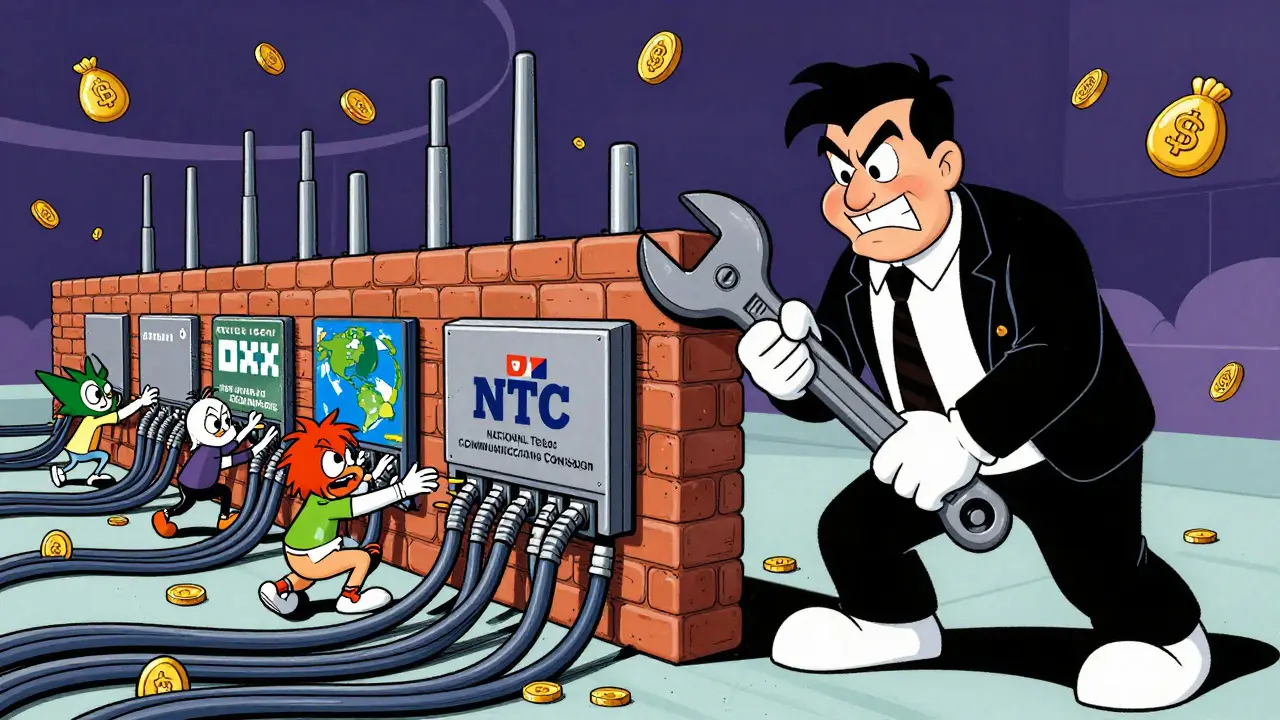
These weren't small, obscure sites. They are platforms with millions of global users. Their restriction signals that size and reputation don't matter if you haven't done the paperwork in Manila. The National Telecommunications Commission (NTC) ordered internet service providers to cut off access, meaning if you use a standard connection from PLDT or Smart, these sites simply stop loading.
How the Blocking Works: ISPs and Technical Enforcement
You might wonder how the government actually stops a website from working. It’s not magic; it’s infrastructure coordination. The NTC issued directives to major telecommunications providers, specifically targeting the backbone networks of PLDT Inc. and its wireless unit, Smart Communications, Inc.. Once the directive hit, these companies updated their routing tables to block traffic destined for the flagged domains. For users, the experience is immediate. You type in the URL, and instead of the login page, you get a message saying the site is unreachable or restricted. This happened swiftly; by mid-August 2025, most major ISPs had confirmed the blocks were live. However, tech-savvy users quickly found workarounds using Virtual Private Networks (VPNs) or decentralized browser nodes. While the SEC can block the front door, the back doors via encrypted tunnels remain open, though they carry their own risks of instability and potential future legal scrutiny.
The Tax Implications: A New Financial Reality
Blocking the exchanges was only half the battle. The other half is making sure you pay up. The 2025 regulatory package introduced a stricter taxation regime for digital assets, changing how much you keep when you sell.
- Capital Gains Tax: Selling crypto for fiat currency (like Pesos) or exchanging it for goods now attracts a 15 percent capital gains tax. This is a significant jump from previous flat rates.
- VAT Application: If you sell physical goods in exchange for cryptocurrency, a 12 percent Value Added Tax applies.
- Income Tax Integration: Income from mining, staking, or receiving crypto as payment is no longer treated as a simple transaction fee; it falls under the general income tax regime.
Failure to file these taxes carries penalties. This shift means that holding crypto is no longer a gray area. Every trade, every sale, and every receipt of payment needs to be documented. For casual traders, this adds administrative overhead. For serious investors, it forces a more disciplined approach to record-keeping. The goal is clear: bring crypto revenue into the mainstream tax net, just like stocks or real estate.
What This Means for Your Wallet and Strategy
If you are still trading in the Philippines, here is what you need to do right now. First, check which exchange you are using. If it’s on the blocked list, you may need to migrate your assets to a licensed local CASP or move them to a self-custody wallet. Moving to a self-custody wallet (like MetaMask or Ledger) gives you full control but removes the convenience of one-click trading. Second, update your tax strategy. That 15% capital gains tax will eat into your profits. If you were relying on frequent trading to generate income, calculate your net returns after tax. Many traders find that long-term holding becomes more attractive than short-term flipping when the tax burden increases. Finally, stay alert for marketing scams. The new rules require anyone promoting digital assets to be registered. If someone on social media is pushing a specific coin without disclosing their affiliation, they might be violating the new transparency laws. Protect yourself by verifying the source before investing.
The Bigger Picture: Southeast Asia’s Trend
The Philippines isn’t acting alone. This crackdown fits into a broader regional trend. Thailand blocked five exchanges in May 2025, including some of the same names seen in the Philippine list. Indonesia tightened its tax policies, raising income tax on domestic trades. The message across Southeast Asia is consistent: offshore platforms can’t just ignore local rules anymore. Regulators want accountability, visibility, and consumer protection. For you, this means the era of anonymous, unregulated trading is fading. The future of crypto in the region will be defined by compliance, transparency, and integration with traditional financial systems.
Are all foreign crypto exchanges banned in the Philippines?
No, not all. Only those that fail to register as Crypto Asset Service Providers (CASPs) with the SEC are targeted. Foreign exchanges can operate legally if they incorporate locally, meet the PHP 100 million capital requirement, and segregate customer funds. The ban is on non-compliance, not nationality.
Can I still access blocked exchanges using a VPN?
Technically, yes. Many users bypass ISP-level blocks using Virtual Private Networks. However, this doesn't make the platform legal. You still face the risk of the platform being shut down globally, and you may face scrutiny if the SEC decides to pursue individual users for using unauthorized services. It is a workaround, not a solution.
What is the difference between MC No. 4 and MC No. 5?
MC No. 4 generally outlines the licensing requirements and operational standards for CASPs, such as capital reserves and fund segregation. MC No. 5 typically covers reporting obligations, anti-money laundering compliance, and investor protection measures. Together, they form the complete regulatory framework for digital asset services in the Philippines.
How does the 15% capital gains tax affect my profits?
If you buy Bitcoin for PHP 1,000,000 and sell it for PHP 1,200,000, your profit is PHP 200,000. The 15% tax would be PHP 30,000. You take home PHP 170,000. This tax applies to selling crypto for fiat or goods. Trading crypto for crypto (e.g., BTC to ETH) may not trigger immediate capital gains tax until you convert to fiat, but rules can evolve, so consult a tax professional.
Should I move my coins to a hardware wallet?
It depends on your risk tolerance. Hardware wallets (self-custody) protect you from exchange failures and regulatory blocks. However, you become responsible for backing up your seed phrase securely. If you lose your seed phrase, no one can help you recover your funds. For large holdings, self-custody is safer against regulatory risk; for small, active trading amounts, a licensed local exchange offers more convenience.